Class 9
 Call Kai
 Learn
Learn Practice Test
 Spaced Repetition
 Match
Match Flashcards
 Knowt Play
1/9

There's no tags or description
Looks like no tags are added yet.
Name | Mastery | Learn | Test | Matching | Spaced | Call with Kai |
|---|
No analytics yet
Send a link to your students to track their progress
10 Terms
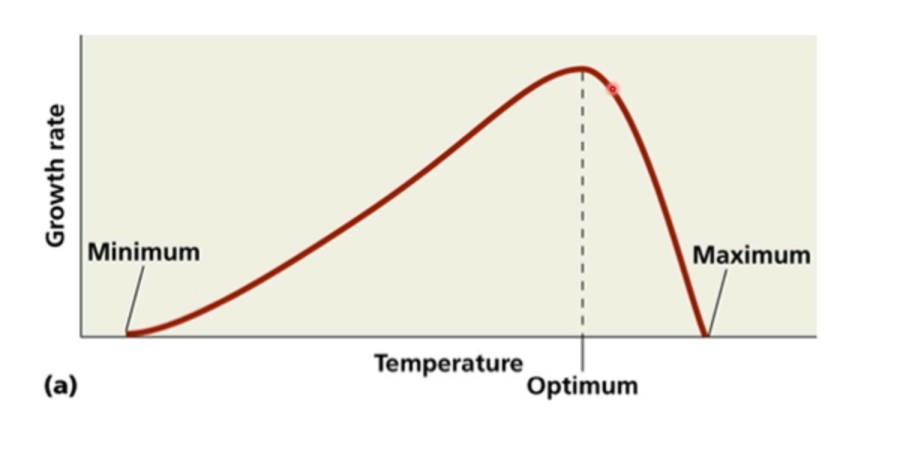
What explains the shape of a growth vs temperature curve for a bacterium (or Chlamy)
Increase in temp. increases the reaction rate
Peak = most ideal temp for functioning
When its too hot, enzyme denatures
In what ways is hexokinase different in a bacterium adapted to low temperature vs one adapted to high temperature.
Hexokinase in cold temp:
more flexible
Hexokinase in hot temp:
rigid
Basics of measuring respiration in isolated mitochondria: what do you need?
Need a oxygen electrode chamber
purify mitochon. from a chlamy cell
incubate mito in a buffer and put into electrode chamber
How can we measure rate of cellular respiration
By measuring change in O2 conc.
O2 conc. is always going down because it is the terminal e- acceptor
Change in respiration rate (oxygen consumption) in isolated mitochondria by addition of NADH, ADP & Pi, uncoupler
NADH: O2 decreases cuz oxygen is being consumed by the electron transport (slight decrease)
ADP and Pi: steeper slope
Uncoupler: its the highest rate (ETC rate is increased) (steepest slope)
BUT
if ADP is added first, the line will be straight
For any slope to even happen, make sure NADH is added first
Rate of respiratory control
Rate of e- transport (O2 consumption) adjusts based on availability of ADP and Pi to make ATP
Autotrophic metabolism: Link(s) between photosynthesis and cellular respiration.
While photosynthesis builds up (anabolic) builds up glucose storing energy, cellular respiration (catabolic) breaks it down to release energy, creating a balanced flow
Photosynthesis uses light to combine O2 and H2O to produce glucose and O2.
Cellular respiration uses O2 to break down glucose, releasing energy and producing CO2 and water as waste
Two distinct roles served by G3P that is exported form the chloroplast into the cytosol: energy source and carbon source (why do we need both?)
Energy
Growth
Can Chlamy grow in the dark? Why acetate and not glucose?
YES it can
heterotrophic growth
Requires organic carbon source: acetate
because it is a 2 carbon molecule which chlamy prefers and it can convert into acetyl coa which can be used in the citric acid cycle
The concept of Mixotrophic metabolism.
Can use light and CO2 to grow or use organic carbon molecules to grow
Can grow using only one method but thrives with both
Highest rate of growth

