CREATIVITY MIDTERM 2
 Studied by 0 people
 Call with Kai
 Learn
Learn Practice Test
 Spaced Repetition
 Match
Match Flashcards
 Knowt Play
1/41

There's no tags or description
Looks like no tags are added yet.
Name | Mastery | Learn | Test | Matching | Spaced | Call with Kai |
|---|
No analytics yet
Send a link to your students to track their progress
42 Terms
Commissures
What are they?
What is the corpus callosum?
What are split-brain patients?
Large bundles of nerve fibers connecting the two hemispheres allowing them to communicate by sending signals back and forth
Largest commissure
People who have undergone a commissurotomy, in which the corpus callosum is severed to relieve seizures in epileptic patients. This procedure helps relieve the epileptic seizures but inhibits the ability of the hemispheres to communicate.
Hoppe (1988)
What did he find regarding “affect” experienced and described by split-brain patients compared to control subjects?
They lacked sad affect in response to an emotionally evocative film, and described their reactions in unemotional and episodic terms, such that their descriptions focused on basic sequences of events in the film rather than the meaning of what was happening
Alexithymia
What is it?
Characteristics of alexithymia?
Do alexithymics tend to be creative?
Why or why not?
Lack of emotional awareness, emotional relating, and social attachment
Difficulty distinguishing, identifying, and appreciating emotions; difficulty describing feelings to other people; decreased imaginal processes of fantasies
No
They lack excitement about opportunities/challenges and are uninterested/unmotivated to think creatively
TenHouten (1994)
Were split-brain subjects more alexithymic than control subjects?
What was the speech of split-brain subjects like?
Were their verbal productions creative?
Yes
Used few affect-laden words and few adjectives; language was flat, dull, uninvolved, and lacking in expression
No, they lacked creativity in spoken and written verbal productions, as analyzed by flexibility and elaboration
Overall conclusion of split-brain research regarding creativity?
Creativity involves the interaction of both hemispheres because split brain patients show impairments in creativity
Burke et al (1989)
Were there any differences in performance between right-handers vs left-handers?
If so, how did their performance differ?
Any difference between performance on verbal vs visual divergent thinking?
Researchers' suggestions about why certain differences might occur?
Yes
Left handers did slightly better on 4 visual tests of divergent thinking (pattern meaning, line meaning), with only one being statistically significant. There was no difference between lefties and righties for verbal tests of divergent thinking (instances, alternate uses).
Differences only appeared for visual tasks, not verbal
Left handers may have a creative advantage over right handers because they may have developed a coping mechanism from having to adjust to a right handed world. This may contribute to their flexibility and creative thinking.
Peterson & Lansky (1977)
What did they investigate?
What population?
What did they find regarding their population of interest?
The fact that creative populations have more left handers than what would be expected based on the distribution of lefties in the general population
University architecture program
29% of faculty were left handed (3x the rate in the general population); left handed students were more successful; more left handers applied to the program
Martindale & Hasenfus (1978, Experiment 1)
What task did they give subjects?
During what writing phases did they measure EEG?
What did they find regarding EEG activity?
They were told to be creative and original in making up a story about a man who asks a woman out, and to use their imagination to make up who they are, how they meet, and what happens to them. Their professors graded their creativity levels before the task to sort them into creative vs not creative.
Waiting for the study to begin, 3 min inspiration period where they thought about what to write, and the elaboration phase where they actually wrote the story
Highly creative writers showed higher alpha activity during the inspiration phase than during the elaboration phase, while less creative writers showed no difference in any band of EEG activity
Martindale & Hasenfus (1978, Experiment 2)
What did they change from Experiment 1?
What did they find regarding creative vs. non-creative subjects and for subjects who were instructed vs. not-instructed to be creative?
The subjects did a fantasy story writing task but this time their professors did not rate their creativity (the RAT did) and some subjects were not specifically told to be creative and original.
Same increase in alpha activity during the inspiration phase for highly creative subjects, but only when instructed to be creative and original. If they were not told, then the increase in alpha activity during inspiration was not evident. This suggests that a highly creative person trying to be creative will yield the greatest increase in alpha activity during the inspiration phase.
Primary process vs secondary process cognition
To what does each refer?
Primary process cognition: irrational, free associative, weakly linked ideas, uninhibited, analogical; common in children, dreams, and psychosis
Secondary process cognition: logical and realistic; common in normal waking adult life
At any given time, our thinking is on a continuum between the two
What do studies suggest regarding creative people vs. non-creative people in terms of their primary/secondary process thinking and in terms of their creative writing? Creative people employ more primary process thinking and put more primary process content into their fantasy narratives
#1
Primary process cognition: irrational, free associative, weakly linked ideas, uninhibited, analogical; common in children, dreams, and psychosis
Secondary process cognition: logical and realistic; common in normal waking adult life
At any given time, our thinking is on a continuum between the two
Creative people employ more primary process thinking and put more primary process content into their fantasy narratives
Regressive Imagery Dictionary
What is it?
Identifies words and phrases that are indicative of primary process thinking
Martindale et al (1986)
What did they find regarding differences in left- vs right-hemisphere activity?
When did this difference show up?
Authors' conclusion?
Greater right hemisphere activation than left in subjects whose narratives had more primary process content
Basal (baseline) stable long term EEG measures (researchers predicted this during the inspirational phase but this did not occur)
People who have high levels of right hemisphere activation will generate more primary process thinking and think in more primary process ways
Prefrontal cortex
What are its basic functions and structures?
Self-construct
Self-reflective consciousness
Willed action
Planning
Abstract thinking
Working memory
Temporal integration
Sustained and directed attention
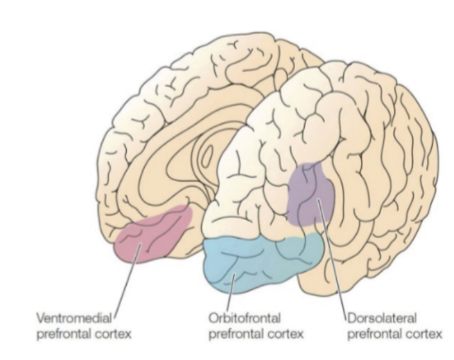
Dorsolateral PFC
Functions of dorsolateral PFC?
Integration of sensory information with higher cognitive functions
Ventromedial PFC
Major connections to what brain system?
Most common deficit associated with damage?
Might damage be beneficial to creativity?
Limbic system (amygdala and cingulate cortex), allowing for the integration of emotion with higher cognitive functions
Impaired social function (inappropriate social behaviors, lack of moral judgment, lowered social inhibitions, little concern for self/others, little regard for social restraints, unconventionality)
No, because unconventionality in creative people tends to be intentional and controllable, and thus still requires judgment for determining what is original, fitting, effective, and valuable for creative ideas. Thus we can infer that creative people have a fully functional VMPFC since an impaired VMPFC involves a lack of judgment while creativity does not.
Dietrich (2004)
What is the difference between “deliberate” creativity and “spontaneous” creativity?
Which brain areas seem to support each type?
Deliberate creativity: focusing attention on the problem and putting effort into coming up with a creative solution; direct attention to relevant information and access semantic memory
DLPFC
Spontaneous creativity: occurs during periods of de-focused attention like insight
Temporal occipital parietal regions
Cerebellum
What kinds of functions?
What do its many parallel circuits enable?
Does it have connections with PFC?
Does it enable rapid processing of information?
Timing and coordination of motor control and cognitive processes like working memory
Powerful processing capabilities where the cerebellum is able to receive information from various brain regions and send output to various other regions, regardless of modality
Yes
Lateral cortex of cerebellum receives input from the PFC via the pons
Cerebellum sends output back to the PFC via the thalamus
Yes, especially processing novel situations requiring creative solutions. In these cases, it activates working memory in the PFC and is able to quickly process incoming information and make a decision that accommodates the novel situation
Flaherty’s (2005) theory of creativity
Three main brain areas proposed to interact in creativity?
Frontal lobes: working memory and attention
Temporal lobes: creative drive, damage results in greater creative drive
Limbic system: emotional center
Hypergraphia
What is it?
Associated with what kind of brain activity?
What usually causes it?
Disinhibition?
What aspect of creativity is a decrease in temporal lobe activity associated with?
Nature of temporal lobe involvement?
Compulsive drive to write all the time and on anything
Decrease in temporal lobe activity, most commonly occurring in lesions to the right temporal lobe
Disrupted equilibrium between right and left temporal lobes, causing the left one (dominant in language) to become disinhibited
Weakening of restraint against performing actions or cognitions
Creative suppression
Temporal lobes seem to be involved in creative drive
How might creative drive help with creative skill?
Two possibilities?
Practice effects: the more you do something, the better you get at it
Darwinian model: high motivation causes more novel and original ideas to be produced
Subjects who have the best ideas are the most driven and productive
Innate creative skill is less important
Evidence is that in people above the IQ threshold necessary for creativity, creativity is more dependent on the brain’s motivational systems than on the person’s creative skill
Limbic system
Related to what aspect of creativity?
What two limbic system components play a large role in creative drive?
Emotion
Amygdala and the mesolimbic dopaminergic pathway (reward pathway)
Mesolimbic dopaminergic pathway
What is it?
Also known as?
Travels from the ventral tegmental area (midbrain) up to the limbic system, and is involved in reward-seeking activity (gambling, addiction) by identifying rewarding stimuli and driving us to perform/repeat actions to obtain said reward. May drive high goal-directedness of creative arousal.
Reward pathway
Snyder et al (2003)
How many subjects showed stylistic changes in their drawings after having TMS used on their left fronto-temporal lobe?
How long did the effect last?
Did TMS have an effect on proofreading ability?
4/11
45 min
Yes. 2 of 4 of the same subjects also showed improvement in proof-reading ability after the TMS. This is likely due to inhibiting “meaning” networks, which facilitates more conscious access to literal details like savants have.
Norlander & Gustafson (1998)
Did alcohol affect divergent thinking scores?
Effect on originality?
Effect on flexibility?
Effect on fluency?
Effects of moderate alcohol vs. lower levels of alcohol?
Yes
Higher
Lower
None
This study used moderate levels while others that have used lower levels did not find any effects of alcohol on creativity
West et al (1983)
Primary process content when under influence of marijuana?
Marijuana group wrote stories in response to TAT with higher primary process content. Individual subjects had more primary process content when they were on marijuana than when they were not.
Bourassa & Vaugeois (2001)
Effects of marijuana on divergent thinking of regular vs. novice users?
How does the amount of marijuana consumed affect divergent thinking?
No effect on divergent thinking of novices, but reduced divergent thinking in regular users
Effects are subjective depending on the person and task. There may be an optimal level of ingestion for any person performing any particular task. Other research finds that it depends on the amount ingested, such that low levels enhance divergent thinking while high levels inhibit it.
Nichols (1978)
What did he find regarding genetics and divergent thinking scores?
0.61 average correlation of divergent thinking scores for identical twins
0.50 average correlation of divergent thinking scores for fraternal twins
All together, about 22% of variation in divergent thinking scores is due to the influence of genes
Waller et al (1993)
What did they find regarding genetics and creative personality for identical twins?
For fraternal twins?
0.54 (moderately high) correlation
-0.06 (very low and insignificant)
Emergenic traits
What are they?
Do they tend to run in families?
High order traits that emerge from interaction among a collection of more fundamental traits. Dependent on genetics.
Unlikely to run in families because it is unlikely for most relatives to share all or even a large % of the necessary collection of fundamental traits
Andreasen (1997)
What did she find when comparing creative writing faculty to other professions like lawyers, social works, etc?
Regarding depression?
Regarding bipolar disorder?
High incidence of affective disorders (depression and bipolar) in writing faculty
80% of writing faculty had an affective disorder (compared to 30% of controls)
43% of writing faculty had an affective disorder (compared to 10% of controls)
Ludwig (1995)
What did he find regarding depression among various professions?
What “type” of profession had the most depression?
What “type” of profession had the most mania?
Depression and mania were highest in creative professions
Artistic
Artistic
Possible connections between affective disorders and creativity
What are the possible connections proposed by researchers?
Physical energy exertion: lots of energy in manic episodes results in high creativity
Mood swing effect: cycle of manic writing and depressed editing leads to the best piece of writing possible
Creativity as catharsis in depression: keeping busy alleviates depression by offering an escape
Immersion in work leading to depression: getting consumed in an activity can make other facets like social life be neglected (Jung said that an imbalance → depression)
Hirt (1999)
General findings regarding the effect of mood on creativity?
Positive mood states lead to more creativity
Overinclusive thought
What is it?
What is meant by “loosened conceptual boundaries”?
Excessive activation of semantic memory leading to the activation of weakly associated ideas, and the loosening of conceptual boundaries/categories
High overinclusive thought leads to ideas that do not typically fit into stereotypical categories (i.e. camel vs car in response to vehicle)
Kaufmann & Vosburg (1997)
What did they find regarding positive mood vs neutral and negative mood in solving insight problems?
Positive mood did not enhance ability to solve insight problems. In fact, positive mood people were outperformed by people in negative and neutral moods
Kaufmann & Vosburg (2002)
What kind of mood led to more ideas early on?
More ideas later, after the first minute?
What are “unconstrained” solution requirements vs “constrained” solution requirements?
Positive
Negative and neutral
#3
Unconstrained: early idea production where all or most options are still available to be reported
Constrained: later idea production where many options have already been exhausted
Nicol & Long (1996)
Findings regarding creativity and stress levels for music hobbyists vs music therapists?
Researchers' suggestion about creativity as a coping mechanism for hobbyists vs therapists?
#1
Hobbyists = significant correlation between high levels of creative thinking and lower stress levels (creative thinking can reduce stress levels)
Therapists = no difference in stress levels between high and low level creative thinkers
Therapists have psychological training which has exposed them to broader coping strategies, while hobbyists rely more on music because they have less coping mechanisms to draw from.
Creativity and high-stress levels
Do creative people have more stress than non-creative people?
Trait of creative people that may lead to stressful interpretations of life events?
Yes but not because they face more stressful events. Rather, they tend to interpret events as more stressful.
Sensitivity
Alcoholism & drug abuse
Does research suggest a connection between creativity and the abuse of drugs and alcohol?
Yes, likely because people deal with stress using alcohol and drugs. Ludwig found alcoholism in over half of people involved in theater, and drug abuse in most musicians.
Norlander & Gustafson (1996-1998)
Findings regarding the effect of alcohol on incubation?
Effect on verification?
Effect on illumination, from earlier study?
Alcohol was related to improved incubation
Alcohol was related to poor verification
Alcohol related to high originality and low flexibility, but was unrelated to fluency
Psychoticism
What is it?
Who proposed it as a basic trait?
Relationship of overinclusive thought to psychosis?
Relationship of overinclusive thought to psychoticism?
Do high-creativity people have higher or lower psychoticism scores than low-creativity people?
#1
Personality dimension related to risk taking, recklessness, impulsiveness, disregard for common sense, non-conformist behavior, and inappropriate emotional expression
People high in psychoticism will share qualities with psychotic individuals and may be more susceptible to becoming psychotic
Creative people and psychotic people score high on psychoticism
Eysenck
Overinclusive thought can lead to psychosis because it is related to psychoticism, which makes a person more susceptible to becoming psychotic
People high in psychoticism will have a tendency of overinclusive thought, but not to the degree that they are considered psychotic
Higher
Connection between creativity and psychosis
Who scores high in psychoticism?
What does Eysenck NOT claim about psychosis and creativity?
What evidence suggests that psychoticism may being genetically based?
Highly creative people, such that having a high score on psychoticism is necessary for creativity
Eysenck does not say that psychosis produces creativity, or that people high in creativity are psychotic
High levels of creativity have been found in descendants of psychotic parents
 Note
Note  Flashcards (23)