Midterm Review
 Studied by 0 people
 Call Kai
 Learn
Learn Practice Test
 Spaced Repetition
 Match
Match Flashcards
 Knowt Play
1/163

There's no tags or description
Looks like no tags are added yet.
Name | Mastery | Learn | Test | Matching | Spaced | Call with Kai |
|---|
No analytics yet
Send a link to your students to track their progress
164 Terms
Hermann Ebbinghaus
first historian of psychology
starting to research psych in a scientific way
Cave Paintings
one of the first signs what was happening in human minds
The Greek “Miracle”
sudden change in types of explanations for the cosmos/reality
starting to use reason/rational/scientific thinking
Pre-Socratics
2 main questions:
qualitative monism/pluralism
quantitative monism/pluralism
qualitative monism/pluralism
is there one or many basic elements?
quantitative monism/pluralism
is there just one thing or many things?
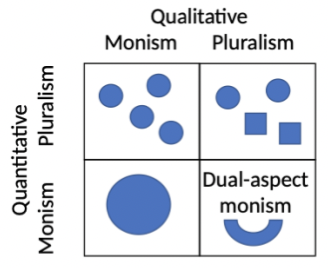
Pre-Socratic on mind vs. matter
2 diff things - qualitative & quantitative pluralism
OR
2 aspects of same thing - qualitative pluralism & quantitative monism
OR
1 thing - qualitative & quantitative monism
dual-aspect monism
one thing in the universe, but it has 2 diff aspects
ex: mind & matter are 2 facets of the same reality
qualitative / quantitative / monism / pluralism diagram
Empedocles
quantitative & qualitative pluralist
everything comes from 4 elements
earth - solid
fire - thinking
air - breath of life
water - liquid
2 causes/forces that combine elements
love & strife
attraction & repulsion
Heraclitus
dual-aspect monism
universe is one thing constantly changing, and there’s order in change
same thing 2 perspectives
everything we think is permanent is always changing
Pythagoras of Samos
change + math
order in change follows mathematical rules
Parmenides
qualitative & quantitative monist
all change = illusion and only understood through reason
sensory experiences NOT real
Zeno of Elea
qualitative & quantitative monist
movement - illusion (succession of still frames we compose into movement)
Zeno’s paradoxes used to prove our senses lie
Anaxagoras
qualitative & quantitative pluralist
there is a basic element for all things
seeds of bone, seeds of air, etc.
there is a nous/cosmic spirit drawing things to order
Democritus
qualitative monist (only one thing), quantitative pluralist (many atoms)
theory of the atom
everything is made of small indivisible things
order comes from force combining things by chance
Socrates
changes focus back to subject instead of external reality bc it doesn’t tell you what you should do
brings humanities into philosophy
Plato
what’s important can be achieved w reason
Theory of Forms
anamnesis
Plato’s Theory of Forms
distinction between realm of never-changing ideas (Forms) & realm of ever-changing material reality where forms of ideas are imperfectly realized
ex: allegory of the cave - diff between what senses perceive & pure/ideal forms
our sense perceptions can’t be trusted
anamnesis
humans can obtain knowledge of Forms by focusing on innate knowledge
“knowing is remembering”
our souls are immortal & made of leftovers
the only things we can discover are things we already knew
Tripartite Model of the Soul
3 main parts of the soul associated w diff body parts
reason = brain
spirit = heart
appetite = liver
diff ppl have diff proportions of these
Hegel’s Dialectic
thesis
antithesis
synthesis
Freud
ID
ego
superego
ID
pleasure & avoiding pain
ego
pleasure & avoid pain tempered by reality
compromises demands of ID, superego & the world
superego
do the right thing, be good according to moral code
the “conscience”
Aristotle
start w observations, gradually use reason
Biological Taxonomy - classifying all life forms (led to Darwin’s evolution)
truth found by observing nature - senses are reliable but still need reason
mind = organizer of knowledge
hylomorphism
an object is a composite of form & matter
ex: ship metaphor
teleology
in every living thing, there is potential to be actualized
the telos / the end / the good
all living things designed to reach an end goal
4 Causes why things are the way they are
efficient cause (force exerted)
material cause (stuff it’s made of)
formal cause (essential nature/structure of it)
final cause (telos, goal, purpose, potential to be actualized)
Aristotle’s Epistemology
refutes empiricism
refutes rationalism/innatism
deductive reasoning
deductive reasoning
we can be certain of the conclusions if the premises are valid & we follow the rules of logic
inductive reasoning
can’t be certain of conclusion - observation of one non-white swan is possible and could prove conclusion wrong
induction
sensation → memory → organized experience → intuitive apprehension
Induction - sensation
5 senses
we don’t directly perceive the matter of the universe - we perceive it indirectly through senses
Induction - memory
humans can think abt sensory objects even when they’re not there
tissue of sensory organs can receive “imprints” from external stimuli
Induction - organized experience
regrouping/classifying diff memories as a function of diff laws of association
contiguity
contrast
similarity
law of frequency
contiguity
when we think of something, we think of things that occurred w it
contrast
when we think of something, we think of its opposite too
similarity
when we think of something, we think of things similar to it
law of frequency
the more often 2 experiences occur together, the stronger their association
Induction - intuitive apprehension
we abstract the Form from particulars
abstract universal idea, not empirical generalization
4 Main Epistemological Positions in philosophy
empiricism
rationalism
rational/moderate empiricism
skepticism
empiricism
generalizations in philosophy
rationalism
innate knowledge
rational/moderate empiricism
innate capacity
skepticism
no truth - everything is relative
on the soul
living things have souls that differentiate from non-living things
soul = form of a living body
life of the body when it’s alive
scale of nature
hierarchical ordering of life forms bounded by simple plants at the bottom and humans at the top
Pain & Pleasure
w every action
guide decisions
morality - we must pursue the right pleasures
The Original Sin
God = all good & powerful
gave humans free will
humans let evil into the world
Empiricists
Bacon
Locke
Berkeley
Hume
Rationalists
Descartes
Spinoza
Leibniz
Kant
external world skepticism
we can’t know what lies behind our sensations
inductive skepticism
we can’t know if patterns found in the past will also be true in the future
phenomenalism
our concept of the world = a pattern of collection of sensations
Veil of Ideas
we only have access to what we see in our minds - we don’t know beyond that
Copernicus heliocentric model
sun = centre of universe
Earth orbits around Sun annually
Formulation of the First Laws of Physics
Newton
objects are attracted to one another as a function of their mass
Newton’s 1st Law
inertia
an object at rest will remain at rest unless acted on by an unbalanced force
object in motion continues at same speed/direction unless acted on by unbalanced force
Newton’s 2nd Law
acceleration produced when a force acts on a mass
greater mass = greater amount of force needed
F = ma
Newton’s 3rd Law
for every action there is an equal & opposite reaction
Francis Bacon
father of empiricism
cultural mandate given by God to Adam & Eve
creation → sin → redemption
dreamt of scientific utopia
René Descartes
rationalist
if we found a certain method to acquire knowledge, we could solve all of Nature’s problems
pre-emptive skepticism
“I think therefore I am”
pre-emptive skepticism
new method must present arguments that can be defended from skepticism
imagine evil spirit wants to deceive him
Mind-Body Dualism
dissociation between subject & object
soul stirs the body - free will
Pineal Gland = interface between soul & body
Emotion vs. Reason
animal spirits circulating human body
cause passions of the soul
influence soul to want certain actions
mind/reason dominates
passions of the soul
wonder
love
hatred
joy
sadness
Clockwork Universe
God created self-perpetuating machine so he didn’t have to look after it
rejected existence of immaterial force besides human soul
universe made of material objects moving in space
all other properties = mental
Baruch Spinoza
rationalist - reason, logic
God = infinite
no diff between God & his creation
metaphysical monist (only 1 substance)
double aspect monism
double aspect monism
mind & matter are just names for 2 aspects of the same thing
God & universe = one thing w 2 aspects
pantheism
belief that the physical universe is equivalent to God
no division between creator and substance of its creation
determinism
no free will
emotions hold us in bondage
liberty comes when we gain clarity about causal forces determining our circumstances
John Locke
empiricist
enlightenment
no innate ideas
all ideas originate in the senses
John Locke: enlightenment
reason as primary source of authority & legitimacy
“knowledge is to be discovered, not recovered from antiquity”
John Locke: Theory of Ideas
knowledge is the addition/subtraction of ideas
ideas = mental representation
tabula rasa
atomistic view
tabula rasa
humans are blank pieces of paper where experiences leave a mark
ideas must come from experience
atomistic view
complex ideas are made of simpler ideas that can be traced back to the experience
simple ideas
can be comprehended by one or more sense
primary or secondary qualities
2 types
2 types of simple ideas
sensation
smell, sound, etc.
reflection
thinking, wishing, worrying, etc.
complex ideas
arise from “voluntarily” compounding simple ideas into logical composite
ex: Rose = complex
it’s simple ideas = colour, smell, shape
John Lock - copy theory of knowledge
our ideas are mental copies of the external world
use sense to know something from external world
George Berkeley
you can’t get to what is outside the mind
the only thing we have are our ideas that compose our experience
phenomenalism
anti-realism - matter doesn’t exist
God is sufficient cause of everything
David Hume
skeptic
sticks to experience & what we get directly from environment
David Hume: impressions vs. clear & distinct ideas
simple ideas arise form impressions
idea = cognitive state that follows an impression that gives you a copy of the impression
perceptions NOT clear ideas - just states of consciousness that begin w impressions
David Hume: principles that govern formation of ideas
3 principles of association
resemblance
contiguity
cause & effect
David Hume: empiricist criterion of meaning
meaning must refer to an original impression
space, time, matter are all abstract ideas - don’t rlly exist
thinking is not empirical
doesn’t feel like anything in itself
Free Will: compatibilism
freedom of action is consistent w causal determinism
free will = no obstacles prevent us to act on desires
Free Will: incompatibilism
freedom of action is NOT consistent w causal determinism
libertarianism
skepticism
libertarianism
we are free
causal determinism is false
skepticism
freedom is impossible
rational compatibilism
causal determinism by recognition of what I should do
ex: recognize taking medicine is right thing to do → taking medicine
Thomas Hobbes - Free Will
decisions to act are NOT voluntary
we can’t decide to decide
Immanuel Kant
reconciliation between empiricism & rationalism
metaphysics is impossible - no way to know ultimate/real reality behind our percept/sensation
transcendental method
metaphysics
branch of philosophy that studies the essence of a thing
transcendental method
to get at inner resources that human mind brings
use imagination to strip everything based on sensation to see what remains
causality remains
ex: ice cube tray - you can’t hold water unless you put it through that structure
Immanuel Kant - space
space is just a relationship between diff objects
Kant’s Copernican Revolution
mind actively contributes to our perception of the world
subject is at the centre of the world it perceives
psychology is NOT a science
Auguste Comte
founded doctrine of positivism
proposing scientific utopia
positivism
certain knowledge is based on natural phenomena and their properties and relations
info from sensory experience, interpreted w reason & logic, forms source of all certain knowledge
valid knowledge only found in a posteriori knowledge
 Note
Note  Flashcards (133)