Motivation
 Call Kai
 Learn
Learn Practice Test
 Spaced Repetition
 Match
Match Flashcards
 Knowt Play
1/22

There's no tags or description
Looks like no tags are added yet.
Name | Mastery | Learn | Test | Matching | Spaced | Call with Kai |
|---|
No analytics yet
Send a link to your students to track their progress
23 Terms
What Motivates People?
Goals
Motives
Needs
needs → motives → goals
goals
specific outcomes that people desire
motives
more fluid and changeable than personality traits such as the Big Five Based in and stem from our needs
Needs
necessary to survive or thrive
approach motivation
anticipating rewards for success
people who are approach-oriented:
higher in extraversion
more likely to fight for rewards
Avoidance Motivation
worrying about the negative consequences of failure
people who are avoidance-oriented:
higher in neuroticism
more likely to take flight from negative consequences
lower in self-esteem and lower life satisfaction
true or false. the same goal can be reframed in terms of approach and avoidance motivation.
true
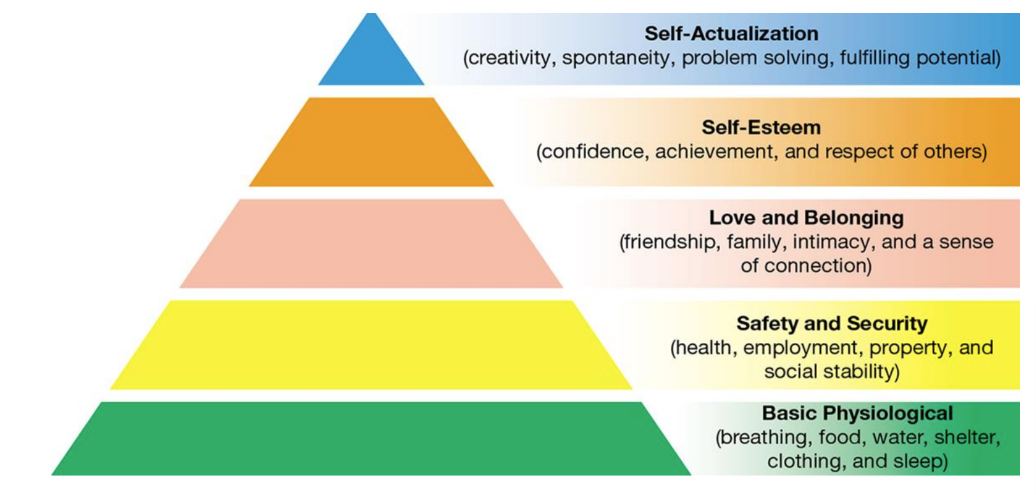
Maslow’s Hierarchy of Needs Background
Humanistic Psychology
focuses on the “whole person” (more than just unconscious)
includes free will, creativity, and human potential
Abraham Maslow as a proponent
fundamental needs are at the base and each higher need is built upon them
Maslow’s Hierarchy of Needs Levels (Top to Bottom)
Self-Actualization: creativity, spontaneity, problem solving, fulfilling potential
Self-Esteem: confidence, achievement, and respect of others
Love and Belonging: friendship, family, intimacy, and a sense of connection
Safety and Security: health, employment, property, and social stability
Basic Physiological: breathing, food, water, shelter, clothing, and sleep
Implicit Motives:
Henry Murray (1937): people are driven by mostly unconscious motivations, called implicit motives
often measured by having people tell stories in response to pictures, called projective measures
Thematic Apperception Test (TAT): asks people to write stories in response to pictures
Murray’s Implicit Motives
originally called “needs” and abbreviated with “n”
Achievement (“nAch”)
Power (“nPow’)
Affilication(”nAff”)
achievement and power overlap with Maslow’s need for self-esteem
affiliation overlaps with Maslow’s need for belonging
Murray’s Implicit Motives: Achievement (“NAch”)
wanting to accomplish things, usually without help
Murray’s Implicit Motives: Power (“nPow”)
wanting to have an impact on others without others impacting them
Murray’s Implicit Motives: Affiliation (“nAff)
valuing relationships with other people
How Motives Impact Behavior
implicit motives differ from explicit motives
unaware of implicit vs. can self-report on explicit
explicit and implicit motives are often quite different, not necessarily related
esp. for high self-monitors & people low in self-determination
predict different types of behavior:
implicit motives predict performance
explicit motives predict choices and judgments
Self-Determination Theory (SDT)
Three needs can explain much of human behavior:
Autonomy (overlaps with Murray’s power need)
having control over one’s actions and life
Competence (overlaps with achievement)
being able to use skills effectively and learn new ones
Relatedness (overlaps with affiliation)
feeling connected to others
Differences between Murray’s theory and Self-Determination Theory (SDT)
focuses on explicit needs
posits each one as essential to human functioning, rather than an individual difference
Types of goals:
extrinsic goals
intrinsic goals
extrinsic goals
external rewards:
financial success, popularity or fame, and physical attractiveness
often promoted by popular culture
instrinsic goals
internal fulfillment:
personal growth, affiliation, and community feeling
what we “should” value
goals and outcomes
which goals are more likely to make you happy?
extrinsic goals more likely to lead to anxiousness and depression
intrinsic goals are more likely to lead to happiness
why?
intrinsic goals more likely to inspire behavior that fulfills the needs in self-determination theory
autonomy
relatedness
competence
overall important for human functioning and psychological well-being
motivation & goals
what works better: extrinsic or intrinsic motivation?
extrinsic motivation comes from outside the self (external)
intrinsic motivation comes from inside the self (internal)
extrinsic goals and rewards diminish intrinsic motivation
overjustification effect
short-term vs. long-term benefit of extrinsic vs intrinsic motivation
beliefs about ability can impact motivation

