Lecture 6 - Suture Materials & Patterns
 Studied by 0 people
 Call Kai
 Learn
Learn Practice Test
 Spaced Repetition
 Match
Match Flashcards
 Knowt Play
1/210

Earn XP
Description and Tags
Dr. Thompson
Name | Mastery | Learn | Test | Matching | Spaced |
|---|
No study sessions yet.
211 Terms
1. Provides hemostasis
2. Supports healing tissue by apposing and supporting tissue layers
What are suture's important roles in wound repair? (2)
1. type of tissue
2. anticipated duration of healing
Tissues have different requirements for suture support, depending on what 2 things?
clot
A ligature placed on a vessel may only need to function for hours, until a _____ is formed
muscle; subcutaneous tissue; skin
Some tissues, such as _____, _____, and _____ need support for only a few days
fascia
_____ requires weeks of support
tendon
A _____ requires months of support
1. Infection
2. Obesity
3. Malnutrition
4. Neoplasia
5. Drugs (e.g., steroids)
6. Collagen disorders
7. Hypoproteinemia
8. Radiation Therapy
What are some things that can delay wound healing? (8)
tissue strength
Maintain apposition of tissue until wound's _____ returns
subjective
_____ preferences, such as familiarity with the material, price, and availability, need also be taken into consideration when choosing a suture material
1. Easy to handle
2. Reacts minimally in tissue
3. Inhibits bacterial growth
4. Holds securely when knotted
5. Resists shrinking in tissue
6. Absorbs with minimal reaction after the tissue has healed
7. Noncapillary
8. Nonallergenic
9. Noncarcinogenic
10. Nonferromagnetic
What are the characteristics off ideal suture? (10)
true
T/F - The ideal suture material does not exist
United States Pharmacopeia (USP)
The most commonly used standard for suture size is the _____
-Denotes dimensions from fine to coarse
-According to a numeric scale
-With 12-0 being the smallest and 7 the largest
12-0; 7
The United States Pharmacopeia (USP) suture sizes range from _____ being the smallest to _____ being the largest
smallest to largest
3-0 -> 2-0 -> 0
Is this going from the largest to smallest size or smallest to largest size?
"three ought"
How do you read this?
3-0
"ought"
How do you read this?
0
should
The smallest diameter suture that will adequately secure wounded tissue [should/should not] be used in order to...
-Minimize trauma as the suture is passed through the tissue
-Reduce the amount of foreign material left in the wound
true
T/F - There is no advantage to using a suture that is stronger than the tissue to be sutured
torsional stiffness; diameter
The flexibility of a suture is determined by its _____ and _____, which influence its handling and use
flexible
_____ sutures are indicated for ligating vessels or performing continuous suture patterns
cannot
Less flexible sutures (e.g., wire) [can/cannot] be used to ligate small bleeders
nylon; surgical gut
_____ and _____ are relatively stiff compared with silk suture
intermediate
Braided polyester sutures have _____ stiffness
surface
The _____ characteristics of a suture influence the ease with which it is pulled through tissue (i.e., the amount of friction or "drag" and the amount of trauma caused)
more
Rough sutures cause [more/less] injury than smooth sutures
smooth
_____ suture surfaces are particularly important in delicate tissues, such as the eye
smooth
Sutures with [smooth/rough] surfaces
-Require greater tension to ensure good apposition of tissues
-Have less knot security
more
Braided materials have [more/less] drag than monofilament sutures
capillarity
Braided materials are often coated to reduce _____ and provide a smooth surface
1. teflon
2. silicone
3. wax
4. paraffin wax
5. calcium stearate
What materials are used to coat sutures? (5)
capillarity
The process by which fluid and bacteria are carried into the interstices of multifilament fibers
nonabsorbable
Neutrophils and macrophages are too large to enter the interstices of the fiber, so infection may persist, particularly in _____ sutures
true
T/F - Braided materials (e.g., polyglycolic acid, silk) have degrees of capillarity
noncapillary
Monofilament sutures are considered [capillary/noncapillary]
true
T/F - Coating reduces the capillarity of some sutures
should not
Capillary suture materials [should/should not] be used in contaminated or infected sites
knot tensile strength
_____ is measured by the force in pounds that the suture strand can withstand before it breaks when knotted
the normal tissue through which they are being placed
Sutures should be as strong as _____
tissue
Tensile strength of the suture should not greatly exceed the tensile strength of the _____
relative knot security
The holding capacity of a suture expressed as a percentage of its tensile strength
knot-holding capacity
_____ of a suture material is the strength required to untie or break a defined knot by loading the part of the suture that forms the loop
tensile strength
The strength required to break an untied fiber with a force applied in the direction of its length
structure
Suture materials may be classified according to their _____ - "monofilament" or "multifilament"
behavior in tissue
Suture materials may be classified according to their _____ - "absorbable" or "non-absorbable"
origin
Suture materials may be classified according to their _____ - "synthetic", "organic" or "metallic"
1. structure
2. behavior in tissue
3. origin
What are the 3 things suture material is classified by?
monofilament
_____ sutures are made of a single strand of material
less
Monofilament sutures have [more/less] tissue drag than multifilament sutures
interstices
Monofilament sutures do not have _____ that may harbor bacteria or fluid
weaken; breakage
Care should be used in handling monofilament suture because nicking or damaging the material with forceps or needle holders may _____ the suture and predispose it to _____
twisted or braided
Multifilament sutures consist of several strands of suture that are _____ together
multifilament
Generally, _____ sutures are more pliable and flexible
true
T/F - Multifilament sutures may be coated to reduce tissue drag and enhance handling characteristics
monofilament
The following are characteristics of [multifilament/monofilament] suture:
-Non-wicking
-More memory
-Does not handle as well
multifilament
The following are characteristics of [multifilament/monofilament] suture:
-Wicking
-Less memory
-Good handling
2
There are __#__ major mechanisms of absorption that result in the degradation of absorbable sutures
organic
Sutures of _____ origin are gradually digested by tissue enzymes and phagocytized
hydrolysis
Sutures manufactured from synthetic polymers are principally broken down by _____
nonabsorbable
[Absorbable/nonabsorbable] sutures are ultimately encapsulated or walled off by fibrous tissue
1. surgical gut
2. chromic gut
3. multifilament
What are the absorbable suture materials/characteristics? (3)
reviewed
Absorbable Suture Materials: Review
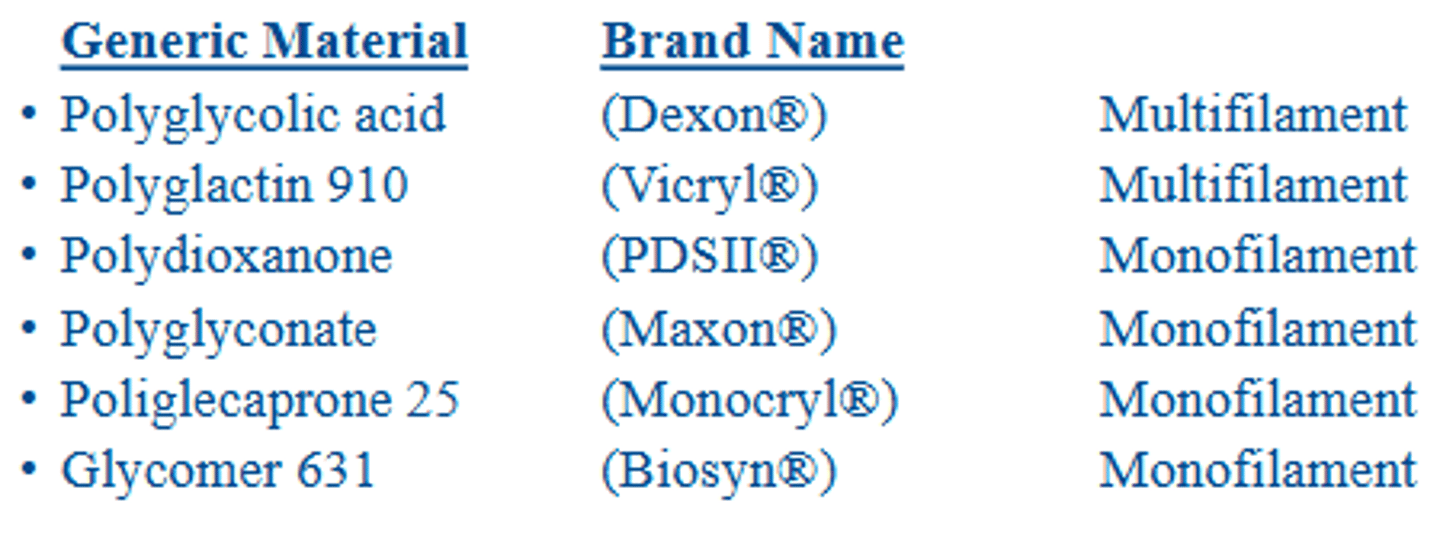
60 days
Absorbable suture materials lose most of their tensile strength within _____
phagocytized; hydrolyzed
Absorbable suture materials eventually disappear from the tissue implantation site because they have been _____ or _____
catgut (surgical gut)
-Most common non-synthetic absorbable suture material
-Made from the submucosa of sheep intestine or the serosa of bovine intestine
collagen
Catgut (surgical gut) is approximately 90% _____
phagocytosis
Catgut (surgical gut) is broken down by _____
inflammatory
Catgut (surgical gut) elicits a notable _____ reaction
rapidly
Plain surgical gut loses strength [slowly/rapidly] after tissue implantation
tanning
"_____" (cross-linking of collagen fibers) slows absorption
increased
[Increased/decreased] tanning generally implies prolonged strength and reduced tissue reaction
true
T/F - Surgical gut is available as plain, medium chromic, or chromic
infected; catabolic
Surgical gut is rapidly removed from _____ sites or areas where it is exposed to digestive enzymes and is quickly degraded in _____ patients
wet
Surgical gut knots may loosen when _____
hydrolysis
Synthetic absorbable suture are, generally, broken down by _____
true
T/F - Synthetic absorbable suture cause minimal tissue reaction
true
T/F - The time to loss of strength and to absorption of synthetic absorbable suture is fairly constant even in different tissue
does not
Infection or exposure to digestive enzymes [does/does not] significantly influence the rate of absorption of most synthetic absorbable sutures
alkaline; contaminated
Polyglactin 910 and polyglycolic acid are more rapidly hydrolyzed in _____ environments, but they are relatively stable in _____ wounds
infected urine
Polyglycolic acid, polyglactin 910, and poliglecaprone 25 may be rapidly degraded in _____
sterile; E. coli
Polydioxanone, polyglyconate, and glycomer 631 are acceptable for use in _____ bladders and those infected with _____
Proteus spp.
Any suture that is degraded via hydrolysis may be at risk for accelerated degradation when the bladder is infected with _____
7 days
All common monofilament absorbable sutures have been shown to degrade within _____ in P. mirabilis-inoculated urine
1. organic nonabsorbable materials
2. synthetic nonabsorbable materials
3. metallic sutures
What are the 3 nonabsorbable suture materials?
silk
_____ is the most common organic nonabsorbable suture
silkworm
Braided multifilament suture made by a special type of _____
true
T/F - Organic nonabsorbable suture is marketed as uncoated or coated
organic nonabsorbable
_____ suture has excellent handling characteristics and often used in cardiovascular procedures
vascular grafts
Silk does not maintain significant tensile strength after 6 months and is therefore contraindicated for use in _____
contaminated sites
Organic nonabsorbable suture should be avoided in _____
braided multifilament; monofilmanet
Synthetic nonabsorbable suture is marketed as _____ threads or _____ threads
synthetic nonabsorbable
_____ sutures are typically strong and induce minimal tissue reaction
-toxic substances are released during their degradation
-their use may result in abscess or tumor formation
Cable ties should never be implanted in the body. Why? (2)
stainless steel
_____ is the material most commonly used for metallic sutures
twisted
Metallic sutures are available as monofilament or multifilament _____ wire
true
T/F - Surgical steel is strong and inert with minimal tissue reaction
inflammatory
Metallic suture knot ends evoke an _____ reaction
cut tissue
Metallic sutures have the tendency to _____
migrate
Metallic sutures may fragment and _____
is
Stainless steel [is/is not] stable in contaminated wounds
1. judging knot security
2. judging tissue reaction to suture materials
What are metallic sutures standard for? (2)
 Note
Note  Flashcards (45)