Bio Exam 3
 Call Kai
 Learn
Learn Practice Test
 Spaced Repetition
 Match
Match Flashcards
 Knowt Play
1/177

There's no tags or description
Looks like no tags are added yet.
Name | Mastery | Learn | Test | Matching | Spaced | Call with Kai |
|---|
No analytics yet
Send a link to your students to track their progress
178 Terms
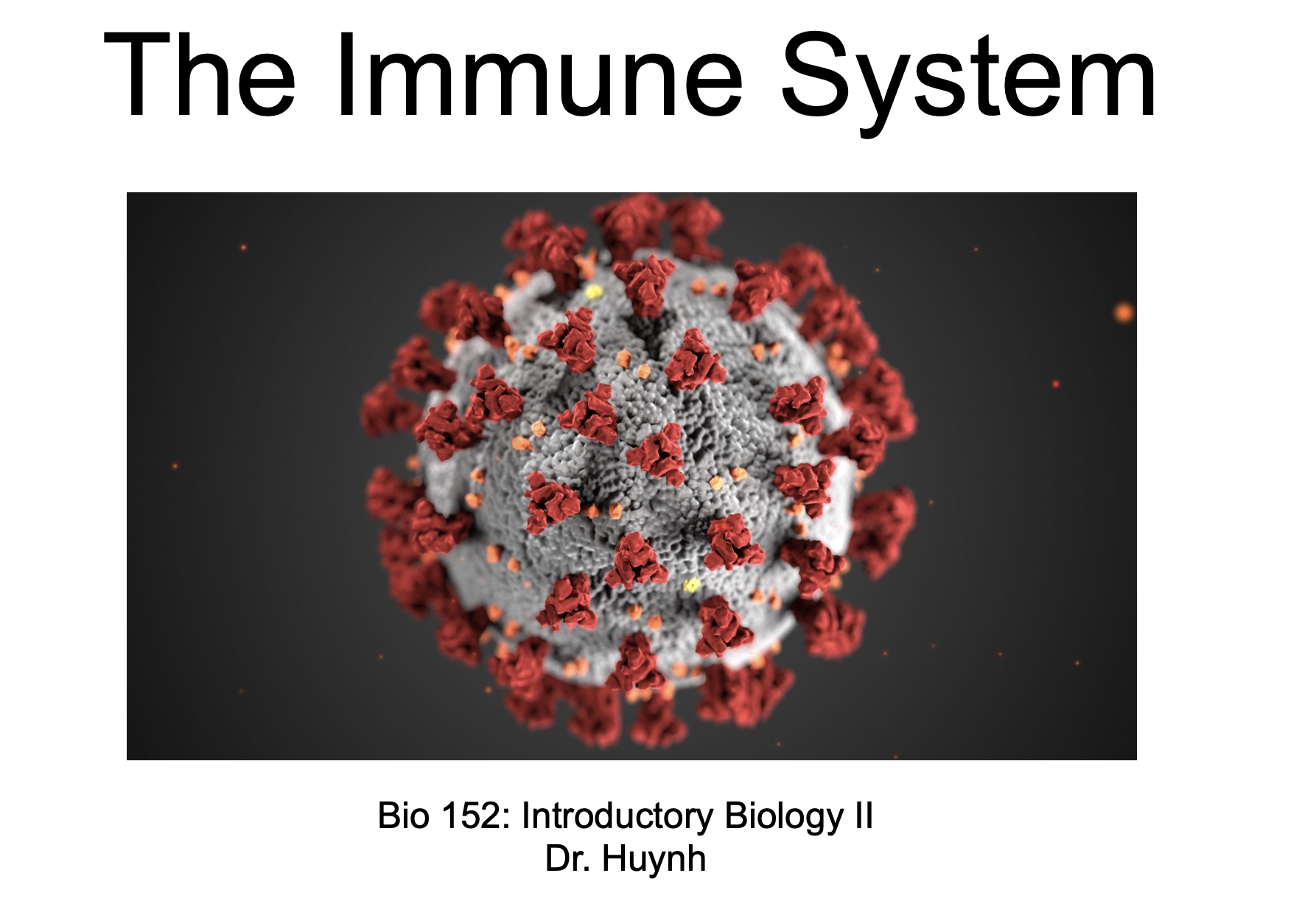
Immune System
What is the immune system?
The body’s defense system against small organisms that try to parasite you
How does the immune system work?
Innate Immunity + Adaptive Immunity
Why does the immune response work?
Immunological Memory + Vaccines
Why does the immune response not work?
Allergies, autoimmunity, immunodeficiency (sometimes body reacts to much)
Pathogens
Bacteria, Fungi, Viruses
Innate Immunity
Barrier Defenses
Internal Defenses
All animals
Rapid response
Adaptive Immunity
Humoral response
Cell-mediated response
Vertebrates only
Slower but more powerful response
If infection spreads which immunity is the 2nd defense?
Adaptive (acquired) immunity
Examples of barrier defenses
Skin, tears, ear wax
Mucous membranes
Secretions
Examples of internal defenses
Phagocytic cells
Natural killer cells
Antimicrobial proteins
Inflammatory response
Humoral response
B cells + antibodies
Antibodies defend against infection in body fluids
Cell - mediated response
T cells
Cytotoxic cells defend against infection in body cells
Inflammatory response
Local response - when skin gets red around splinter
Mast cells release…
histamines
triggers blood vessel dilation
sends out distress signals
Macrophages release…
cytokines
signals molecules that recruit more white blood cells
Leukocytes
General term for white blood cells
Which 2 recruit white blood cells?
Mast cells and Macrophages
Phagocytosis
Cells that eat cells/bacteria
Phagocytic cells include…
macrophages localizes in certain body tissues and neutrophils that circulate in the blood stream
Antimicrobial peptides
proteins that recognizance and target pathogens
Inflammatory response ends in the accumulation of?
Pus
Evidence of warzone
Pus
Fluid rich in white blood cells, dead pathogens, and cell debris
Lymphatic system
Series of lymphatic vessels that meet at lymph nodes
Lymphatic vessels
Screens for intruders
Funnels any pathogens to lymph nodes
Lymph Nodes
Identify pathogen
Remove harmful substances like bacteria and viruses
Store white blood cells to fight infection
Swell when fighting illness
Ex: When testing for strep, doctors check neck lymph nodes to see if they are swollen
Adaptive immunity relies on 2 types of lymphocytes
B-Cells
T-Cells
Lymphocytes
Specific kind of white blood cells
B and T cells
Antigen receptors
On surface
Each lymphocyte has 1 type of antigen receptor
B Cells have 2
T Cells have 1
Antigen
Any substance on or secreted by a pathogen that can give an immune response
B Cells have antigen receptors
Clonal Selection
B-cell matches foreign antigen, that specific cell activates, divides rapidly (proliferates), and creates many identical copies (clones) of itself to fight the specific pathogen
Ensures that only B cells capable of binding to a pathogen are expanded
Effector Cells
Plasma B Cells
Produce Antibodies
Fights active infections
Memory B-cells
long-term
protection against future repeat exposures to the same pathogen
Neutralization
Prevents infection
Naturalize and kills pathogen
Opsonization
Tags foreign bodies for phagocytosis
Can flag pathogens for death
T-cells
Look for infected cells
Recognize antigen fragments presented by host cells
Host proteins are called…
MHCs
Present antigen fragments on a cell surface for recognition
MHC
Major histocompatibility complexes
Helper T-cells
can bind the antigen fragment proliferate (clonal selection)
promote proliferation of B-cells
signal cytotoxic T-cells to kill infected host cells
memory T - cells
4 reasons why adaptive immunity is powerful
Diversity of antigen receptors
B+T cells proliferate (clone) after activation
Self- tolerance
Not binding random cells
Immunological memory
Remembering past infections to attack in future
Autoimmunity
Body looses self tolerance and attacks ones self
Self-reactive lymphocytes undergo…
apoptosis
Gene rearrangement
Cutting out parts of a template to give to a unique antigen receptor
Vaccine
Part of nonliving pathogen so body can remember and identify strains allowing for immediate help
Type of diseases that have vaccines
Small Pox + Chicken Pox
Influenza
Measles
Hepatitis
Covid
4 times when the immune response doesn’t work
Immune Rejection
Exaggerated response
Self-directed response
Diminished response
Immune Rejection
Blood transfusion
Organ transplants
Need to be molecularly compatible
Exaggerated response
Allergies - immune system exaggerates and thinks it’s dangerous when it is not
Self-directed response
When body looses self tolerance and attacks ones self
Rheumatoid arthritis
Lupus
Multiple sclerosis
Diminished response
Stress, age, lack of sleep
Antigenic variation
Specific to antigen so if flu mutated then you would need a different/new antigen - ie. why we need new flu shots every year
Viral latency
Viruses cab lay dormant for years and you could be asymptomatic
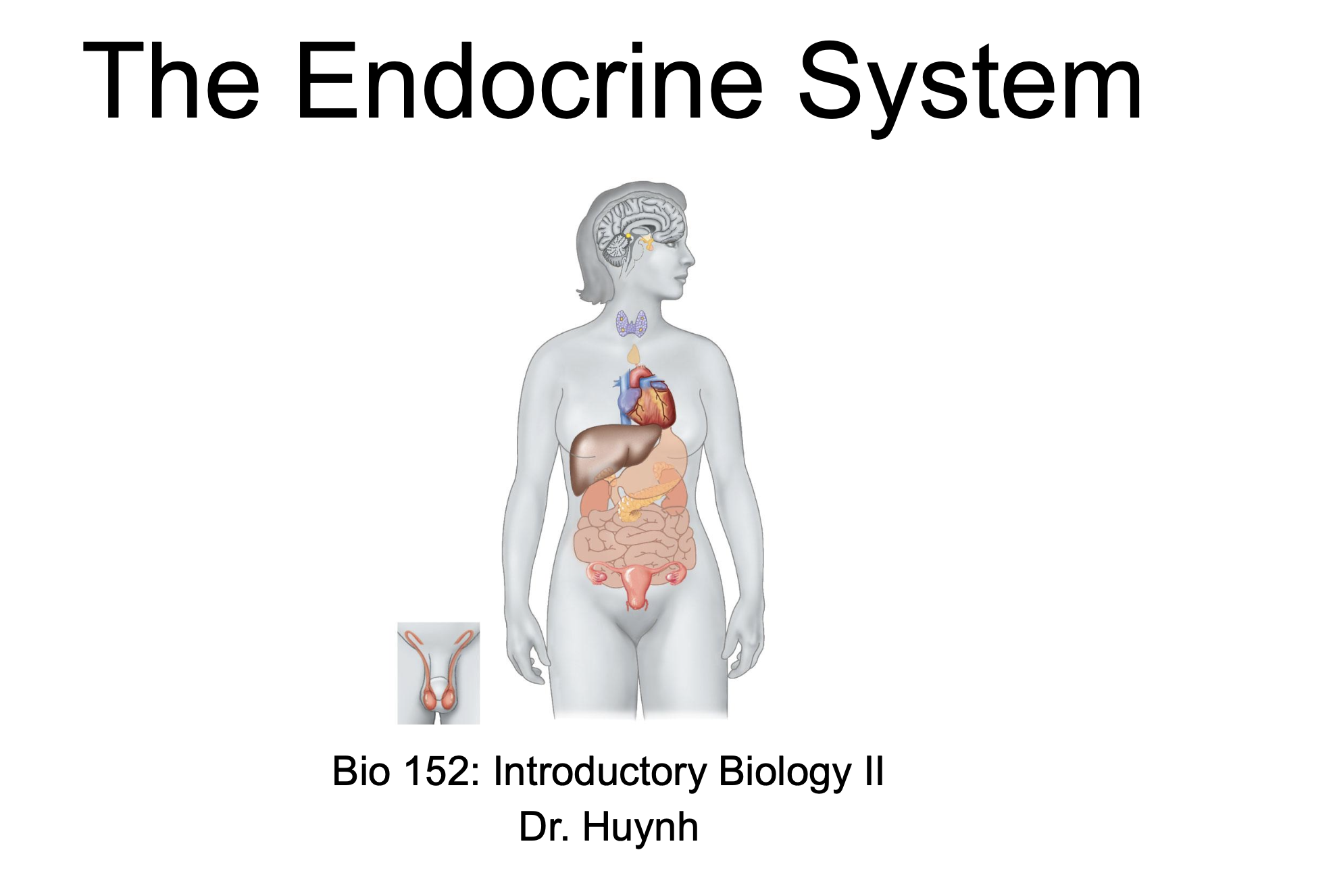
Endocrine System
What is the endocrine system?
System of organs that coordinate hormones that influence functions and behaviors
How does the endocrine system work?
Endocrine gland secret hormones
Hypothalamus, pituitary, adrenal, thyroid, gonads
Hormones travel through circulatory system to target cells
Hormone receptors trigger cellular response
Why does the endocrine system work?
Feedback mechanism
Coordination of biological systems requires…
cell communication
Animals have?
Both Nervous system and Endocrine system
Plants have?
Only Endocrine systems (we and plants have chemical communication)
Question:
Testosterone is an example of a chemical signal that affects
the very cells that synthesize it, the neighboring cells in the
testes, along with distant cells outside the gonads. Thus,
testosterone is an example of?
A) an autocrine signal
B) a paracrine signal
C) an endocrine signal
D) an autocrine signal, a paracrine signal, and an endocrine
signal
D) an autocrine signal, a paracrine signal, and an endocrine
signal
Endocrine signaling
Long distance form of transmitting
Endocrine glands
Released from majority of body
Glands main goal is to release hormones
Major endocrine glands
Hypothalamus
Pineal gland
Pituitary gland
Thyroid gland
Parathyroid glands
Adrenal glands
Pancreas
Ovaries and Testes
Organs containing endocrine cells
Thymus
Heart
Liver
Stomach
Kidneys
Small Intestine
Pancreas
Ovaries and Testes
Water-soluble hormones (hydrophilic)
Polypeptides
Insulin
Amines
Epinephrine (adrenaline)
Lipid-soluble hormones (hydrophobic)
Steroids
Cortisol (stress hormones)
Amines
Thyroxine
A single hormone can have multiple effects
different receptors for the same hormone can trigger different transduction pathways
same receptors for the same hormone can have different signal transduction pathways
Negative feedback
Inhibits a response by reducing the initial stimulus
epinephrine, cortisol
Positive feedback
reinforces a stimulus to produce an even greater response
oxytocin, estradiol
Question:
An example of antagonistic hormones controlling
homeostasis via negative feedback is?
A) oxytocin and prolactin in milk production
B) insulin and glucagon in glucose metabolism
C) thermostat controlling the temperature in a room
D) pheromonal attraction
B) insulin and glucagon in glucose metabolism
HPE (GTA) system
Hypothalamus receives information from nervous system and secretes hormones
Pituitary glands receives released hormones from the hypothalamus and secretes tropic hormones
Tropic hormones trigger hormone secretion in endocrine glands (gonads, thyroid, adrenal glands)
Posterior Pituitary
ADH
regulates water balance and blood pressure
Target → Kidney tubules
Oxytocin
affects social bonding behaviors, childbirth and milk secretion
Target → Mammary glands, uterine muscles
Antierior Pituitary
Tropic effects
FSH/LH - release s3x hormones from gonads
Target → Testes and Ovaries
TSH - releases thyroid hormones
Target → Thyroid
ACTH - releases stress hormones
Target → Adrenal cortex
Non-tropic effects
Prolactin - promotes milk production
Target → Mammary Glands
MSH - promotes melanin
Target → Melanocytes
Tropic and non-tropic effects
GH - directs bone growth
Target → Liver, bones, other tissues
Gonadal Hormones - Gonads
Ovaries and testes
Secret steroid sex hormones in response to anterior pituitary hormones FSH and LH
Androgens (testosterone) - male skewed
Estrogens (estradiol) - female skewed
Progestins (progesterone) - female skewed
Thyroid hormones - thyroid
general metabolism and physiology
Secretes two hormones in response to TSH
Triiodothyronine (T3)
Thyroxine (T4)
Adrenal hormones - adrenal gland
stress response
secretes a variety of hormones in response to stress (ACTH release)
steroid hormones (cortisol, aldosterone)
amines (epinephrine/adrenaline)
mediate fight or flight
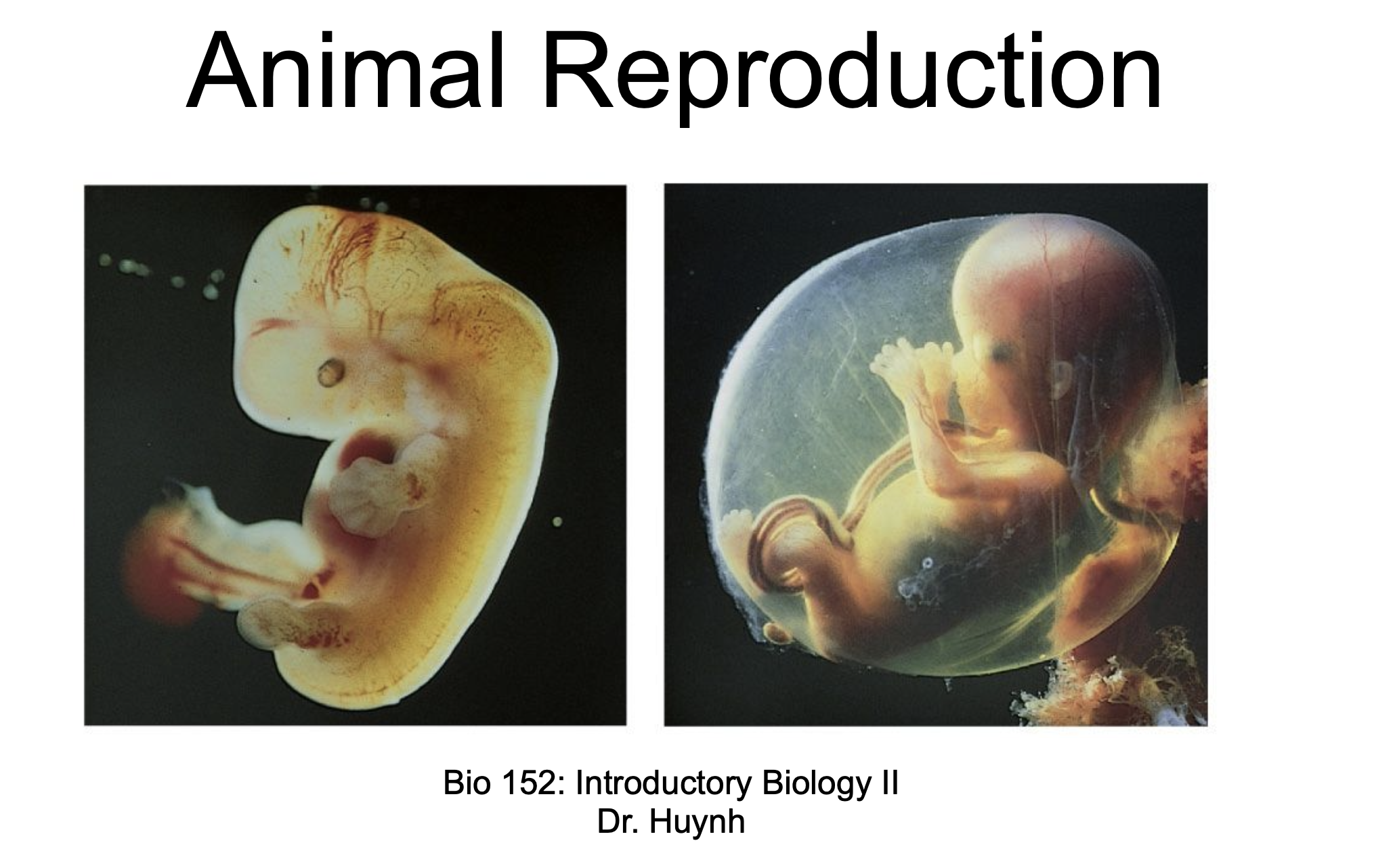
Animal Reproduction
What is reproduction?
Generation of new individuals from existing individuals
How does reproduction occur in animals?
Asexual versus sexual reproduction
Internal versus external fertilization
Specialized reproductive organs
Testes → sperm
Ovaries → egg
Accessory glands and ducts
Why does the reproductive system work?
Endocrine regulation (H-P-G axis)
Question:
Suppose you wanted to start an animal-breeding business.
For most of the following animals, you could start out with
just a single animal. Which of the animals below would
require that you start with at least two individuals?
A) Whiptail lizards
B) Hammerhead shark
C) Bullfrog
D) Komodo dragons
C) Bullfrog
Sexual Reproduction
Creation of zygote by fusion of male gamete (sperm) and female gamete (egg)
Asexual reproduction
Creation of offspring without the fusion of egg and sperm
Fission and Fragmentation
Asexual
Separation of a parent into two or more individuals
Worm like creature tearing in half and growing to be an individual
Budding
Asexual
New individuals arise from outgrowths of existing ones
moss piece taking off and moved somewhere else and begins to grow again
Parthenogenesis
Asexual
Development of new individual from an unfertilized egg
Eusocial Insects
Colony - Queens do the reproduction
Bees, wasps, ants, termites
Hermaphroditism
Sequential + Simultaneous
Sequential
Can change sex throughout life, all typically start as male and produce sperm then switch to female
Clownfish, blue head wrasse
Simultaneous
Female and male at same times - make sperms and egg
Earthworms, sea slugs, hamlet fish
Parthenogenesis with ‘mating’
all females
take turns acting in male+female s3x roles
Reproductive cycles
related to changing seasons
controlled by hormones and environmental cues
Internal fertilization
Eggs are fertilized sperm in the female reproductive tract
requires behavioral interactions (courtship) and compatible copulatory organs
External fertilization
Eggs are fertilized by sperm in the external environment
Requires aqueous environment and precise timing
Sperm and egg goes into water and fertilizes
Bullfrogs
Gonads
Organs that produce gametes
Non-mammalian vertebrates have…
cloaca
fish, amphibians, reptiles, birds
Cloaca
Common opening between the external environment and the digestive, excretory, reproductive systems
Female reproductive anatomy
Egg cell production, fertilization, embryo development
Egg cells produced in → ovaries
Fertilization occurs in → oviducts/fallopian tubes
Embryo develops in → uterus
Question:
In male mammals, excretory and reproductive systems
share?
A) the testes
B) the urethra
C) the seminal vesicle
D) the vas deferens
B) the urethra
Male reproductive anatomy
Sperm (gamete) and Semen (sperm+fluid) production
Sperm are produced in → seminiferous tubules in testes
Sperm are propelled via → the muscle vas deferens to form semen during ejaculation
Gametogenesis
Production of gametes

