Animal Diversity Lab Exam 3
 Call Kai
 Learn
Learn Practice Test
 Spaced Repetition
 Match
Match Flashcards
 Knowt Play
1/74

There's no tags or description
Looks like no tags are added yet.
Name | Mastery | Learn | Test | Matching | Spaced | Call with Kai |
|---|
No analytics yet
Send a link to your students to track their progress
75 Terms
What clades of echinoderms do we need to know?
Clade Deuterostomia [dü-tə-rō-stō’mē-ə] – anus forms first from blastopore
Clade Echinodermata [i-kī′nə-dər′mä-tə]
Clade Holothuroidea [hol′o-thu-roy′dē-ə] – sea cucumbers
Clade Echinoidea [ik′ī-noi′dē-ə] – sand dollars, sea urchins
Clade Asteroidea [as′tər-oi′dē-ə] – sea stars
Clade Ophiuroidea [ō′fē-yu-roi′dē-ə] – brittle stars, basket stars
Clade Crinoidea [krī-ˌnȯid-ə] – sea lilies, feather stars
What gut cavity type do echinoderms have?
True coelomate
What skeletal structure do echinoderms have?
Endoskeleton: internal, living, mineralized frameworks (bones/cartilage) that grow with vertebrates
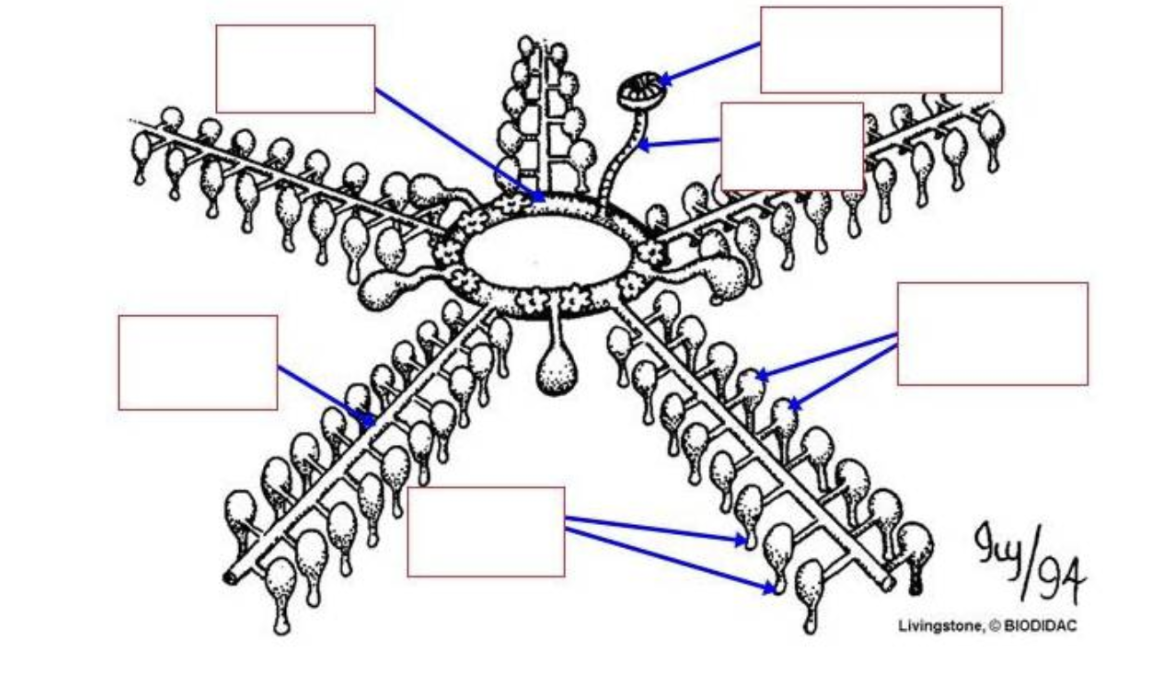
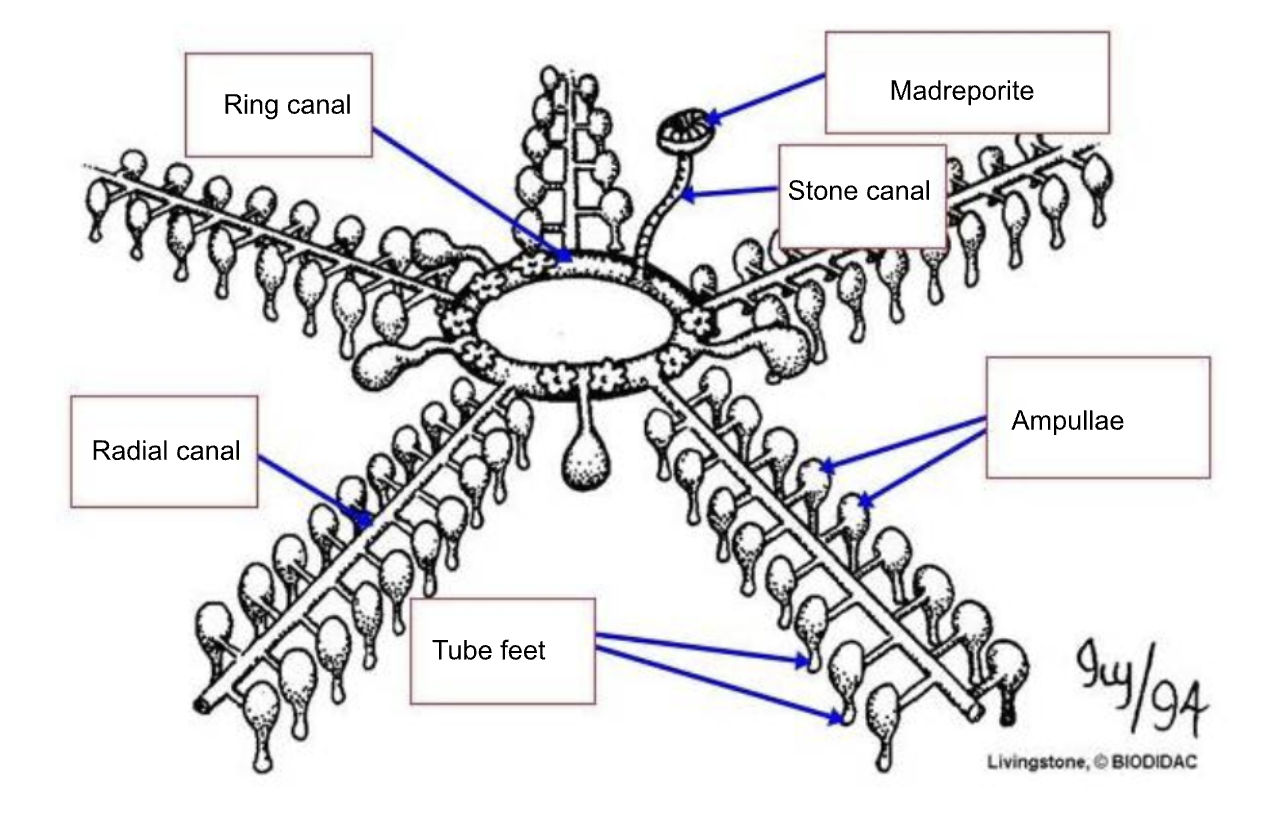
What is the water-vascular system of echinoderms, and what is the sequence of the structures?
A Hydraulic network of fluid-filled canals and appendages used for locomotion, feeding, and gas exchange
Madreporite → stone canal → ring canal → radial canals → lateral canals → ampullae → contracts podia (tube feet)
What is secondary radial symmetry (in echinoderms)?
Larva exhibit bilateral symmetry, adults exhibit (penta)radial symmetry (body parts are arranged in multiples of five around a central oral-aboral axis)
What is a nerve ring (in echinoderms)?
A decentralized nervous system featuring a central nerve ring around the mouth, which connects to five radial nerves extending along their arms or body
Lacking a brain, this ring and radial nerve network coordinate motion, sensory input, and feeding behavior
What are the dermal branchiae, tube feet, respiratory tree (holothuroids), and bursae (ophiuroids) of echinoderms?
Dermal branchiae: Thin, soft, finger-like projections of the body wall that function as respiratory and excretory organs. They increase surface area for gas exchange and waste removal by allowing diffusion between the coelomic fluid and surrounding seawater
Tube feet: small, hydraulic, suction-cup-like projections part of the water vascular system. They are used for locomotion, feeding, respiration, sensory, and attaching to surfaces
Respiratory tree (found in holothuroids): highly branched, thin-walled, tube-like organs found exclusively in sea cucumbers. They function as a specialized respiratory system, branching off the cloaca to facilitate gas exchange by pumping seawater in and out through the anus
Bursae (found in ophiuroids): specialized, cilia-lined sacs or pouches. They act as primary respiratory organs, where cilia and muscular contractions draw water into the sacs to exchange gases.
What are the aboral and oral sides of echinoderms?
Oral: mouth side
Aboral: opposite side, usually anus side
What evolved in echinoderms as adaptations to a sedentary lifestyle?
Radial symmetry and the absence of cephalization
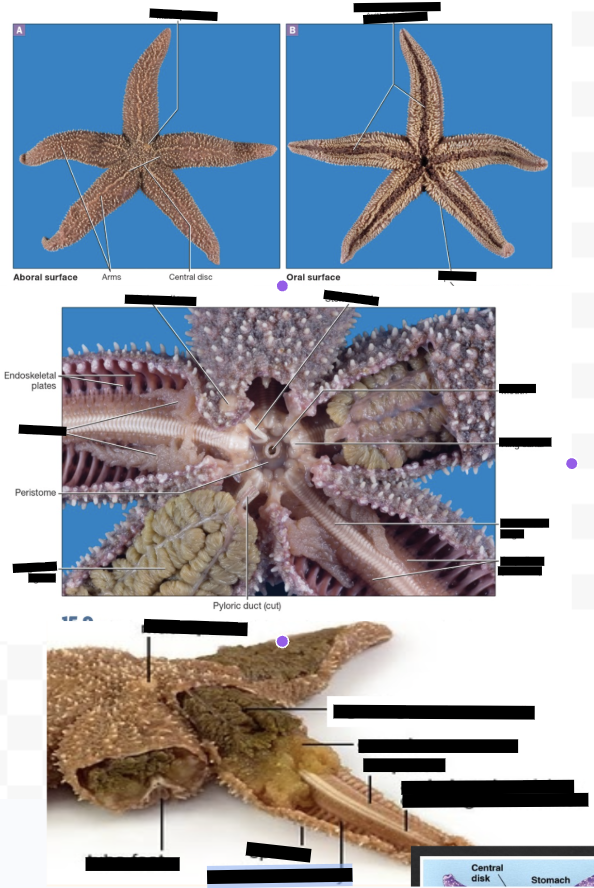
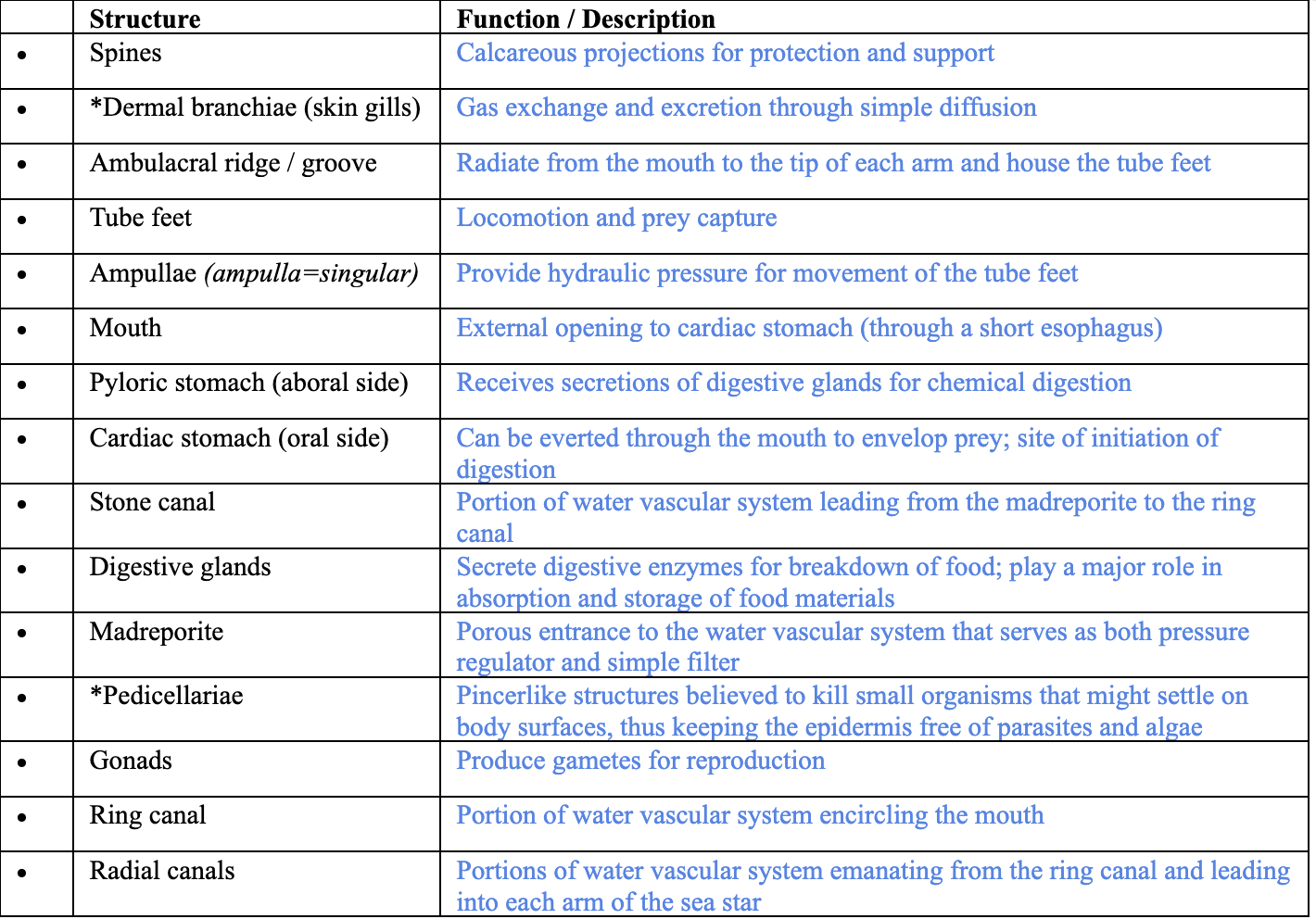
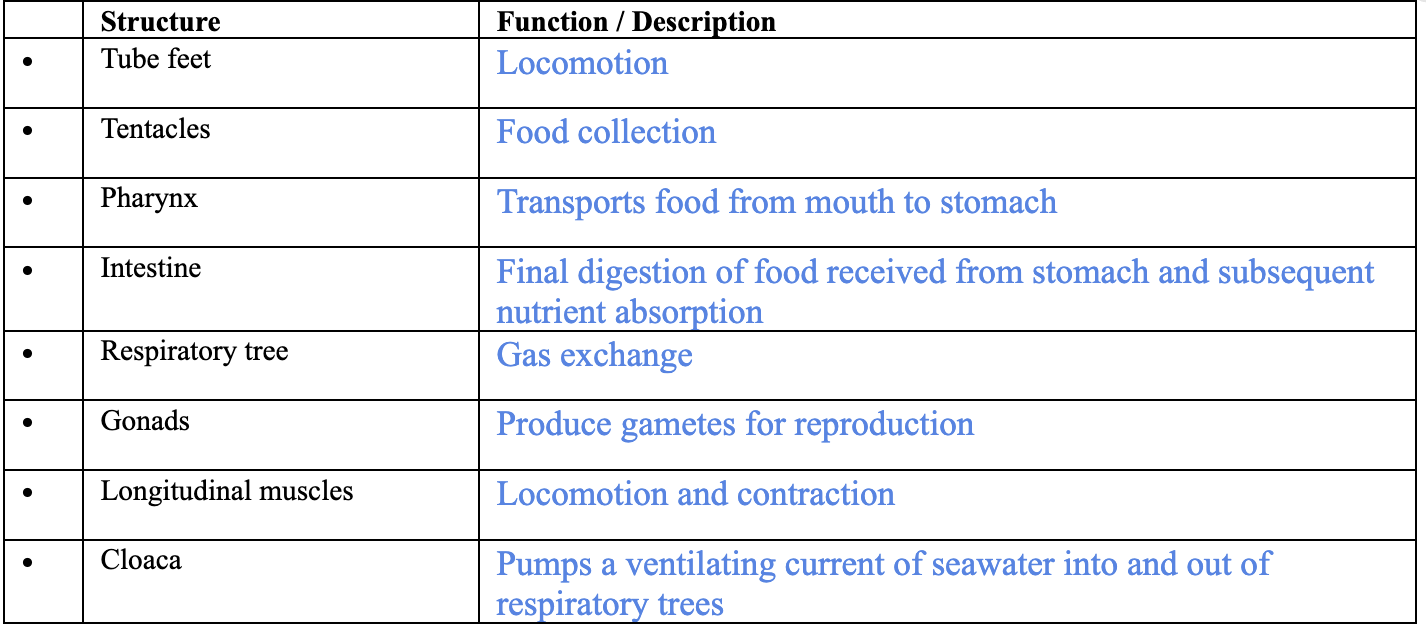
Sea star (clade, structures)
Clade Asteroidea within Clade Echinodermata
Digestive glands look like ground beef
Gonads looks like applesauce
Not it diagram: dermal branchiae, pyloric stomach, cardiac stomach, pedicellariae
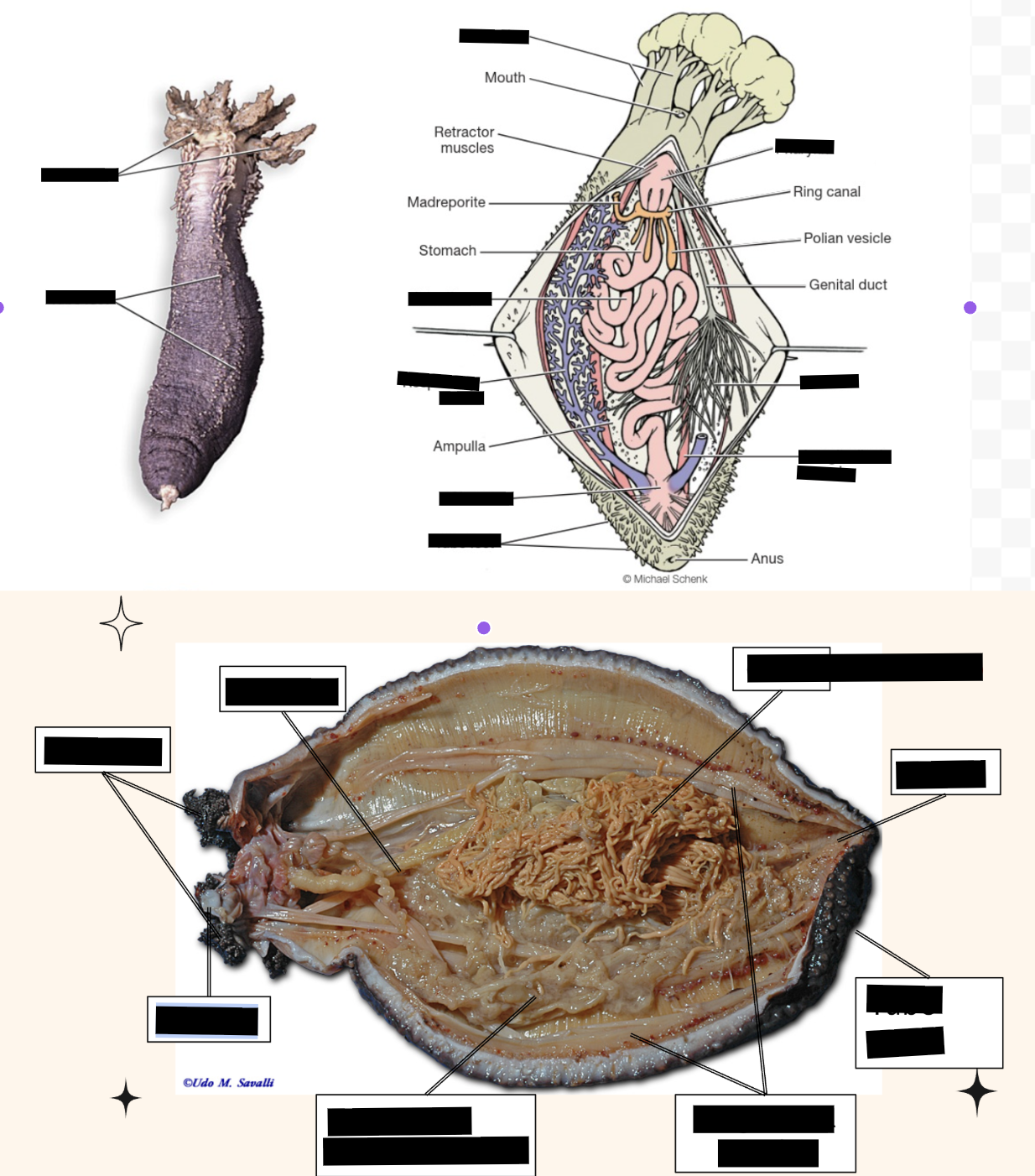
Sea cucumber (clade, structures)
Clade Holothuroidea within Clade Echinodermata
Respiratory tree looks like applesauce
Gonads look like spicy ramen
Echinoderms are believed to share a close evolutionary link to modern chordates. What about their embryological development suggests this?
Evidence for their common ancestry with chordates can be seen best in the embryological pathways that both groups display
Echinoderms and chordates are both deuterostomes, meaning that their anus develops from the embryonic opening, they exhibit indeterminate development, and radial cleavage
What characteristics make echinoderms unique from other phyla?
No brain
Water vascular system
Generally no respiratory system (except holothurians)
Secondary radial symmetry: bilateral larvae, radial adults
Unique endoskeleton made of calcareous ossicles
No excretory system
Unique feeding strategies between different classes
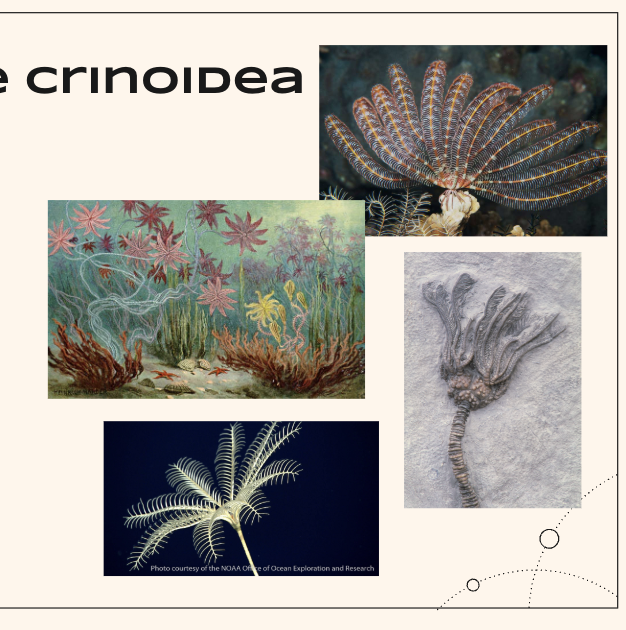
Characteristics of Clade Crinoidea
Sea lilies and feather star
Lack madreporite: water vascular system filled with coelomic fluid
Stalk attaches to floor, generally sessile
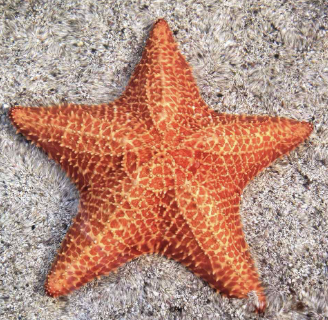
Characteristics of Clade Asteroidea
Sea stars
External digestion via expulsion of the cardiac stomach
Regenerative
Model for the water vascular system
Dermal branchiae for respiration
Characteristics of Clade Ophiuroidea
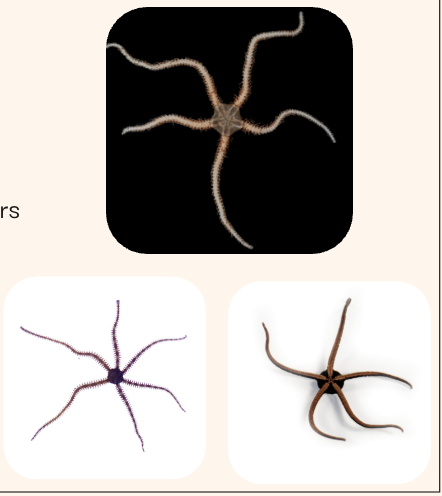
Brittle stars
Star-shaped long arms, tube feet reduced, not used for locomotion
Respire with bursae
Fastest echinoderms
Can drop and regenerate arms to escape predators
Characteristics of Clade Echinoidea
Sea urchins, sand dollars, and sea biscuits
Compact body with a protective test (endoskeleton shell, made up of closely fitted plates)
Aristotle’s lantern:
Mouth type unique to sea urchins
Used to scrape at food
Characteristics of Clade Holothuroidea
Sea cucumbers
Elongated along the oral/aboral axis
Reduced ossicles, resulting in a soft body
Excrete respiratory tree out of cloaca in defense
Use mucus coated tentancles to capture prey
Does clade chordata consist of diplo or triploblasts?
Triploblasts
What body cavity type is Chordata?
True coelom
What type of symmetry does clade Chordata possess?
Bilateral symmetry
What type of circulatory system does clade Chordata possess?
Closed circulatory system
What is the skeletal structure of clade Chordata
Endoskeleton: an internal supporting framework within an animal's body, composed of mineralized tissues like bone and cartilage
Does clade Chordata possess cephalization?
Yes, they are highly cephalized
What are homologous structures?
Inherited structures in different species are similar because of their common ancestry
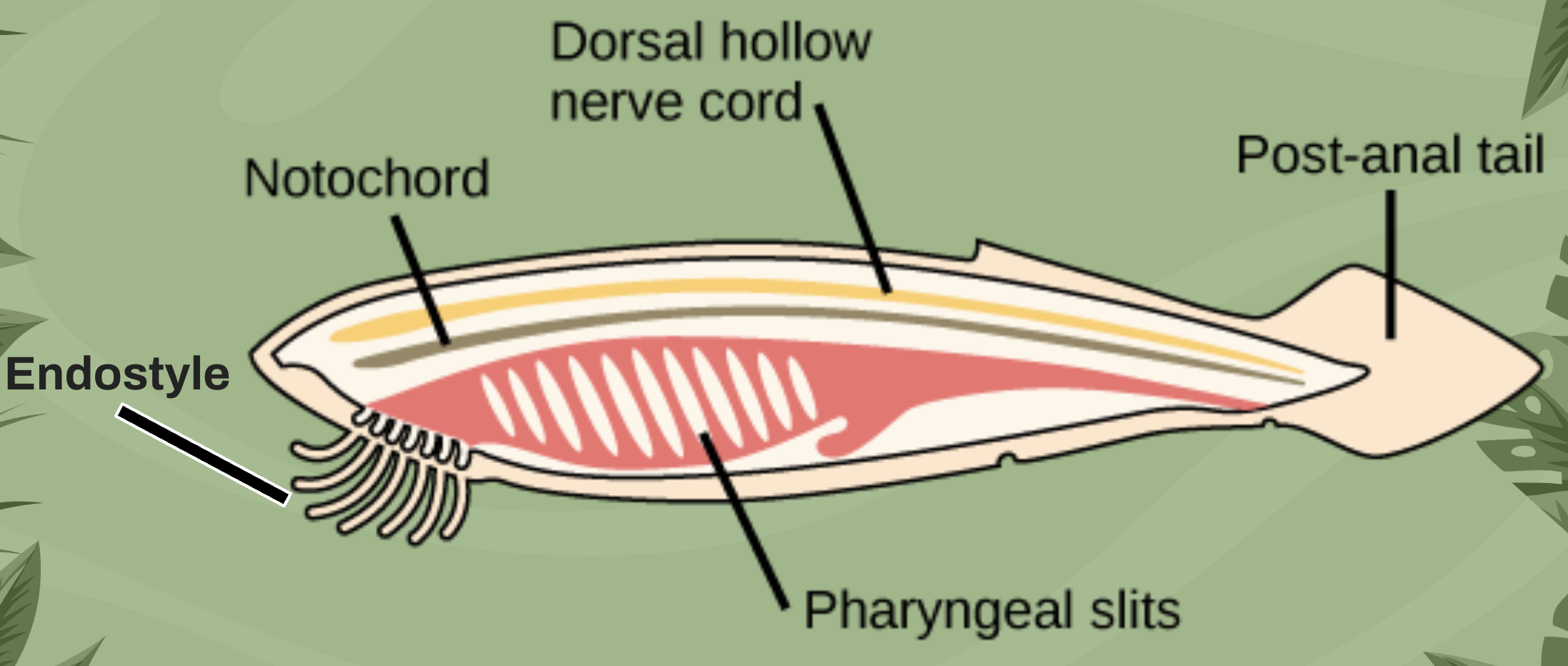
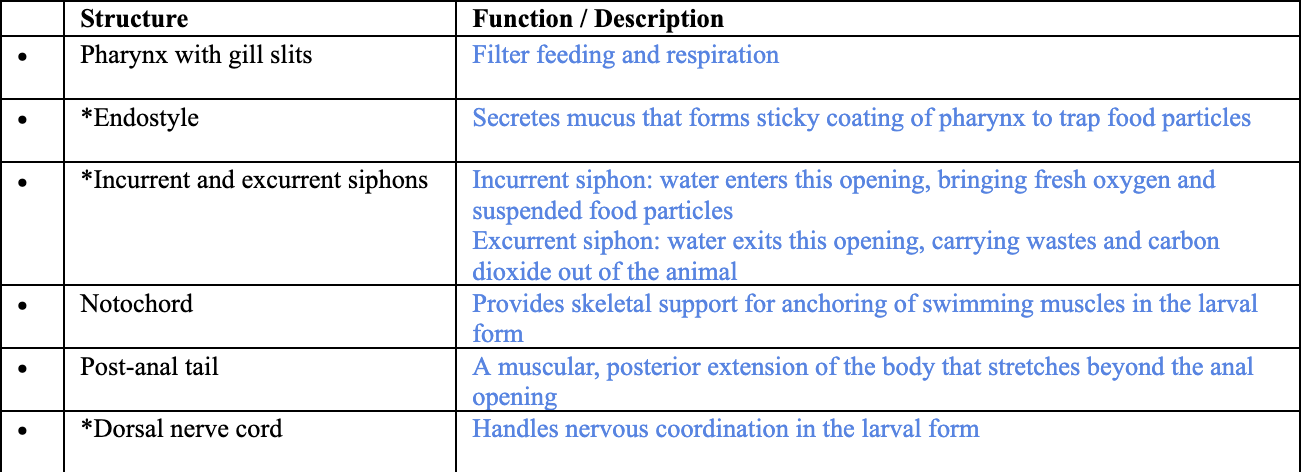
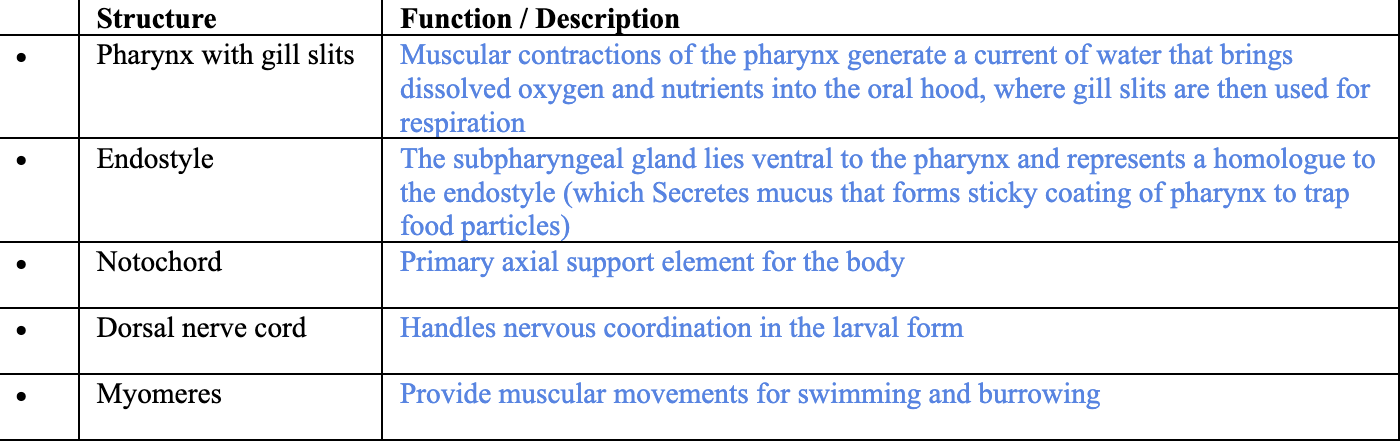
What are the five specific features that all chordates share at some point of development?
Notochord
Pharyngeal gill slits
Dorsal, hollow nerve cord
Post-anal tail
Endostyle or thyroid gland
What is a notochord?
A flexible, rod-shaped structure made of cells that forms the primary axial support in the embryos of all vertebrates and in some adult invertebrates
What are pharyngeal gill slits?
Paired openings in the throat (pharynx) of chordates, appearing during development in all vertebrates, including humans. They function primarily for filter-feeding in early chordates and respiration in fish, while modifying into structures like ears and throat components in terrestrial vertebrates
What is the dorsal hollow nerve?
A hollow tube of nervous tissue positioned dorsally (on the back/top side) relative to the notochord, develops into central nervous system.
What is the post-anal tail?
A muscular, posterior extension of the body that stretches beyond the anal opening
What is the endostyle or thyroid gland?
A mucus-secreting, pharyngeal organ in non-vertebrate chordates used for feeding. It is evolutionary homologous to the vertebrate thyroid gland, as both are endodermal, iodine-binding organs
What are the clades within Chordata that we need to know?
Clade Deuterostomia – anus forms first from blastopore
Clade Chordata
Clade Cephalochordata – filter feeders (Amphioxus / lancelets)
Clade Urochordata (Tunicata) – sessile, filter feeders (tunicates / sea squirts)
Clade Vertebrata (Craniata) – humans and other vertebrate animals
“Agnatha”* – jawless
Clade Cyclostomata – living jawless fishes (hagfishes, lampreys)
Clade Petromyzontida – lampreys
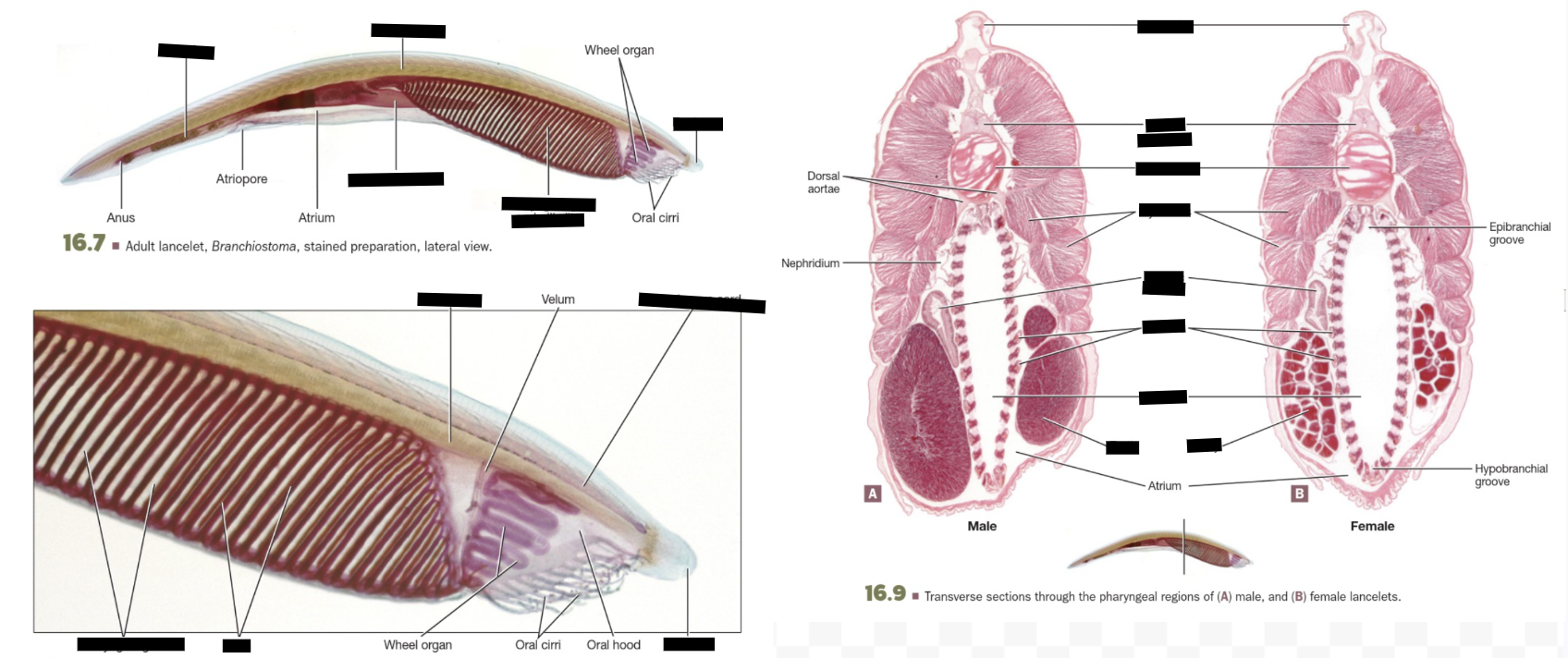
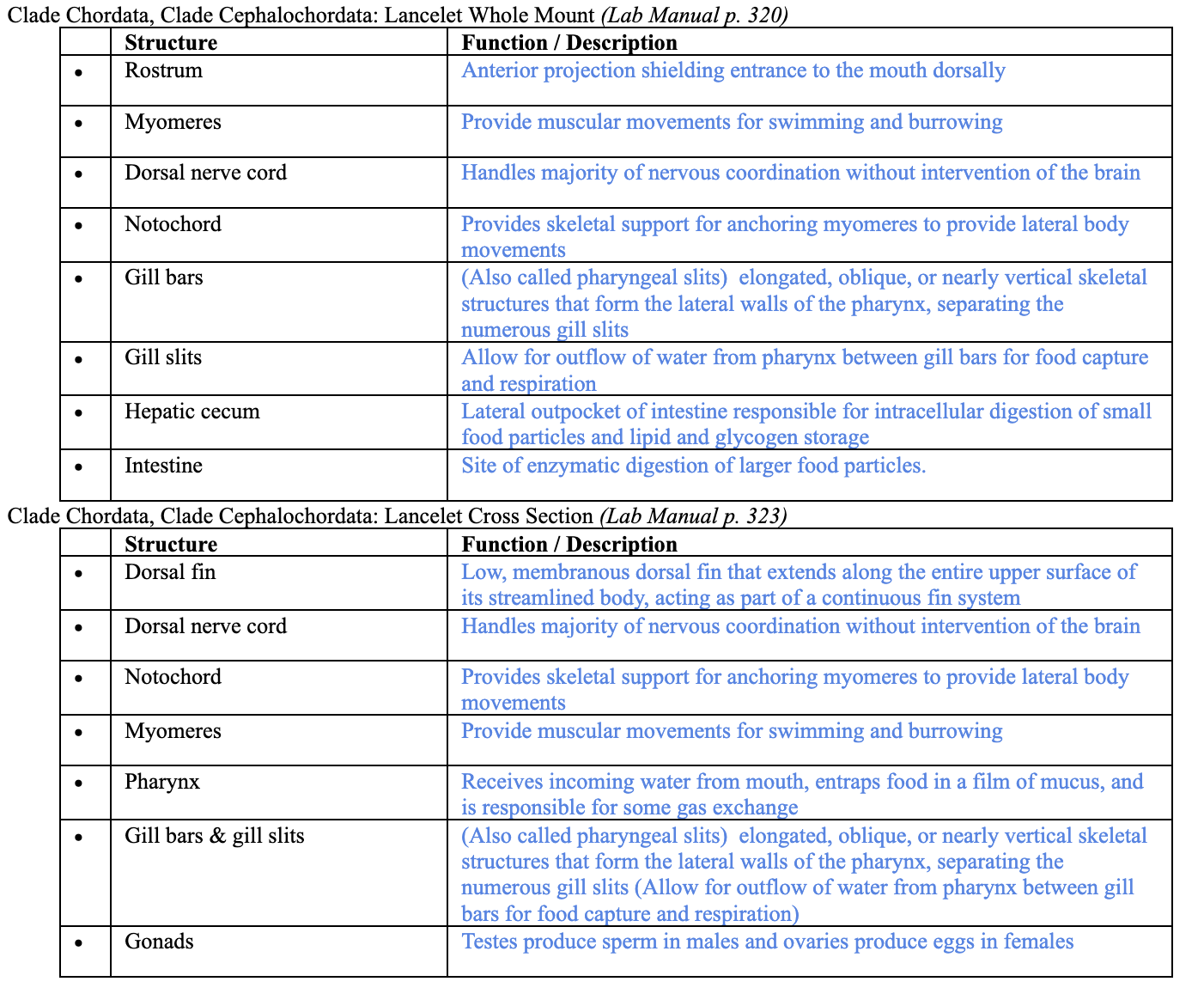
Lancelet Whole Mount (clade, structures)
Clade Cephalochordata within Clade Chordata
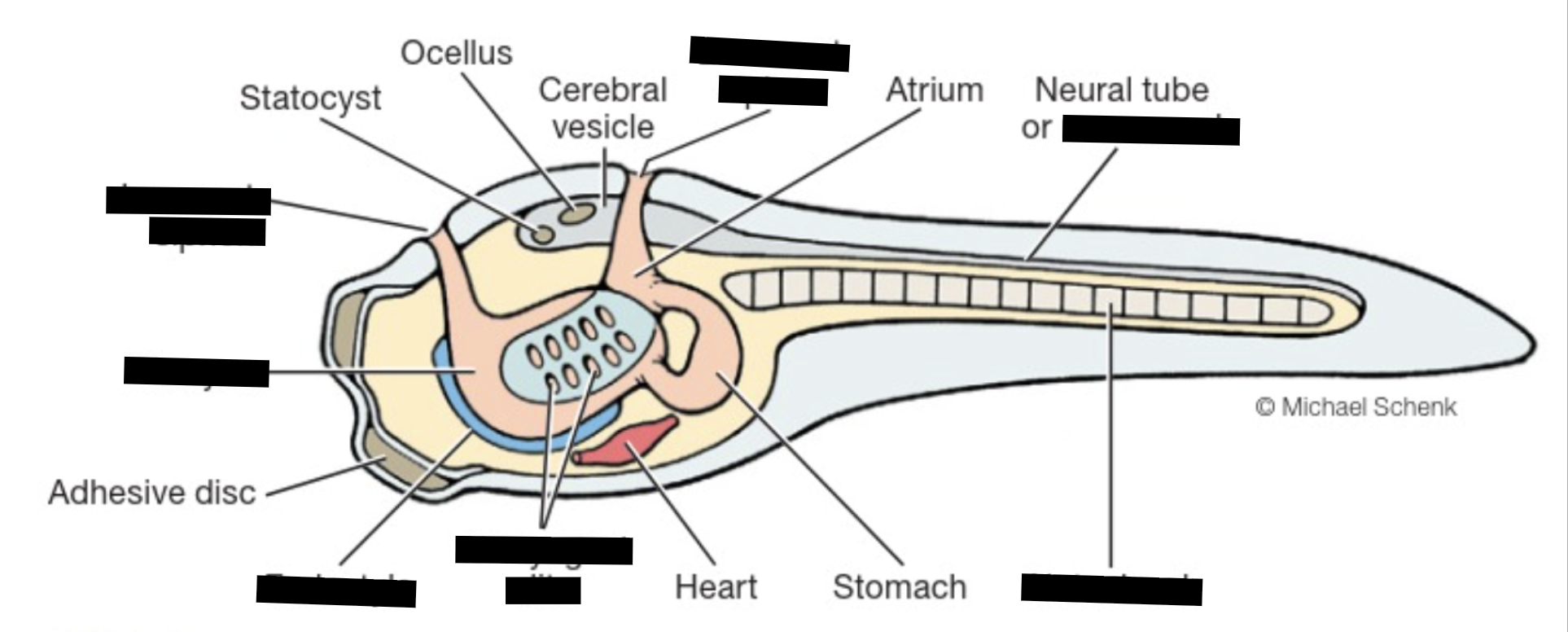
(larva) Tunicate (clade, structures)
Clade Urochordata (Tunicata) within Clade Chordata
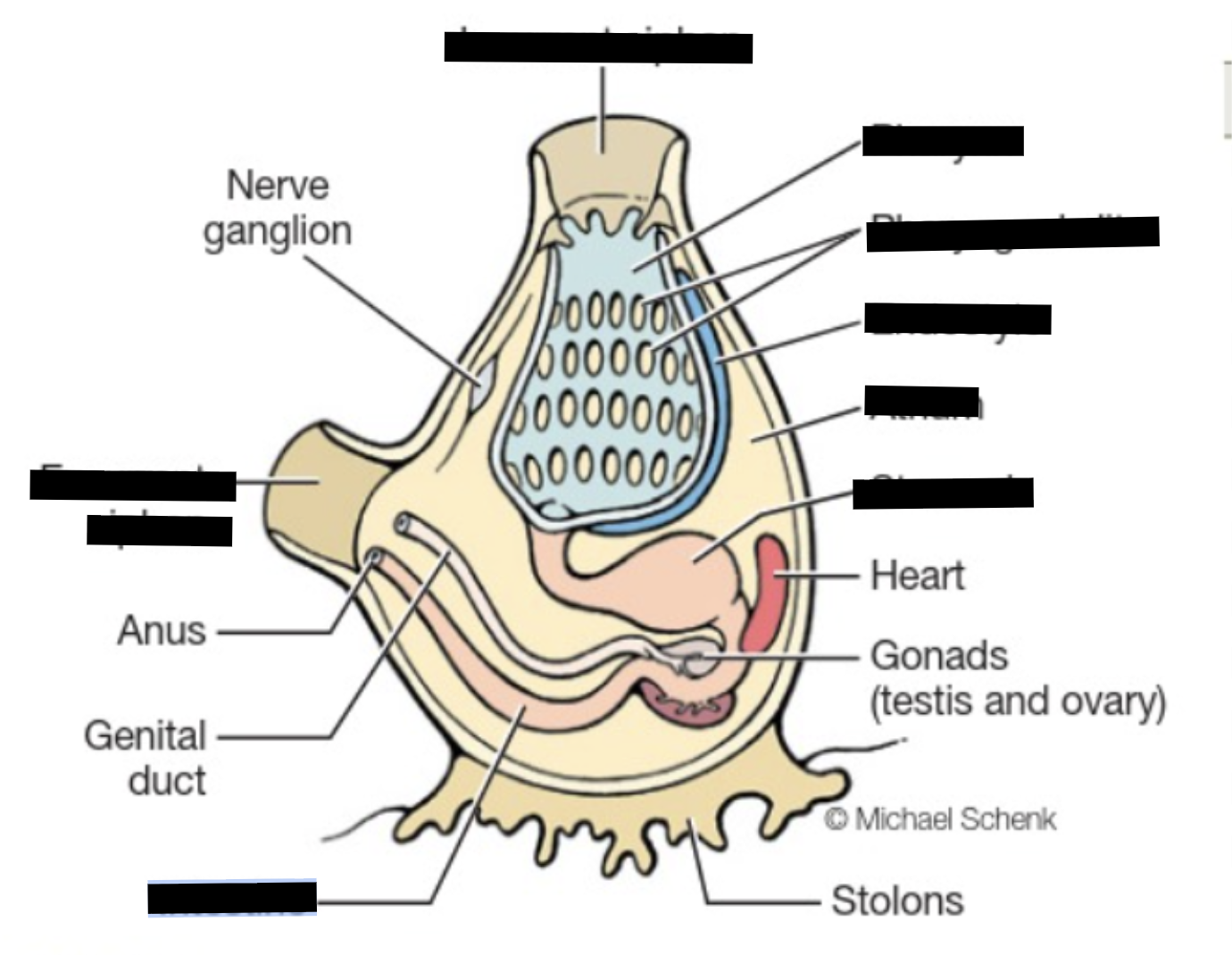
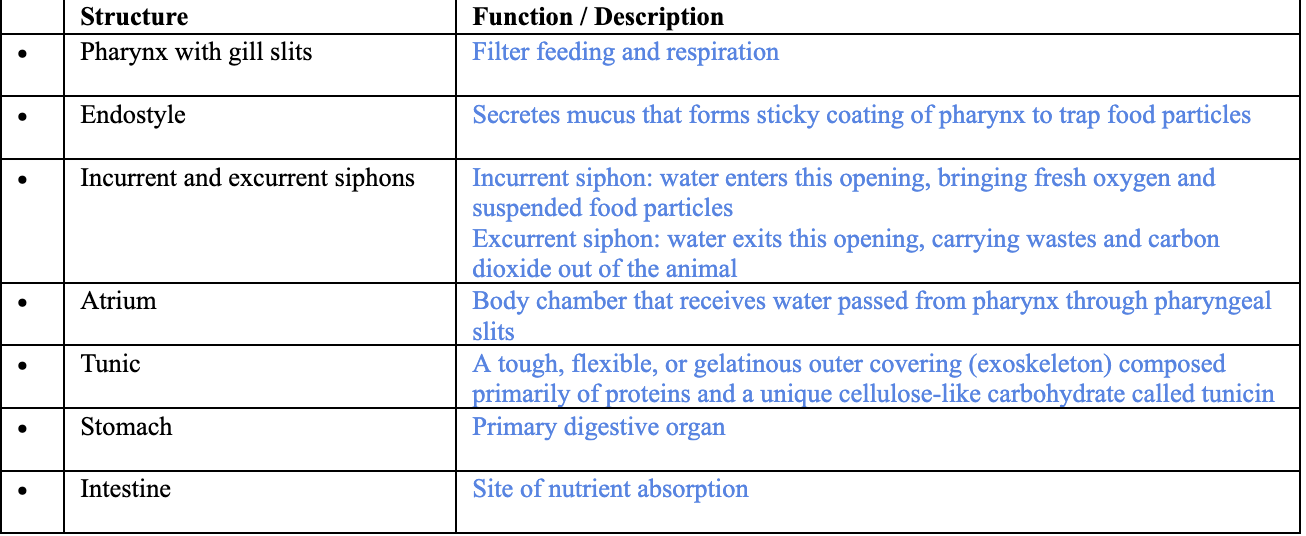
(Adult) Tunicate (clade, structures)
Clade Urochordata (Tunicata) within Clade Chordata
Not included in diagram: tunic
Describe the first chordates as recently understood by molecular data and fossil evidence
More recent fossil evidence and molecular data suggest that the sessile tunicates represent a derived body form and that free-swimming adult forms were the ancestral condition
Early chordates somewhat resembled the motile larvae of tunicates or the adults of modern cephalochordates, such as the lancelet
Describe the “protochordates,” i.e., lancelets and tunicates. What vertebrate features did they possess/lack?
They possessed some vertebrate characteristics, such as paired eyes and an enlarged brain, along with a notochord, pharynx, and dorsal nerve chord
Lacked a cranium, ears, and other important vertebrate characteristics
What are the vertebrate characteristics of Clade Vertebrata?
Bilateral symmetry
Well-developed head with a cranium
Closed circulatory system
Vertebral column encasing dorsal nerve cord
Chambered heart
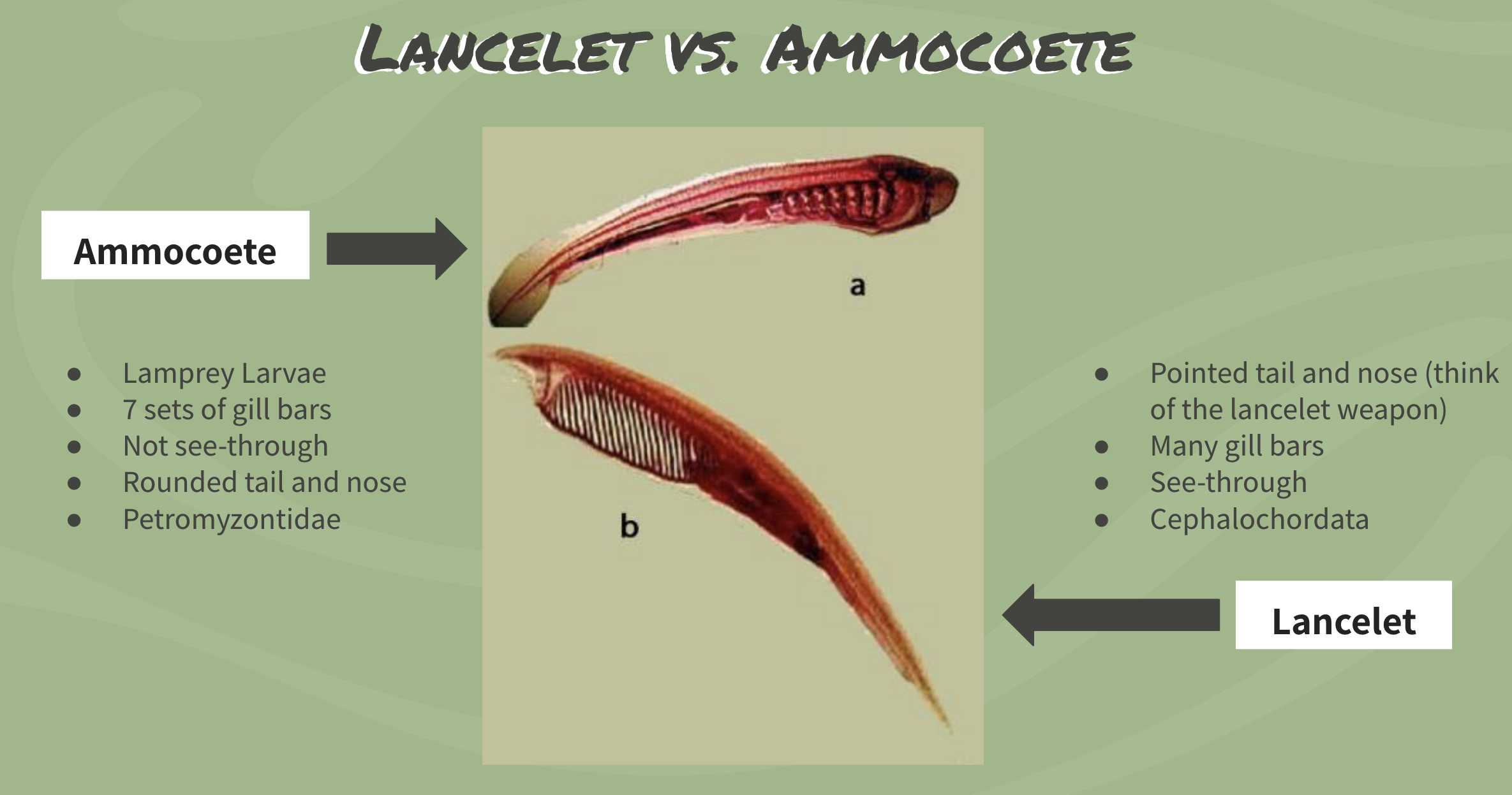
What are ammocoetes? How do they differ from their adult form?
Lamprey larvae
Anadromous vs catadromous
Anadromous and catadromous fish are types of diadromous fish (migrate between fresh and salt water to spawn)
Anadromous fish: (e.g., salmon) live in the ocean but spawn in freshwater
Catadromous fish: (e.g., eels) live in freshwater but spawn in the ocean
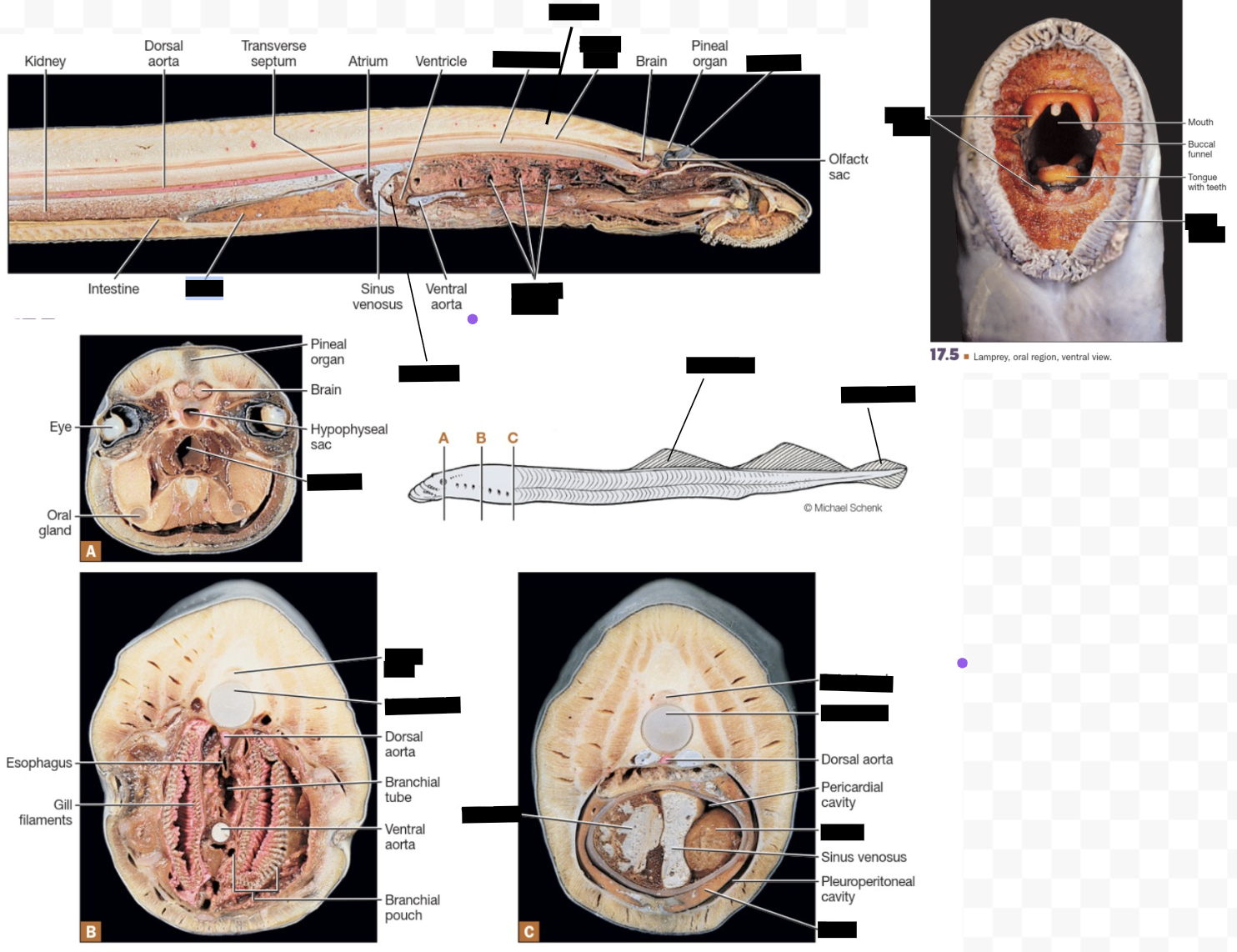
Lamprey (clade, structures)
Clade Petromyzontida within Clade Vertebrata within Clade Chordata
Not pictured in diagram: gonads
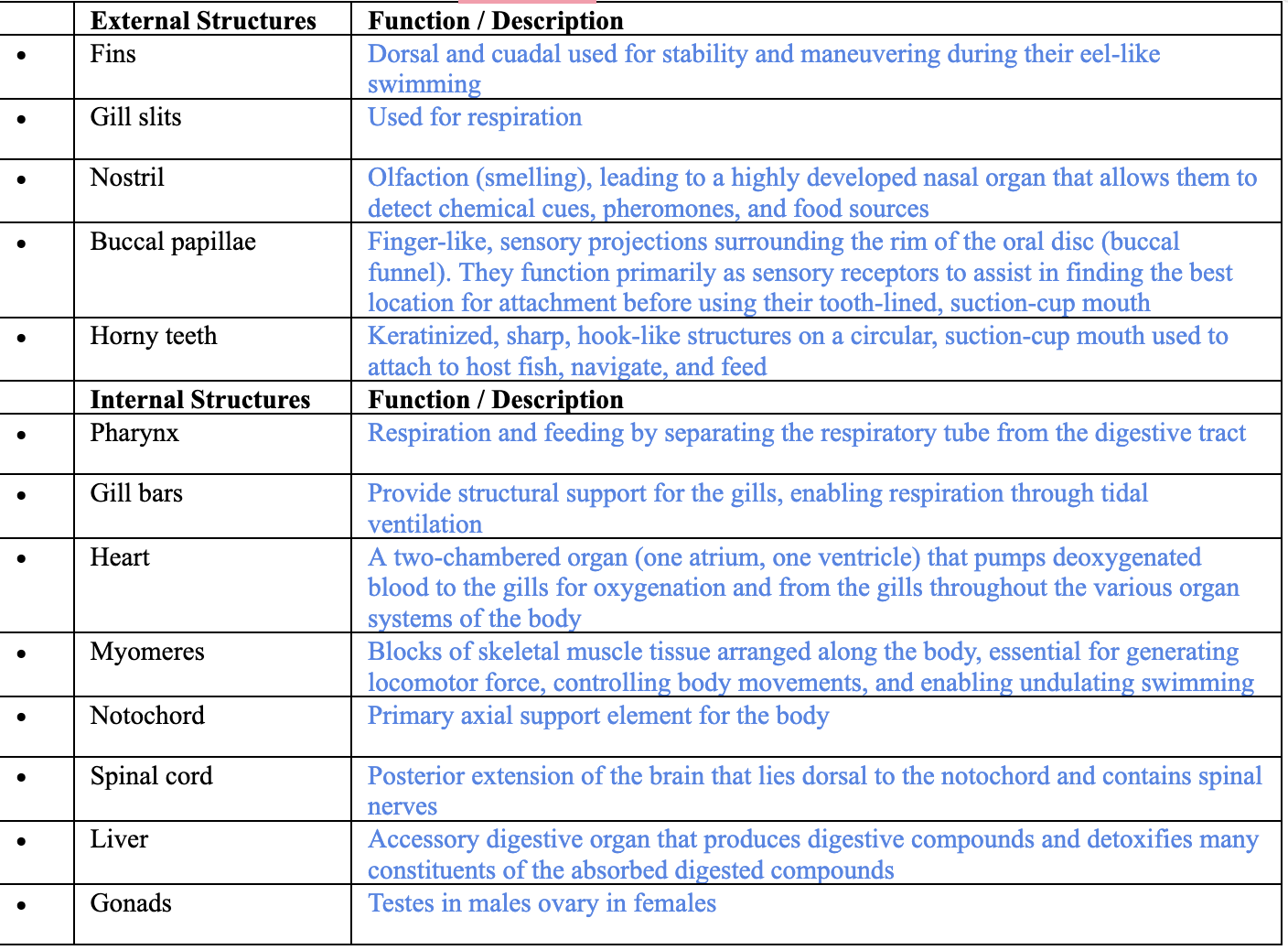
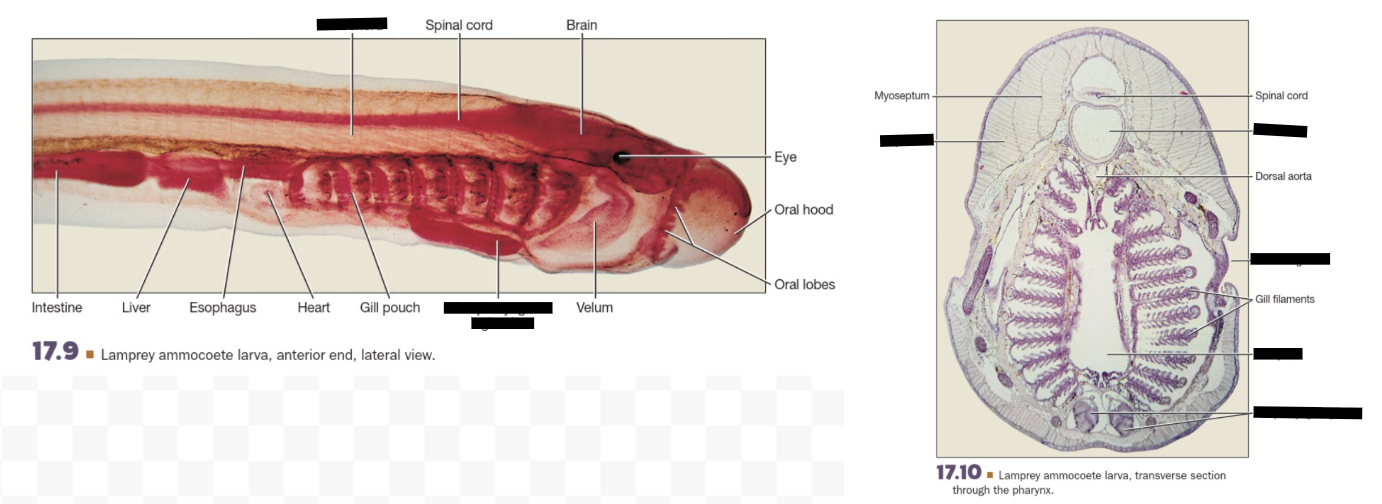
Ammocoete Larvae (clade, structures)
Clade Petromyzontida within Clade Vertebrata within Clade Chordata
Not shown in diagram: pharynx with gill slits
Central nervous system vs Peripheral nervous system
The central nervous system (CNS): consists of the brain and spinal cord, acting as the body's control center for processing information
The peripheral nervous system (PNS): includes all nerves outside the CNS, acting as a delivery system that connects the brain and spinal cord to limbs and organs
Cerebrum function (sheep brain)
Sensory, motor, integrative, and associative processing
Cerebellum function (sheep brain)
Balance and motor control
Medulla oblongata function (sheep brain)
Control of automatic functions (e.g., breathing, swallowing, heart rate)
Corpus callosum function (sheep brain)
Inter-hemispheric communication
Optic chiasma function (sheep brain)
Where optic nerves cross one another
Pituitary gland function (sheep brain)
Part of the endocrine system, NOT CNS. Secretes 6 hormones with direct and indirect effects
Hypothalamus function (sheep brain)
Link between the nervous and endocrine systems. Controls pituitary, homeostasis
Pons function (sheep brain)
Unites messages from cerebellum and cerebral cortex
Pineal body function (sheep brain)
Involved in biorhythms (e.g., growth stages like puberty)
Thalamus function (sheep brain)
Sensory integration and relay to cerebrum
Meninges function (sheep brain)
Protective covering
What type of skeleton do sharks have?
Cartilaginous skeleton: skeletons entirely made of cartilage and connective tissue, rather than bone, making them lighter, more flexible, and more buoyant
What is special about the jaws and teeth of sharks?
Their jaws are very strong, and their teeth are very sharp: sharks do not chew, but rather rely on ripping, sawing, and swallowing large, nutritious chunks of prey to survive.
What are the tooth-like placoid scales of sharks?
Tiny, V-shaped scales that cover shark skin, making it feel like sandpaper
What are the paired fins of sharks?
Pectoral fins and pelvic fins, located on either side of the body, provide essential control for lift, stability, steering, and braking
What is the fusiform body of sharks?
A streamlined, torpedo-like shape that is rounded and tapers at both ends, specifically adapted to minimize drag and turbulence, allowing them to glide efficiently through water
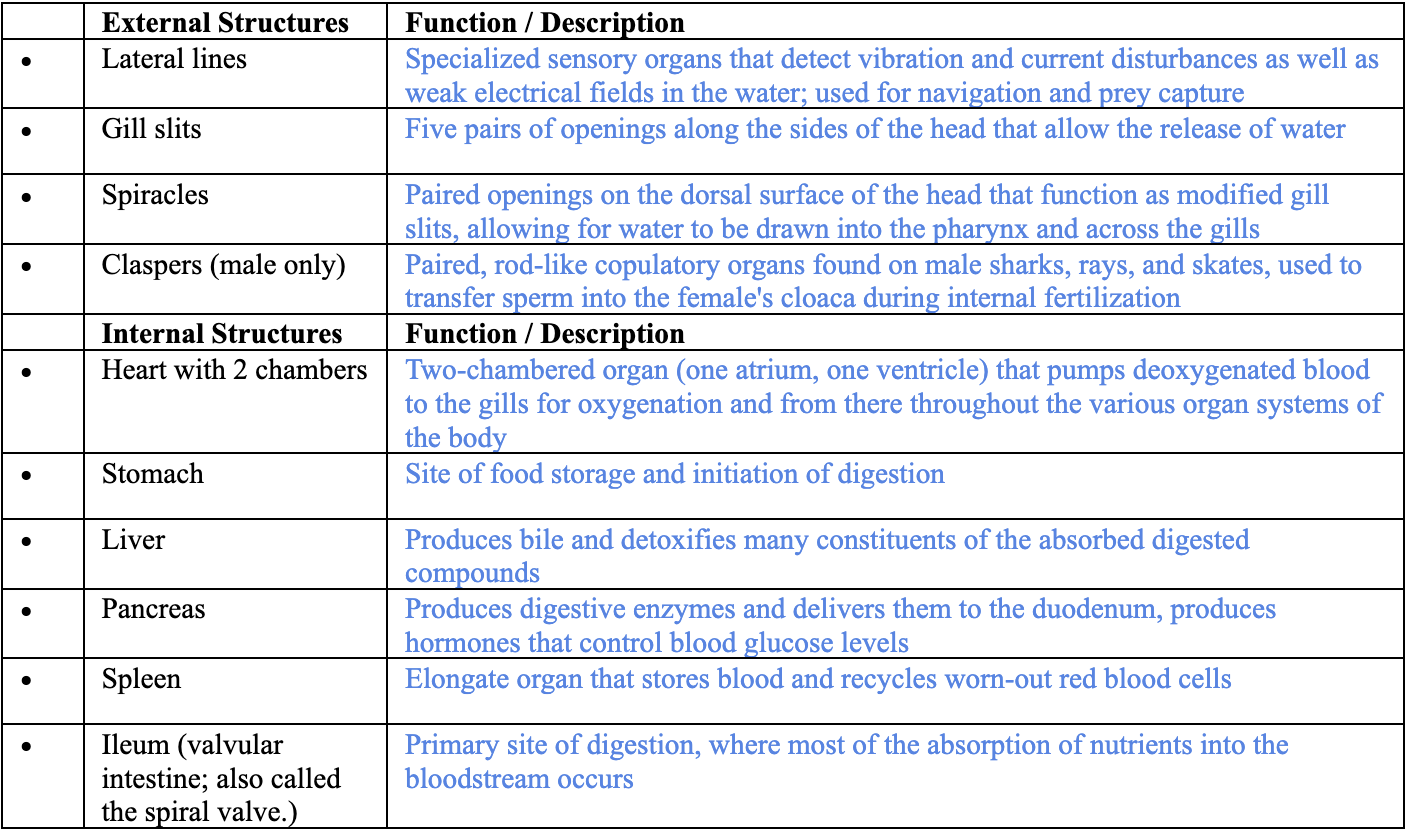
What well-developed sensory organs do sharks have?
Olfactory organs: dedicated solely to smelling
Lateral line system: a highly sensitive sensory system consisting of fluid-filled canals and pores running along the head and down both sides of the body. It detects minute vibrations, pressure changes, and water movement
Electroreceptors (ampullae of Lorenzini): detect weak electrical fields generated by prey, such as muscle movements and heartbeats
What is the heterocercal tail of sharks?
An asymmetrical caudal fin found in sharks where the vertebral column extends into the upper lobe, making it larger and longer than the lower lobe
This specialized structure provides essential upward lift to counteract the shark’s natural tendency to sink
Ram ventilation vs spiracles in sharks
Ram ventilation: involves swimming forward with an open mouth to force water over gills, necessary for active, pelagic species
Spiracles: openings behind the eyes, used by bottom-dwelling sharks to draw water in while resting
What is countershading in sharks?
A common form of camouflage in sharks where the dorsal (top) side is dark and the ventral (bottom) side is light
What clades within Agnatha do we need to know?
Clade Deuterostomia
Clade Chordata
Clade Vertebrata (Craniata)
“Agnatha” – jawless
Clade Cyclostomata – living jawless fishes (hagfishes, lampreys)
Clade Petromyzontida – lampreys
Clade Gnathostomata – animals with jaws
Clade Chondrichthyes – sharks, rays, chimaeras
Clade Osteichthyes – bony fish
Clade Actinopterygii – bony, ray-finned fishes
Clade Sarcopterygii – bony, lobe-finned fishes and tetrapods
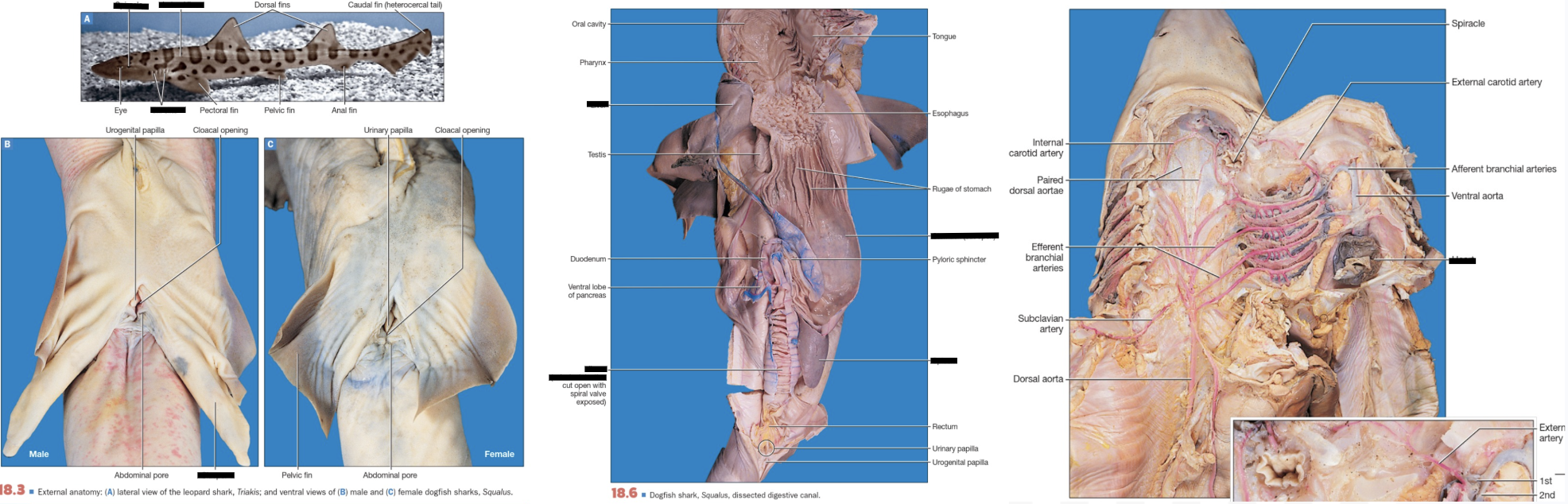
Shark (clade, structures)
Clade Chondrichthyes within Clade Vertebrata within Clade Chordata
Not pictured: pancreas attached at top of spleen
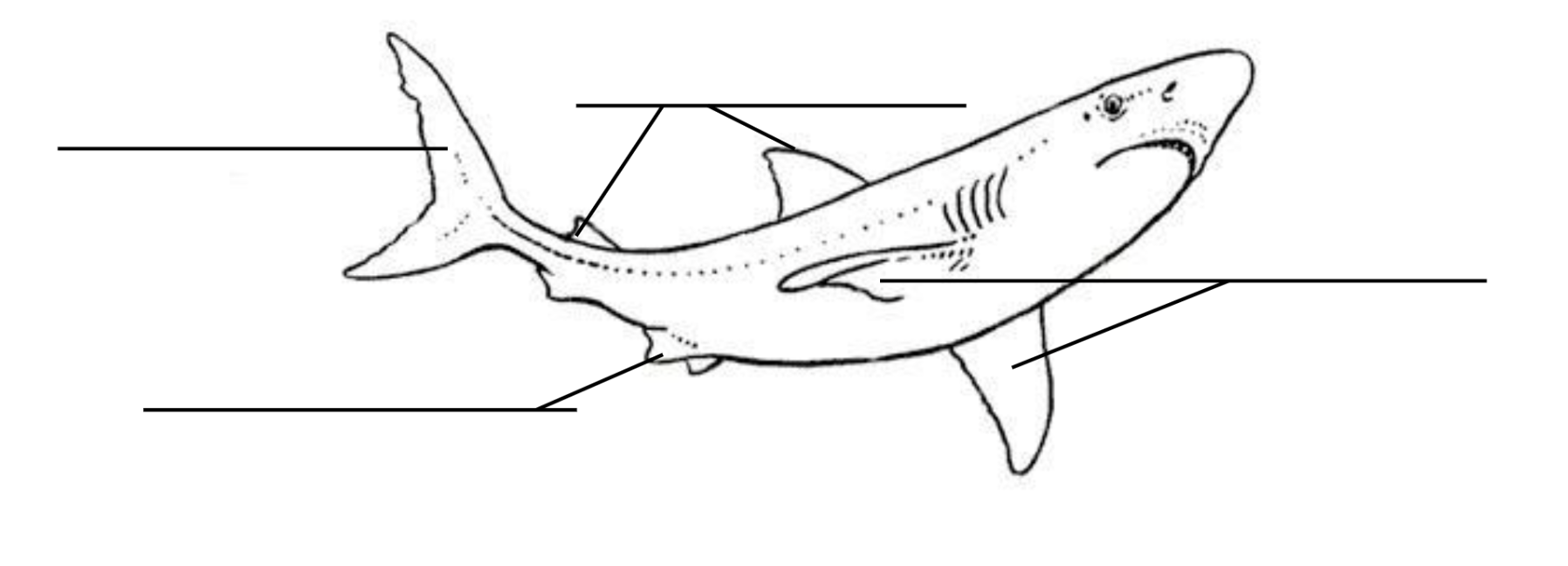
Identify the fins of a shark and the functions of each
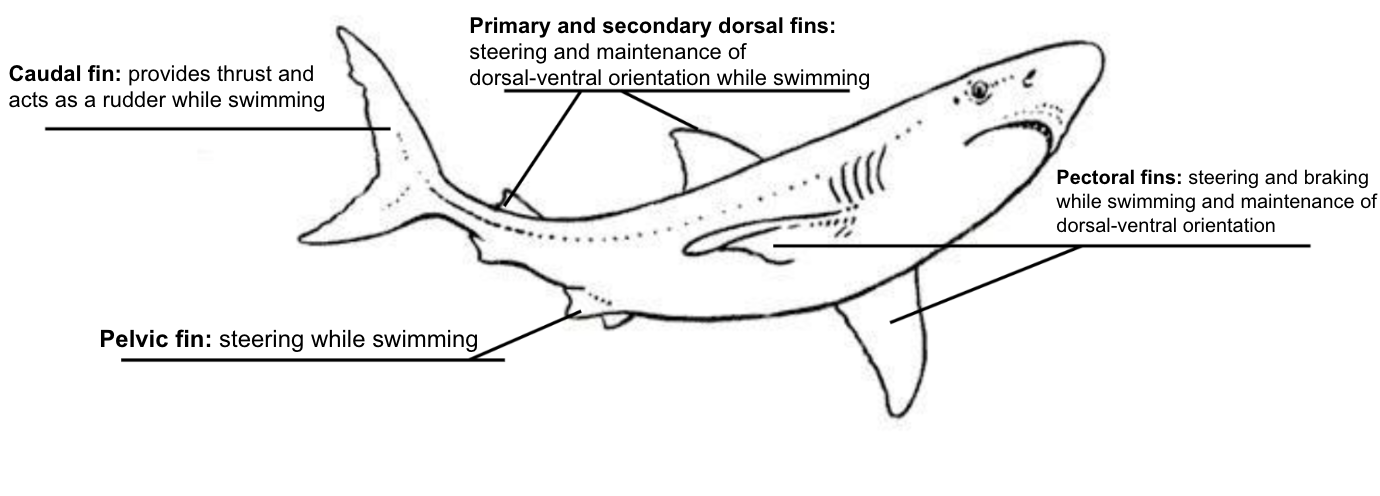
What are the adaptations of Clade Actinopterygii for life in water?
Gills: highly efficient
Operculum: a protective, bony flap covering the gill chamber, critical for respiration, working with the mouth to pump water across the gills
Swim bladder: a dorsal, gas-filled organ derived from the gut that primarily controls buoyancy, allowing fish to maintain neutral buoyancy at various depths without swimming
Paired fins supported by parallel bony rays: generally thin, webbed, and moved by muscles within the body wall
How does the endoskeleton of Actinopterygii differ from Chondrichthyes
Actinopterygii: possess a hardened, mineralized skeleton, bony opercula covering gills, and swim bladders
Chondrichthyes: have flexible cartilage skeletons, exposed gill slits, and lack true bone.
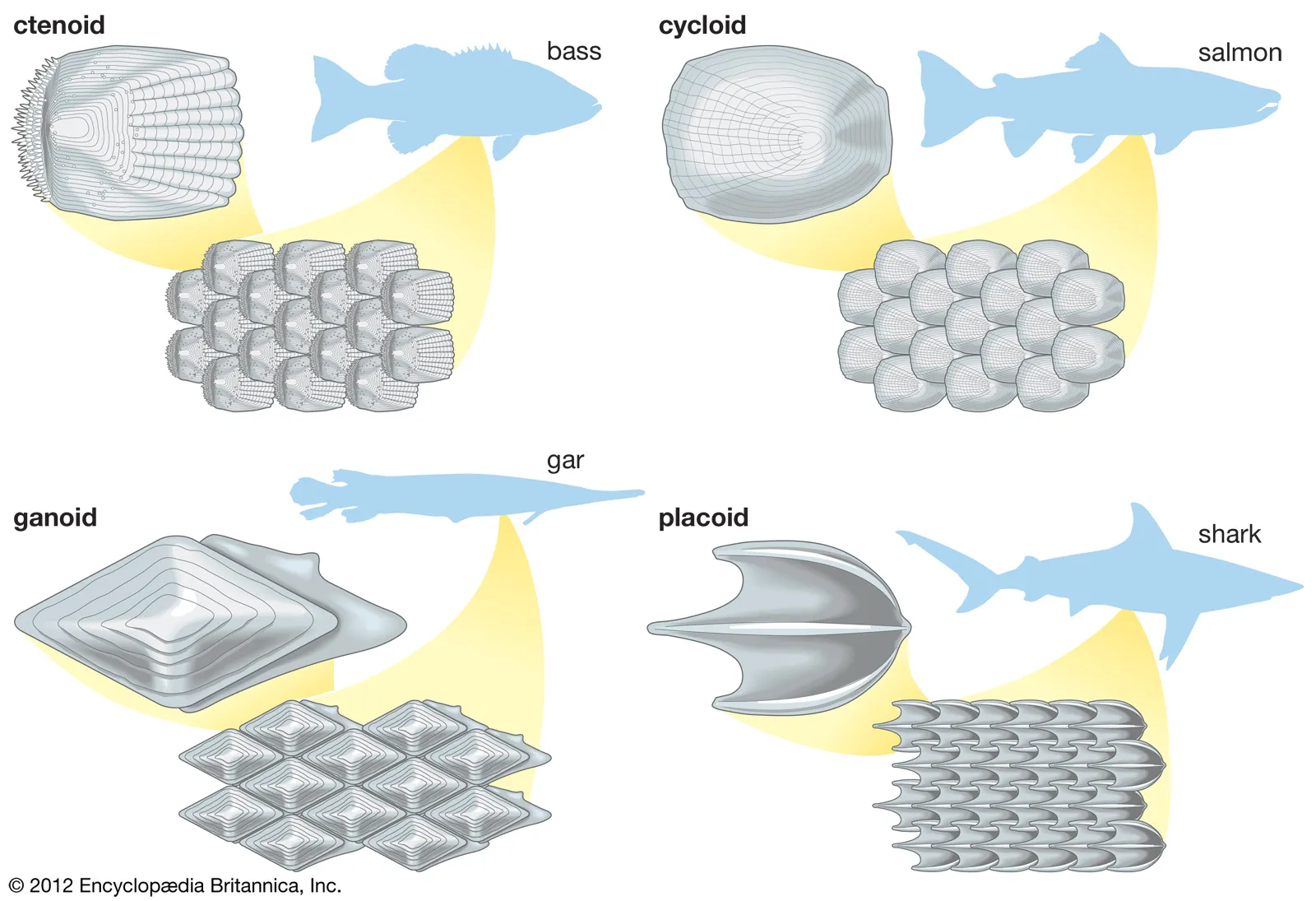
Ganoid vs overlapping cycloid vs ctenoid
Bony scales
Ganoid (ancestral condition): diamond-shaped, bony, and interlocking, offering armor-like protection for primitive fish
Overlapping cycloid and Ctenoid: overlapping, thin, and flexible, common in modern bony fishes
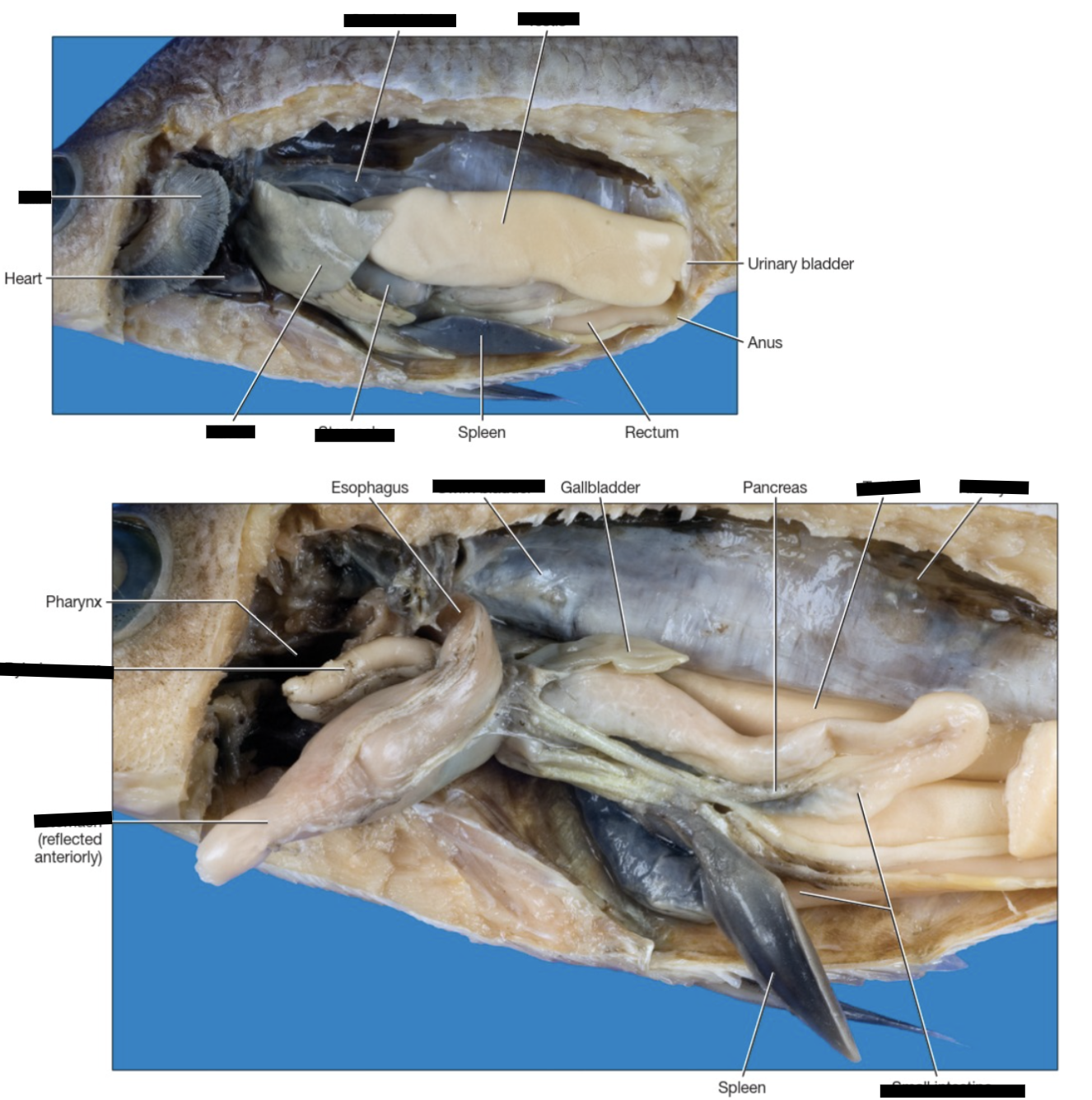
Perch (clade, structures)
Clade Actinopterygii within Clade Vertebrata within Clade Chordata
Not pictured: lateral line, gill operculum
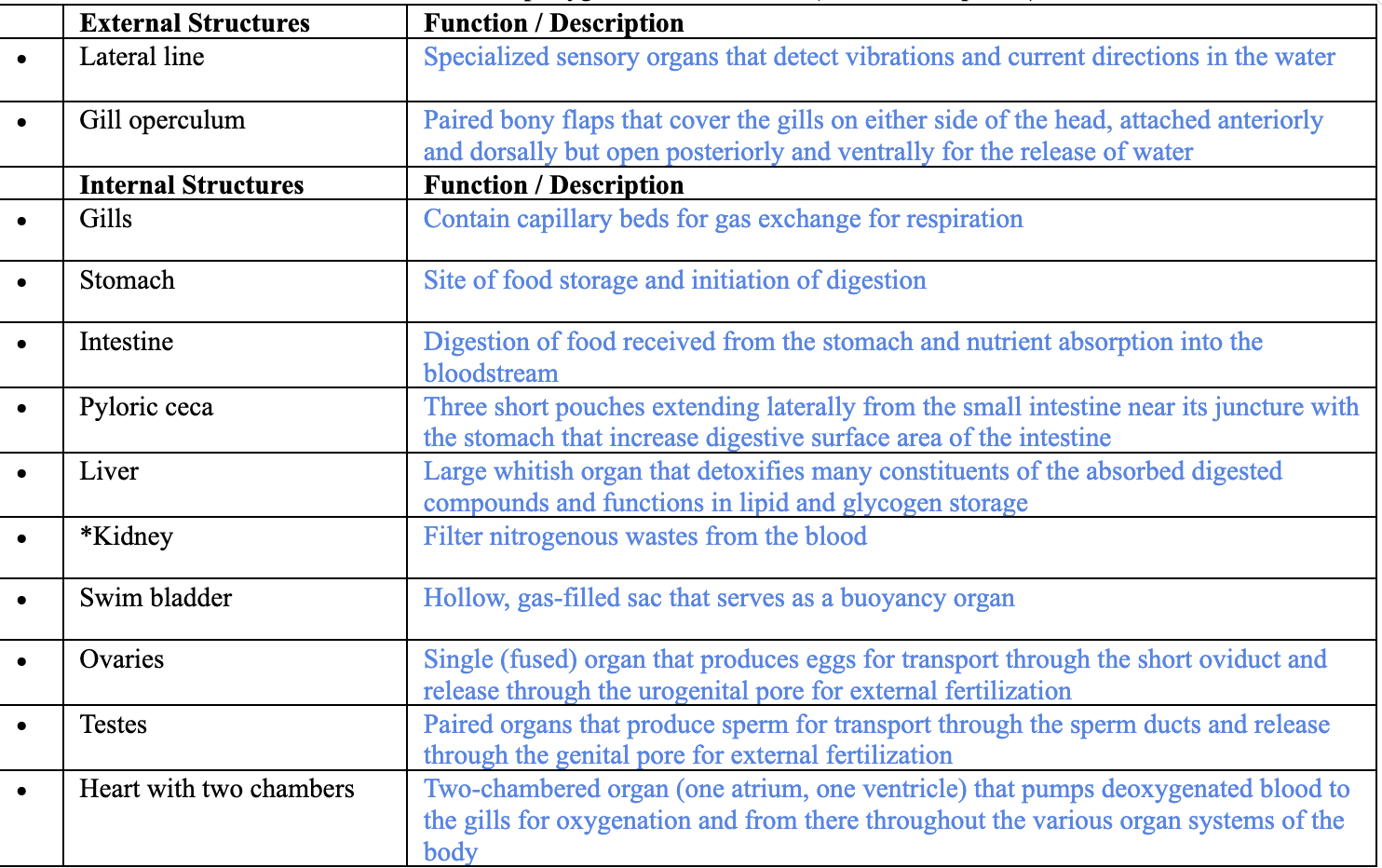
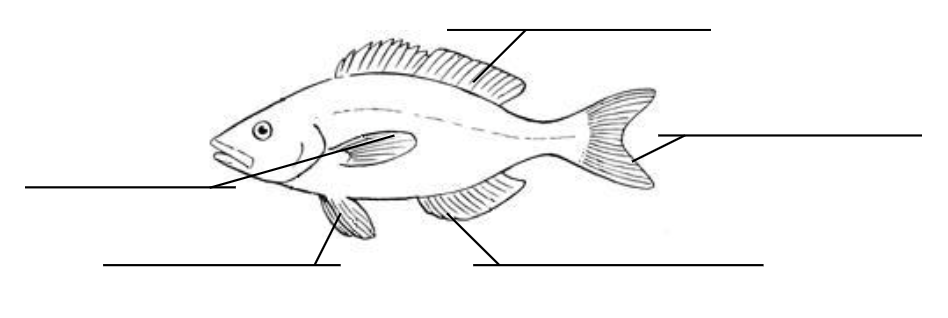
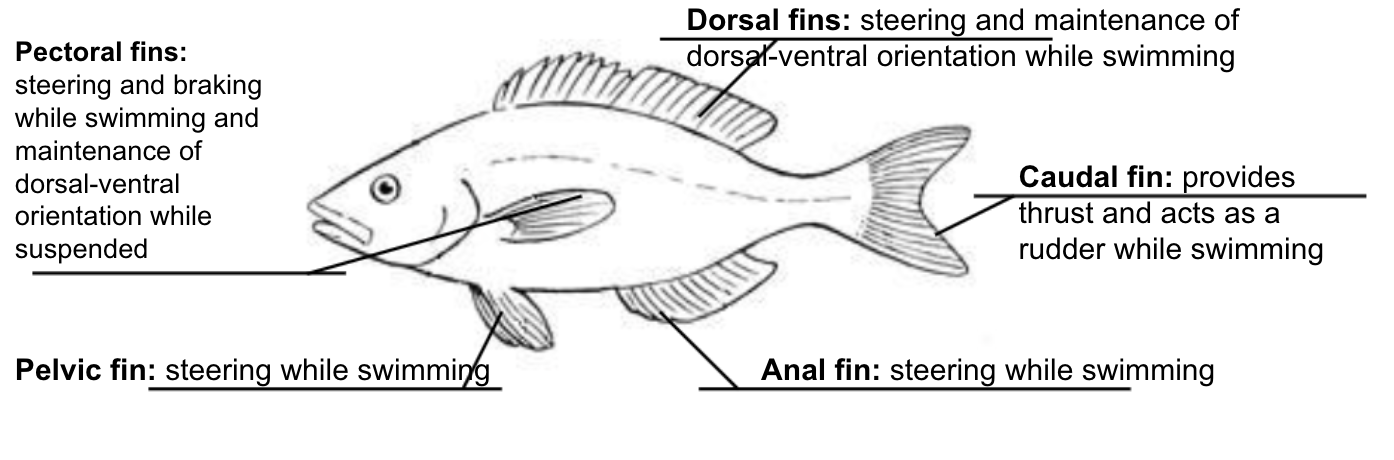
Identify the fins of a perch and each of their functions
Describe the first true vertebrates
Small, jawless, eel-like fish that lacked true bones and paired fins, instead possessing a cartilaginous notochord for structural support, early crania (skulls), and rudimentary vertebrae
Jaws and paired fins were major milestones in vertebrate evolution. What were the benefits of each?
Jaws: changes in jaw musculature and jaw suspension allowed rapid jaw protrusion and flaring of the opercula to create a highly sophisticated suction device for capturing prey
Paired fins: changes in the fins of bony fish increased stability, maneuverability, and speed
Given what you know about the function of the lateral line, how might it interact with various parts of the brain?
The lateral line interacts with various parts of the brain through a specialized central processing system, primarily through the hindbrain, midbrain, and forebrain
Research suggests that lungfishes are likely ancestors of all tetrapods. What physical characteristics did the early bony fishes have that would help them survive? Under what conditions would they be helpful? (come back to this)
Rudimentary lungs: paired air sacs that were connected to the back of the throat and could be inflated with air to regulate the fish’s buoyancy in the water column

