Umich Nursing Anatomy 210: Exam 3
 Call Kai
 Learn
Learn Practice Test
 Spaced Repetition
 Match
Match Flashcards
 Knowt Play
1/308

There's no tags or description
Looks like no tags are added yet.
Name | Mastery | Learn | Test | Matching | Spaced | Call with Kai |
|---|
No analytics yet
Send a link to your students to track their progress
309 Terms
What is blood?
A liquid connective tissue consisting of cells surrounded by plasma.
--> 55% blood plasma, 45% RBC, Buffy Coat
What are the three layers of spun blood?
Erythrocytes on the bottom, White blood cells and platelets in buffy coat in the middle, and plasma on top.
What are the cellular components of blood?
Red blood cells, white blood cells, and platelets.
What is plasma made from?
Water, proteins, and other solutes.
What are the functions of blood?
Transport oxygen, nutrients, and waste; regulate homeostasis and pH; protect against loss by clotting.
What is hemopoiesis?
The process of producing blood cells.
What kind of cells differentiate into different types of blood cells?
Pluripotent stem cells.
What are colony-stimulating factors?
Secreted glycoproteins that bind to receptor proteins on the surface of hemopoietic stem cells.
What can colony-stimulating factors cause
the cells to proliferate and differentiate into a specific kind of blood cells
What kind of colony-stimulating factor stimulates bone marrow to produce more of the particular white blood cell
exogenous colony stimulating factor
What protein do red blood cells produce?
Hemoglobin.
What does hemoglobin do?
Carries oxygen to cells and CO2 to the lungs.
What kind of ion does hemoglobin contain?
Iron ion.
How many iron ions are in hemoglobin?
Four; each molecule can bind to four oxygen molecules.
True or False: Red blood cells have no nucleus but have other organelles.
False; they have no nucleus or organelles.
What is the shape of red blood cells?
Biconcave discs.
Why are red blood cells this shape?
It allows them to carry more oxygen more efficiently.
What plasma membrane protein do red blood cells contain?
Spectrin.
What does spectrin allow?
Provides flexibility to change shape.
What does nitric oxide do in hemoglobin?
Regulates blood flow and blood pressure.
True or False: Nitric oxide causes vasodilation, which improves blood flow and exchanges oxygen
True.
What catalyzes the conversion of carbon dioxide to carbonic acid?
Carbonic anhydrase.
How long do red blood cells live?
120 days.
How are dead red blood cells removed from circulation?
Spleen and liver.
Where does erythropoiesis begin?
red bone marrow
What is hypoxia
lowered oxygen concentration
where is erythropoietin produced
kidneys
What does erythropoietin do?
Stimulates differentiation of hematopoietic stem cells into erythrocytes.
What are reticulocytes?
Immature red blood cells.
How long does it take for reticulocytes to mature?
1-2 days.
What does artificial EPO allow?
Increases stamina performance and can cause blood to clot, leading to stroke or heart failure.
What are most erythrocytes classified as?
Anemia.
What is anemia?
Blood abnormally low in oxygen-carrying capacity due to low red blood cell count or hemoglobin.
True or False: Sickle cell disease is a genetic anemia.
True.
What causes red blood cells to sickle?
Hemoglobin S (HbS).
What is the most common type of anemia?
Iron deficiency anemia, which is caused by blood loss and low iron intake
True or False: White blood cells contain a nucleus and organelles.
True, but they do not contain hemoglobin.
How are leukocytes classified?
Granular and agranular.
What do granular leukocytes contain?
Vesicles that appear when the cells are stained.
What WBCs are considered granular?
Neutrophils, eosinophils, and basophils.
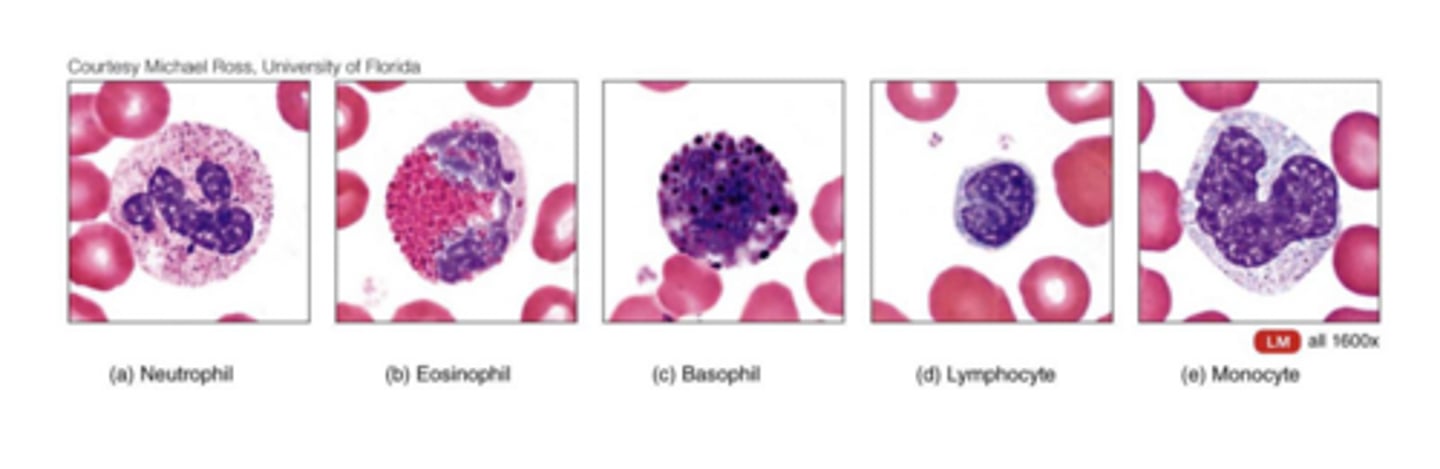
What WBCs are considered agranular?
Lymphocytes and monocytes.
How long do WBCs live?
Several months to years.
What do WBCs do?
Combat invading microbes.
What is it called when WBCs leave the bloodstream?
Diapedesis or emigration.
What does an increase in WBC indicate?
An infection or inflammation.
What does a differential WBC count measure?
Percentage of each WBC to determine if a problem exists.
True or False: Leukocytosis is a low WBC count.
False; it is a high WBC count.
What is leukemia?
A cancerous condition involving overproduction of abnormal WBCs.
What are megakaryocytes?
Red bone marrow cells that splinter into 2000-3000 fragments to make platelets.
What hormone makes hemopoietic stem cells differentiate into megakaryocytes?
Thrombopoietin.
What are platelets used for?
To clot the blood.
What is hemostasis?
Sequence of responses to stop bleeding.
What are the steps of hemostasis?
Vascular spasm, platelet plug formation, and blood clotting (coagulation).
What happens when the platelet plug gets activated?
Platelets swell, become spiked and sticky, and release chemical messengers.
What chemical messengers are used in the platelet plug?
ADP, serotonin, and thromboxane A2.
What does ADP do in the platelet plug?
Causes more platelets to stick.
What do serotonin and thromboxane A2 do in the platelet plug?
Enhance vascular spasm and platelet aggregation.
True or False: The platelet plug is negative feedback.
False; it is positive feedback.
How is blood clotting activated?
Extrinsic and intrinsic pathways.
What do both the extrinsic and intrinsic pathways lead to?
The formation of prothrombinase.
What is the intrinsic pathway?
Clotting factors are activated within the blood.
What is the extrinsic pathway?
Clotting factors are activated in tissues located outside blood.
What triggers the extrinsic pathway?
Exposure to tissue factor.
What is phase 2 of the coagulation pathway?
Transformation of prothrombin into the active enzyme thrombin.
What is phase 3 of coagulation?
Common pathway to the fibrin mesh.
How many clotting factors are there?
12.
True or False: Once a clot forms, it tightens to pull the edges of the damaged vessel together.
True.
What is the process where clots are removed after repair is completed?
Fibrinolysis.
What is plasminogen?
Plasma protein that is trapped in a clot.
What is plasminogen converted to?
Plasmin, a fibrin-digesting enzyme.
What enzyme gets rid of unwanted small clots?
Plasmin.
What is a thrombus?
A clot that develops and persists in unbroken blood vessels, potentially blocking circulation.
What is an embolus?
A thrombus that is freely floating in the bloodstream.
What is thrombocytopenia?
Deficient number of circulating platelets causing spontaneous hemorrhage.
How many known blood groups are there?
100.
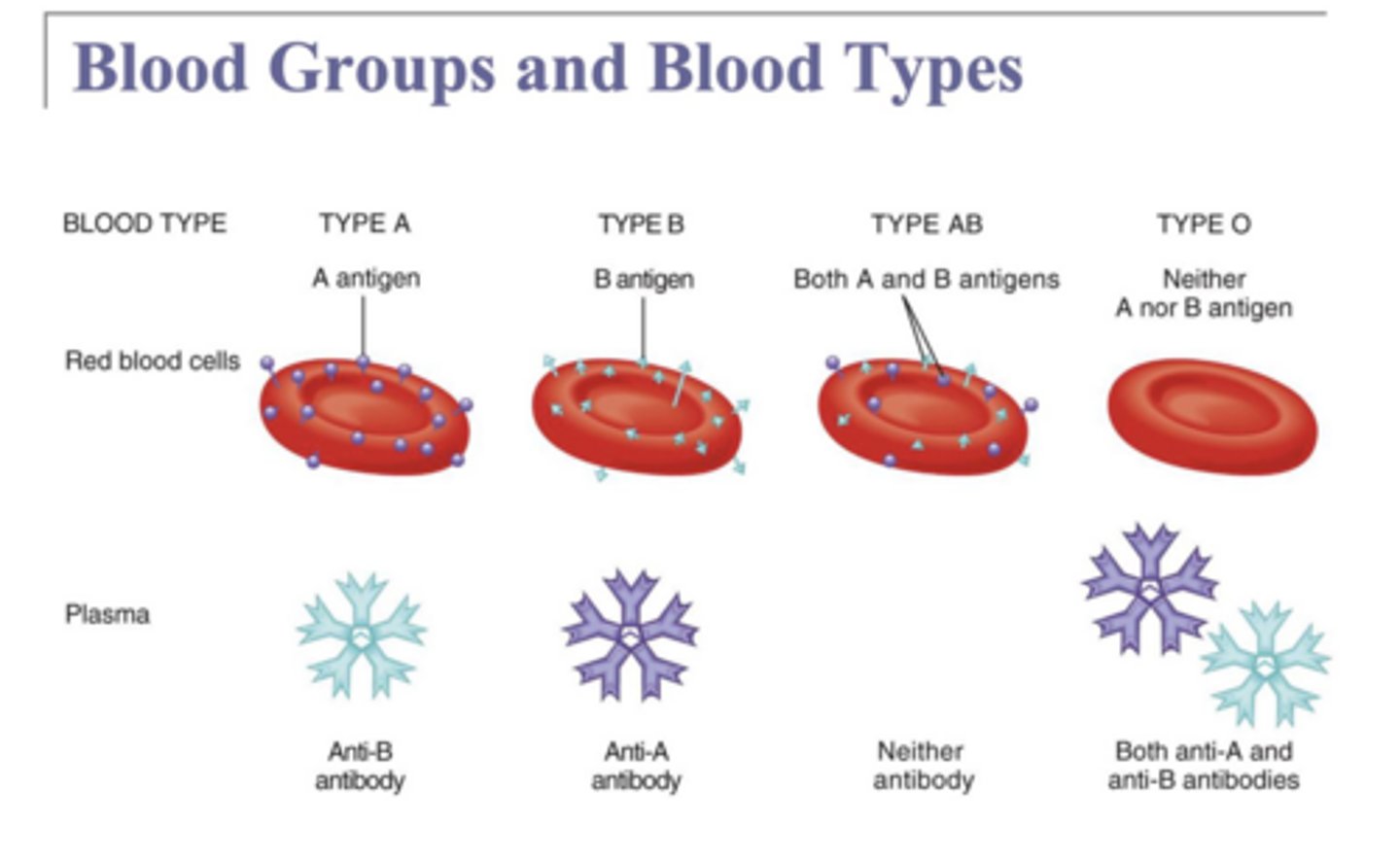
How is blood characterized into different blood groups?
By the presence or absence of glycoprotein antigens on the surface of red blood cells.
What are the ABO classifications?
A, B, AB, O.
What percentage of humans have the Rh factor?
85%.
What does Rh indicate?
Presence of D antigen on RBC surface.
What is blood type determined by?
Antigens on the surface of RBC.
What are antibodies?
Proteins in plasma that attack foreign antigens, resulting in agglutination or hemolysis.
Where is the heart located?
In the mediastinum.
What encloses the heart and holds it in place?
Pericardium.
What are the two layers of the pericardium?
Outer fibrous pericardium and inner serous pericardium.
What are the two layers of the serous pericardium?
Visceral and parietal.
What separates the visceral and parietal layers?
Serous cavity (fluid-filled space).
What are the three layers of the heart?
Epicardium, myocardium, and endocardium.
What are the four chambers of the heart?
Two upper atria and two lower ventricles.
Where does the right atrium receive blood from?
Superior vena cava, inferior vena cava, and coronary sinus.
Where does the right ventricle receive blood from?
From the right atrium; sends blood to the lungs.
Where does the left atrium receive blood from?
Pulmonary veins.
Where does the left ventricle receive blood from?
From the left atrium; sends blood all over the body.
Why is the wall of the left ventricle thicker than the right?
It deals with more pressure due to oxygenated blood.
How do heart valves affect blood flow?
They ensure unidirectional blood flow through the heart.
How do the valves open and close?
Through pressure changes.
What are the two major types of valves in the heart?
Atrioventricular valves and semilunar valves.
What do the atrioventricular valves do?
prevent backflow from the ventricles into the atria
What do the semilunar valves do?
Prevent backflow from the arteries into the ventricles.
What are the two atrioventricular valves called?
Tricuspid (right AV valve) and Bicuspid (left AV valve or Mitral valve).
What is the chordae tendineae?
Anchors cusps of AV valves to papillary muscles.

