Electrical Stimulation
 Call Kai
 Learn
Learn Practice Test
 Spaced Repetition
 Match
Match Flashcards
 Knowt Play
1/92

There's no tags or description
Looks like no tags are added yet.
Name | Mastery | Learn | Test | Matching | Spaced | Call with Kai |
|---|
No analytics yet
Send a link to your students to track their progress
93 Terms
How does electricity produce therapeutic effects?
depolarizes nerve membranes and produces action potentials
How many sodium ions exit the cell during resting potential?
3
How many potassium ions enter the cell during resting membrane potential?
2
The charge on the inside of the cell is slightly NEGATIVE/POSITIVE during resting membrane potential.
negative
The charge on the outside of the cell is slightly NEGATIVE/POSITIVE during resting membrane potential.
positive
What is the resting membrane potential value (mV)?
-70
What is the threshold value to start an action potential (mV)?
-55
The process during the action potential when sodium is rushing into the cell causing the interior to become more positive.
depolarization
period during which potassium ions diffuse out of the neuron
repolarization
a period of inactivity after a neuron has fired
refractory period
these types of nerve fibers have the lowest pulse duration in the strength-duration curve
A-beta sensory
these types of fibers have the longest pulse duration in the strength-duration curve
denervated muscle
Order of fibers from shortest to longest pulse duration in the strength-duration curve
A-beta sensory
Motor
A-gamma sharp pain
C dull pain
Denervated muscle
T/F: A-gamma sharp pain fibers have a shorter pulse duration than motor nerves.
false
T/F: C dull pain nerve fibers have a longer pulse-duration than A-gamma sharp pain fibers.
true
rheobase
the minimum current amplitude with very long pulse duration to produce an action potential
chronaxie
minimum duration it takes at twice rheobase to produce an action potential
usually considered the most comfortable setting for patients
Action potentials occur in ONE/BOTH direction(s) physiologically.
one
Action potentials occur in ONE/BOTH direction(s) if stimulated electrically.
both
NMES (neuromuscular electrical stimulation) is associated with what type of muscle
innervated muscle
EM (electrical muscular stimulation) is associated with what type of muscle
denervated muscle; higher amplitude
What muscle type is recruited first with electrical stimulation?
type II
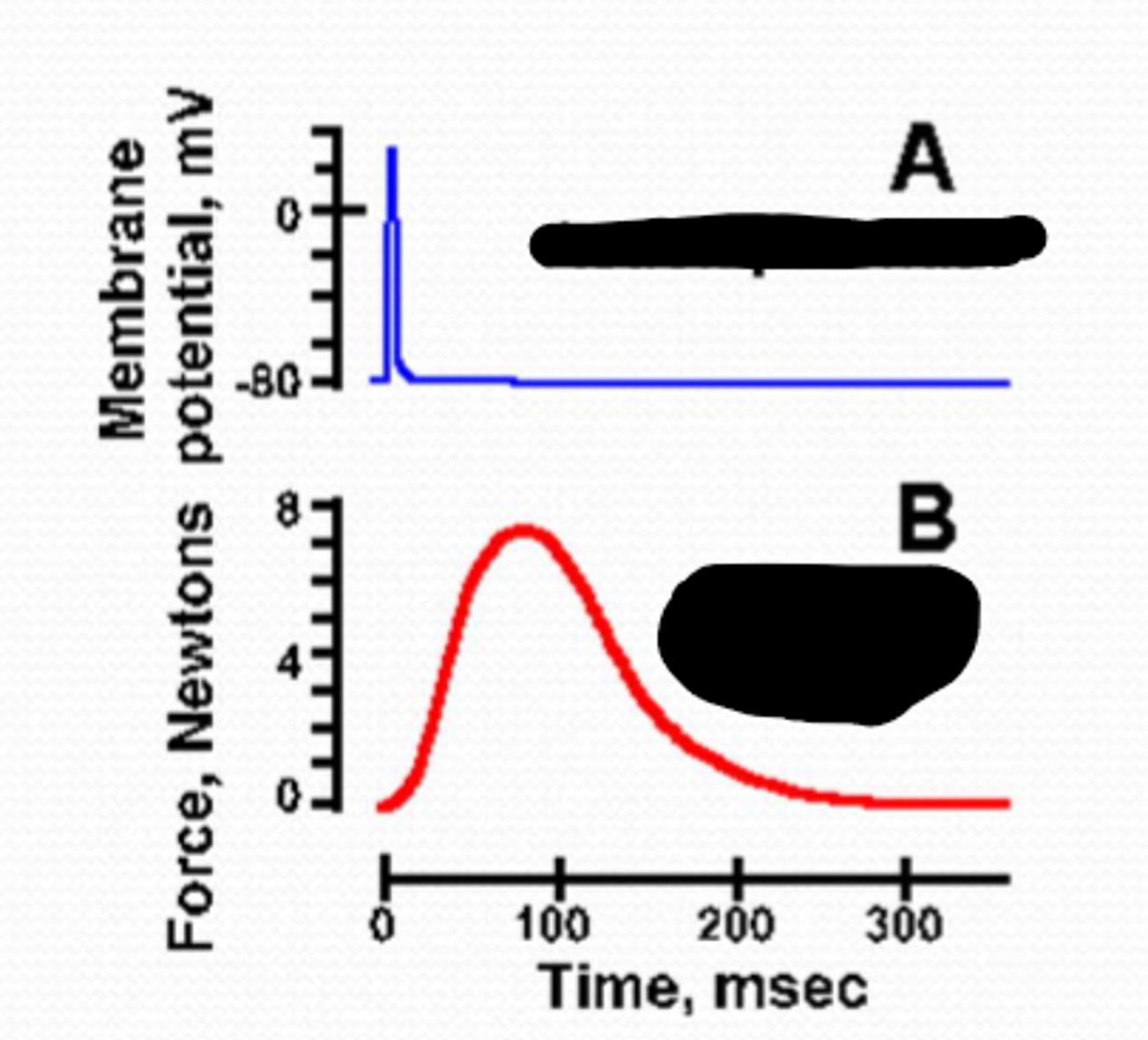
Label A.
action potential
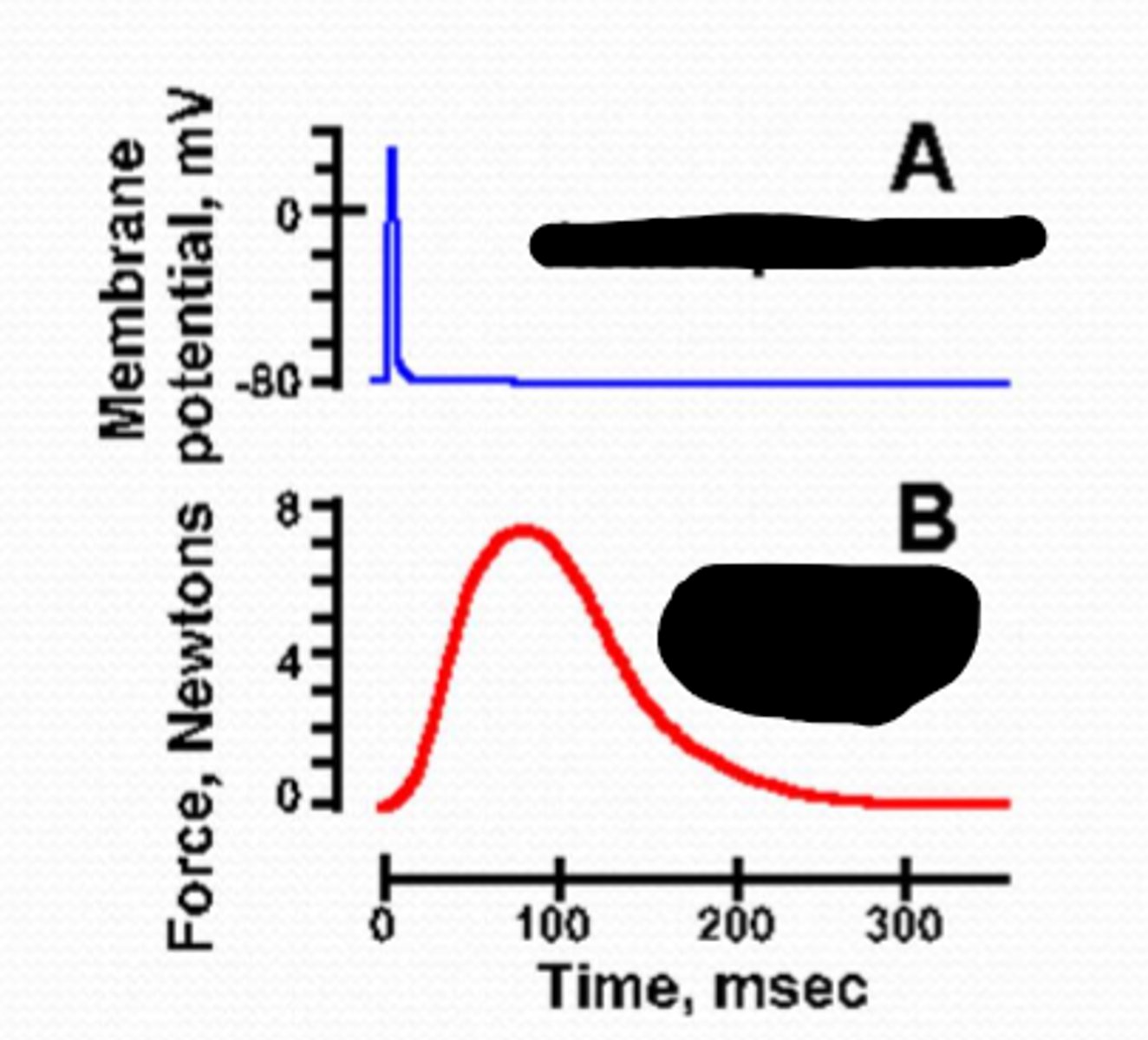
Label B.
isometric twitch
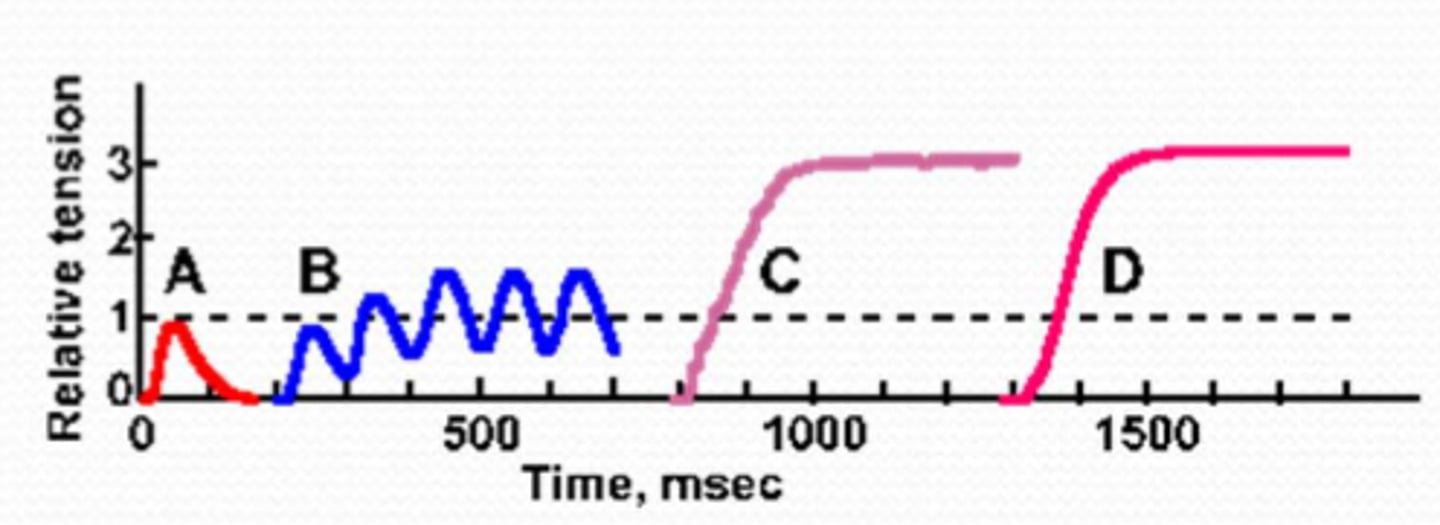
C and D are considered what?
Tetanus
neuropraxia
local nerve conduction block due to mild compressive forces
may involve local demyelination or the arm going to sleep
axonotmesis
axon and myeline sheath disintegrate but endoneurial sheath intact due to severe compression of nerve
example - spinal nerve root compression via herniated nucleus pulposus
neurotmesis
loss of axonal and connective tissue continuity due to stretch or severance of nerve
Wallerian degeneration
degeneration of the peripheral nerve, specifically the nodes of Ranvier
Denervation - Regeneration
Schwann cells proliferate
Growth tip (cone) forms
Axons elongate
Axon guided by Schwann cells to target muscle
Axon connects to target muscle
What is the daily rate of regeneration for nerves?
1-2 mm
What is the rate of generation of nerves in a month?
1 inch
electric charge
positive or negative charge
protons
positive charges
electrons
negative charges
electricity
difference in the number of electrons at two points
electromagnetic force
potential difference or voltage
magnitude of the attraction or driving force behind the electrons
current
electrons flowing in an attempt to equalize the difference in charges
the movement of charge particles through a conductor
flow will be in the pathway of least resistance
1 ampere = what
movement of 1 coulomb of charge past ay point in one second
Current flow in a battery moves from the POSITIVE/NEGATIVE pole to the POSITIVE/NEGATIVE pole.
negative, positive
cathode
negative pole of the battery
has high electron concentration
anode
positive pole of the battery
has low electron concentration
cation
positively charged particles
anion
negatively charged particles
voltage
change in electrical potential energy between 2 points
driving force that makes charged particles move, also referred to as the electromotive force of EMF
conductors
charged particles move readily
What are examples of good conductors within the body
biological tissues and Na+, K+, and Cl-
insulators
substances where there is limited movement of charged particles
What are examples of good insulators within the body
Skin and fat
direct current
galvanic
continuous, uninterrupted flow of electrons (1 second)
alternating current
sinusoidal
continuous or bidirectional flow of electrons
expressed n Hz or cycles per second
pulsed current
the flow of the current starts and stops
may be monophasic or biphasic, electrical current delivered discontinuously
periods of pulsing followed by periods where no current is flowing (usually off longer that it is on)
may be unidirectional or bidirectional
amplitude
magnitude of the current or intensity or strength
intensity - stimulus high enough to effect depolarization of membrane
measured in amperes and volts
frequency
RATE
number of cycles or pulses per second (pps)
measured in Hz
duration
consists of pulse and phase
pulse duration (red)
pulse width
may involve multiple phases
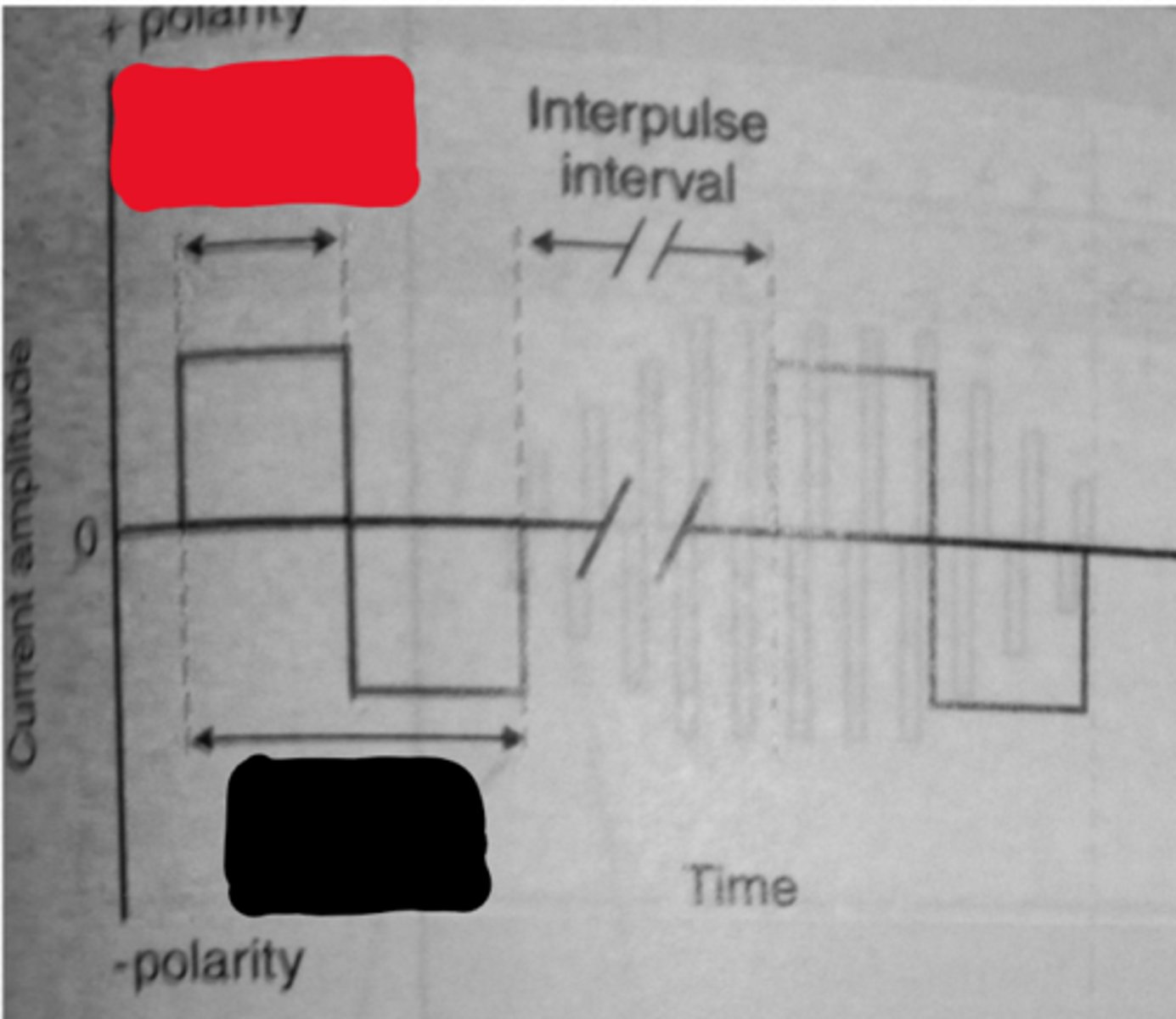
phase duration (black)
equal to pulse in monophasic wave forms
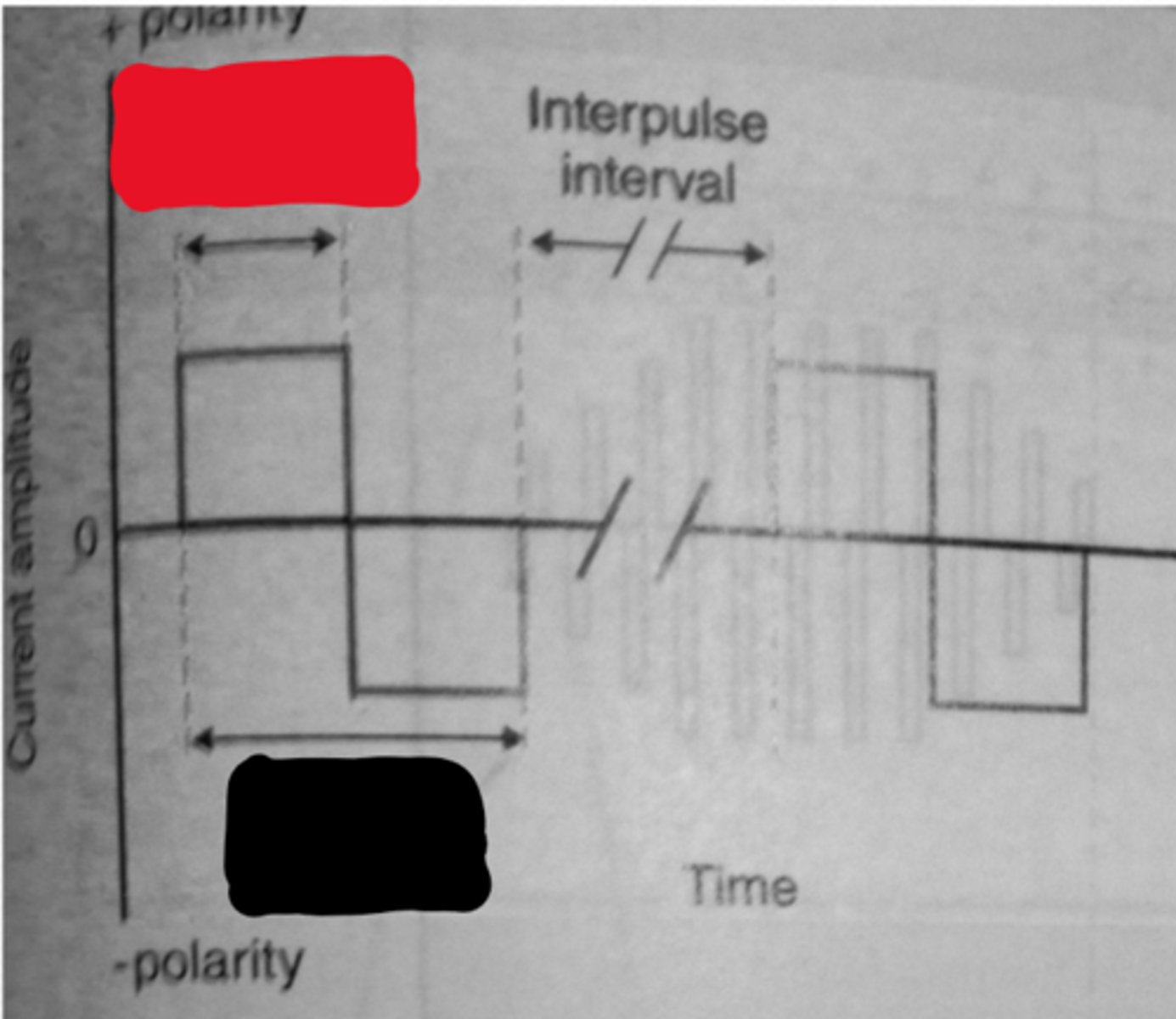
List 5 contraindications for electrical stimulation.
cardiac pacemaker
unstable arrhythmias
over carotid sinus
over arterial or venous thrombosis
pregnancy
List the 6 precautions for electrical stimulation.
cardiac disease
impaired mentation
impaired sensation
tumors
skin irritation
open wounds
iontophoresis current
anti-inflammatory is produced in a liquid form (typically dexamethasone)
Does dexamethasone have a slightly positive or negative charge?
negative
___cc placed on the electrode of the same charge for iontophoresis.
2
What are the typical parameters for iontophoresis (include intensity and duration)?
1-4 mA for 40 mA/min
iterferential current
1000-10,000 Hz
two circuits with 2 different carrier frequencies
beat frequency = carrier frequency 1 - carrier frequency 2
increased comfort
may stimulate wider and deeper area
premodulated current
single circuit, same waveform
used for topical/more superficial pain relief
Russian protocol
intended for quad recruitment
____ Hz frequency in 10 ms long burst for Russian protocol
2500
___ bursts per second with a 10 ms interburst interval for Russian protocol.
50
What are the two types of monophasic currents
Monophasic (MPC)
High volt (HVPC)
biphasic
symmetrical and asymmetrical (balanced and unbalanced)
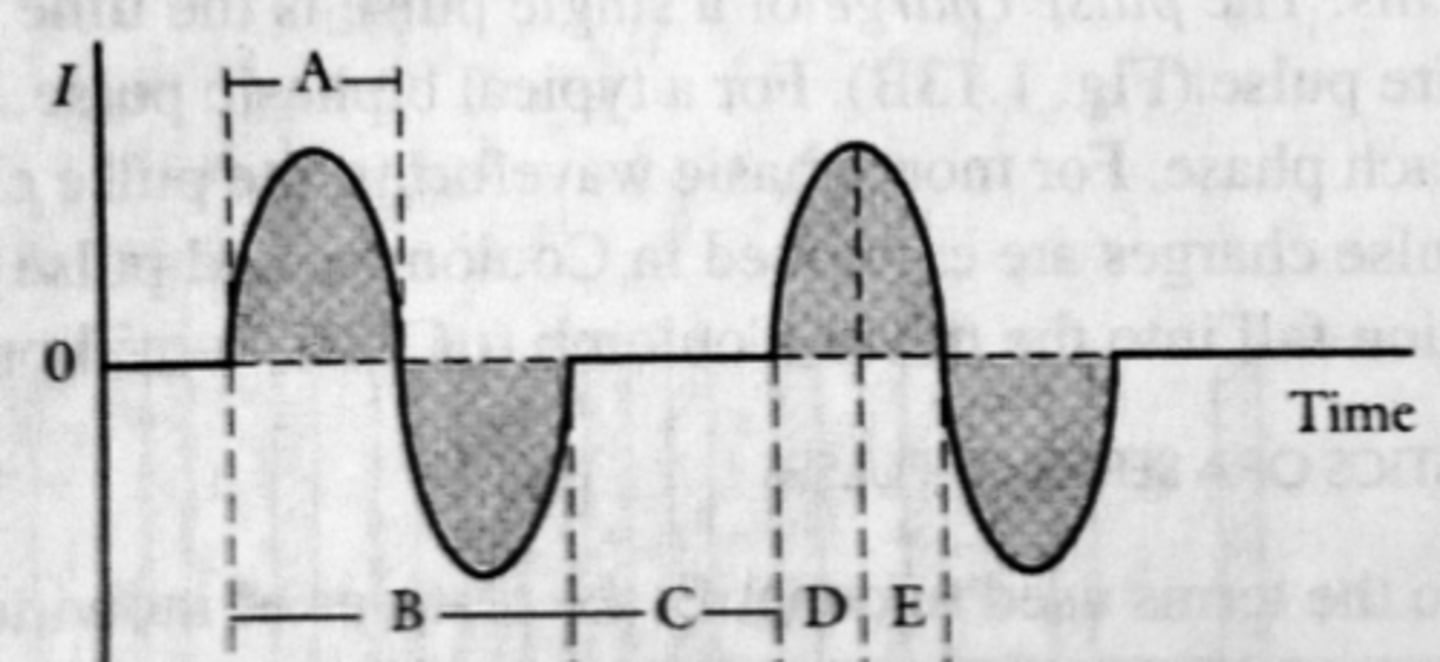
Label C.
interpulse interval
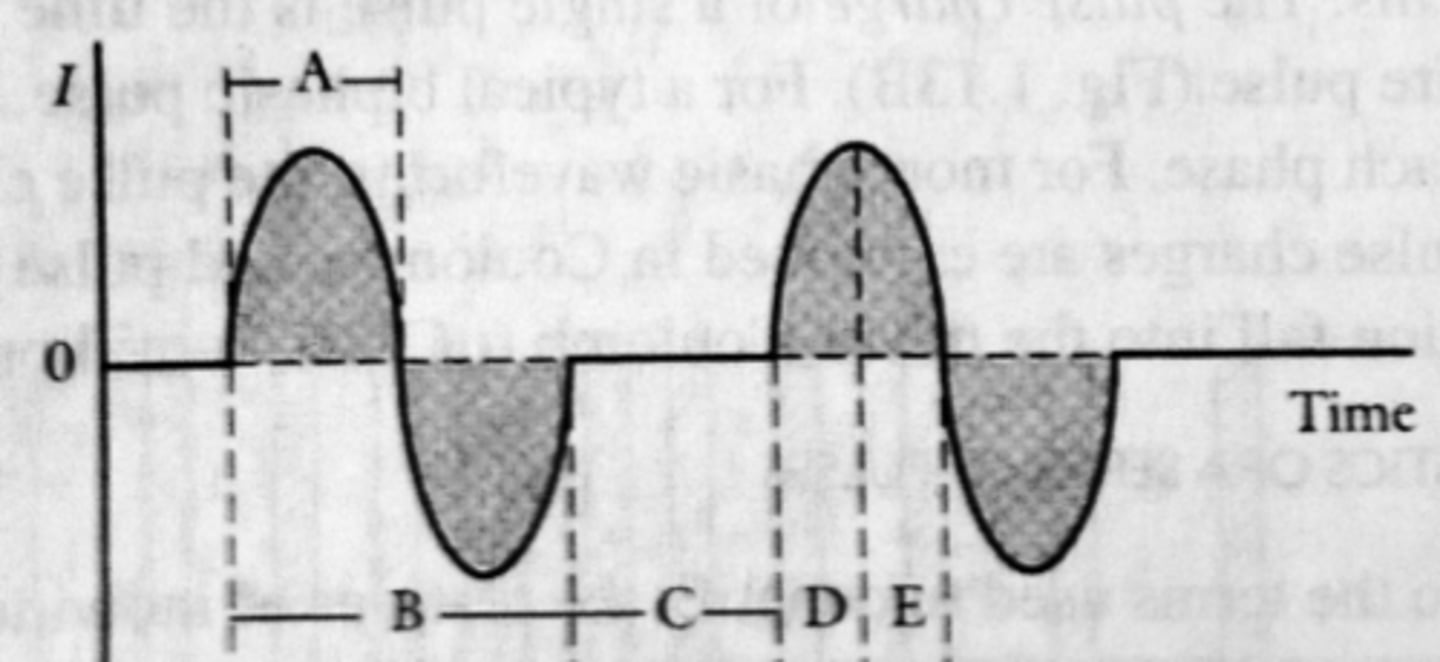
Label D.
rise time
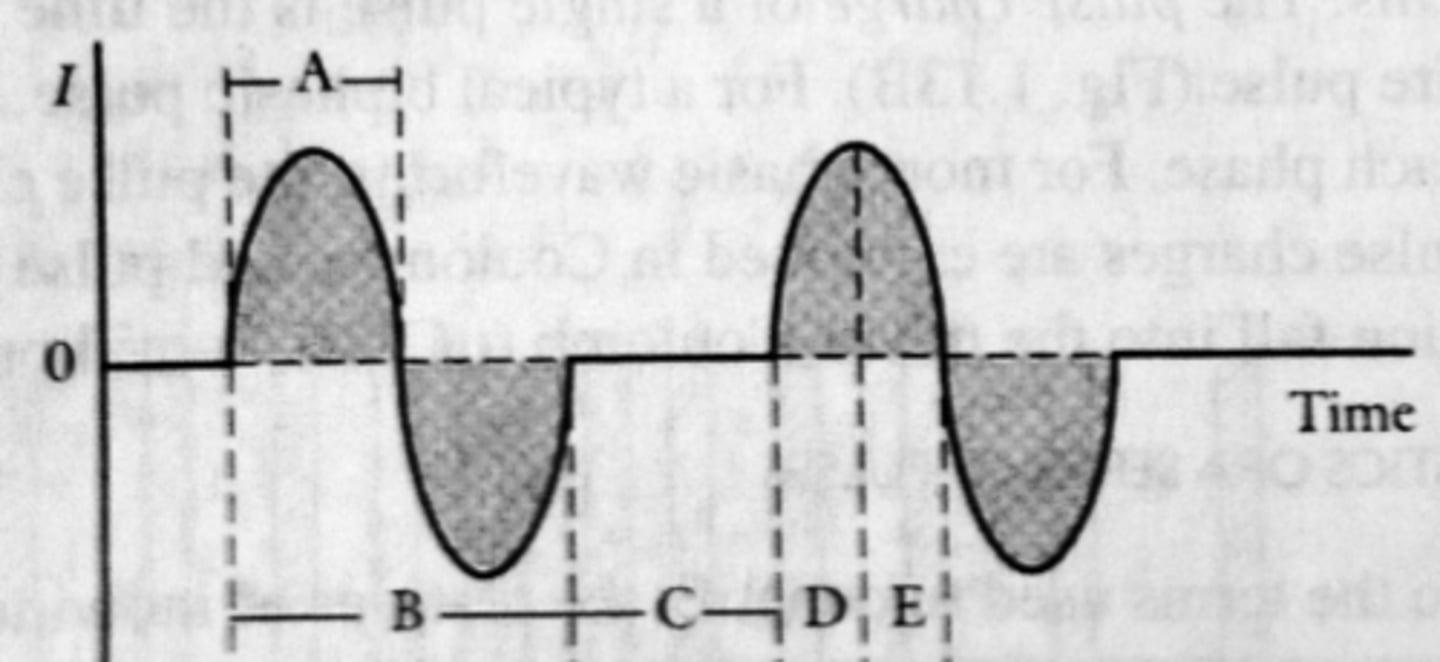
Label E.
decay time
peak amplitude
point of positive or negative maximum displacement during electrical stimulation
1000 Hz is considered LOW/MEDIUM/HIGH
low
1001-10000 Hz is considered LOW/MEDIUM/HIGH
medium
>10000 Hz is considered LOW/MEDIUM/HIGH
high
modulation
changes in current characteristics
burst of cycles/pulses
amplitude modulation
variations in peak amplitude of a series of pulses
pulse duration modulations
regular changes in time over which each pulse acts
frequency modulation
cyclic variations in the number of pulses applied per unit time
accomodation
the effect of modulation on adaptation
List the four dynamics of electrodes.
skin-electrode interface
electrode size and current density
distance between electrodes
electrode orientation
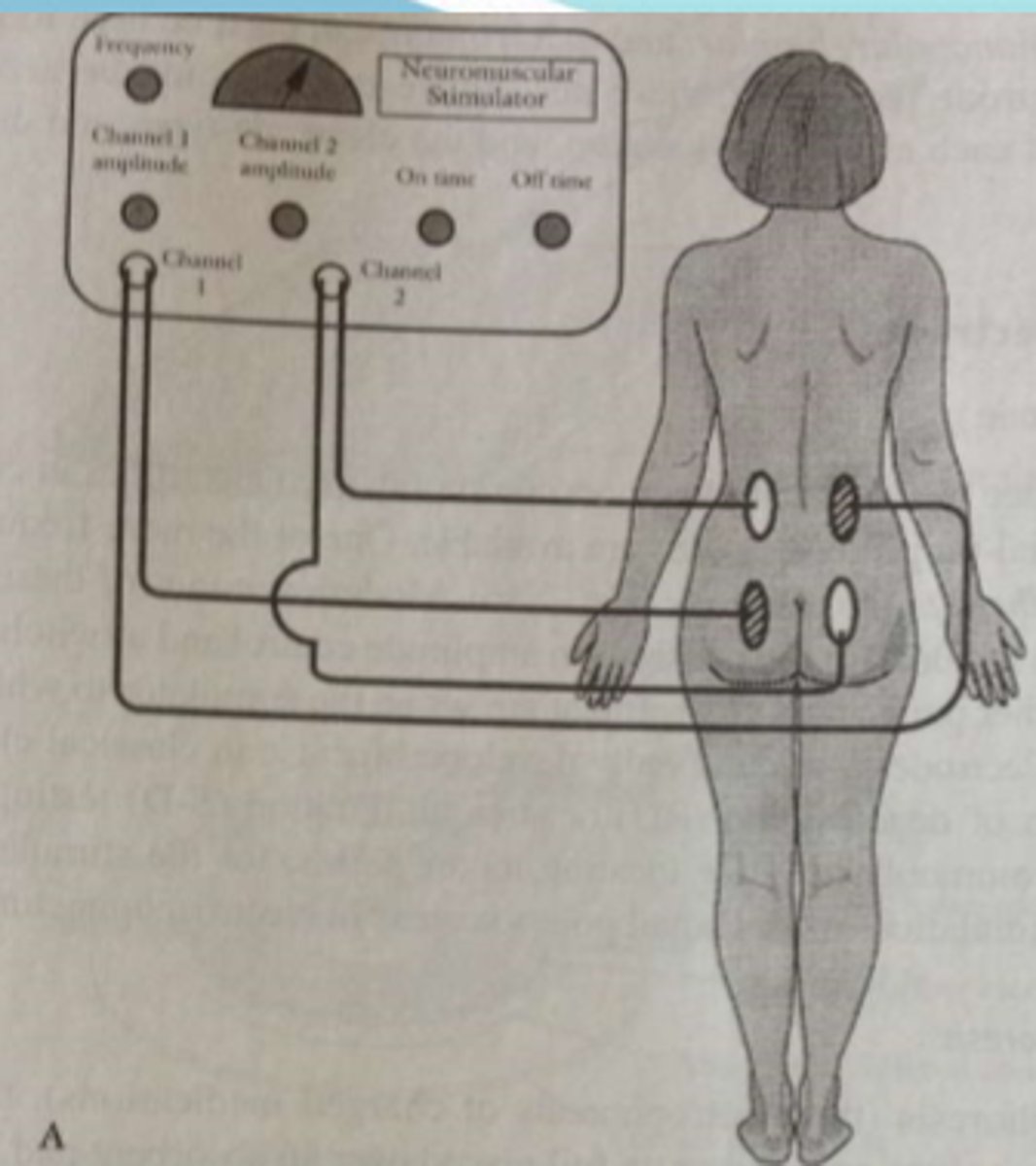
What type of electrical stimulation is depicted?
IFC
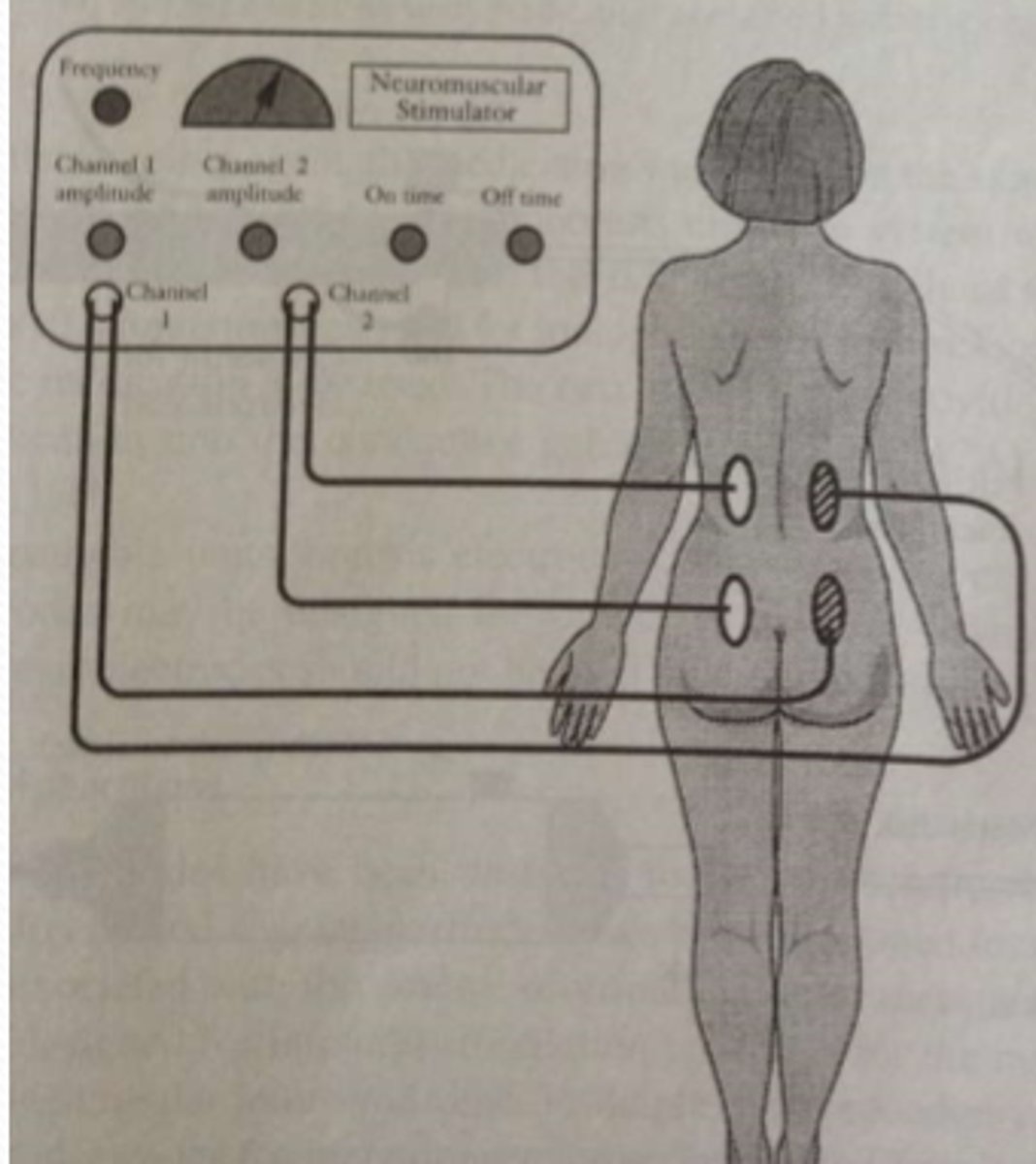
What type of electrical stimulation is depicted?
monophasic
motor point
site in nerve/muscle which is most easily excited producing a visible muscle response using a minimal level of electrical current
innervated motor point
muscle twitch (low rate) > tetanic contraction > fused tetanus (high rate)
denervated motor point
vermicular contraction
TENS acupuncture
limited utility in individuals with long-term opioid use and chronic caffeine intake
same binding site
Frequency 2-3
pulse duration and intensities should be changed at least every __-__ visits.
NMES
muscle contraction is visible
TENS
patient muscle be able to feel the stimulation
T/F: Electrical stimulation is best when using a multimodal approach.
true

