Vygotsky
 Studied by 0 people
 Call Kai
 Learn
Learn Practice Test
 Spaced Repetition
 Match
Match Flashcards
 Knowt Play
1/7

There's no tags or description
Looks like no tags are added yet.
Name | Mastery | Learn | Test | Matching | Spaced | Call with Kai |
|---|
No analytics yet
Send a link to your students to track their progress
8 Terms
Vygotsky’s theory of cognitive development
vygotsky agreed with Piaget that a child’s thinking is qualitatively different to an adult. however, he placed much greater emphasis on the important of the social context of children’s learning. he believed that culture is the prime determination of individual development. cognitive maturation is driven by a child’s biological maturation but it is most importantly a product of a child’s interactions with others
elementary and higher mental functions
vygotsky claimed that we are born with four “elementary mental functions”: attention, sensation, perception and memory. it is our social and cultural environmental that allows us to use these elementary skills to develop and finally gain “higher mental functions”. elementary mental functions are biological and share with other mammals whereas higher mental function are exclusively human. the role of culture and language is to transform elementary to higher mental functions
the role of others: experts or More knowledgable others (MKOs)
a child learns through problem solving experiences shared with someone else, usually a parent or teacher but also more competent peers. all people with greater knowledge than the child are called experts or More knowledgable others (MKO). initially, the person interacting with the child assumes most of the responsibility for guiding the problem-solving acidity, but gradually this responsibility transfers to the child
the role of language
vugotsky emphasised the role of language that experts use. semiotics if you want to be any because language can be spoken word or signs or symbols. he said that culture is transmitted through language from expert to child.
therefore if reasoning abilities are acquired from others via the language they use, it follows that the child will acquire the reasoning abilities of those particular people. this means that there may be cultural differences in cognitive development, with children picking up the mental ‘tools’ that are most important for life within their physical, social and work environment (direct contrast to Piaget)
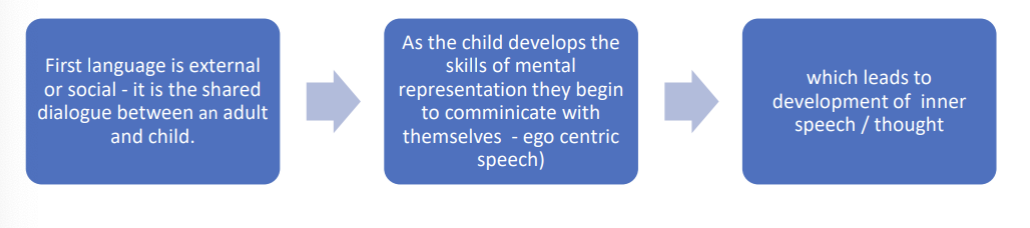
first language is external and social and is shared dialogue between adult and child
egocentric speech - communicating with themselves
inner speech/thoughts - communicate with themselves
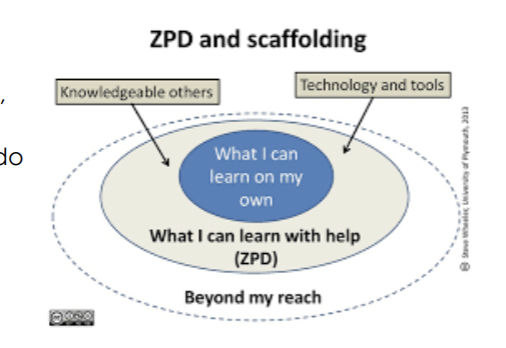
the zone of proximal development (ZPD)
a child’s zone of proximal development is the region where cognitive development takes place, it is the gap between a child’s current development i.e. what they can understand and do alone, and what they can potentially understand after interaction with more expert others. thus the term ‘proximal’ refers to those skills that the learner is ‘close’ to mastering.
expert assistance allows a child to cross the ZPD and understand as much of a subject or situation as they are capable - children are still to some extent limited by their development stage. vygotsky believed that children develop a more advanced understanding of a situation and hence the more advanced reasoning abilities needed to deal with it by learning from others. as opposed to Piaget’s view which is through individual exploration of the world.
critically, vygotsky was not just saying that children can learn more facts during social interaction but also that they acquire more advanced reasoning abilities. in fact he believed that higher mental functions, such as formal reasoning, could only be acquired through interaction with more advanced others.
scaffolding
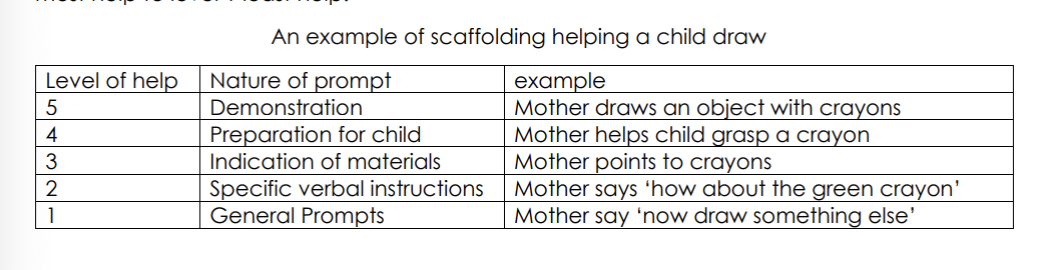
scaffolding is the next logical step in understanding the ZPD. the term scaffolding refers to all the kind of help experts give a child to help them to cross the ZPD. scaffolding was first introduced by Jerome Bruner and his colleagues. wood, Bruner and Ross (1976) identified 5 aspects to scaffolding which are general ways in which an adult can help a child better understand and perform a task:
recruitment: engaging the child’s interest in the task
reduction of degrees freedom: focusing the child on the task and where to start with solving it
direction maintenance: encouraging the child in order to help them stay motivated and continue trying to complete the task
marking critical features: highlight the most important parts of the task
demonstration: showing the child how to do aspects of the task
wood et al, also noted the particular strategies that experts use when scaffolding in general as a learner crossed the ZPD, the level of help given in scaffolding declines from level 5 most help to level 1 help.
scaffolding must be removed
evaluation of Vygotsky’s theory of cognitive development
research - there is clear evidence to show that there is indeed a gap between the level of reasoning a child can achieve on their own and what they can achieve with help from a more expert other. Roazzi and Bryan (1998) gave 4-5 year old children the task of estimating the number of sweets in a box. in one condition the children worked alone and the other they worked with the help of an older child. most children working alone failed to give a good estimate. in the expert condition the older (expert) children were observed to offer prompts, pointing the younger children in the right direction to work out how to arrive at their estimate. most 4-5 year olds receiving this kind of help successfully mastered the task. studies like this support Vygotsky’s idea that children can develop additional reasoning abilities when working with a more expert individual. this in turn suggests that the ZPD is a valid concept
can explain cultural differences in development - vygotsky’s claims about the role of culture in cognitive development have been supported in cross-cultural research. Matang and Owens (2014) 272 school children from 22 schools in Papa New Guinea. each child was assessed on their mathematical knowledge. results showed on average children using their traditional counting systems in their own language spent shorter time and made fewer mistakes solving tasks, compared to children using English and non-counting systems. suggesting how culture and language can enhance cognitive development.
research with non human animals has provided further evidence of the role of culture in cognitive development. some psychologists believe that non-human animals possess elementary mental functions which may be transformed into higher mental functions by immersing an animal in human culture. for example, Savage-Rumbaugh (1991) has exposed Bonobo apes (such as Kanzi) to a language rich culture, the apes are spoken to all the time through the use of a lexigram. it is debatable as to whether Kanzi could be said to have acquired human language but he is able to communicate using a symbol system. this suggests that higher mental functions (a symbol system) can be transmitted through cultureapplication - Vygotsky’s theory has been applied successfully to education. scaffolding has shown to be an effective way of teaching and based on this theory teachers are trained to guide children in their learning through careful scaffolding. collaborative work is also used in the classroom, mixing children of different level of ability to make use of reciprocal/peer teaching. Van Hilde Keer and Jean Pierre Verhaeghe found that 7 year olds tutored by 10 year olds, in addition to their whole class teaching, progressed further in reading than a control group who only had class teaching. this supports Vygotsky’s belief that more able people, even if they are essentially peers, can enhance the development and learning and therefore increases the validity and usefulness of
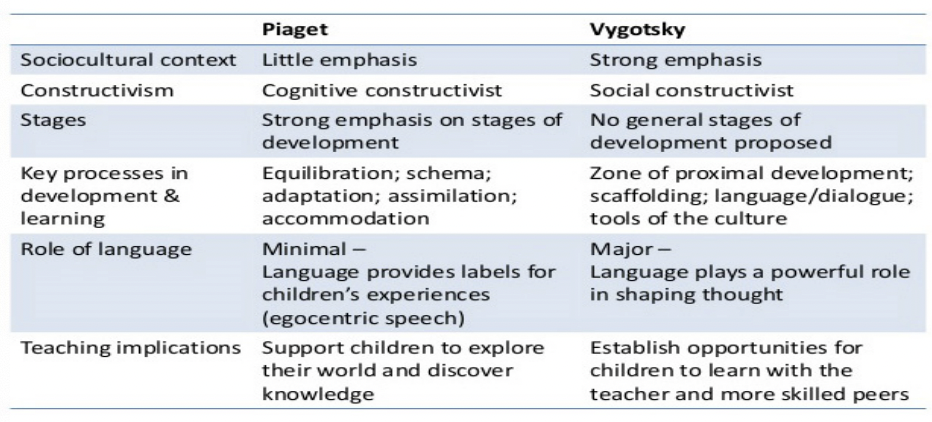
Vygotsky’s theory alternaive theory - The differences between Piaget's and Vygotsky's approaches reflect differences between the two men. Vygotsky was a Communist who believed in the power of community, and thus valued the role of society in the development of the individual; Piaget was a product of individualist European society. Apart from their different cultural backgrounds, the two men may also represent rather different kinds of learner; Piaget's child is an introvert, whereas Vygotsky's child is an extrovert, and this may be a reflection of the men themselves (Miller, 1994). Thus the two views can be reconciled because they are talking about different styles of learning and different kinds of learner. It is also possible to reconcile the theories by taking the view that they are not that different at their central core (Glassman, 1999). If one contrasts these theories with others in psychology, such as those by Freud, Pavlov or Skinner, we can see that there are similarities. They both place cognition at the centre of the theory; both emphasise the complex interactionist nature of development; both see abstract, scientific thought as the final stage of development; and both see the learner as active rather than passive
Piaget vs Vygotsky
 Note
Note  Flashcards (28)