Circular Motion
 Call Kai
 Learn
Learn Practice Test
 Spaced Repetition
 Match
Match Flashcards
 Knowt Play
1/27

Earn XP
Name | Mastery | Learn | Test | Matching | Spaced | Call with Kai | Chat |
|---|
No analytics yet
Send a link to your students to track their progress
28 Terms
What is the equation for critical speed for circular motion in a vertical plane?
v = √(gr)
Critical speed = √(acceleration of free fall × radius)
How do you derive equation for critical speed for circular motion in a vertical plane?
Weight = centripetal force, W = mv2/r
mg = mv2/r
g = v2/r
v2 = gr
v = √(gr)
For circular motion in a vertical plane, what is the centripetal force equal to at the top of the circle when at the critical velocity?
The weight is equal to the centripetal force
Why are some sharp bends in roads banked?
When a vehicle hoes round a bend on a flat road, the centripetal force is provided by friction between tyres and road.
Cars must slow down to ensure the available friction is enough to provide the required centripetal force
Additional centripetal force can be provided by banking the road so that there’s a horizontal component of the normal contact force which acts towards the centre of the bend. This allows cars to travell faster round the bend
Why do aeroplanes bank their wings to turn?
When 𝜃 is the angle of banking
The horizontal component of the lift 𝐿𝑠𝑖𝑛𝜃 is unbalanced and provides a centripetal force so the plane will follow a horizontal circular path.
The vertical component 𝐿𝑐𝑜𝑠𝜃 is balanced by the weight.
What is centripetal force?
The force required to maintain circular motion
It magnitude is constant and it acts perpendicular to velocity and towards the centre of the circle
Definition of Angular velocity
The rate of change of angular displacement of an object moving in a circular path
Derive ω = 2π/T
Angular velocity is the rate of change of angle, so ω = θ/t
In a time t equal to one period T, the object will move through an angle θ equal to 2π radians.
Therefore ω = 2π/T
Derive ω = 2πf
ω = 2π/T and f = 1/T, so ω = 2πf
Derivation v = rω
For a constant speed v = distance travelled / time taken
When distance traveled = circumference of circle = 2πr, t = time period = T
v = 2πr/T = r × 2π/T
Angular velocity = 2π/T, so v = rω
How can a body moving at a constant speed be accelerating?
A change in direction of motion changes velocity so causes acceleration (even at constant speed as velocity is a vector)
What is uniform circular motion?
An obejct moving in a circular path that:
Has constant speed
Only has centripetal acceleration, so no tangential acceleration
A ball is attached to a string and whirled in a vertical circle. Draw a freebody diagram of the ball at the top of this circle and derive the expression for the Tension at this position.
Centripetal force F = mg + T
T = F - mg = mv²/r - mg

A ball is attached to a string and whirled in a vertical circle. Draw a freebody diagram of the ball at the side of this circle and derive the expression for the Tension at this position.
Centripetal force F = T
T = F = mv²/r
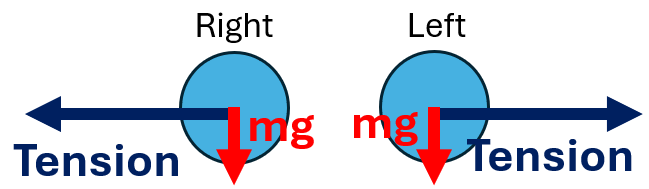
A ball is attached to a string and whirled in a vertical circle. Is the ball’s motion uniform circular motion and why?
When ball is at side of circle, there is no focre to balance the ball’s weight
As such there is a tangential acceleration so the ball’s speed must be changing
This means the ball does not have constant speed, so is not moving in uniform circular motion
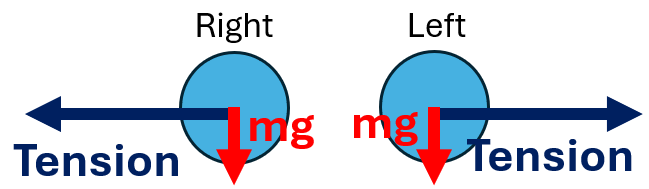
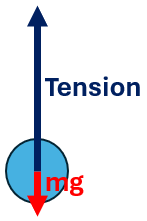
A ball is attached to a string and whirled in a vertical circle. Draw a freebody diagram of the ball at the bottom of this circle and derive the expression for the Tension at this position.
Centripetal force F = T - mg
T = F + mg = mv²/r + mg
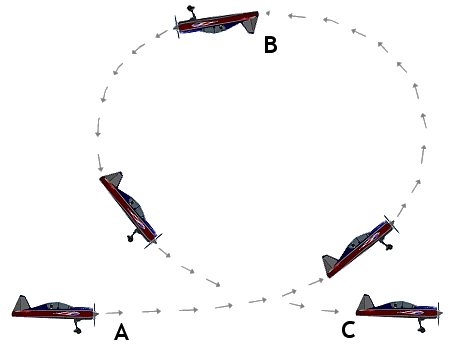
A plane is flying in a vertical loop. Draw a freebody diagram of the plane at the top of this loop and derive the expression for the lift force at this position.
Centripetal force F = mg + L
L = F - mg = mv²/r - mg

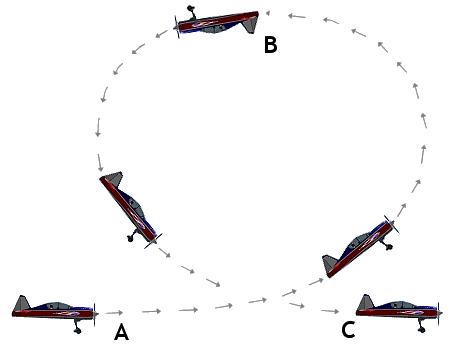
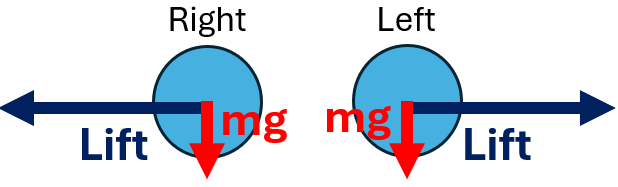
A plane is flying in a vertical loop. Draw a freebody diagram of the plane at the side of this loop and derive the expression for the lift force at this position.
Centripetal force F = L
L = F = mv²/r
A plane is flying in a vertical loop. Is the plane’s motion uniform circular motion and why?
When plane is at the side of the circle, there is no focre to balance the plane’s weight
As such there is a tangential acceleration so the plane’s speed must be changing
This means the plane does not have constant speed, so is not moving in uniform circular motion
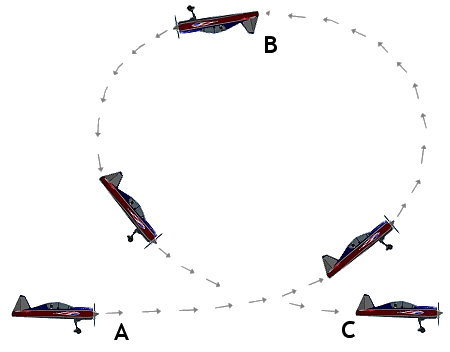
A plane is flying in a vertical loop. Draw a free body diagram of the plane at the bottom of this loop and derive the expression for the lift force at this position.
Centripetal force F = L - mg
L = F + mg = mv²/r + mg

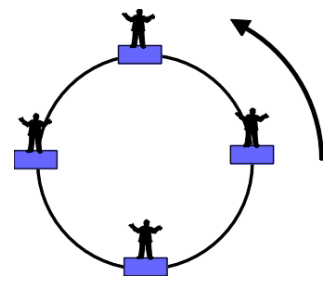
A person stands on a Ferris wheel. Draw a freebody diagram of the person at the top of this loop and derive the expression for the normal contact force at this position.
Centripetal force F = mg - N
Normal contact N = mg - F
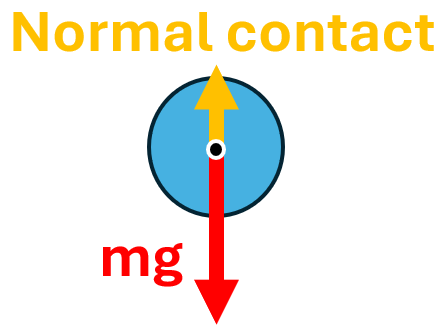
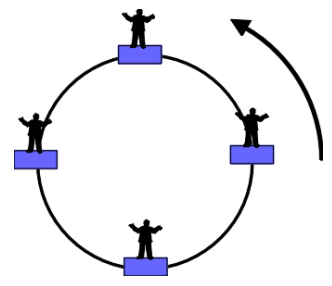
A person stands on a Ferris wheel. Draw a freebody diagram of the person at the left side of this loop and derive the expression for the normal contact force at this position.
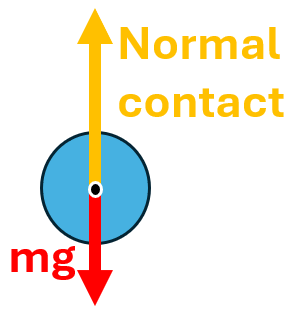
Normal contact = weight = mg
Centripetal force provide by friction between person and ferris wheel floor
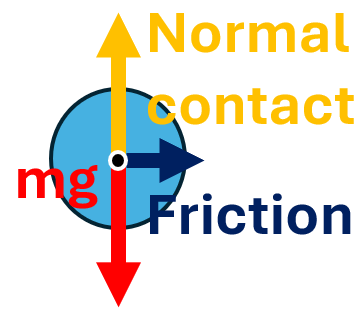
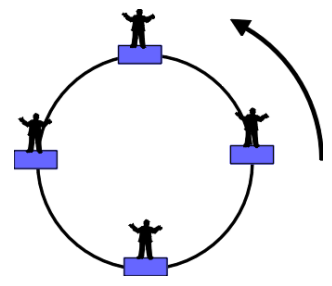
A person stands on a Ferris wheel which spins. Is the person’s motion uniform circular motion and why?
At all points on the circle, there is not tangentiall acceleration
For example, at the side of the circle the weight is balanced by the normal contact force, so no tangential force or acceleration
Therefore speed of person is constant, and they only experience centripetal acceleration, so person’s motion is uniform circular motion
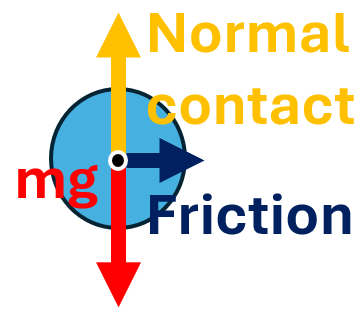
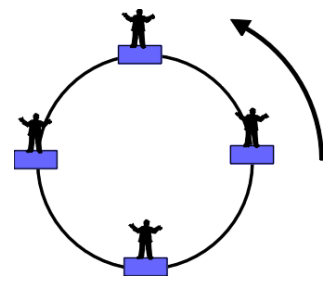
A person stands on a Ferris wheel. Draw a freebody diagram of the person at the bottom of this loop and derive the expression for the normal contact force at this position.
Centripetal force F = N - mg
Normal contact N = F + mg
The angle, θ, swept out in radians.
The angle subtended by a circular arc that is equal in length to the radius of the circle
Why does the centripetal force not do work on the object?
It acts perpedicular to the direction of motion so does not change the object’s speed and therefore energy
No energy change so centripetal force doesn’t do work on object