DDS LEC - Solid Dosage Forms: Tablets Part I
 Studied by 5 people
 Call Kai
 Learn
Learn Practice Test
 Spaced Repetition
 Match
Match Flashcards
 Knowt Play
1/79

There's no tags or description
Looks like no tags are added yet.
Name | Mastery | Learn | Test | Matching | Spaced | Call with Kai |
|---|
No analytics yet
Send a link to your students to track their progress
80 Terms
Tablets
Solid dosage form which may or may not contain medicinal substances with or without diluents prepared either by compression or molding
Can be made in various shape, weight, hardness, thickness, disintegration, and dissolution characteristics
Can be scored/grooved for altering dose and easier administration
Not applicable for sugar-coated
Advantages of Tablets
Precision of Dosage
Convenience of Administration
Physicochemical Stability
Durability
Active Pharmaceutical Ingredient (API)
Components intended to furnish pharmacological activity or other direct effect in the diagnosis, cure, mitigation, treatment or prevention of disease, or to affect the structure or function of the body
Example:
Paracetamol
Diluents/Fillers/Bulking Agents
Inert filler to create desired bulk, flow properties, and compression characteristics of tablets and capsules
Examples:
Lactose
Starch
MCC
Mannitol
Dextrose
Binders or Adhesives
Substances used to cause adhesion (glues powders to form granules) of powder particles in tablet granulations
Examples:
Acacia
Tragacanth
PVP
Starch Paste
Sodium Alginate
Disintegrants
Promotes disruption of the mass into smaller particles more readily dispersed or dissolved
Intragranular Disintegrant
Extragranular Disintegrant
Superdisintegrant
Intragranular Disintegrant
Promotes disruption from small particles (granules) into powders
Added prior to granulation
Extragranular Disintegrant
Promotes disruption from tablets to small particles
Added prior to compression
Superdisintegrants
Has both intragranular and extragranular properties
Added prior to compression
Croscarmellose - swells up to 10x
Croscarmellose
A cross-linked cellulose that swells up to 10x when in contact with water, crospovidone, Sodium starch glycolate
Flow Activators
Enhances the flow of granules during compression
Lubricant
Glidant
Anti-adherents
Lubricant
Agents that act between surfaces in relative motion to prevent punches and dies.
Stearic acid
Polyethylene Glycol (PEG)
Sodium Lauryl Sulfate (SLS)
Glidant
Agents that improves the flow characteristics of granules through the tablet press.
Talc (5%)
Corn Starch
Magnesium stearate (≤1%)
Cab-O-Sil
Anti-adherents
Prevents tablet ingredients from sticking to punches and dies during production (stickin) - a tablet defect.
Magnesium stearate
Talc
Starch
Cellulose
Miscellaneous Adjuncts
Provide color and flavor
FDC Red 40 (allura red)
FDC Yellow 6 (sunset yellow)
FDC Yellow 5 (tartrazine)
FDC Blue 2 (indigotine)
Compressed Tablets
Manufactured with tablet machines capable of exerting great pressure in compacting the powdered or granulated material
After compression, _____ _____ can be coated with various materials
Sugar-coated
Enteric-coated
Film-coated
Multiple Compressed Tablets
Prepared by subjecting the fill material to more than 1 compression
Starts by initial compaction of fill material in a die followed up by additional fill material and compression
Results to a multiple-layer tablet or a tablet within a tablet
Done to combine 2 APIs in 1 dosage form
Done to increase its pharmaceutical elegance
Synergistic Activity
An interaction between 2 or more drugs that causes the total effect of the drugs to be greater than the sum of the individual effects of each drug
Film-Coated Tablets
Compressed tablets coated with a thin layer of a polymer capable of forming a skin-like film
Same function with sugar-coated tablets but less bulky, less time-consuming, and more durable
Designed to rupture and expose the core tablet at the desired location in the GI tract
Gelatin-Coated Tablets
Capsule-shaped compressed tablet
Gelatin - Primary component of capsule shells
More tamper resistant than unsealed capsules
Innovator Product: Gelcap
Enteric-Coated Tablets
Compressed tablets coated with substances that resist acid degradation in the stomach but disintegrated in the intestine to allow drug absorption
Example:
Bisacodyl (Dulcolax) - Pro-drug, converted to bis-hydroxyphenylpyridylmethane (BHPM) upon reacting with intestinal deacetylase enzyme
Methods of Tablet Manufacture
Dry Granulation
Wet Granulation
Fluid Bed Granulation
Dry Granulation
Making granules by applying pressure
Powder → Granules → Tablets
Involves compaction of the components of a tablet formulation into slugs, followed by milling and screening prior to final compression
Used for moisture and heat-sensitive drugs
Granules
Dry aggregates of powdered particles
Slugs
Granules produced in dry granulation
Dry Granulation Process
Grinding/Milling - reduces particle size to desired size or size range
Mixing - utilizes V-shape blender for homogenous mixing
Slugging - creation of slugs using roller compactor; crushed to create granules
Screening - ensure particle size uniformity
Mixing - addition of lubricants or flow activators
Compaction/Compression - passes through the tablet press machine to create the tablet
Wet Granulation
Process of converting the drug and excipient into granules that flows well into dies
Involves wet massing and wet screening of the powders
Wet Granulation Process
Grinding/Milling - reduces particle size to desired size or size range
Mixing - utilizes V-shape blender for homogenous mixing
Wet Massing - add binder solutions to create wet mass or agglomerate (big lump); undergo screening; mesh #4
Drying - moisture content must be within 2-3%
Screening - ensure particle size uniformity
Mixing - addition of lubricants or flow activators
Compaction/Compression - passes through the tablet press machine to create the tablet
Fluid Bed Granulation
The entire process of wet granulation is done in a continuous process
Using fluid bed granulator
Fluid Bed Granulation Process
Pre-Blending
Wet Granulation - spraying of liquid binder solution
Drying - drying to desired moisture content (2-3%)
Tablet Compression Stages
Filling - powdered granules are loaded into the die cavity of the tablet press
Metering - ensures equal amounts of granules will be loaded into the cavity
Compression - granules are compressed or pressed to form a solid tablet
Ejection - the formed tablet is released from the cavity aided by the ejection cam
Tablet Compression Stage Filling
Powdered granules are loaded into the die cavity of the tablet press
Tablet Compression Stage Metering
Ensures equal amounts of granules will be loaded into the cavity
Tablet Compression Stage Compression
Granules are compressed or pressed to form a solid tablet
Tablet Compression Stage Ejection
The formed tablet is released from the cavity aided by the ejection cam
Basic Parts of a Tablet Press Machine
Hopper
Feed Shoe
Die Cavity
Upper Punch & Lower Punch
Hopper
Stores the granules for compression
Feed Shoe
Distributes the granules in the die cavity
Feeds the granules from the hopper to the die cavity
Die Cavity
The mold of the tablet machine
It controls the size and shape of the tablet
Upper Punch & Lower Punch
Compresses the granules
Compression-Related Tablet Defects
Capping
Cracking
Mottling
Soft Tablet
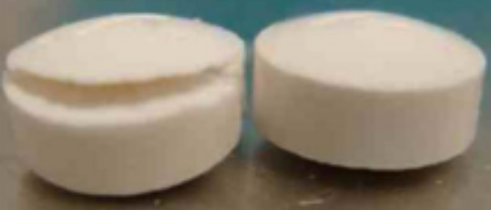
Capping
Separation of a portion of upper or lower tablet
Due to:
Air Entrapment - presence of air in granules before compression
Excessive Fine Granules - excessive fines, doesn’t follow the golden ratio
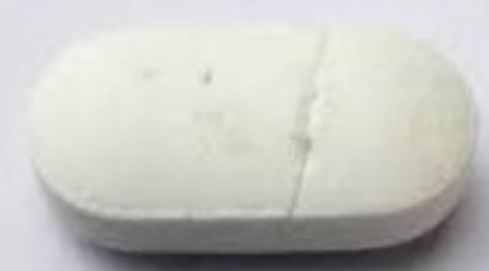
Cracking
Presence of fine cracks around the surface of the tablet
Due to:
Overcompression - pressured exerted by upper & lower punch is too excessive
Poor Granulation - can have excessive fine granules just like capping
Mottling
Improper coloration/blemishes on the surface of the tablet
Due to:
Poor Tablet Design - improper coloration shows that there’s incompatibilities or reaction in drug/excipients

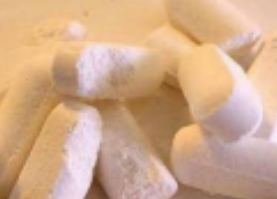
Soft Tablet
Brittle Tablet
Easily breaks down
Due to:
Undercompression - tablet easily breaks upon handling
Tablet Coating Mechanisms
Sugar Coating
Film Coating
Fluid Bed Coating
Sugar Coating
Coating that increases tablet weight by 30-50%
Steps in Sugar Coating
Sealing/Waterproofing - applied to tablet core to protect against water penetration; includes Shellac, Cellulose Acetate Phthalate (CAP), and Hydroxypropylmethylcellulose (HPMC)
Sub-coating - rounds the tablet edges which increases tablet weight; include Scrose & Binder Solution and Gum Solution
Grossing/Smoothing - making the sub-coat surface smooth and even using Syrup Solution (60-70%)
Coloring - gives tablet its color and finished size; uses dyes and lakes
Polishing - produces characteristic gloss; uses besswax and carnauba wax
Sealing/Waterproofing
Applied to tablet core to protect against water penetration
Includes:
Shellac
CAP - Cellulose Acetate Phthalate
HPMC - Hydroxypropylmethylcellulose
Sub-coating
Rounds the tablet edges which increases tablet weight
Include:
Sucrose & Binder Solution - used if it will be done under a lamination process
Gum Solution - used if it will be ddone under a suspension process
Sucrose & Binder Solution
Used if sub-coating will be done under a lamination process
Gum Solution
Used if sub-coating will be done under a suspension process
Grossing/Smoothing
Making the sub-coat surface smooth and even using Syrup Solution (60-70%)
Coloring
Give color and finished size to tablet
Uses:
Dyes
Lakes
Polishing
Produces characteristic Gloss
Uses:
Besswax
Carnauba Wax
Film Coating
Coating that may be non-aqueous or aqueous
Nonaqueous Solutions Component
Film Former - produces a smooth thin film
Alloying Substance - provides water solubility or permeability to the film
Plasticizer - produces flexibility and elasticity of coat
Surfactant - enhances spreadability
Opaquant and Colorants
Sweeteners and Flavorants
Glossant - provides a luster to the tablets
Volatile Solvent - allows spread of other components over the tablets
Film Former
Produces a smooth thin film
Cellulose Acetate Phthalate (CAP)
Alloying Substance
Provides water solubility or permeability to the film
Polyethylene Glycol (PEG)
Plasticizer
Produces flexibility & elasticity of coat
Castor Oil
Aqueous Solutions Component
Film-forming polymer (7% to 18%)
Plasticizer (0.5% to 2.0%)
Colorant (2.5% to 8%)
Vehicle (qs. ad. to 100%)
Fluid Bed Coating
Spray coating of powders, granules beads, pellets, or tablets held in suspension by a column of air
Utilizes the continuous stream of air to evenly administer/apply the coating or granulation solution in the granules
Top-Spray Fluidized-Bed Coating
Coating solution is applied at the top of the floating tablets
Botton-Spray Fluidized-Bed Coating
Coating solution is applied at the bottom of the floating tablets
Tangential-Spray Fluidized-Bed Coating
Coating solution is applied at the middle of the floating tablets
Coating-Related Tablet Defects
Blistering
Chipping
Cratering
Picking
Blooming
Blushing
Infilling
Mottling
Blistering
The film becomes locally detached from the substrate forming a blister
Due to:
Air Entrapment Due to Overheating - too high temperature used during the coating process upon drying to make the coat stick to the coat tablet
Chipping
Chipped and dented at the edges of the tablet
Due to:
Rough Coating Pan - edges of the coating pan are too rough, resulting in possible dents or chips around the tablet

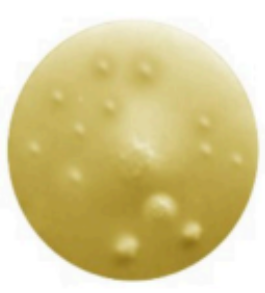
Cratering
Volcano-like crater appearance
Due to:
Inefficient Drying - moisture or solvent in the coating layer fails to evaporate
Excessive Rate of Coating - applying the coating solution too quickly or in excessive amounts
Picking
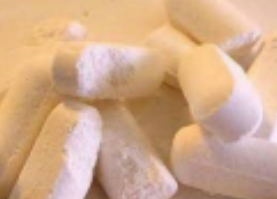
Some areas of the film pull away from the surface
Due to:
Uneven Sticking - film did not stick evenly to the surface of the core tablet
Blooming
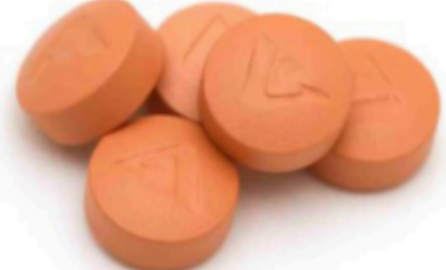
Dulling (pamumutla) of the coating
Due to:
Excessive Plasticizer - can lead to migration of the plasticizer to the surface over time, creating a dull or “bloomed” look

Blushing
Whitish specks or haziness in the film
Due to:
Precipitation of Polymers - precipitate out if the coating environment is not controlled properly which causes the polymers to separate from the solution, forming whitish or cloudy areas in the film coating
Infilling
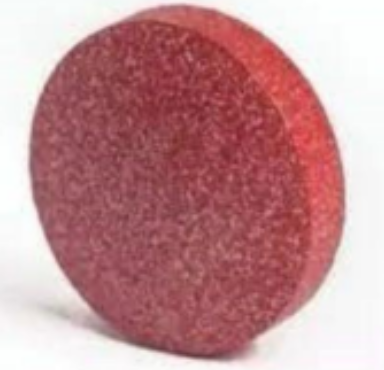
Same effect as bridging, logo, or the monogram is filled with solidified foam structure
Due to:
Foam Formation - there are solidified foams that enter on the imprints making it less viable

Molded Tablets
Can be called Tablet Triturates
Usually made from moist material
Usually soft and are rapidly soluble in water
Triturate mold is used to give a cylindrical shape
Upon molding, add alcohol into molds to have a unified size and for it to stick into a molded tablet
Diluent: Lactose and Sucrose
Hypodermic Tablets
Soft, readily-soluble tablets used for preparation of solutions to be injected
Dissolved in sterile water and then injected
Disadvantage: Difficulty in ensuring sterility of the preparation
Since there is a creation of a sterile solution, it needs to have a sterile area for it to be made
No _____ _____ have been recognized in compendia
Dispensing Tablets
Contains large amounts of highly-potent drugs substances to obtain pre-measured amounts for compounding multiple dosage units
No longer in use as this had the dangerous potential of being inadvertently dispensed to patients
It needs to be diluted into pre-measured amounts, resulting in errors in compounding and possible toxic effects due to overdose
Lozenges
Made using a high degree of compression to produce harder than ordinary tablets so that they dissolve and integrate slowly in the mouth
Strepsils
Vaginal Tablets
Uncoated bullet-shaped or ovoid tablets inserted into the vagina for local effects
Packaged with a plastic inserter for convenient placement of the tablet in the vagina
Clotrimoxazole (Canesten)
Lollipops
Sugar-based lozenge on a stick
Fentanyl Citrate
Pills
Small, round dosage forms intended for oral administration
Prepared by wet massing before molding
Contraceptives
 Note
Note  Flashcards (33)