4.1.6.6 - The National Minimum Wage
 Call Kai
 Learn
Learn Practice Test
 Spaced Repetition
 Match
Match Flashcards
 Knowt Play
1/6

There's no tags or description
Looks like no tags are added yet.
Name | Mastery | Learn | Test | Matching | Spaced | Call with Kai |
|---|
No analytics yet
Send a link to your students to track their progress
7 Terms
National Minimum Wage =
The lowest wage which a worker can be employed, set by the government.
aka National Living Wage
Trade Union and National Minimum Wage
They have the same diagrams & same chain of analysis on competitive and monopsony labour markets
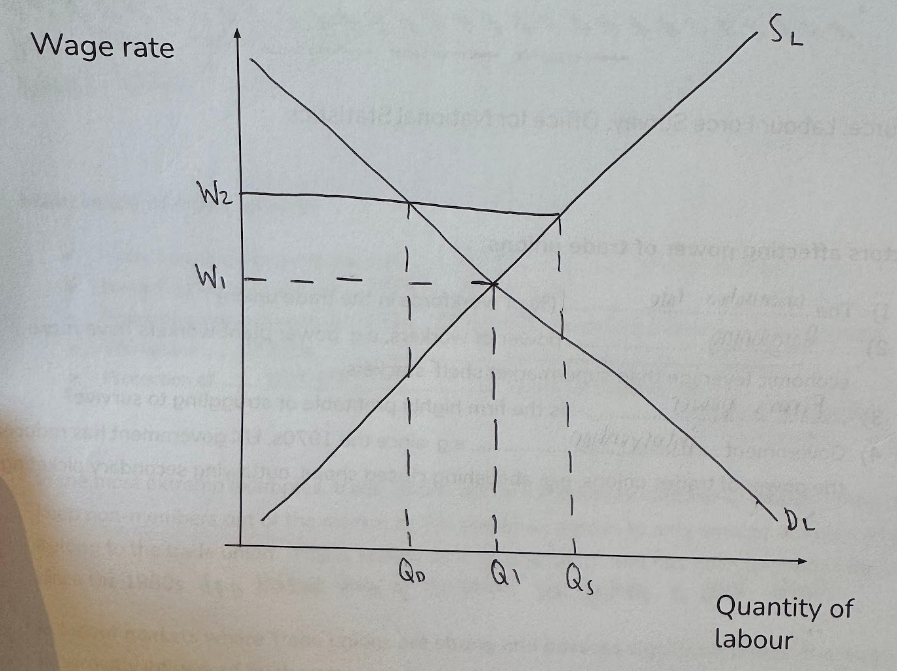
Impact of NMW on Perfectly Competitive Labour Market Chain of Analysis
In a competitive labour market, wages were W1.
Government sets NMW of W2 above the equilibrium wage rate
Wages increase from W1 to W2
But employment falls from Q1 to Qd
As supply extends to Qs and demand contracts to Qd, there is real wage unemployment of Qs-Qd
The labour supply curve is kinked - perfectly elastic up to Qs, but to raise labour supply beyond this, firms must offer higher wages.
Impact of NMW on Monopsony Labour Market Chain of Analysis
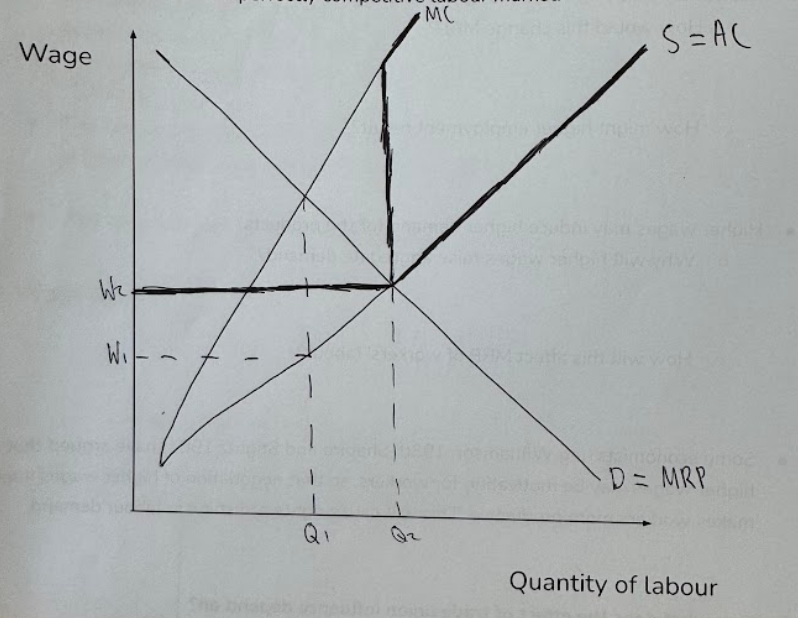
In a monopsony, profit-maxing point where wages are at W1 and employment is Q1
Government sets NMW of W2
MC and AC is now perfectly elastic up to Q2 as hiring one extra worker up to this point costs the same wage rate.
The profit-maximising point where MC=MRP is now at W2, Q2
Wage has increased from W1 to W2 and employment has increased from Q1 to Q2
Evaluations of NMW Impact on Wages & Unemployment
IDO:
Level of wage rate imposed - the greater it is above equilibrium, the lower the level of employment
Elasticity of Supply & Demand for labour - if inelastic, effect on u/e is smaller
Counter:
‘Corporate Flight’ - if NMW set too high, firms may just leave and move to other locations with lower NMW
Combination of Policies required to reduce poverty - need to also do investment in training, reforms to welfare system
Advantages of a National Minimum Wage
Poverty alleviation:
Ensures a fair wage, reduces wage inequality, reduces social deprivation & crime
UK NLW = At least 67% of median hourly wages
‘Relative Poverty’ defined as 60% of median income
Therefore, NLW prevents relative poverty
Greater incentives to work:
Earnings/poverty trap reduced as it makes taking a job more beneficial/worthwhile
Increases productivity:
Workers on higher wages tend to work harder
Reduced government spending:
on in-work benefits (universal credit)
& on out-of-work benefits via lower earnings trap effect
Prevents monopsonist exploitation:
Higher wages & higher employment in monopsonist markets
Disadvantages of a National Minimum Wage
Increases unemployment in competitive labour markets:
Employment falls from Q1 to Qd
Real wage unemployment of Qs-Qd (from contraction along D and extension along S)
Increases firms costs & raises prices:
SRAS left → increase prices → less internationally competitive + products more expensive for consumers
Increases inequality further:
Reduces income of the workers who lose their jobs in competitive labour markets (Q1-Qd)
Difficulty in targeting & setting the correct wage:
Different wages in every industry
Inflexibility:
Firms cannot reduce wages in a recession, so have to lay off workers instead

