Unit 3.1 Lifespan Development
 Studied by 0 people
 Call Kai
 Learn
Learn Practice Test
 Spaced Repetition
 Match
Match Flashcards
 Knowt Play
1/131

There's no tags or description
Looks like no tags are added yet.
Name | Mastery | Learn | Test | Matching | Spaced | Call with Kai |
|---|
No study sessions yet.
132 Terms
Developmental psychology
a branch of psychology that studies physical, cognitive, and social changes throughout the lifespan
Nature vs nurture
genetic inheritance or experience?
Continuity vs stages
is development gradual or in distinct stages?
Stability vs change
is our personality established as kids or do we change over time?
Longitudinal study
research in which the same people are restudied and retested over time
Ex: How does your IQ test change from age 20 (in 2017) to age 70 (2067)? 👧 → 👩 → 👵
Cross-sectional study
a study in which people of different ages are compared with one another
Ex: In 2017, do 20 year olds score higher on an IQ test than 70 year olds? 👦 AND 👨 AND 🧓
Can be experimental or correlational!
Maturation
Development that reflects the gradual unfolding of one’s genetic blueprint
Change that comes with age– not based
on learning or experienceBiological growth process
Ex: growing really tall because everyone
in your family is tall
1) Prenatal periods of development
Germinal → conception-2 weeks
Baby is a Zygote = Fertilized egg
2) Prenatal Periods of development
Embryonic → 3-8 weeks
Baby is an Embryo = organs begin to form and function
Very vulnerable at this stage → miscarriages, major birth defects caused by problems in this stage
3) Prenatal Periods of development
Fetal → 9 weeks- birth
Baby is a Fetus = developing more complex physical and cognitive abilities
Teratogens
Any external agent that can harm the embryo or fetus
Ex: Prescription drugs, alcohol, tobacco, recreational drugs, viruses, etc.
All pass through the placenta to the baby's bloodstream
→ Can cause birth defects
Fetal alcohol syndrome (ex of teratogen)
physical and cognitive abnormalities in children caused by pregnant person’s heavy drinking
Severe cases = noticeable facial misproportions
Ex: Babies of heroin addicts will be born addicted to the drug as well
Ex: Maternal illnesses– Placenta will screen for infectious agents, but will not catch all
Chicken pox, measles, HIV/AIDS
Even environmental pollutants can pass through to the baby
Habituation
decreasing responsiveness with repeated stimulation
Babies attention will wane the longer or more often a stimulus is presented- they become familiar with it
Focus on new stimuli longer→ new people, toys, places, etc.
This allows us to understand what newborns are able to remember
Newborns’ preference for faces
When shown these two stimuli with the same elements, newborns spent nearly twice as many seconds looking at the facelike image.
innate preference for social interaction
ex: baby toys always have a face
When did you have most of your neurons?
the day you were born
As you learn- neural connections are
formedNervous system is immature at birth
Most rapid growth in frontal lobe
Associations develop last
Thinking, language, memory
When is it rare to have our earliest memories
earliest memory is rarely before our 3rd birthday
Reflexes
Automatic behaviors, not learned, necessary for survival
Information for reflexes is not interpreted or processed by the brain
Rooting reflex
Necessary for feeding
Touch a baby's cheek and baby turns
head in that direction
Grasping reflex
Babies will hold onto things
Ex: if a baby grabs your hair- hard to get the
baby to let go
Gross motor skills
Involving large muscles or whole body movement
Develop coordination
Ex: crawling, running, jumping jacks, etc.
Fine motor skills
movements involving small muscles
Develop dexterity
Ex: drawing, cutting, grabbing, etc.
Sit, crawl, walk, run
the sequence of these motor development milestones is the same around the world, though babies reach them at varying ages.
When will crawling occur
when the baby is physically ready to crawl
Not influenced by watching mom and dad crawl
Happens when nervous system is prepared
→ cerebellum needs to develop
Development time for each child
Genes oversee the process
Order of development is generally the same
Exact timing is different for every baby
Often, for identical twins its very similar
Critical periods
an optimal periods early in the life of a child when exposure to certain stimuli or experiences produces normal development
Ex: language– those who were not exposed to language never developed it
Imprinting (ex of critical periods)
Infant animals follow whatever is seen first after birth → might imprint on wrong animal
AKA: sensitive periods– not necessarily written in stone → thanks to neuroplasticity
Parents often compare their kids development to what is deemed “normal” development
Indicates the typical (median) age at which children display various behaviors and abilities
Useful benchmarks
Use as general guidelines
Development will not be exact
What can influence physical and cognitive development?
Adverse Childhood Experiences (ACEs)
Adverse Childhood Experiences (ACE)
potentially traumatic events that occur in childhood (up to 18)
Rat study– enriched environment (p. 307)
Jean Piaget
developmental psychologist who believed children learn from interacting with
the environment; intelligence is not fixed
Children’s ability to understand, think about, and solve problems in the world develops in a stop-start, discontinuous manner
“Little Scientists” constantly trying to
make sense of the world around
them
Schemas
concept or framework that organizes & interprets information
seeing black Labrador for your first seeing of a dog
Assimilation
interpreting/improving existing info thanks to new but similar information
Ex: seeing a Dalmation for the first time– that’s a dog→ matches idea of “dog”
Accommodation
adapting our current schemas based on new information that contradicts old information
Ex: seeing a cow → thinking it’s a dog → having to adjust
Not all black and white, 4-legged animals are dogs
Have to change idea of “dog”& create concept of “cow”
Piaget’s Stages of Cognitive Development
four qualitative stages, each with distinctive characteristics that allow certain types of thinking
Piaget Stages(1) - Sensorimotor
Birth-2 years(range)
Experiencing the world through sensations/actions
Looking, hearing, touching, mouthing, grasping
Raw sensations, significant movement development
Reach for bottle or toys
Egocentric (prevalent in sensorimotor)
only can see things from their perspective
Out of sight, out of mind → hide and seek fail
Begin language development
Connection between objects and sounds/words
Object permanence (also in sensorimotor)
kids view the world from their own reference point
Before this– If you hide something, it’s gone
Once developed, a child knows things are permanent, even when out of sight
Ex: Peek-a-boo
Demonstrates the beginning of memory
Seperation anxiety (sensorimotor)
A baby is afraid when mom or dad leave
Normal, universal across cultures
Begins when object permanence is developed
Babies now can remember you & they can understand that you are leaving
Important to teach babies that you will return
Connects to attachment (later)
Piaget Stages (2) - Preoperational
2-7 years
Still egocentric
Acquire language and the ability to use symbols
Represent things with words and images
Understand things are permanent
Still not capable of logical thought
Development of symbolic thought in preoperational allows for:
Animism and pretend play
Animism
believing nature, objects are alive/have feelings
Ex: my sister and the dishwasher
Pretend play
the stage of play engaged in by children who are capable of assigning action to symbolic objects.
Ex: taking on roles/characters, assign meaning to objects, and transform their reality into a world of their own
Ex: playing with Barbies/house– each one gets their own personality, come up with a complex story…
Ex: Using stick as a swords
What are children incapable of in preoperational stage
children are still incapable of logical thought
What 2 concepts are not achieved until the end of preoperational stage
Reversibility and conservation
Reversibility
A relationship that goes in one direction can also go in the opposite direction
Ex: “do you have a brother?”
Ex: “does your brother have a brother?”
Conservation
Some of an object's
characteristics can change while others
remain the same
Ex: $5 bill vs. five $1 bills
Persisting ego-centrism develops into what
Theory of mind
Theory of mind
people’s ideas about their own vs. others’ mental states
Kids can begin to understand how others see the world, what others’ intentions might be, predict behavior, etc.
Ex: Crayon experiment
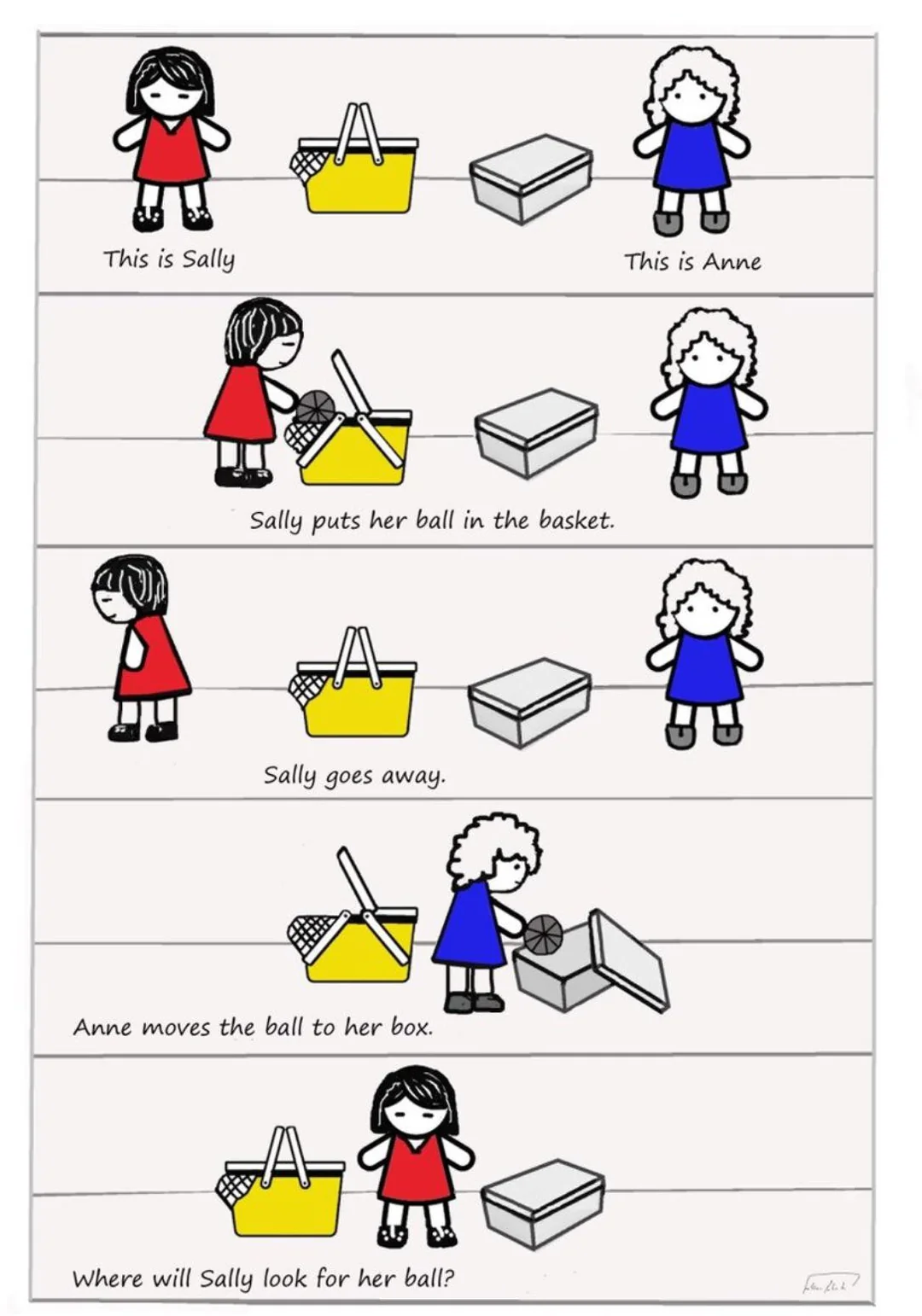
Ex: Sally Anne test (next slide)
Sally-Anne Test
Without theory of mind: child will believed Sally knows what they know (the ball is in the box)
WITH theory of mind: child will see the world from Sally’s point of view– she was not present when Anne hid the ball, therefore she will think the ball is still in the basket
Piaget Stages (3) - Concrete Operational
7-11 years
Understand world in logical, realistic, and straightforward ways, but struggle to think systematically → need tangibility
Learn to compare items
Can think logically about concrete events
Grasping concrete analogies
Performing mathematical operations
8+4 = 4+8
If this then that
Piaget Stages (4) - Formal operational
11 years+
Highly symbolic thought is developed
Potential for mature and moral reasoning
Abstract thinking and hypothetical thought→ think of how a tween tells a story vs. little kids
Ex: logic, math, ethics, pro/con list, “What if…”
→ some logic develops earlier than 11– easier if it’s concrete
Ex: If John is in school, then Mary is in school. John is in school. Where is Mary?
Piaget’s stages - criticism
Development is more continuous than Piaget claimed
Heavy focus on age
Should be focused on unique development of kids
Proposed not everyone achieve formal operational
Lev Vygotsky
Emphasized social interaction in the development of cognitive abilities
He believed the more a child is talked to or interacted with by other people, the better their cognitive abilities will develop– collectivist
More stimulation = more neural connections
Scaffolding
framework that offers children temporary support as they develop higher levels of learning
Ex: learning repeated addition before multiplication
vygotsky
Zone of proximal development
The measurement or indication of what a child can do alone versus when other people are around offering encouragement and guidance
Kids might feel comfortable completing a task when parent or teacher is present, but get frustrated if not
parents offer encouragement and guidance
parents there makes them feel secure
when they leave they lose this security
might demonstrate they don't know something but they actually do
Vygotsky
Language
mutually agreed upon system of arbitrary symbols that are rule-governed and generative to produce an infinity of ideas
our spoken, written, or signed words and the ways we combine them to communicate meaning
Phoneme
the smallest distinctive sound unit in a language
Bat = b, a, t
Chat = ch, a, t
Not all languages have the same phonemes!
Not the same as syllables!
Morpheme
smallest units that communicate meaning
Ex: dog
Ex: un-, -ed, -ly, pre-
Charcuterie has 1 morpheme, while mistakes has 3!
Semantics
set of rules by which we derive meaning from morphemes
Ex: -ed meaning the past; a- meaning not; dog meaning a fluffy canine pet
Syntax
the rules for combining words into grammatically sensible sentences in a given language
Ex: Clifford the big red dog, not Clifford the
red, big dog→ different order for different languages
Nonverbal manual gestures
a form of communication that uses body movements, postures, and gestures to convey messages
A type of body language
Ex: pointing at an object signals that you want it or want someone to look at it
Grammar
system of rules that enables
us to communicate with and understand others → written, spoken, and signed
Ex: Because it was sunny, I walked to the store
Ex: American Sign Language has
different signs than British Sign
Language even though both stem
from English-speaking populations
What did B.F. Skinner believe
Children learn language through association, imitation, and reinforcement
Connecting sights with sounds, using grammar/syntax the same way as those around them, reinforced by smiles, reactions
Nurture
Children learn their language
Depends on environmental factors
Ex: grow up hearing English and Spanish → you will learn both English and Spanish
Benjamin Whorf: Linguistic determinism
Our language abilities structure the way we think
As vocab increases, intelligence and thinking skills improve
Ex: if your language does not use past-tense, it is more difficult to think about the past
Ex: if your language had 100 different terms for types of snow, how might this affect your perception of snow?
Cooing/Babbling (1st for learning language)
~3-4 months; the infant spontaneously utters various sounds at first unrelated to the household language → not tied to a language
Ex: cooing = vowel sounds (ooh, ahh)
babbling = consonant sounds (da-da)
One-word stage (2nd in Learning language)
~1 year; child utters single words
Holographic speech= one word standing for an entire sentence (“ball” = “I want the ball”)
Telegraphic speech (3rd in Learning language)
18-24 months; Child utters 2-word statements
Speaks like a telegraph → verb before noun
Ex: “goes daddy”
aka Two word stage
From 2+ years, learn longer sentences quickly
When people make errors in language its because of?
Overgeneralization of rules
the application of a grammatical rule in cases where it doesn't apply
Ex: child saying “foots” instead of “feet”
Ex: “I goed to the store” vs. I went to the store
→ Trying to apply rules where there are exceptions
The wugs test
wug is made of word but children would use it right even it was made up word and say “wugs”
Temperament
a person’s characteristic emotional reactivity and intensity
Easy Temperament
cheerful, relaxed, on predictable feeding and eating schedules
Difficult temperament
irritable, intense, and unpredictable
Tend to remain stable throughout life, particularly childhood
Likely genetic– identical twins tend to be very similar
Means that temperaments/personalities are not necessarily “given” to or copied by kids from their parents
Attachment
an emotional tie with another person
Shown in young children by their seeking closeness to the caregiver and showing distress on separation
Ex of Attachment is Harry Harlow’s Contact Comfort
Experiments on monkeys
Attachment was better through
contact and warmthNot so much about providing
food and nourishment
Monkey experiment
2 “mothers” that “raised” a baby monkey
“Wire mother” was cold and hard, only provided a bottle
“Cloth mother” provided no nutrients, just made of soft cloth
Baby monkeys formed attachments
more quickly and effectively with the
cloth mother than the wire motherWhat does this tell us about how we
develop attachment?
What can influence how children attach to their caregivers
temperament
Attachment style
the characteristic ways people relate to others in close relationships
influenced by how a person's primary caregivers interacted with them as an infant
Mary Ainsworth’s Strange Situation
Secure Attachment
children who feel protected by and can trust their caregiver
Ex: children who show some distress when their caregiver leaves but are able to compose themselves quickly when the caregiver returns
Children who grow up with secure
attachment styles tend to be secure in
future relationships → more trusting,
more social
Insecure Attachment
elements of mistrust toward caregiver → Can be for a number of reasons
Anxious attachment
upset when parent leaves, but when parent returns, alternates between clinging to them and rejecting them
Due to inconsistent reactions from caregiver
Tend to become adults who crave
attention but often worry about
being rejected– clingy
Avoidant attachment
child avoids parent when they returns → due to typically being ignored
Tend to become adults who struggle w/ commitment, discomfort, conflict
Tend to avoid relationships
Disorganizaed attachment
reactions to parent leaving/returning are inconsistent and disorganized
Often stemming from inconsistent or frightening caregiving experiences– source of comfort is also source of fear
Fears both intimacy
and isolation
Diana Baumrind = studied parenting styles
Determined 4 main parenting styles which predicted behaviors in children
Correlational!
Consider: a child’s personality traits may influence the parenting style
maybe calm, easy-going babies evoke more trusting parents
maybe competent parents have competent children, influencing a more trusting parenting style
Authoritative 🔼 rules 🔼 emotion (parenting style)
-Parents use themselves as role models
-Reason with the children
-Emphasize maturity
-Democratic parenting
-Children become social and competent
-Children exhibit the highest level of self-esteem, self-reliance, and self- regulation
Permissive 🔽 rules 🔼 emotion
-Parents do not take an interest in the child
-Children are free to do whatever they please
-Children are not taught responsibility and consequences for their actions
-Children end up more aggressive and immature
Authroitarian🔼 rules 🔽 emotion
-Based on power and emphasis on discipline
-Children might end up experimenting with various behaviors that were prohibited
-Children exhibit less self-esteem, less social skills, and a brain that overreacts when they make a mistake
Negligent 🔽 rules 🔽 emotion
-Parents are uninvolved
-Neither demanding, nor responsive
-Careless, inattentive
-Do not seek close relationship with kids
-Children with more academic and social problems
Ecological systems theory
the different environments we encounter affect our cognitive, social, and biological development
5 nested systems, varying in influence from direct to indirect
Starts with the individual
Microsystem
groups that have direct contact with the individual
Ex: parents, siblings, teachers, friends
Mesosystem
he relationships between the groups in the microsphere
Ex: school, the neighborhood, home
Exosystem
indirect factors in an individual’s life
Ex: media (TV shows, music), parents’ jobs, local governments,, friends’ parents…
Macrosystem
world events that affect the individuals and others around them
Ex: social norms, legal systems, political landscape, economic systems…
Chronosystem
the individual’s current stage of life
Ex: becoming a big sister, starting kindergarten, graduating high school, getting a phone…
whats infancy major social achievement
attachment
whats childhood’s major social achievement
self-concept
Self-concept
An understanding and assessment of who they are
Early on, this means recognizing oneself The Rouge Test
Rouge Test
recognizing that the person in the mirror is you, your reflection
Parallel play
children playing side-by-side with minimal interaction, but still being aware of each other's presence
By school age: more detailed description
of who they are/what makes them happy“I like yellow” “I like my friends” “I like
to play soccer”
What happens during adolescence
Parental influence diminishes, while
peer influence increasesSearch for identity (our sense of self) becomes more serious/complicated
Looking for where they fit into society
Frequently changing their peer groups
 Note
Note  Flashcards (21)