Biological Therapeutics Terms to Know
 Studied by 0 people
 Call Kai
 Learn
Learn Practice Test
 Spaced Repetition
 Match
Match Flashcards
 Knowt Play
1/52

There's no tags or description
Looks like no tags are added yet.
Name | Mastery | Learn | Test | Matching | Spaced | Call with Kai |
|---|
No analytics yet
Send a link to your students to track their progress
53 Terms
Problems with Herbal Medicine
Effectiveness depends on:
Location where grown
Time of year harvested
How plants were processed before administered
What/How many other plans were included in medication
Environmental contamination
What three tenets ushered in the Modern Era of Drug Discovery?
Analytical chemistry for isolating, purifying, and structural aand property determination
Organic synthesis for making compounds
Advances in our understanding of medicial sciences and mechanism for disease
What are the characteristics of health?
Grow and develop
Metabolize
Maintain homeostasis
Adapt
Respond
Reproduction
What are tissues? What are the four types?
A group of cells in close proximity that are organized to perform specific functions.
Epithelia
Connective
Muscle
Nervous
What is an Organ?
A group of tissues that work together to do a particular job.
What is a disease (Definition, characteristics, biological basis)?
Medical condition that impairs the normal function of part or whole body and disrupts the body’s normal homeostatic processes.
Disease tends to have an identifiable group of signs or/and symptoms such as pain, dysfunction, distress, and social problem.
Disruption of the body’s homeostasis.
What are Extrinsic and Intrinsic Factors that cause disease?
Extrinsic:
Physical agents (heat, radiation, force)
Chemical agents (pollution, toxins, chemicals, carcinogens)
Biological agents (fungus, bacteria, virus, parasites)
Nutritional imbalance (protein, vitamin, ion deficiency)
Intrinsic:
Genetic factors (mutation)
Congenital factors (defects recognized at birth)
Immunological factors (over/under immune response)
Pscyhological factors
What are the two approaches to mechanism-based drug discovery?
Find a chemical (conventional/small molecular drug) to modulalte the activity of the disease-causing component and to restore homeostasis (rationale-based drug design)
Find a biological therapeutic to replace or regulate the level of disease-associated component(s) to restore homeostasis
What is the Orphan Drug Act? Benefits?
Passed to encourage pharma companies to develop drugs to treat diseases which affect less than 200k people, such as Huntington’s disease, ALS, muscular dystrophy, OR more than 200k people and for which it is not expected to recover the costs of developing and marketing the drug in the US.
Benefits:
7 years exclusivity
Grants to phase 2 and 3 clinicals
Waiver of NDA/BLA fees
Qualify for Expedited approval
Priority review (6 vs 10 months)
What is a Drug Target?
Specific macromolecule, or biological system, with which the drug will interact
What are the steps in the Process of Drug Development?
Discovery & Development
Preclinical Research
Clinical Research
Government Review
Post-Market Safety Monitoring
What are the pros and cons of the modern approach for conventional drug discovery and development?
Pros:
rationale-based drug design and development has been proven effective and represents the best strategy for small-molecule drug discovery/development
Cons:
Low success rate, slow and expensive
Challenge:
How to include all factors that determine the outcome of drug treatement into the drug design and lead identification
What is Recombinant DNA?
Molcule of DNA that is created by joining segments of DNA from different sources
What is in the “toolkit” for recombinant DNA technology?
Restriction Enzymes and DNA ligase
DNA Vector
Host organisms
What are restriction enzymes?
Enzymes that recognize and cut short specific nucleotide sequences (restriction sites)
Most restriction sites are symmetrical and palindromic
They exist in bacteria to protect cells against other organisms, cutting phosphodiester bonds in a staggered manner
Staggered cuts = sticky ends/overhand
Event cuts = blunt ends
What is DNA ligase?
When DNA molcule sticky ends come together, they are only able to form hydrogen bonds (not stable enough)
DNA ligase helps join the ends of DNA by reestablishing the phosphodiester bonds.
What is the most commonly used DNA vector? Why?
Bacterial plasmid vector
Contains multicloning sites, replication origin, antibiotics selection gene
Capable of generating high copy number
Whate is Gene Cloning by PCR?
Cloned DNA segment is synthesized by using polymerase chain reactor
Heated then cooled to split strands
Primers bind to split sequences
Taq polymerase extends the primers
Repeat
What is cell culture?
Removal of cells from an animal or plant and subsequent cultivation in an artificial environment for scientific research.
What equipment is required for cell culture?
Laminar flow hood
Incubator
Inverted microscope
Centrifuge
Water Bath
Fridge and Freezer
Liquid Nitrogen Storage
Hemocytometer
Pipettes
Cell culture vessels
Consumables (pipettes, plasticware)
What are the basic reagents for cell culture?
Complete medium
Buffered solution - washing cells
Detaching agent - enzyme used to detach adherent cells from culture vessels
Cryoprotective agent - Agent that reduces the freezing point of media and slws the cooling rate to reduce risk of crystal formation (DMSO)
What are standard culture conditions for cells (pH, osmolarity, CO2, temperature)?
pH = 7-7.4
Osmolarity = 280-320 mOsmol/L
CO2 = 5-10%
Temperature = 35-37 C
What are primary cells? What are immortalized cells?
Primary:
cells isolated directly from intact or dissociated tissues or from organ fragments and grown in a dish.
After a primary culture has been sub-cultured once, it becomes known as a cell line.
Finate life-span, can only be subcultured 10-20 times before senescence
Immortalized:'
Have no limit on their lifespand and have infinite capacity to proliferate
What is adherent cell culture? What is suspension cell culture?
Adherent:
Grow in monolayer attached to surface of cell culture plate
When passaged, detaching agent is used to detach cells from surface
Suspension:
do not form monolayers on surface of cell culture vessel
Remain in suspension
Form clumps, especially at high density
What is mammalian cell culture? Non-mammalian cell culture?
Mammalian:
Most common
Non-mammalian:
Plants (grown as suspension in liquid mediums or as callus on solid medium)
Bacteria/Yeast (solid support culture like agar, large scale cultures in suspension)
Insect cell lines
What are the four phases of cell growth?
Lag phase - cells acclimate to culture conditions and are not dividing
Log Phase - Cells are actively dividing; best for experimentation and data collection
This is when cells should be sub-cultured
Stationary Phase - Overcrowing and cell growth slows
Decline Phase - Cell death predominates
What is cell confluency?
Percentage of culture vessel surface area that appears covered by a layer of cells when observed by microscopy.
What should one consider when choosing a cell line?
Species - species specific?
Functional characteristics - use appropriate cell line for experiment
Finite or immortalized - finite are more functionally relevent, but immortalized are easier to maintain and clone
Normal or transformed - transformed cells have higher growth rate and plating efficiency, but they have undergone permanent genetic change (which may impact experiment)
Growth conditions and characteristics
What are the characteristics of commonly used cell lines?
Species
Tissue Origin
Morphology:
fibroblast
epithelial
endothelial
neuronal
lymphoblasts
What is cell line authentication?
Cells lines can be misidentified or contaminated with other cells, which makes it important to properly identify cells.
Authentication can be achieved by genetic profiling using polymorphic short tandem repeat (STR) loci
What four components are important to consisder when making medium for cells?
Basal medium - mixture of nutrients and salts
Glutamine - essential amino acid for cell growth
Animal Serum - (if included, medium is known as “complete medium”; provides growth factors and nutrients for cells)
Antibiotics - prevents bacterial growth (possible to exclude by using aseptic technique)
What are the Standard Cell Culture Technique Protocols?
Aseptic Technique
Primary Cell Isolation
Subculturing/Passaging Cells
Cryopreservation and Cell Reviving
Testing Cells for Mycoplasma Infection
Cell Counting
Cell Transfection
What safety precautions should be taken for cell culturing?
Wear proper PPE
Read MSDS sheets
Decontaminate all work surfaces before and after experiments
Clean laboratory equipment
Avoid creation of aerosols and/or splashes
Wash hands
Decontamiante all infectionous materials before disposal
Report any accidents that may result in exposure to infectious materials to appropriate personnel
Do not eat, drink, smoke, handle contact lenses, apply cosmetics, or store food for human consumption in the lab
What is a vaccine?
Any preparation of dead or attenuated pathogens or their products that when introduced into the body, stimulates the production of protective antibodies and/or T-cells without causing the disease, and protects the body against the same pathogens
Mimics natural immune response against an infection or invasion of an immungen
What organs are important in the immune system?
Adenoids and Tonsils: checkpoint for entrance of germs from mouth or nose
Skin and Mucous Membranes: physical barrier to prevent germ entry
Lymphoid Organs: lymph nodes and lymphatic vessel that are widely distributed in the body
Bone Marrow: the source of immune cells
Thymus: site for T cell maturation
Spleen: storage site for various immune cells
What is the function of the Lymphoid Organ?
Lymph:
fluid and cells (lymphocytes) flowing in the lymphatic vessels
Lymph Nodes:
Kidney shaped organs at intervals along lymphatic vessels
Lymphatic vessels:
Vessels that link lymph nodes and collect and return interstitial fluid to blood
Transport immune cells throughout body
Transport lipid from intestine to blood
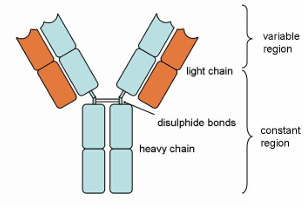
What is the structure of the antibody? How many types are there?
Structure:
Contains variable region (binds to outside cells) and Constant Region (attaches itself to cell surface)
Light chain (parallel to heavy chain on variable region)
Heavy chain (part of main antibody structure)
Held together by disulphide bonds
5 Immunoglobulin (Ig) Classes:
IgM (pentamer)
main antibody of primary respones, monomer form acts as B cell receptor
IgG (monomer)
main blood antibody of secondary responses, neutralizeds toxins, opsonization
Secretory IgA (dimer)
Secreted into mucs, tears, saliva, colostrum
IgE (monomer)
Antibody of allergy and antiparasitic activity
IgD (monomer)
B cell receptor (IgM monomer)
What are the 3 main Immune Components?
Infrastructure of Immune System
Humoral Substances (antibodies)
Cellular Components
What are the Cellular Components of the Immune System? What do they do?
Mast Cell - dilates blood vessels and induces inflammation through release of histamines and heparin; recruits macrophages and neutrophils; helps in wound healing and defense against pathogens, also uses in allergic reactions
Macrophage - Phagocytic cell that consumes foreign pathogens and cancer cells; stimulates response of other immune cells
NK Cells - kills tumor cells and virus-infected cells
Dendritic Cells - presents antigens on its surface, triggers adaptive immunity
Monocyte - differentiates into macrophages and dendritic cells in response to inflammation
Neutrophil - first responders at the site of infection or trauma; 50-60% of all leukocytes; releases toxins that kill or inhibit bacteria and fungi; recruits other cells to site of infection
Basophil - responsible for defense against parasites; releases histamines that cause inflammation and may be responsible for allergic reaction
Eosinophil - Releases toxins that kill bacteria and parasites but also cause tissue damage
What is an Immunogen? What is the characteristic of the best ones?
Molecules that can induce immune response (innate or acquired0
Bests immunogens are over 10,000 MW (carbs, nucleic acids, lipids are potential immunogens)
What is an Antigen?
Molecules which can stimulate production of and binds specifical to an antibody (antibody generator)
What is a Hapten?
Small molecule which, when combined with a larger carrier such as a protein, can elicit the production of antibodies which bind specifically to it.
What is an Epitope?
Also known as an antigenic determinant, is the specific structure in an antigen that binds to a specific antibody.
What are ways pathogens can enter the body?
Skin
Gastrointestinal track
Respiratory track
Urological track
Eyes and ears
What are the two types of immune response? What are characteristics of each?
Innate Immune Response
Firstline defense and fast
No memory
Primarly involves physical barriers, complement components, and immune cells like macrophages, neutrophils, NK cells, and dendritic cells
Releases proinflammatory cytokines
Release soluble antigens
Adaptive Immune Response
Acquired imunity
Acquired by responding to specific pathogen/antigen
Involves antigen presentation, T cells, B cells
Produces antibodyes, cytotoxic T cells, and memory T and B cells
Results in long term protection
What is the process of Innate Repsonse?
Bacterial, viruses, or other pathogens enter wound
Platelets from blood release blood-clotting proteins at wound sites
Mast cells secrete factors that mediate vasodilation, allowing blood plasma and cells to reach injured area
Neutrophils secrete factors that kill and degrade pathogens
Neutrophils and macrophages remove pathogens by phagocytosis
Macrophages secrete cytokines that attract and activate immune cells to initiate tissue repair
Inflammatory response continues until the foreign material is eliminated and the wound is repaired
Dendritic cells capture antigens
What are the outcomes of the Innate Immune Response?
Eliminate antigen/immunogen and restore homeostasis
Induce inflammation, a clinical symptom defined by pain, heat, redness, and/or swelling of the area of infection. Inflammation prevents establishment and spread of pathogens and faciliate wound repair.
Chronic Inflammation: prolonged inflammation that causes tissue destruction and development of inflammatory diseases such as arthritis, allergy, asthma, autoimmune diseases, hepatitis, inflammatory bowel disease, and transplant rejection
What are the two steps of Adaptive Immune Response? What types of cells are involved?
Antigen presentation
Activation of B and T Lymphocytes (B, T Cells)
B Cells
TH cells
TC cells
What is Antigen Presentation?
Antigen Presentation Cells (APCs) are located at common entry sites of pathogens
They express receptors that enable capture and response to antigens
Migrate from epithelia tissues via lymphatics to lymph node
Dendritic cells process and present the antigen to cell surface that binds to T cell receptor and activates T-cells
What are the two classes of Dendritic cells?
Classical Dendritic Cells (DC)
Most DCs in lymphoid organs/tissues, derived from myeloid precursors
Constantly sample environment
Upon encountering microbes/cytokines
Upregulator costimulatory molecules
Produce inflammatory cytokines
Mirgrate from peripheral tissue to draining lymph node
Plasmacytoid Dendritic Cells
Rare type of immune cell; develops in bone marrow and is less than 0l4% of peripheral blood mononuclear cells
Poorly phagocytic and do not sample environmental antigens
Major function: secretion of Type I interferon in response to viral infections
May also differentiate into cells similar as classical DC and present antigen to virus-specific T-cells
How are antigens presented?
MEdiated by major histocompatibility complex (MHC), group of cell surface proteins expressed on all nucleated cells of verterbratse.
Two types:
MHC Class I
MHC Class II
Explain the difference between MHC I and MHC II.
MHC I:
composed of alpha(heavy)-chain in a non-covalent complex with beta2-microglobulin
Recognized by CD8+ T Cells (Tc)
Accomodate peptides that are 6 to 16 amino acid residues in length
Expressed on all nuclealted cells
Process cytosolic proteins that are protelyticall degraded in the proteasome
MHC II:
Contain two MHC-encoded polymorphic chains, an alpha chain and a beta chain
Recognized by CD4_ T cells (Th)
Allows larger peptides (up to 30 amino acids) to bind
Expressed mainly on specialized APCs
Process extracellular proteins that are internalized into endosomes
 Note
Note  Flashcards (62)