Resting membrane potential
 Studied by 0 people
 Call Kai
 Learn
Learn Practice Test
 Spaced Repetition
 Match
Match Flashcards
 Knowt Play
1/30

There's no tags or description
Looks like no tags are added yet.
Name | Mastery | Learn | Test | Matching | Spaced | Call with Kai |
|---|
No analytics yet
Send a link to your students to track their progress
31 Terms
What is the resting membrane potential?
-65mV
What are the components of the mosaic model of the membrane? (4)
Phospholipids
Integral proteins
Peripheral proteins
Cholesterols
Regulate fluidity and permeability
Two main functions of model?
Impermeable to ions and organic molecules and so allows cell to maintain own intracellular environment
Insulator between 2 conductive salt solutions and so acts as a capacitor to store charge on the neuronal membrane
Function of proteins within the membrane?
Enables transport and communication across membrane and enables selective movement of molecules across membrane eg nutrients
What is Bernstein’s hypothesis?
Leak channels allow potassium ions to diffuse down
Corresponding anion doesn’t fit through
Ratio of potassium ions to anions different inside versus outside of cell
Causes inside to have net negative charge
At first diffusion is dominant force
Inside fluid becomes more negative, causes electrical force
No net movement so system in equilibrium
Define the equilibrium potential?
The electrical potential at which the chemical driving force and electrical driving force are equal and opposite and there is no net flow of ions
What ion are leak channels most permeable to?
Potassium (K+)
Is the concentration of potassium ions higher inside or outside the cell, and what does this then mean?
Inside – K ions flow along their concentration grad from inside to outside of cell
What does the movement of K ions mean then? (detailed)
There’s net accumulation of neg charges on inner leaflet of mem and so it becomes hyperpolarised relative to extracellular fluid
This generates an electrical force that tends to attract K ions back into the cell
What will happen due to the opposing electrical and chemical forces?
- First: diffusional grad is stronger than opposing electrical grad and continues to be net efflux of K+
- Eventually reaches electrochemical equilibrium
What is the membrane potential at which electrochemical equilibrium is reached defined by?
The Nernst equation
What is the Nernst equation?
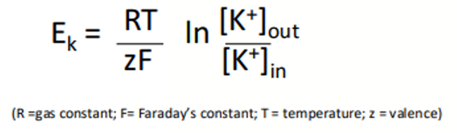
On what scale is the Nernst equation visualised?
Log scale
What do you see when you plot the Nernst equation for low values of extracellular potassium conc?
- Experimental measurements of the membrane potential clearly deviate from Nernst potential for K+ ions
Why does this deviation happen?
- Because leak channels are weakly permeable to other ions eg sodium
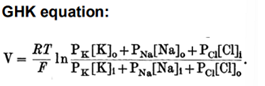
What does the Goldman-Hodgkin-Katz equation do?
- Accounts for contributions of all permeant ions weighted by their relative permeabilities
- This makes the actual resting potential slightly less negative than pure K+ equilibrium potential
What is the Goldman-Hodgkin-Katz equation?
What does the sodium potassium pump do?
- Actively transport 3Na ions out of the cell and 2K ions into the cell using energy provided by ATP
What happens with this pump due to imbalance in cation movement?
- The pump is electrogenic and will directly cause a small hyperpolarisation of the membrane
What is secondary active transport?
- Energy stored in the electrochemical gradient of an ion is used to drive the transport of another solute against a conc or electrochemical grad
What are the 2 types of secondary active transport?
- Exchange (antiport)
- Cotransport (symport) - movement of one down provides energy to move one against
What is predominately responsible for the resting membrane potential?
- The leak channels
If pumps were blocked what would happen?
- Small depolarisation due to the lost electrogenic activity of pump but potential does not collapse
What will an increase in ions mean on water movement?
- More ions, more water associated, so more water moves to ion side, water level rises
- As water movement increase, hydrostatic force increases and drives back until equilibrium and no net movement
More info on osmosis…
- Osmotic pressure on the membrane can cause cells to shrivel or swell
- Accumulation of ions inside neuron will lead to influx of water and corresponding increase in hydrostatic pressure will cause neuron to swell
- Lead to reductions in volume of extracellular space which affects conc and diffusion of molecules in extracellular fluid
What are aquaporins?
- Channels that facilitate water movement across a membrane
What can the neuronal membrane be represented as?
An RC circuit
What does the resistor represent?
- The leak channels allowing current to flow according the Ohms Law
What does the capacitor represent?
The charge storage on the membrane surface
When current flows, some of it charges the capacitor before a steady-state potential is reached
Sensitivity of the mem potential to K+ has led to evolution of mechanisms that tightly regulate extracellular potassium conc of brain. Give 2 examples.
- Blood brain barrier (specialisation of the walls of brain capillaries) limits movement of potassium intro extracellular fluid of brain
- Glia (particularly astrocytes) possess efficient mechanisms to take up extracellular K+ when conc rises as normally do during periods of neural activity - potassium spatial buffering
What does the separation of intracellular and extracellular conducting solutions provided by an extremely thin hydrophobic, insulating layer form?
- Electrical capacitate
 Note
Note  Flashcards (31)