9 - differentiation
 Studied by 0 people
 Call Kai
 Learn
Learn Practice Test
 Spaced Repetition
 Match
Match Flashcards
 Knowt Play
1/35

There's no tags or description
Looks like no tags are added yet.
Name | Mastery | Learn | Test | Matching | Spaced | Call with Kai |
|---|
No analytics yet
Send a link to your students to track their progress
36 Terms
what is the chain rule
dy/dx = dy/du x du/dx
where y is a function of u
and u is a function of x
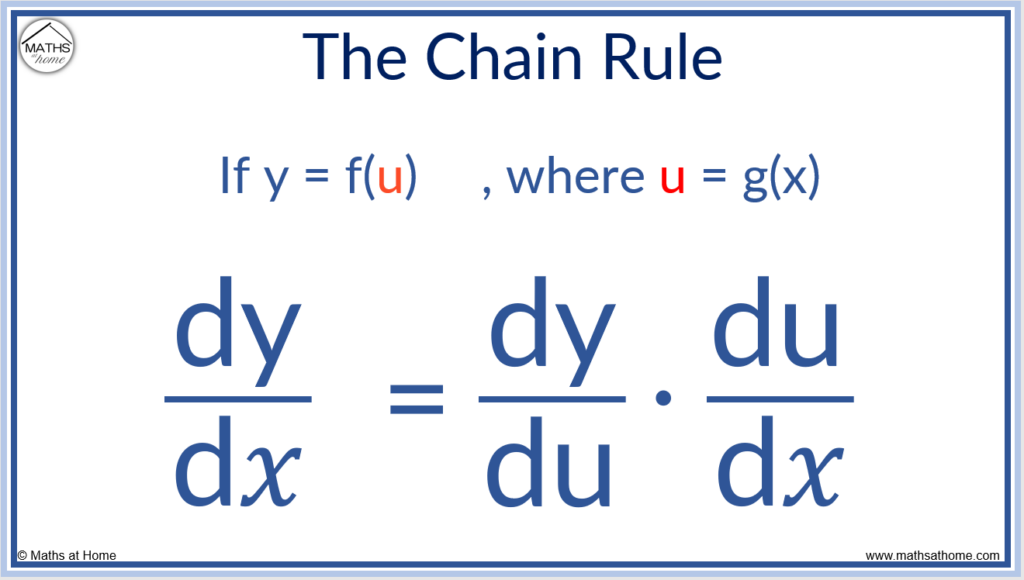
example of the chain rule: differentiate y = (2x + 4)3
define u and y
let u = 2x + 4
let y = u3
differentiate both
du/dx = 2
dy/du = 3u2
use the chain rule - multiply them
dy/dx = 6u2
replace u so its all in terms of x
dy/dx = 6(2x+ 4)2
easier way of thinking of the chain rule
differentiate the bracket then times it by the derivative of what’s in the bracket
(2x + 4)3 —> 2 × 3(2x + 4)2 —> 6(2x + 4)2
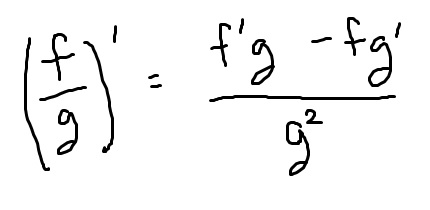
what’s the quotient rule
works when y = f/g
works when f and g are functions of x
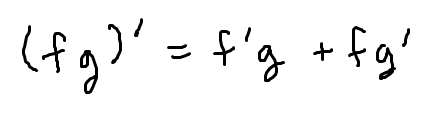
what’s the product rule
when y = fg
when f and g are functions of x
when you are differentiating angles and trigonometry, what do you HAVE to do
use RADIANS
differentiate y = sinx
dy/dx = cosx
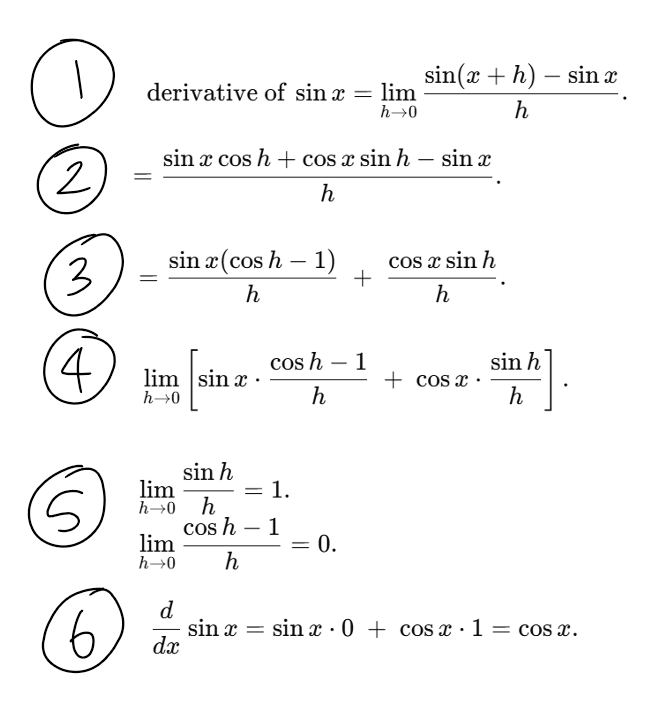
differentiate sinx from first principles
write it out in first principles equation (swap ‘f’ for ‘sin’)
use addition formula to rewrite ‘sin(x+h)’
group the terms involving sin x and cos x (factorise)
set the limit for h as going to 0
use small angles to rewrite ‘sinh’ and ‘cosh' (just learn them don’t bother with why)
evaluate it with the new ‘0’ and ‘1’ you got from step 5
how do you differentiate y = sinf(x) or y = f(sinx)
use the chain rule!
differentiate y = cosx
dy/dx = -sinx
(the negative is VERY important)
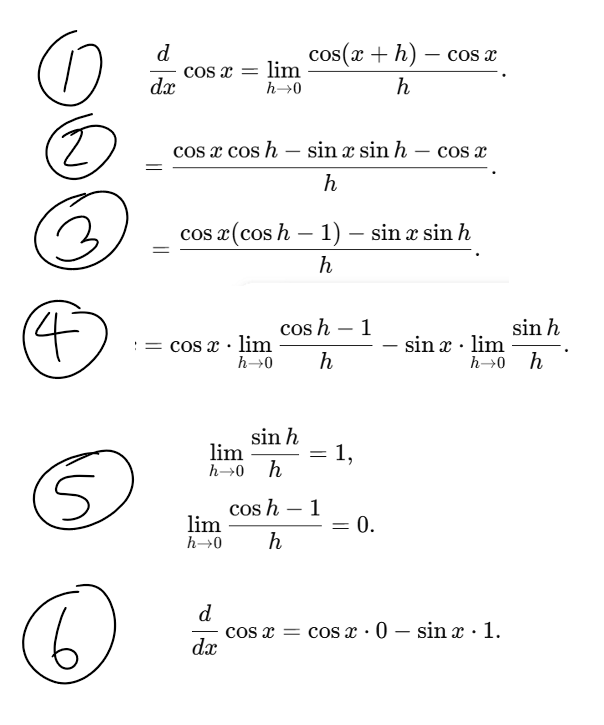
differentiate cosx from first principles
write it out in first principles equation (swap ‘f’ for ‘cos’)
use addition formula to rewrite ‘cos(x+h)’
group the terms involving cos x (factorise)
set the limit for h as going to 0
use small angles to rewrite ‘sinh’ and ‘cosh' (just learn them don’t bother with why)
evaluate it with the new ‘0’ and ‘1’ you got from step 5
how to differentiate y = cosf(x) or y = f(cosx)
use the chain rule!!
differentiate y = tanx
dy/dx = sec2x
proof for differentiating tanx
rewrite tanx as sinx/cosx
use the quotient rule
use trig identities to make the numerator 1
1/cos2 = sec2 as req.
how to differentiate y = tanf(x) or y = f(tanx)
use the chain rule
differentiate y = ef(x)
dy/dx = f’(x)ef(x)
similar vibes to the chain rule
reciprocal rule
dy/dx = 1/dx/dy
use when you have to differentiate something in terms of y
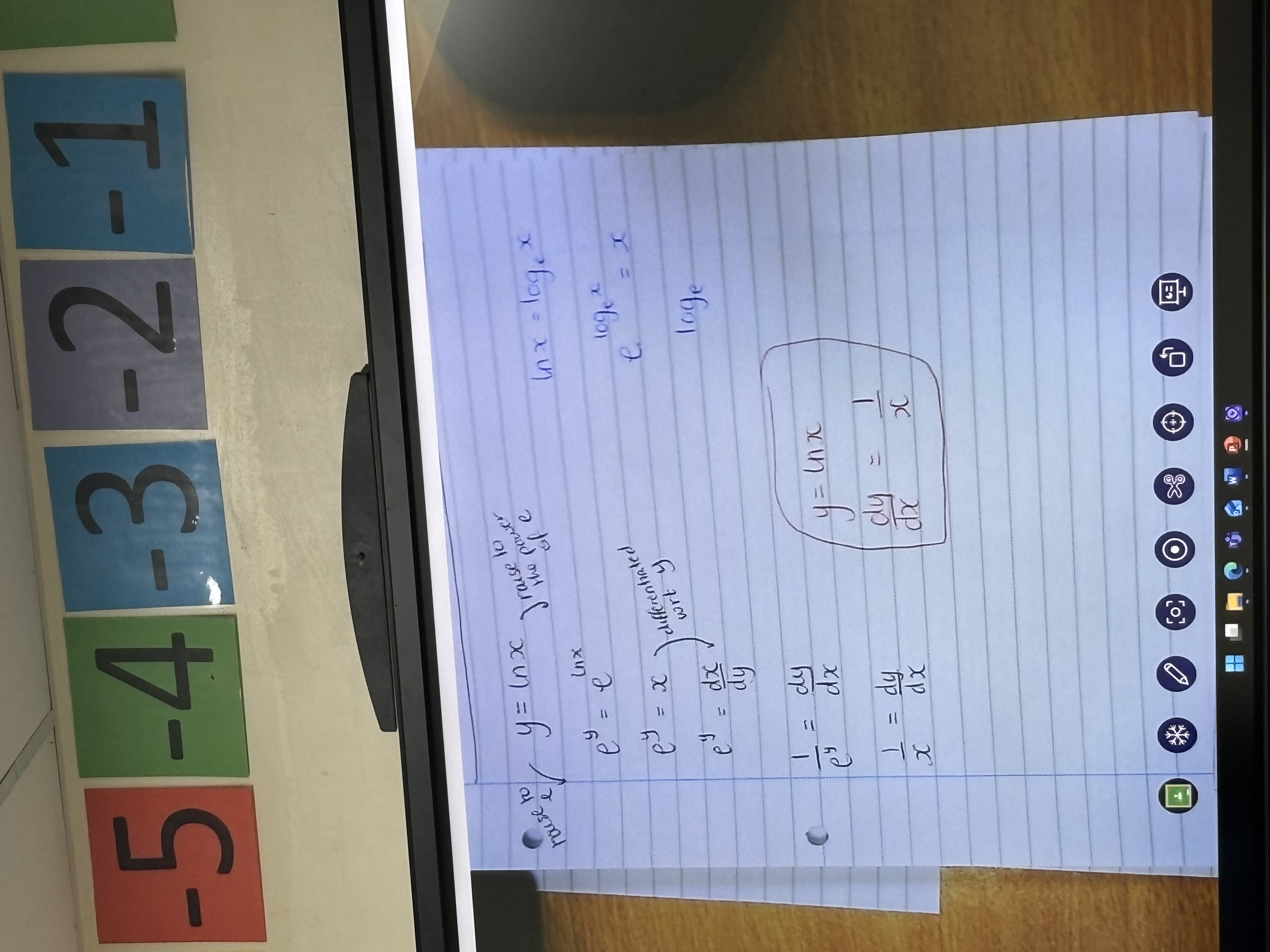
differentiate y = lnx
dy/dx = 1/x
proof in the photo
differentiate y = ln[f(x)]
dy/dx = f’(x)/f(x)
(derivative over original function)
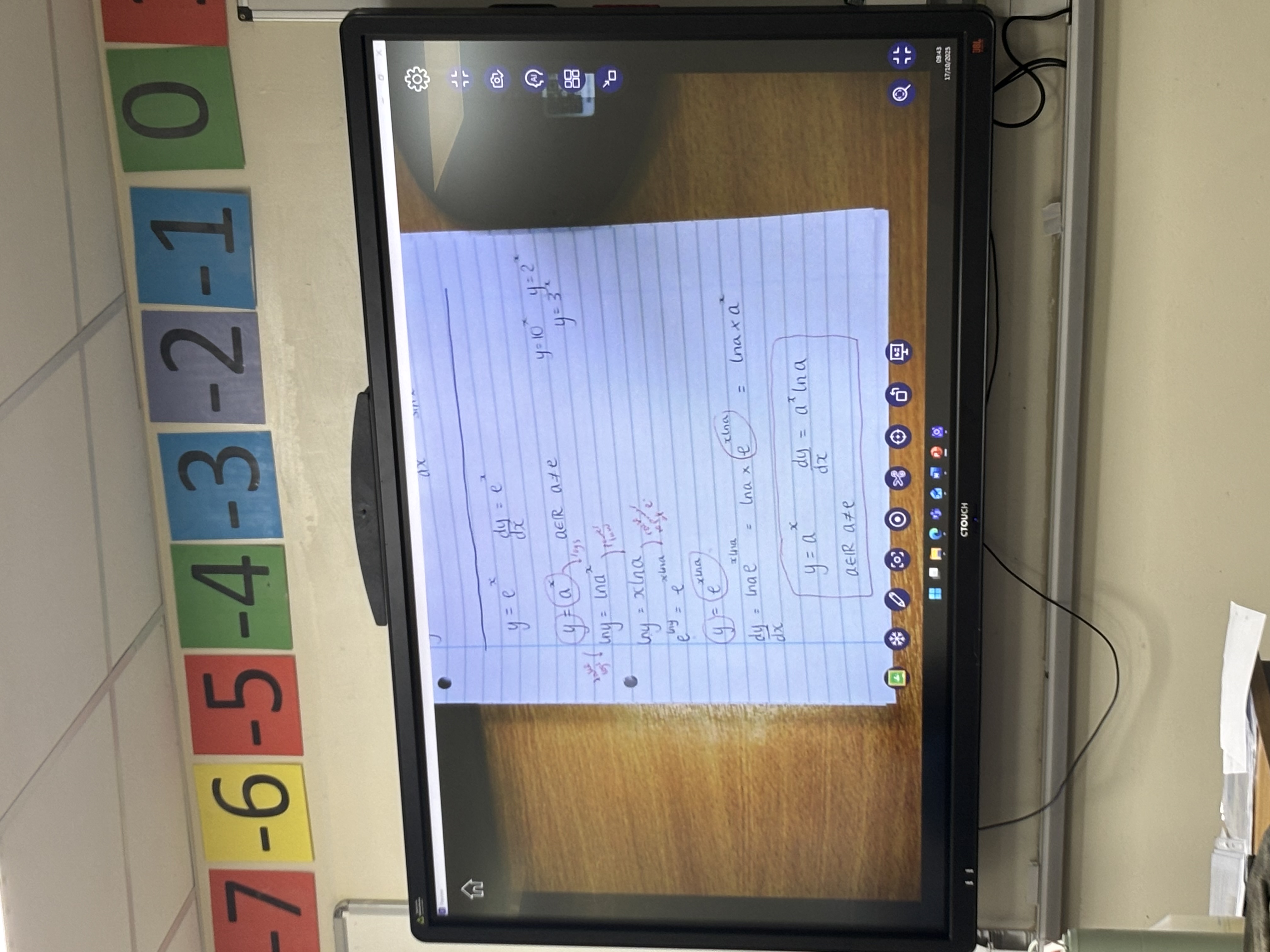
how to differentiate exponentials with no e
the rule and proof is as follows (in the picture)
so if y = ax
then dy/dx = axlna
differentiate cosec x
-cotxcosecx
proof for differentiating cosec x
rewrite as 1/sinx
rewrite as (sinx)-1
differentiate using the chain rule
rewrite to get the answer we have
differentiate cotx
cosec2x
differentiate secx
secxtanx
proof for differentiating cot and sec
same concept as cosec
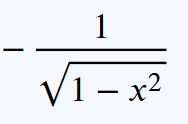
differentiate arcsinx
.
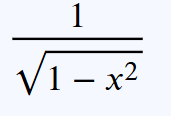
differentiate arccosx
.
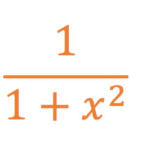
differentiate arctanx
.
where can you find the derivatives of arcsin, arccos, and arctan
the FM section of your booklet
how to differentiate a function of y with respect to x
differentiate as normal
then multiply by ‘dy/dx’
eg. y2 —> 2y(dy/dx)
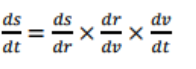
how can derivatives be connected
like fractions
where and what is a point of inflection
what: where the function goes from concave to convex or vice versa
where: when y’’ = 0
what to be careful with with POIs
y’’=0 is not always a poi so check 0.01 to either side of it to check if there is a change in concavity or not
what can we use the chain rule for also
parametric differentiation
how does parametric differentiation work
dy/dx = dy/dt x dt/dx
so if u differentiate both of the equations in the parametric, then flip one around, you’ll have your dy/dt and dt/dx so you can find dy/dx (it would be in terms of t)
do u always have to parametrically differentiate parametric eq.s
no if its easier to do the cartesian version then u can
but both are valid options just do the easiest
 Note
Note  Flashcards (106)