practical lab 4: kingdom animalia - vertebrates
 Call Kai
 Learn
Learn Practice Test
 Spaced Repetition
 Match
Match Flashcards
 Knowt Play
1/56

There's no tags or description
Looks like no tags are added yet.
Name | Mastery | Learn | Test | Matching | Spaced | Call with Kai |
|---|
No analytics yet
Send a link to your students to track their progress
57 Terms
Phylum Chordata
Organisms in Phylum Chordata has 5 major features:
Dorsal, hollow nerve cord → becomes the brain and spinal cord in mammals
The notochord → a cartilaginous rod that develops dorsal to the primitive gut in the early embryo. In lower chordates the notochord persists throughout life. While in vertebrates it becomes the soft centre of the intervebral discs
The presence, during in the life cycles, of paired pharyngeal pouches in the pharynx or throat.
A gland or tissue which concentrates iodine
A post-anal tail → extends past the exit of the anus
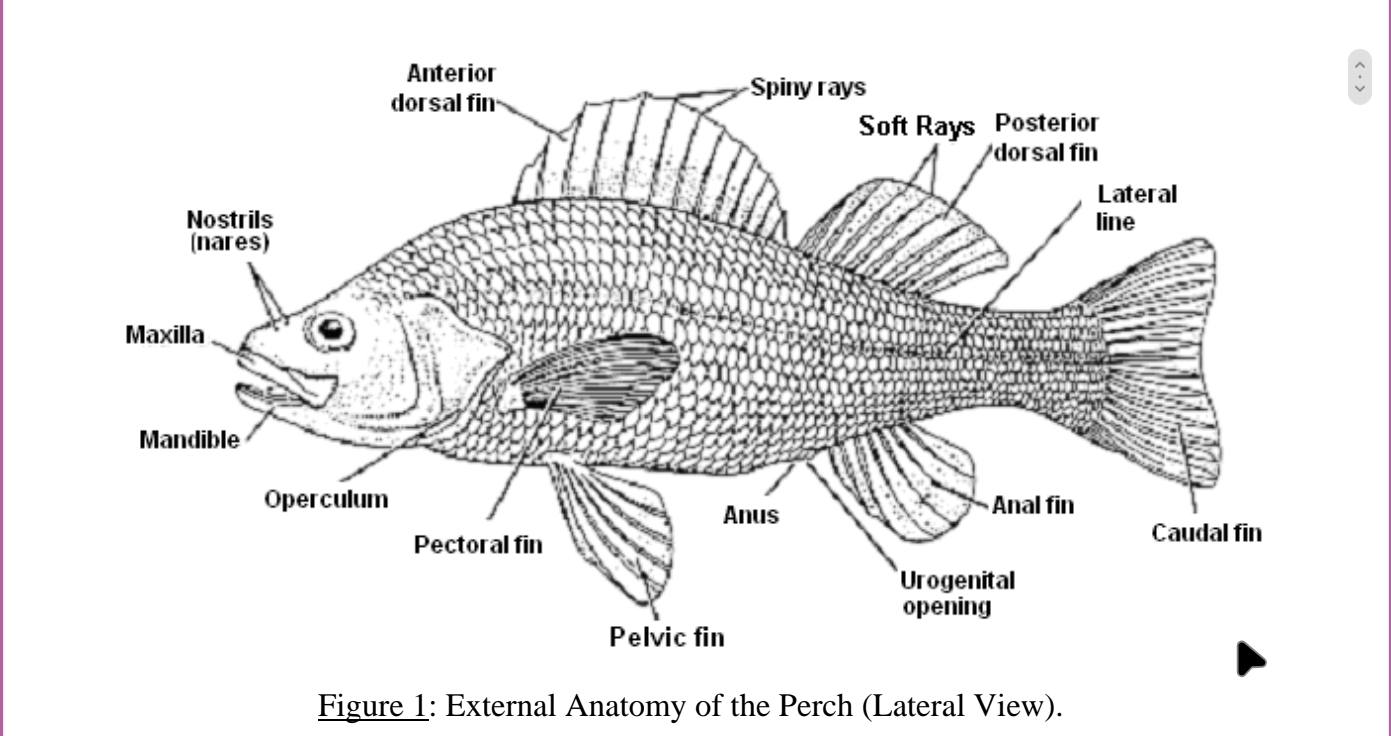
Phylum Chordata (Subphylum Vertebrata) - Perch External features
Perches have a fusiform body shape
meaning it is laterally flattened and streamlined to minimize resistance as the fish moves through it's aquatic environment
Their body is covered by small overlapping scales which also minimixe resistance to movement
Additionally they have a layer of mucous that covers the scales to form a protective layer
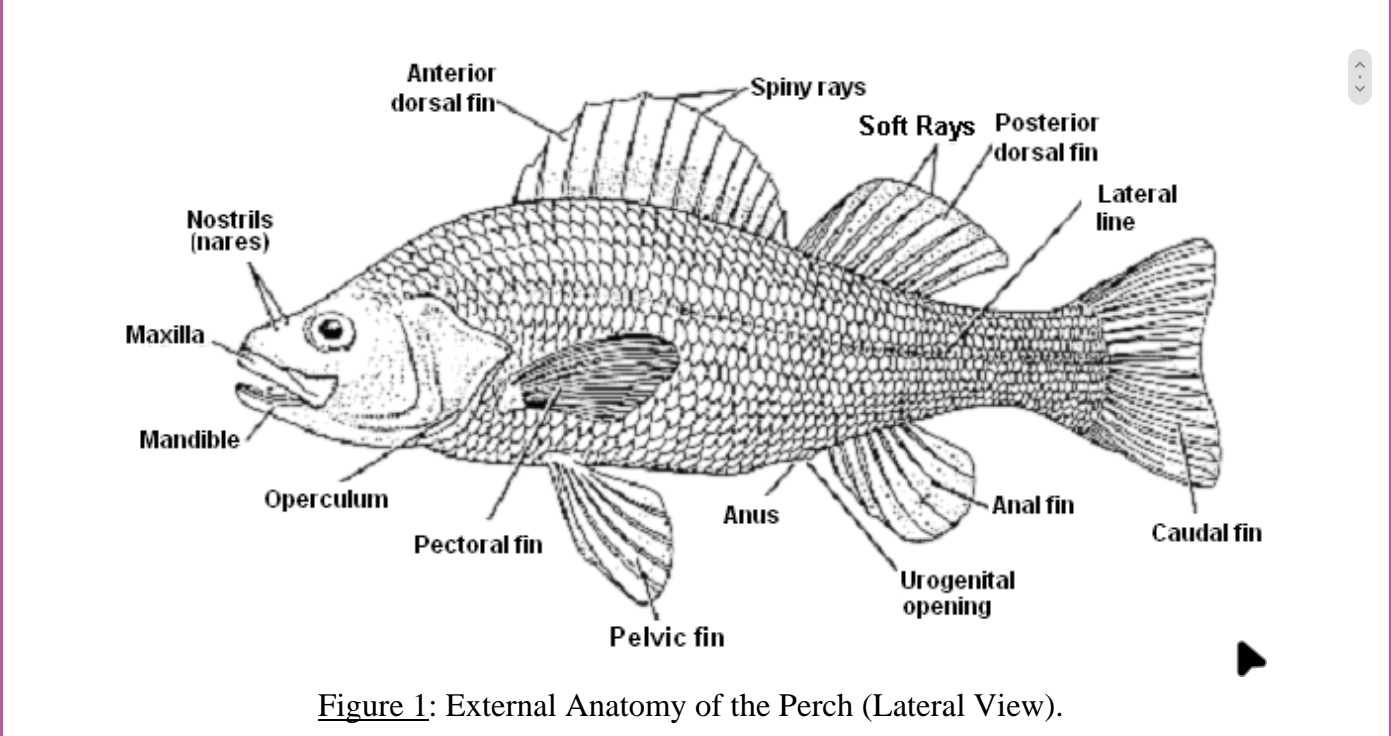
Phylum Chordata (Subphylum Vertebrata) - Perch ventral & lateral surface features
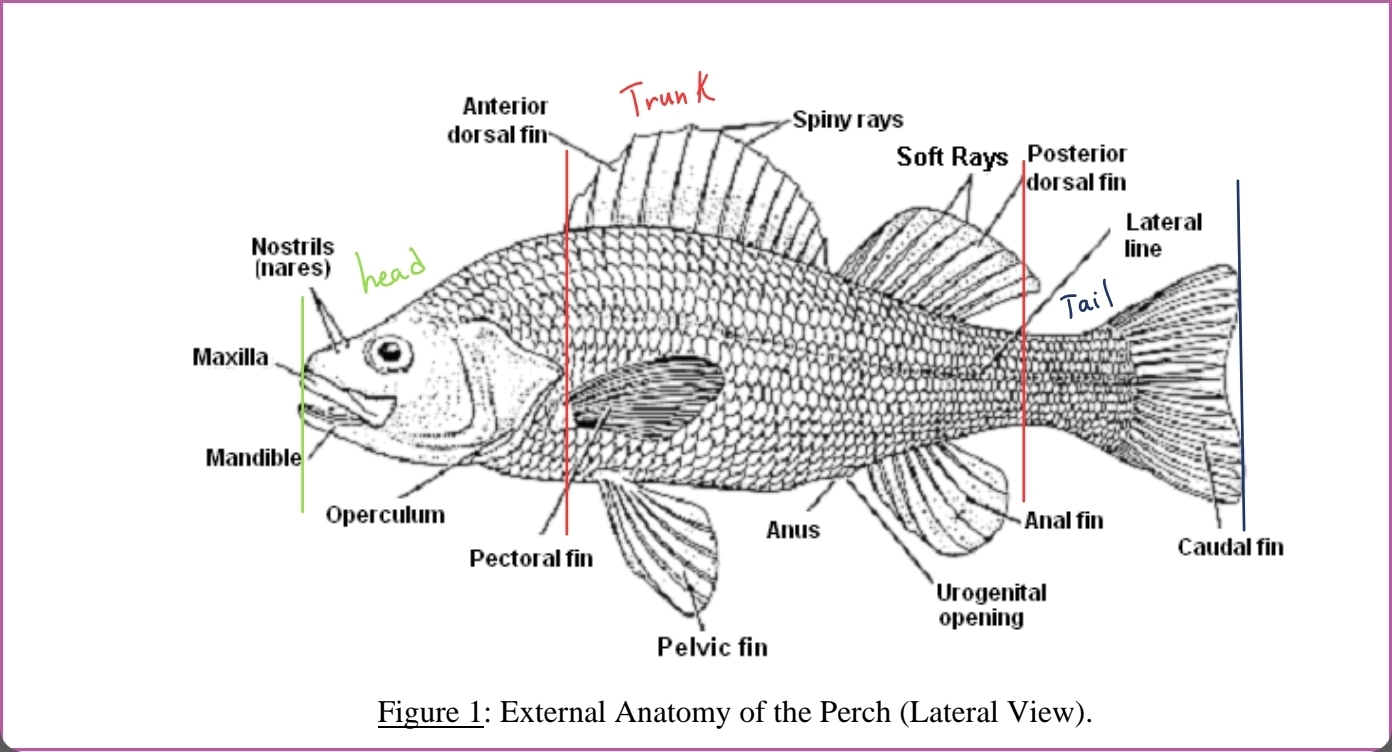
On the ventral surface there are two openings
The larger more anterior opening - anus
Smaller more posterior opening - urogenital opening
On the lateral surface there is aa large crescent-shaped opening to the gill chamber
an operculum is a bone that covers the gill chamber
underneath are the four gill arches with gills on each one
Additionally there is a lateral line system that is formed of modified scales containing sensory pits
it functions in detection of vibrations of low frequenct or movements in the water
Phylum Chordata (Subphylum Vertebrata) - Perch Body (3)
The perch body is divided into 3 parts:
Head
Trunk
Tail
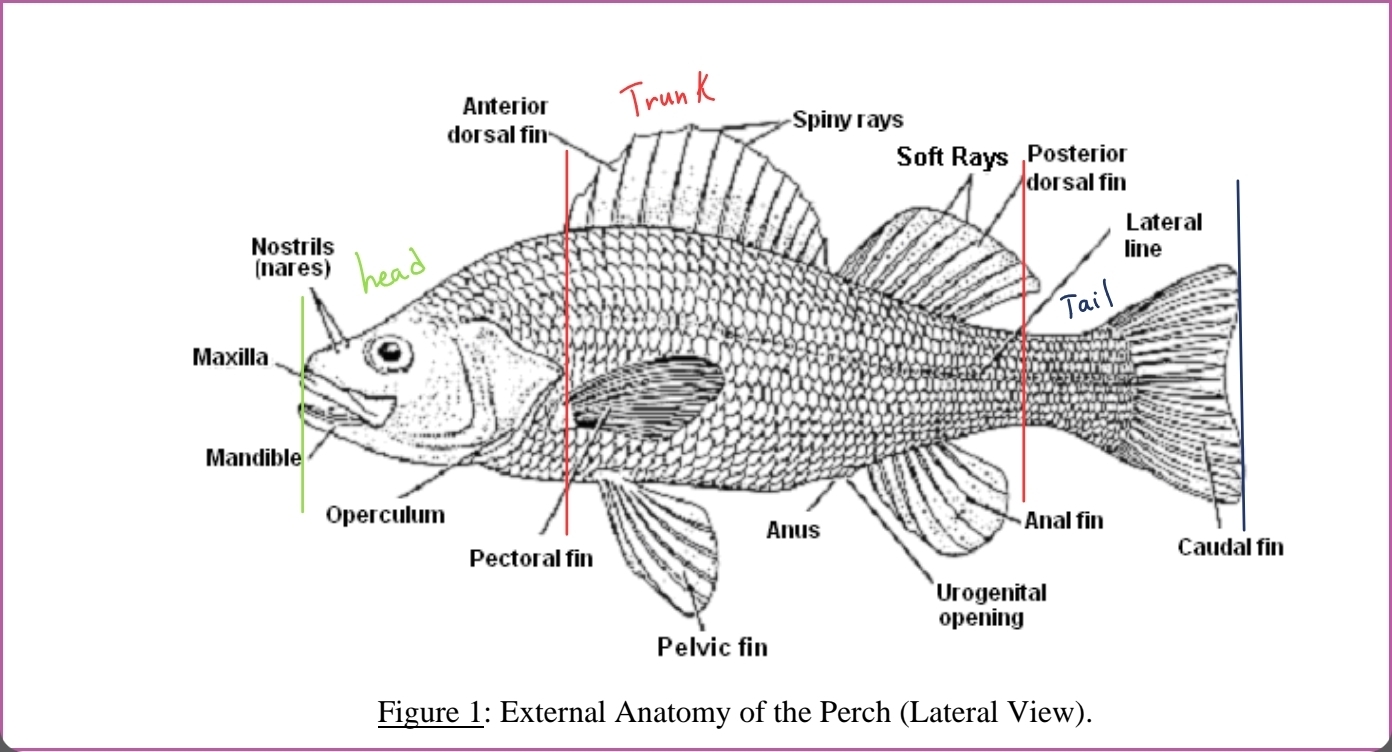
Phylum Chordata (Subphylum Vertebrata) - Perch Head
The head has:
the terminal mouth that is positioned there because of the mode of feeding (modified)
the perch feeds by overtaking prey while swimming
inside contains many sharp teeth
Above the mouth are nasal apertures (nares), two on each side.
If you would to push something through the anterior nare it would come out the posterior nare
these are not connected to the mouth
Eyes have no eyelids but are covered by a transparent integument
the lateral location of the eyes prevents binocular vision
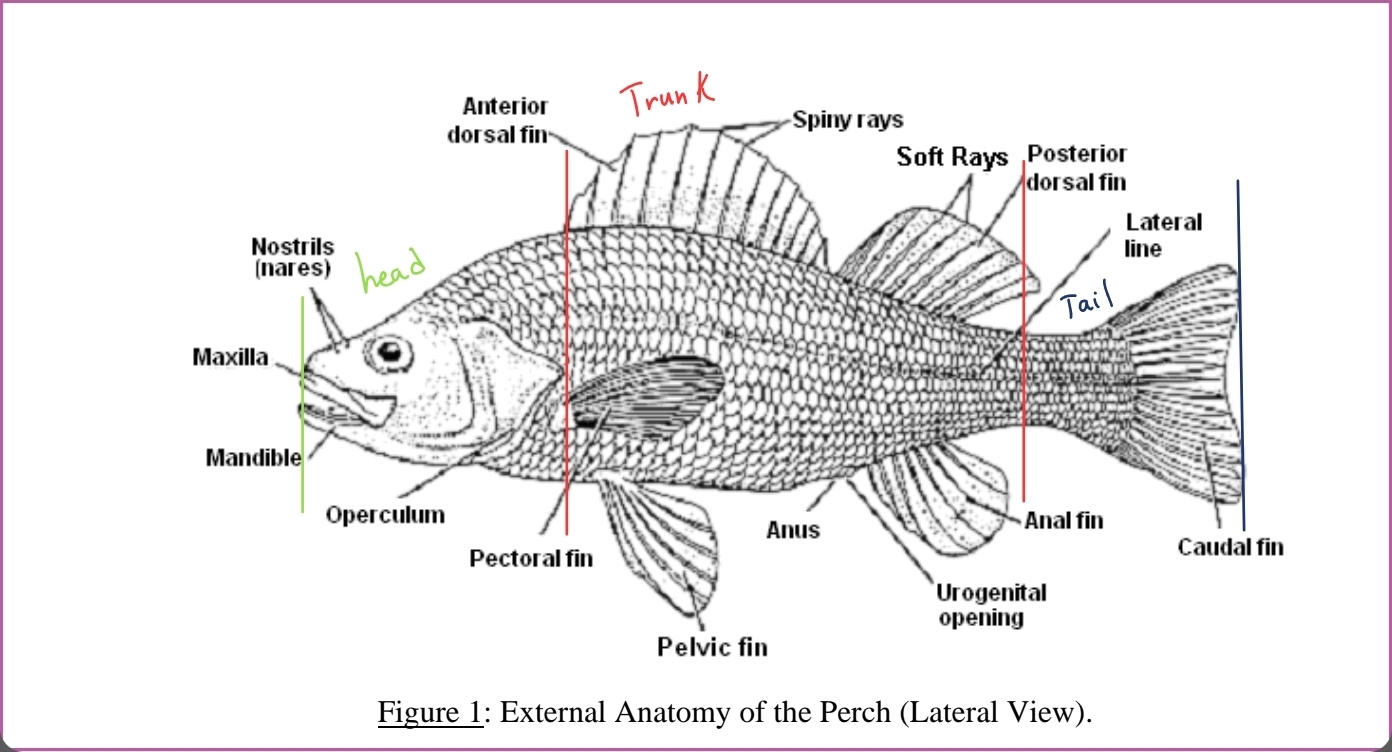
Phylum Chordata (Subphylum Vertebrata) - Perch trunk
The trunk has:
Two sets of paired appendages (fins) located on the trunk of the perch
these fins are homologous to the paired appendages of tetrapods
Posterior to the opercula are the two pectoral fins
these are attached to the pectoral girdle
Posterior & ventral to the pectoral fins are the pelvic fins
Phylum Chordata (Subphylum Vertebrata) - Perch Tail
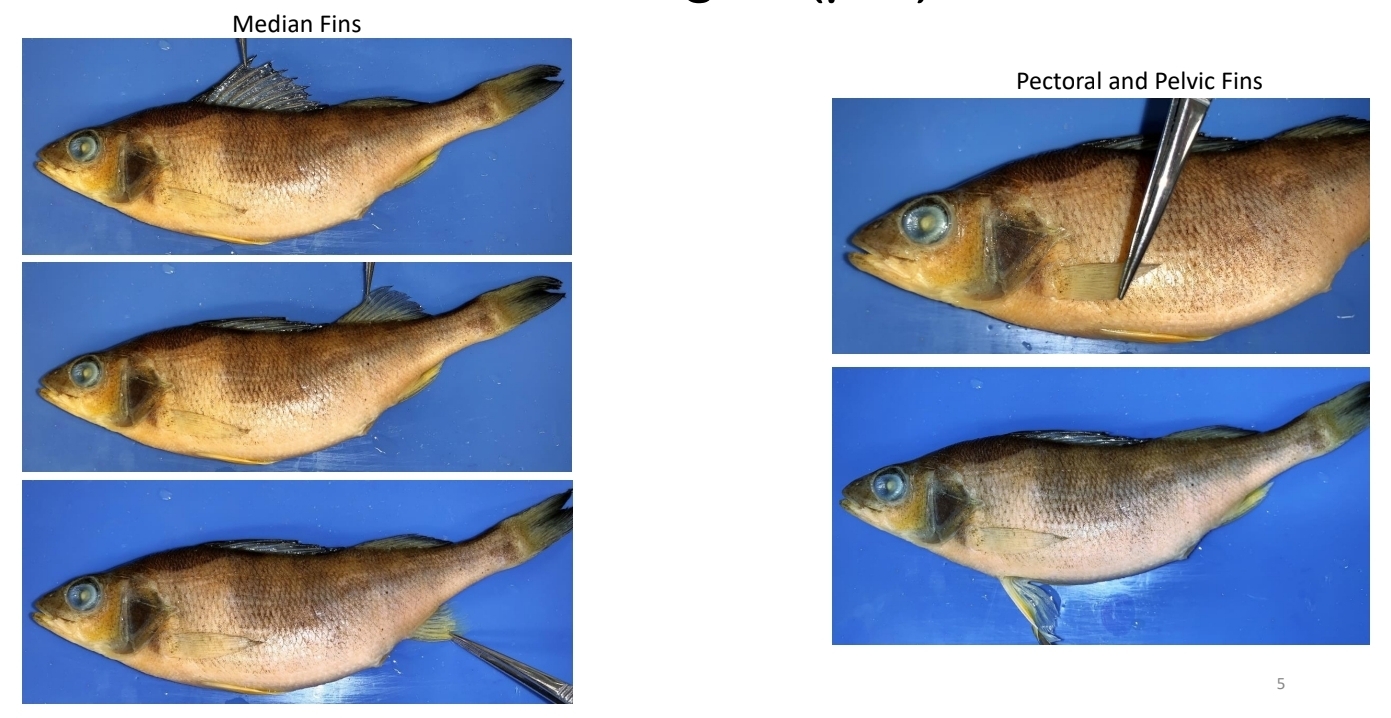
The tail tapers from the trunk and ends as a laterally compressed paddle
the symmetrica; caudal fin surrounds the fleshy end of the tail
this type of symmetrical caudal fin is correlated with the presence of a swim bladder
Phylum Chordata (Subphylum Vertebrata) - Perch: The median fins
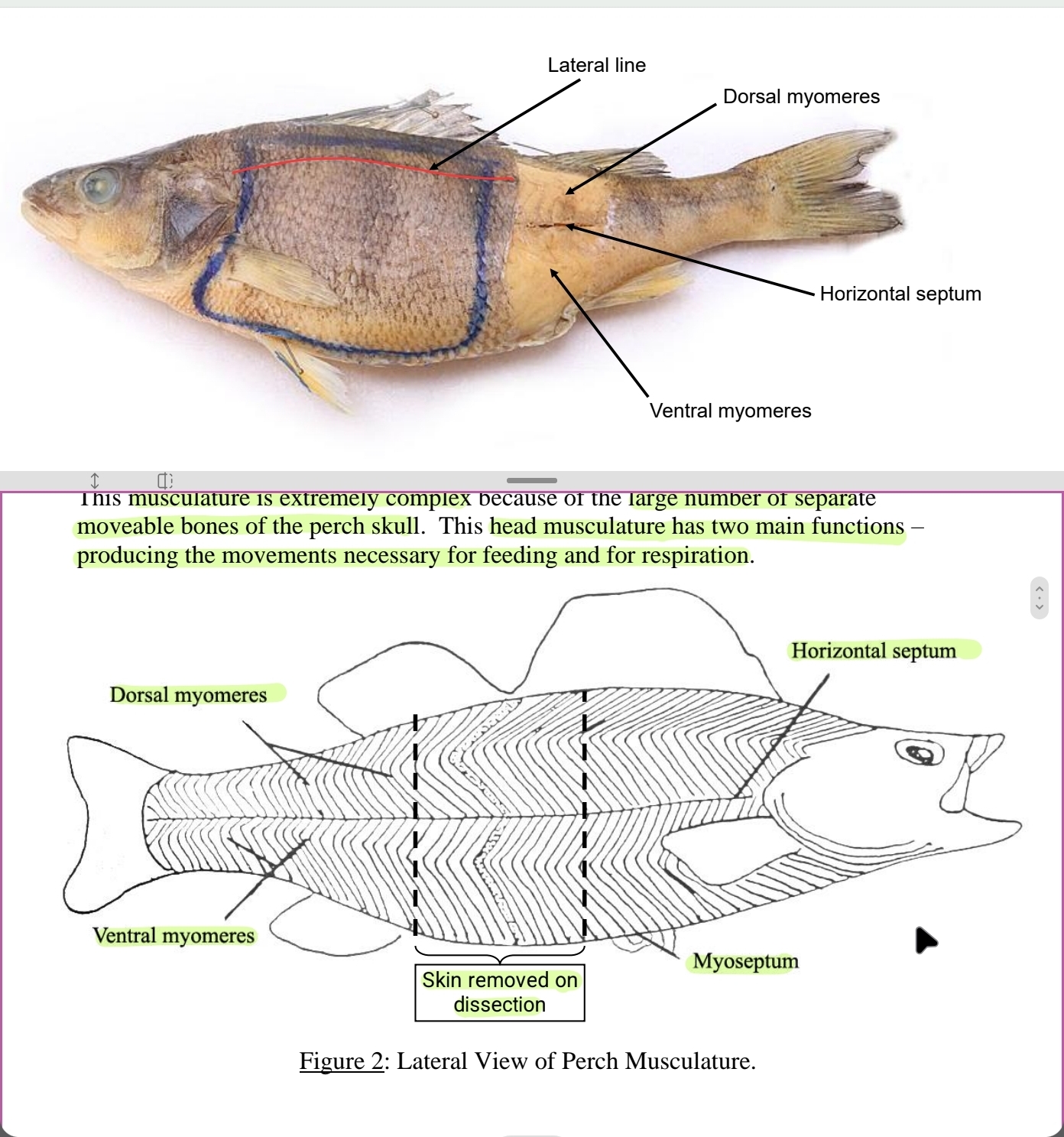
There are 4 median unpaired fins
they are: caudal fin, anal fin, anterior dorsal fin, and posterior dorsal fin
Phylum Chordata (Subphylum Vertebrata) - Muscular System
Muscles are what allow the animal to move, eat and bear young
Most muscles can be separated into:
Axial muscles - muscles in the longitudinal axis of the body
associated with the axial skeleton
Appendicular muscles - muscles that arefor limbs and girdles
associated with the appendicular skeleton
The remainder skeletal muscles are associated with eyes & jaws
and in fish, the gills and opercula
Phylum Chordata (Subphylum Vertebrata) - Perch Muscle system
The muscles of the perch are not as complex as tetrapod vertebrates
muscles of the perch are axial muscles and have twice the muscle mass of most tetrapods
the perch moves via lateral undulations of the body produced by waves of contraction of the axial muscle mass
though larger muscle mass is required for locomotion
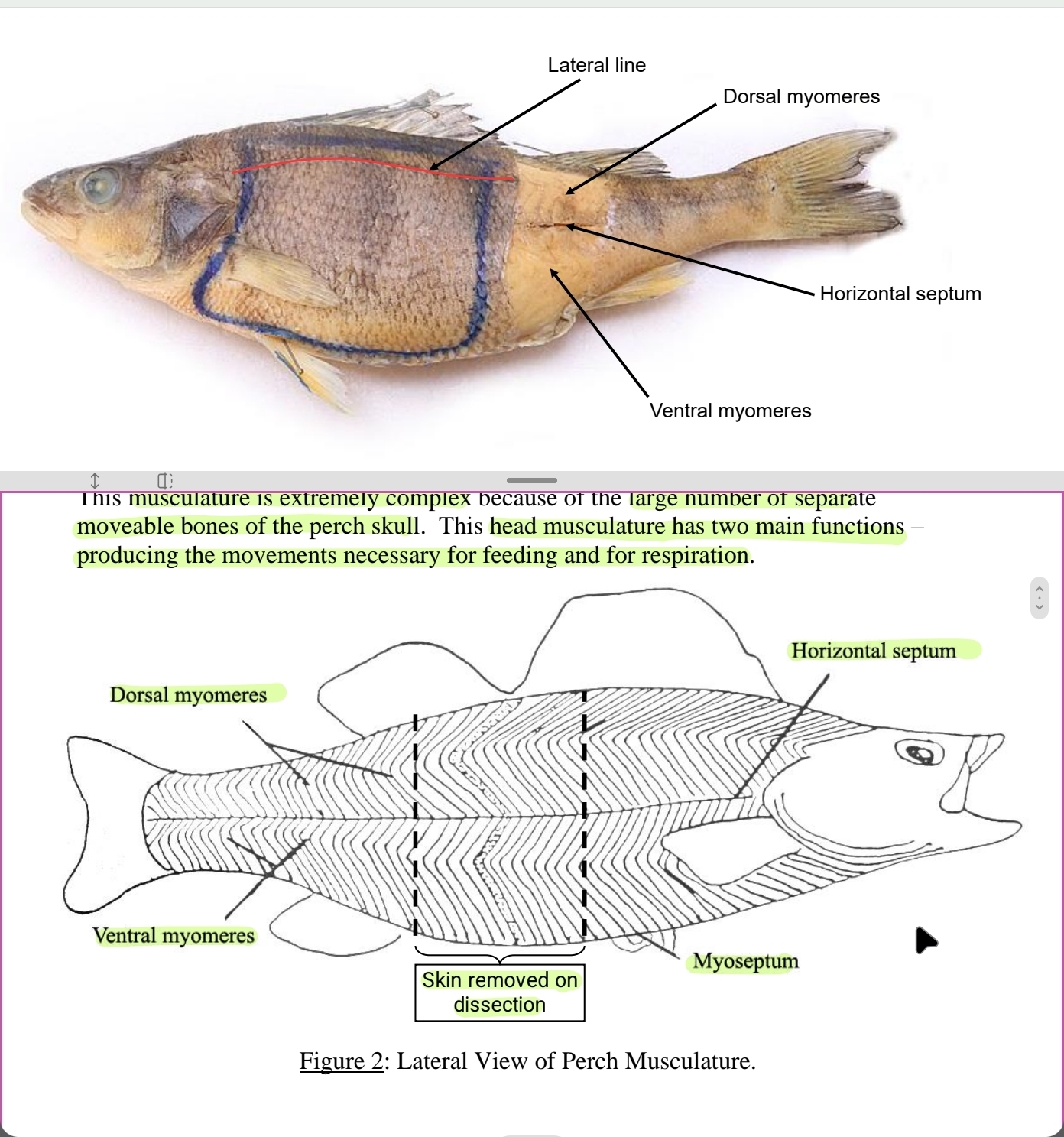
Phylum Chordata (Subphylum Vertebrata) - Perch Axial muscle
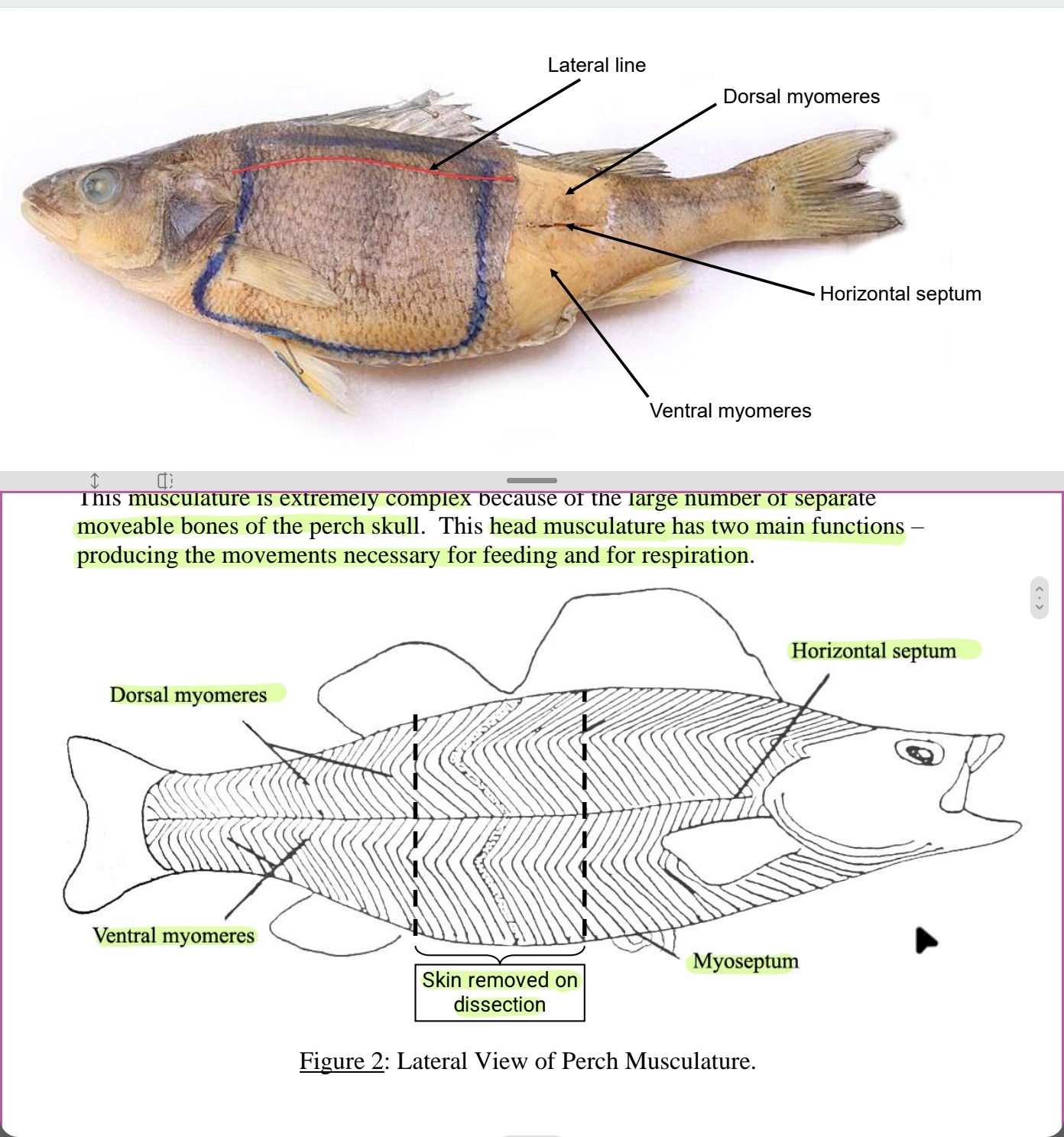
The axial muscles are composed of myomeres
aka series of muscle segments
myomeres are sepearated by myosepta (bands of connective tissue)
A horizontal septum divides the myomeres into dorsal and ventral portions
the main function is not locomotion but to support the body
Usually small and simple in smaller fish because paired fins are used to inc stability & maneuverability
The other muscles are used for the jaws, gills, opercula and skull
the head muscles function in producing movements necessory for feeding and for respiration
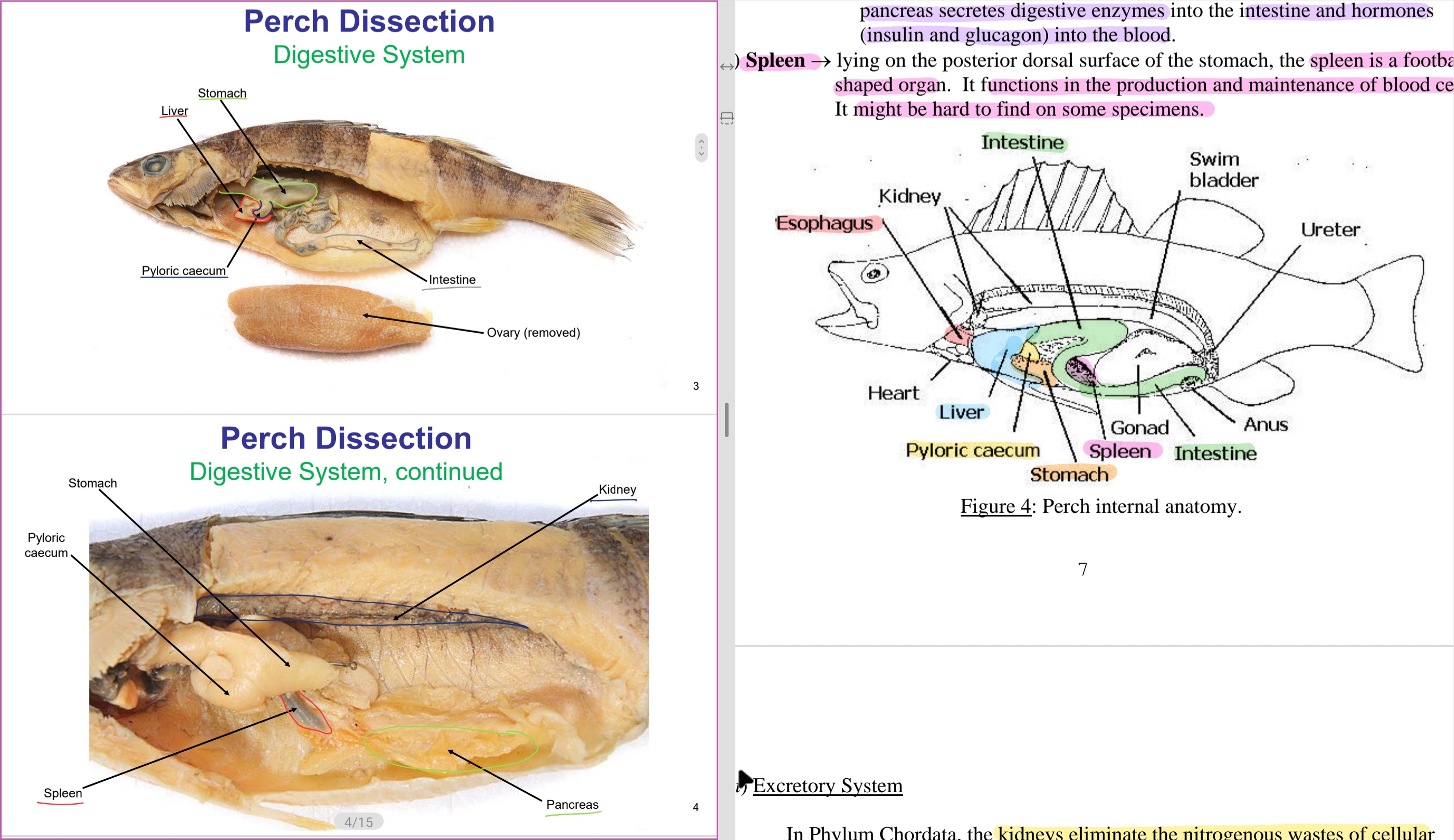
Phylum Chordata (Subphylum Vertebrata) - Digestive tract
The gastrointestinal tract (digestive tract) begins at the mouth and empties into a cloaca or exits through anus
The ingestion, digestion and absorbtion of food & removing undigested wastes are the main functions
The tract include the oral cavity (mouth), pharynx (throat), esophagus, stomach, small intestine and large intestine
Accessory organs are: teeth, tongue, salivary glands, liver and gallbladder
Phylum Chordata (Subphylum Vertebrata) - Digestive tract: What is produced and how is it transported?
Mesentary extrans from the median dorsal wall which suspends the organs
Blood vessels and nerves extend into the organs via the mesentery and serves as a place where diffusion occurs for fluids and enzymes
Products of digestion (monosaccharides, glycerol, fatty acids, and amino acids) all diffuse across the epithelial cells
Phylum Chordata (Subphylum Vertebrata) - Digestive tract: How are plants digested?
Walls of plant cells are not digestible by animal enzymes and tend to be mixed with digestible matter
this makes the process takes considerably longer in animals, especially in herbivores
Herbivores intestines are longer than omnivores and carnivores and depend on bacteria & protozoa to break down cellulose
many have large blind sac or tube called a caecum at the junction of the small and large intestines where food is held and processed
Caeca increase the surface area for digestion
Phylum Chordata (Subphylum Vertebrata) - Digestive tract: In fish
In fish, the mough opens into the oropharyngeal cavity
this extends to the esophagus
both respiratory water and food are taken in through the mouth
Fish have a primary tongue that is an elevation of the floor of the oropharynx, which is immoveable
Fish do not have any salivary glands
In carnivorous fish, like the perch, the teeth are used to capture and hold the prey so it can be swallowed
Phylum Chordata (Subphylum Vertebrata) - Digestive tract: In mammals
In mammals, the mouth opens into the oral cavity, which extends to the pharynx
the palate separates the respiratory and oral cavities enabling breathing and processing of food in the oral cavity to occur simultaneously
most have a moveable protrusive tongue, which is used to manipulate materials in the oral cavity but may also be used in procuring food or water
all mammals have salivary glands
they function as a lubricant and contain enxymes which begin the digestion of carbs.
Phylum Chordata (Subphylum Vertebrata) - Digestive tract: Mammals teeth
All mammalls have teeth that reflect it's diet
Molars are teeth with flat surfaces for crushing and milling and are characteristic of herbivores
Premolars are used for shearing, cutting, and slicing
except in advanced herbivores where they function like molars
Incisors are chisel-shaped teeth in the front are useful for biting
Pointed teeth or Canines (for mammels) are characteristic of carnivores and are useful for tearing flesh as well as catching and holding prey
Phylum Chordata (Subphylum Vertebrata) - Digestive tract: What has specialization in feeding caused?
Specialization in feeding have reduced competition among mammals
Differences in denition are important in identifying and classifying different groups
In addition, with rare exceptions, each mammalian specis has a set number of teeth
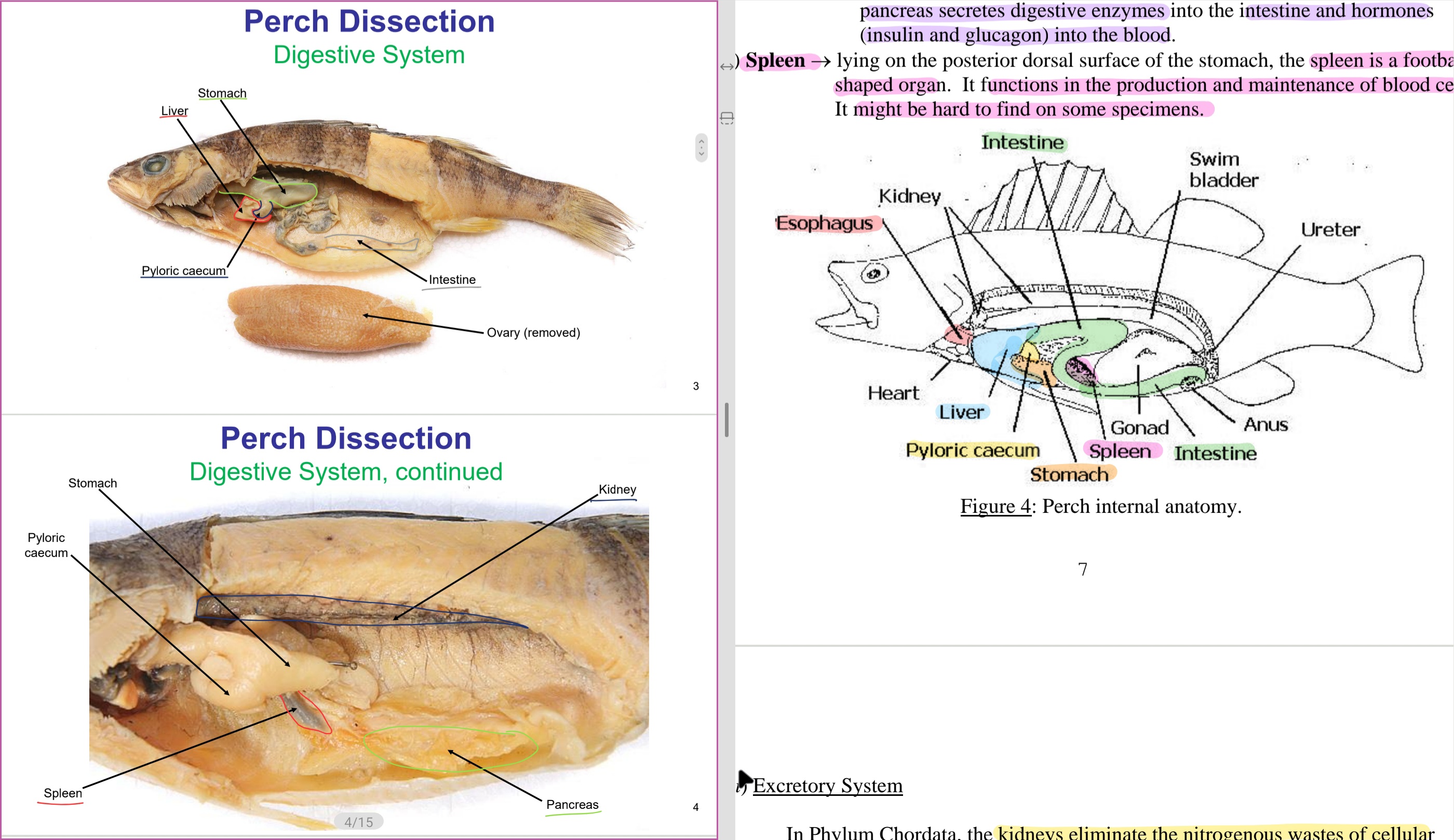
Phylum Chordata (Subphylum Vertebrata) - Perch Digestive tract (Esophagus, Stomach)
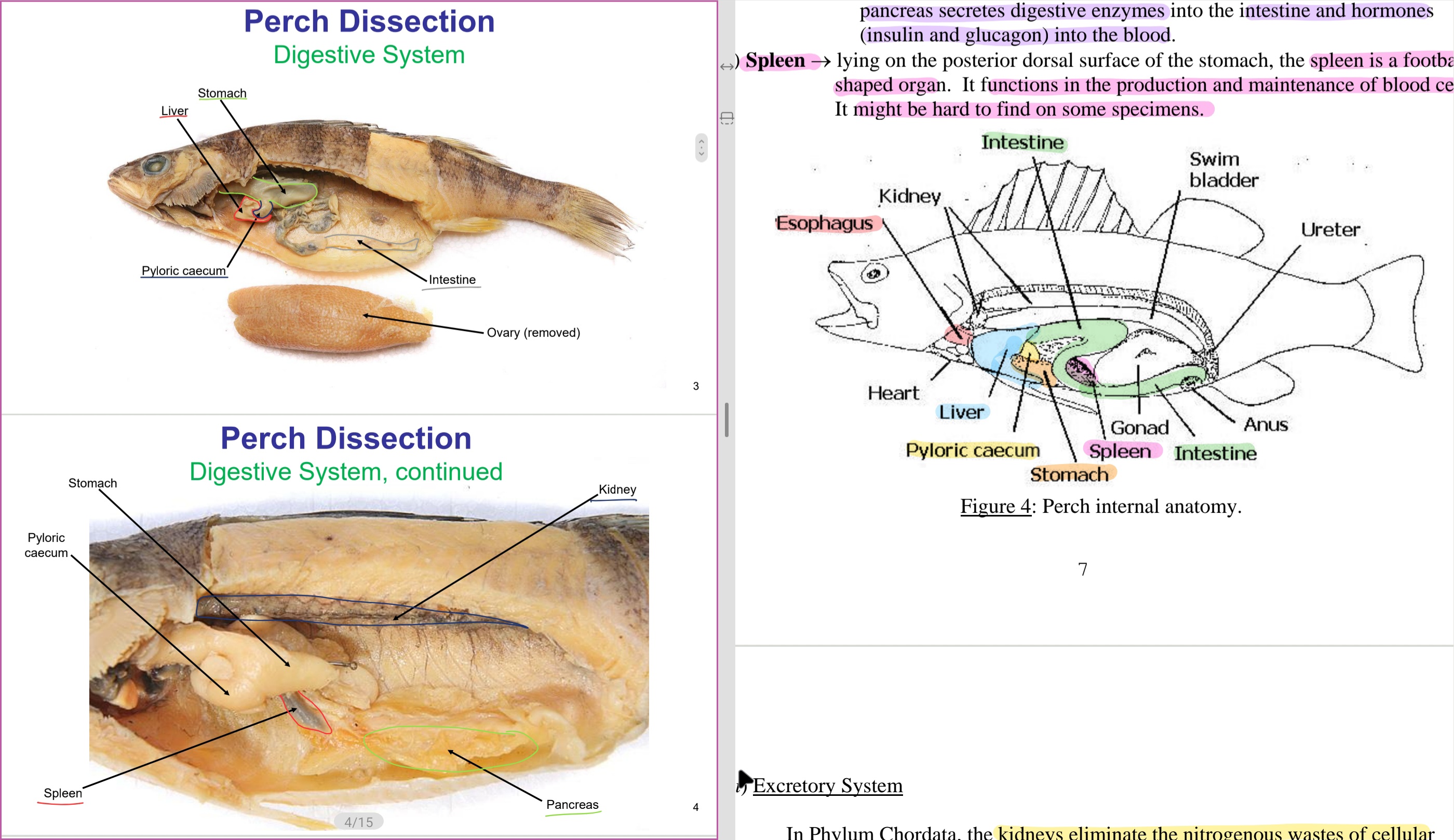
The digestive tract of the Perch includes:
Esoophagus - located at the extreme anterior end of the body cavity. A short, straight tube leading from the oropharynx to the stomach
Stomach - a large, thick-walled U-shaped tube. Breakdown of food by mechanical & chemical means begins in the stomach
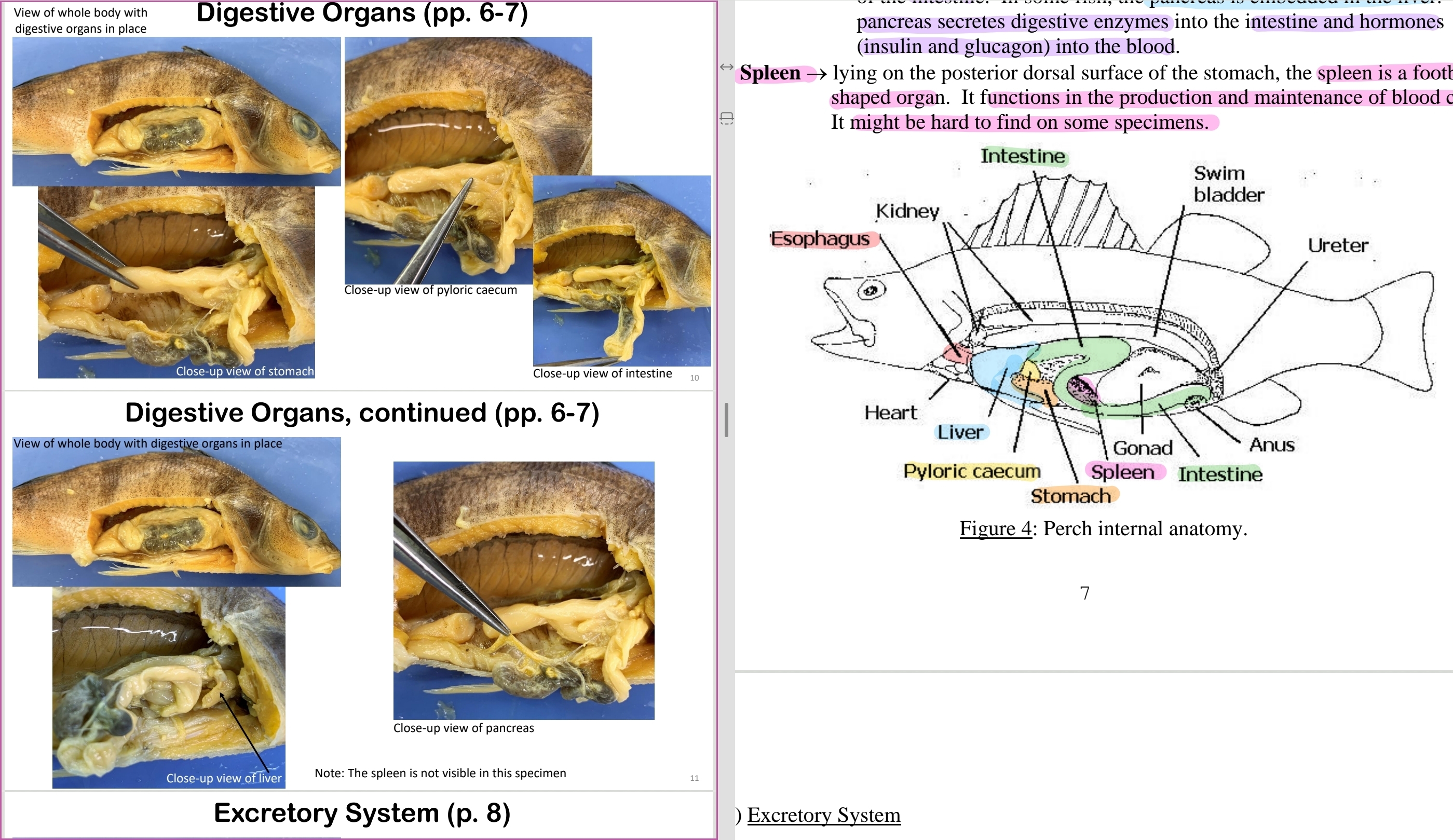
Phylum Chordata (Subphylum Vertebrata) - Perch Digestive tract (Pyloric Caeca)
Pyloric caeca - the junction of the stomach and the intestine is marked by the presence of 3 pyloric caeca. These are blind-ended tubes extending from the gut that serve secretory & absorptive functions
Phylum Chordata (Subphylum Vertebrata) - Perch Digestive tract (Intestine)
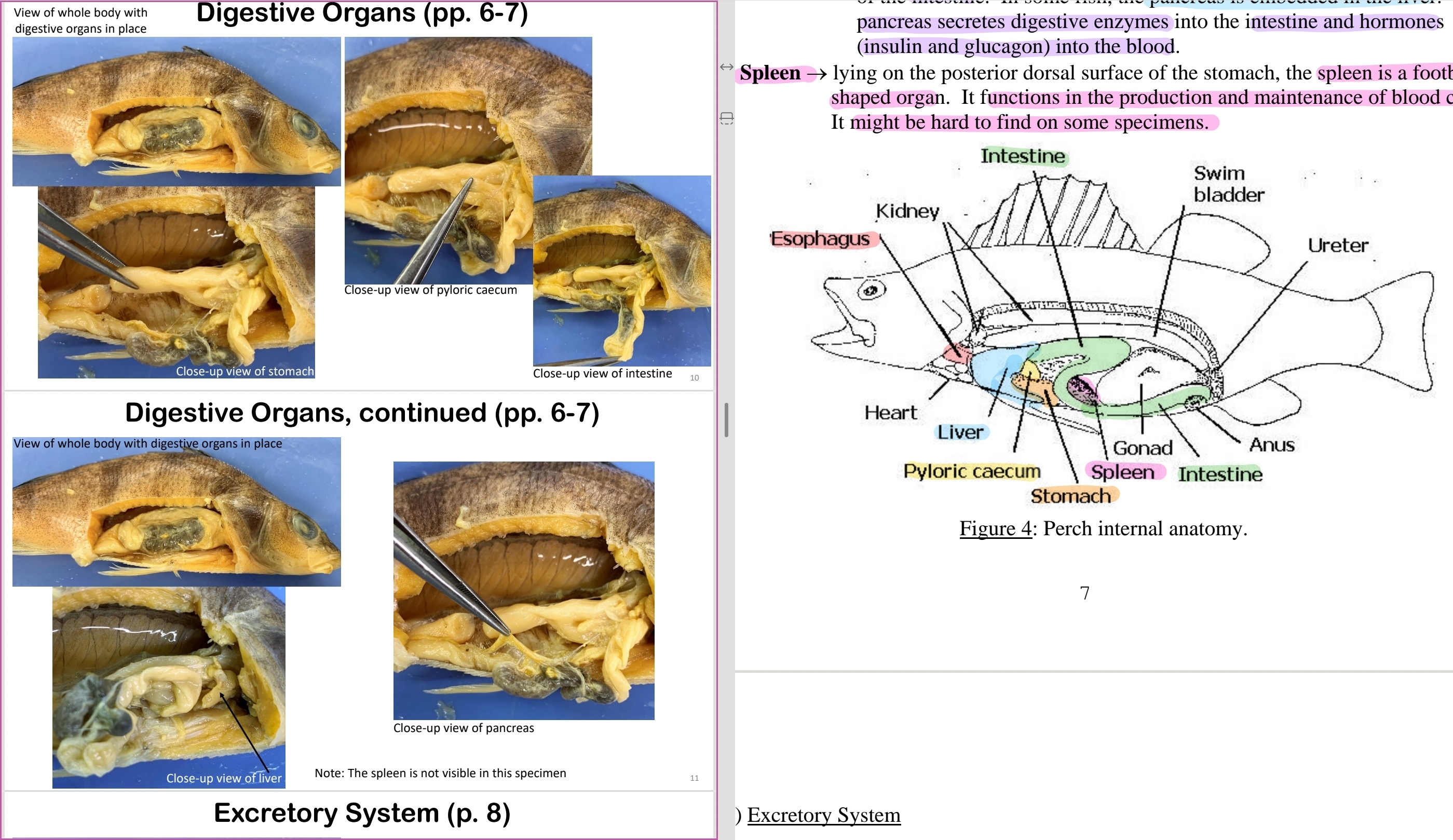
Intestine - originating at the stomach it forms an S-shaped loop. At the end of it the intestine straightens and extends directly to the anus.
The perch intestine is less than the length of it's body. This is because it has a carnivorous life style
Phylum Chordata (Subphylum Vertebrata) - Perch Digestive tract (Liver, Pancreas, Spleen)
Liver - located anterior to the stomach, on the undersurface i has the gallbladder
the gallbladder drains bile from the liver & opens by a number of ducts into the intestine
Bile is necessary for the proper digestion of fats
Pancreas - a digestive gland found along the ventral border of the intestine. They secrete digestive enzymes into the intestines and hormones into the blood (insulin)
Spleen - found of the posterior dorsal surface of the stomach. It's football shaped and functions in the production & maintenance of blood cells
Phylum Chordata (Subphylum Vertebrata) - Excretory system
Kidneys eliminate the nitrogenous wastes of cellular metabolism as well as variety of other materials that may be present in the blood in excess of the body's needs
they conserve materials not in excess
so they have a vital function both in excretion and in maintaining an internal environment with water and salt content of the body in pH and in the content of sugar and other substances in the blood
Phylum Chordata (Subphylum Vertebrata) - Perch Excretory System
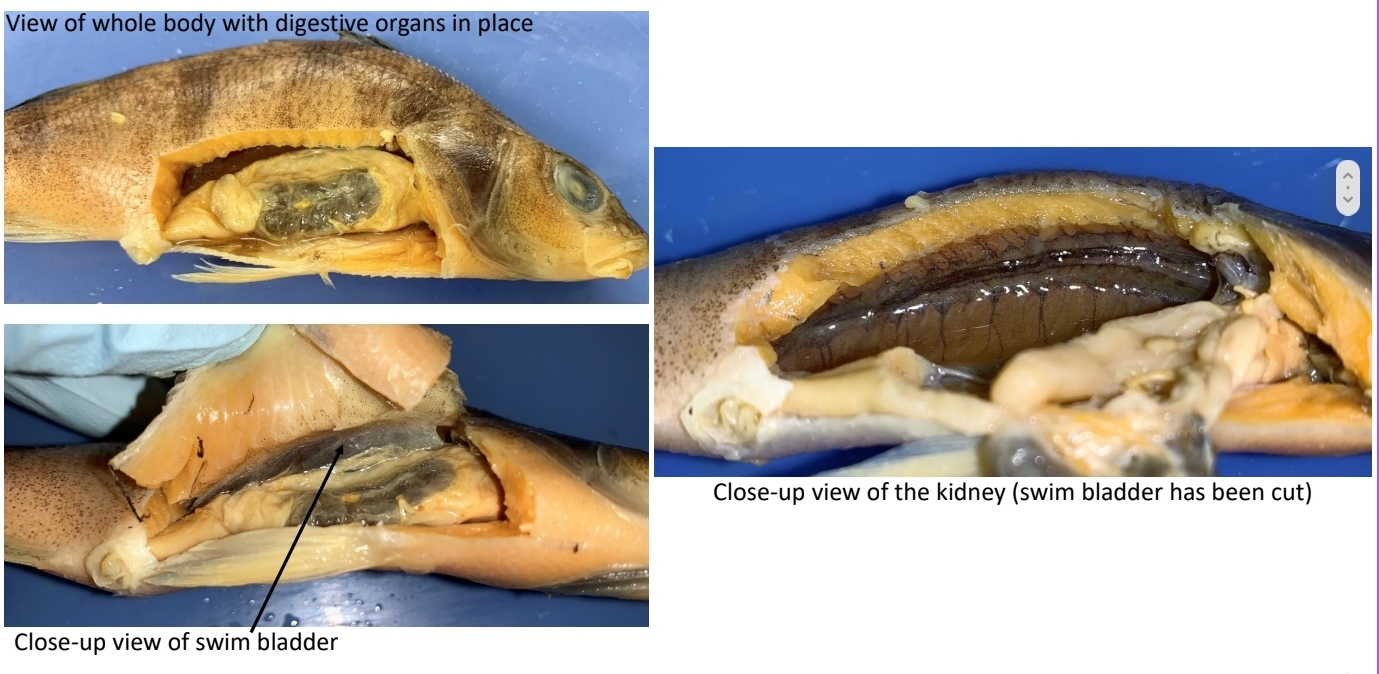
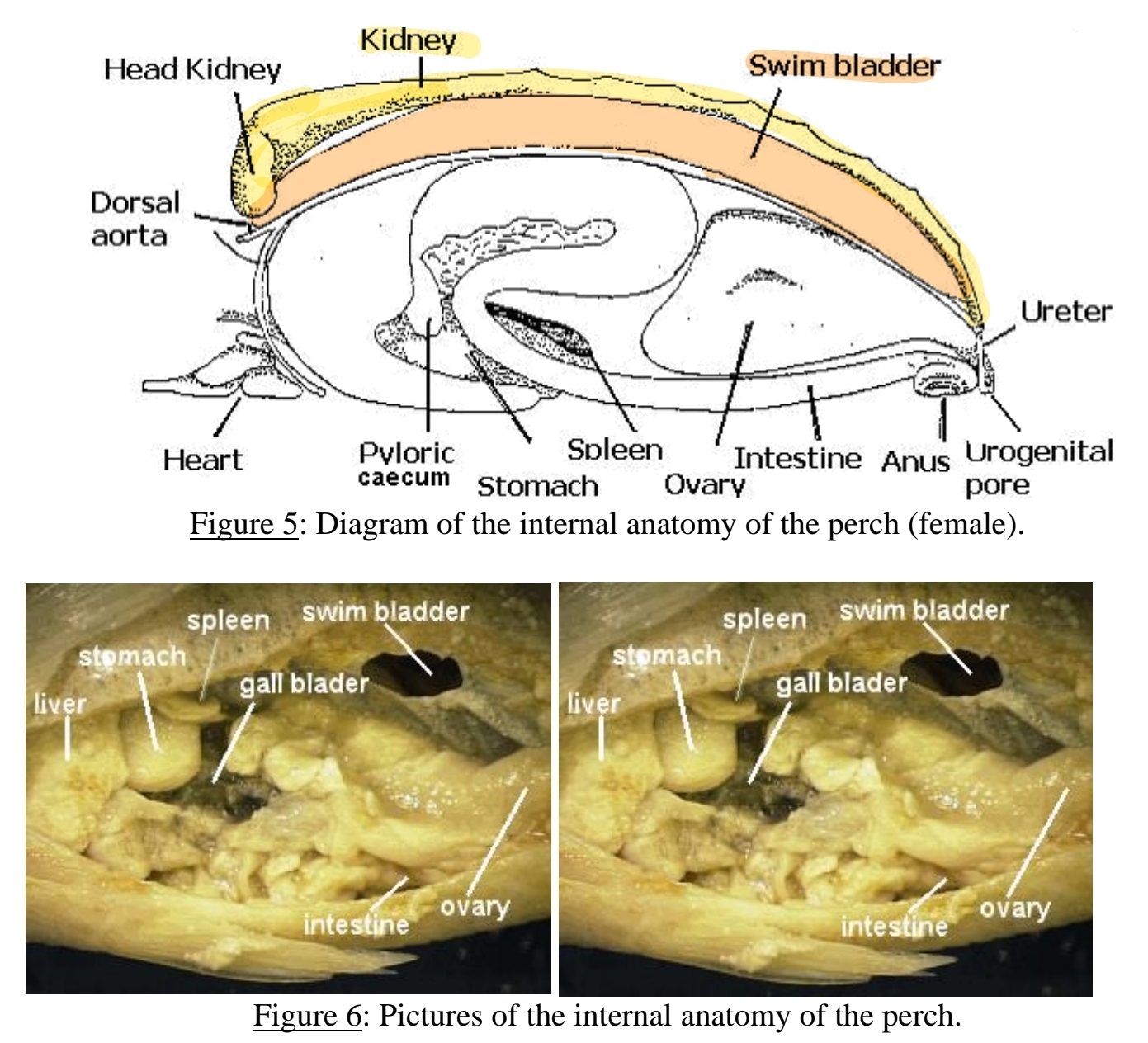
The perch urinary system consists of the kidneys and lies dorsal to the swim bladder.
At the posterior ends two small ducts unite to form one common ureter
The ureter and the gonoduct (passes genital products from the gonad) empty via the common urogenital opening
The urinary bladder is a small sac at the most posterior, ventral end of the body cavity
In males they are separate structures
in females it is incorporated into the oviducts to form the urogenital sinus
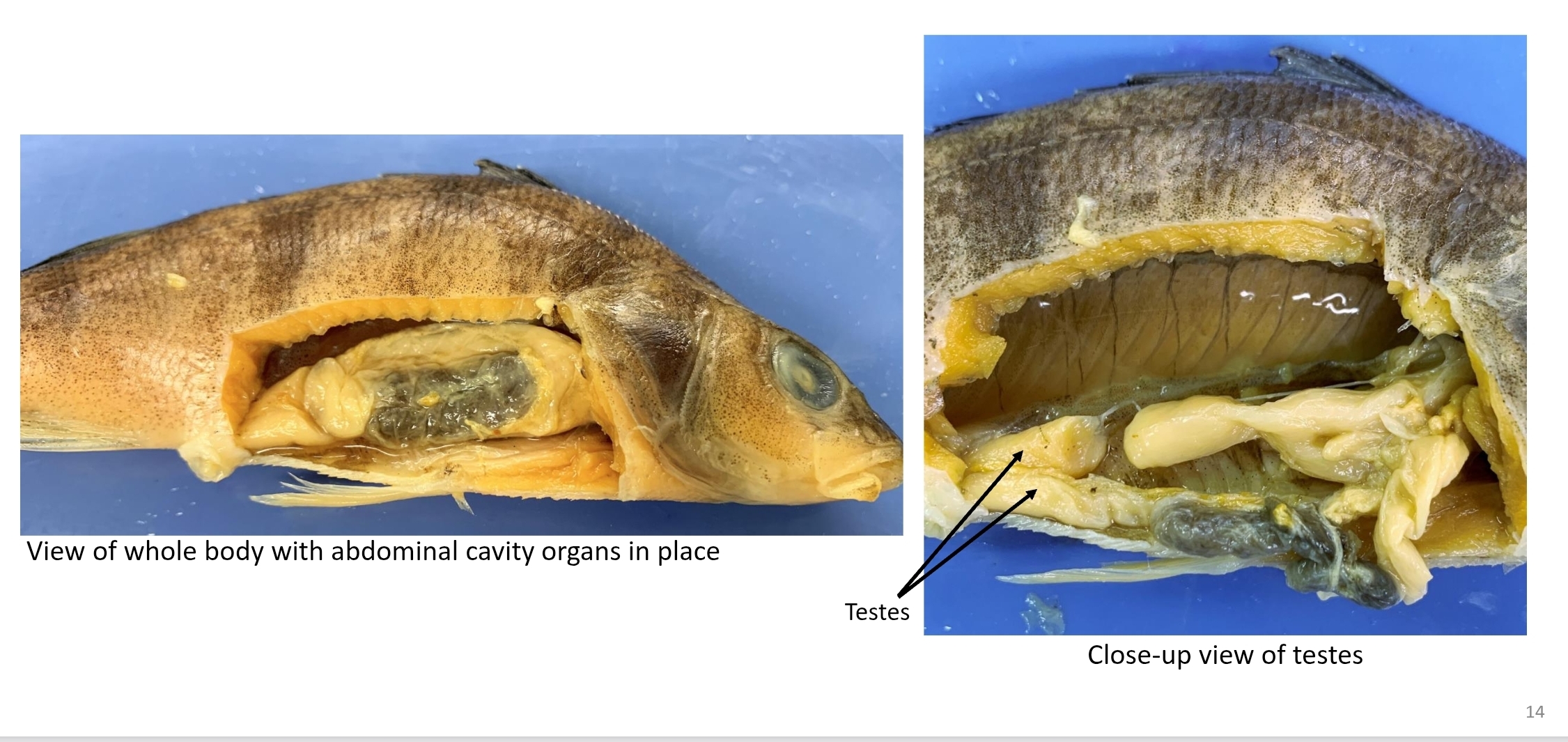
Phylum Chordata (Subphylum Vertebrata) - Perch Reproductive System (Males)
Male Perches have testes are a pair of white elongated bodies lying just below the air bladder
they are joined by a thin sheet of tissue, the mesentery
they fuse together toward the posterior end and the sperm are passed to the outside through the urogenital opening
Phylum Chordata (Subphylum Vertebrata) - Perch Reproductive system (Females)
Female perches have an ovary that lies between the intestine and the air bladder
It is an epithelial sac filled with eggs
the posterior end of the ovary is tapered and the eggs pass to the outside through the urogenital opening just behind the anus
Ovaries are paired in early stages but fuse during development into a single organ
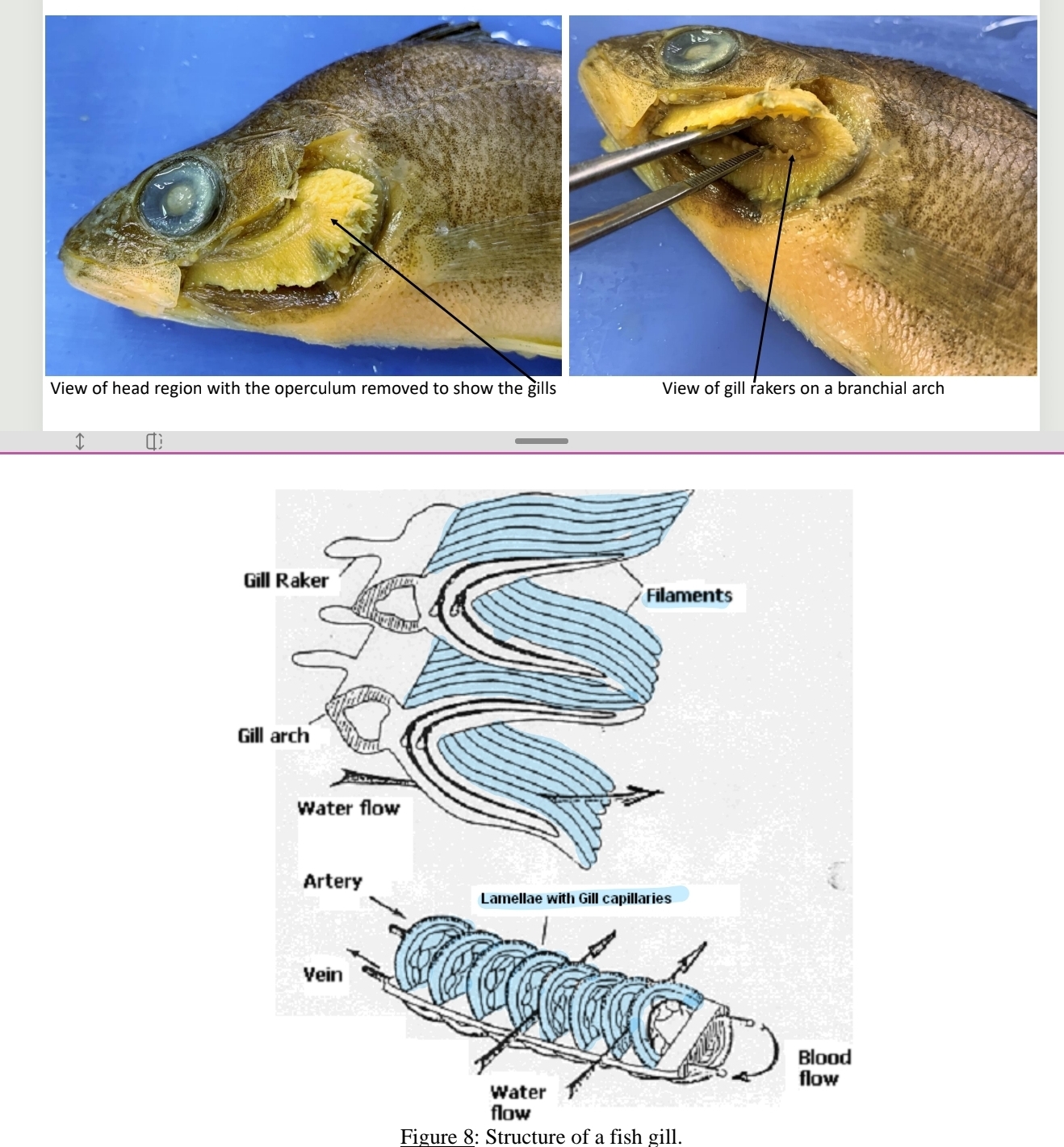
Phylum Chordata (Subphylum Vertebrata) - Perch respiratory system
Gills are the main organ of their respiratory system
they are attached to each of the four pairs of branchial arches
On the archers are gill rakers
each gill has 2 filaments, one anteriorly & the other posteriorly
Ones with double sets are Holobranchs
The filaments are made of lamellae (small thin walled folds)
lamellae contain capillaries & exchange oxygen and CO2 between water and blood via diffusion
Gills can also aid in the excretory system by excreting their nitrogenous wastes by the gills instead of the kidneys
marine fish would also excrete salts and Freshwater fish absorb salts by the gills
Phylum Chordata (Subphylum Vertebrata) - Perch respiratory system: Counter Current System
Where the gill capillaries are arranged in a way that the blood flow is opposite to the flow of water over the gills
Water is passed over the gills by water being drawn into the mouth then into the pharynx while the opercula are closed
Valves in the mouth close and the oral cavity will contract to force water through the gill rakers, gill slits, over the gill filaments & out the opercula
Phylum Chordata (Subphylum Vertebrata) - Circulatory system
In vertebrae they have a closed circulatory system
consists of the heart, arteries, veins, capillaries and blood
Arteries carry blood away from the heart to the capillaries, the place of exchange in the tissues.
Veins carry blood from the capillaries back to the heart
Phylum Chordata (Subphylum Vertebrata) - Perch circulatory system
A perch's ciruclatory system is a low pressure single type system
where the heart is a single pump and there is a single circuit of blood flow
Venous (deoxygenated) blood from the body is pumped through the heart forward to the gills
From the gills the blood becomes oxygenated then goes directly to the body
Which makes a single circuit before returning to the heart
This means that this type of circulation the heart pumps only deoxygenated blood
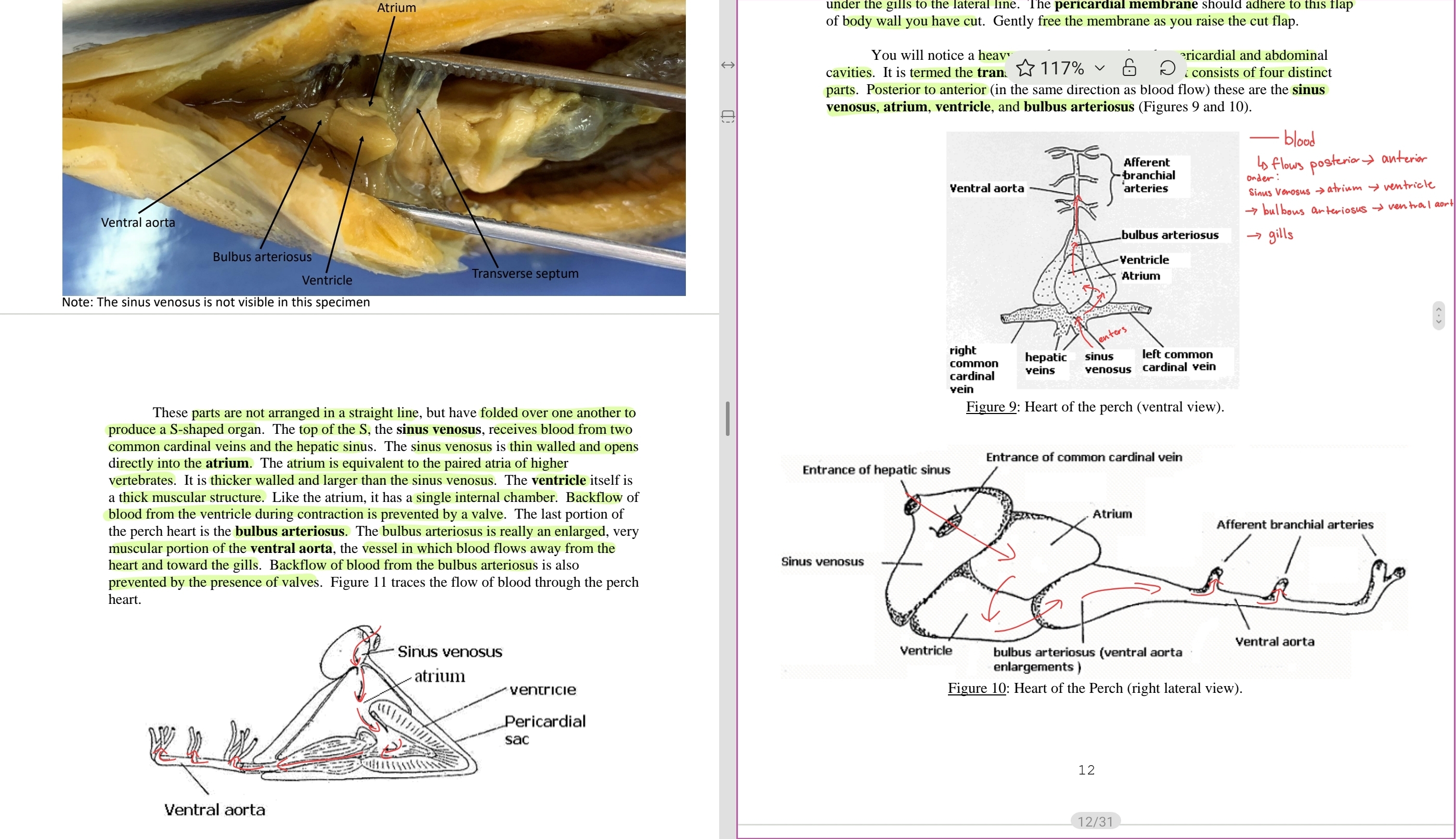
Phylum Chordata (Subphylum Vertebrata) - Perch Circulatory system: the heart anatomy
The heart lies in the pericardial cavity where pericardial membrane is attached
Tranverse septum is a heavy membrane separating the paricardial and abdominal cavities
The heart consists of: sinus venosus, artium, ventricle and bulbous arteriosus
They are folded into an S-shaped organ
Sinus venosus is at the top of the S and receives blood from two common cardinal veins & the hepatic sinus. It is thin walled and opens directly into the atrium
Atrium is equivalent to the paired atria. It is thick-walled and larger
Ventricle is connected to the atrium and is a thick muscular structure and has a valve preventing backflow
Bulbus arteriosus is the last portion of the heart. It is enlarged and very muscular portion of the Ventral aorta
Ventral aorta is when the blood flows away from the heart and to the gills
Phylum Chordata (Subphylum Vertebrata) - Mammals features
all mammals have two characteristics that distinguish them:
They all have hair at some time during their development
all female mammals possess mammary glands with external openings for nourishing their young
Phylum Chordata (Subphylum Vertebrata) - Rat (Rattus rattus) External features
Rats (Order Rodent) have enlarged front teeth and other adaptatons for a gnawing, herbivorous mode of life
The rat is a tetrapod with digitgrade locomotion
meaning they walk on digits only
Their body is covered in hair while scales cover the rail and found in the claws
The rats body has 4 general regions
Head, neck, trunk and tail
Phylum Chordata (Subphylum Vertebrata) - Rat body: Head & neck
The head is large and separated from the trunk by a moveable neck
the mouth is bounded by upper and lower lips
the upper lip is deeply cleft in the rat
they have a pair of large upper incisor teeth and a pair of lower incisor teeth
The ear possesses an external fold called the pinna
this directs sound waves into the ear canal (external auditory meatus)
A tympanic membrane is also found here but not visible
They have vibrissae which are special long sensory hairs
found on other mammals
on the rat they grow from the snout, upper eyelid, cheek, and chin
Phylum Chordata (Subphylum Vertebrata) - Rat body: Trunk
The trunk is divided into an anterior thorax and posterior abdomen
The thorax contains ribs (abdomen has none)
Teats or nipples, which are external openings of the mammary glands, are located in two rows on the ventral surface of the trunk
usually 12 of them distributed evenly between the thorax and abdomen
They also have separate urogenital and anal openings
In females, urinary & genital openings are separate (in males they're not)
The urethral opening is the most anterior; vaginal oriface is found posterior to it
In males, the urethra is the common urogenital duct and opens at the tip of the penis
the scrotum are found at the base of the tail and contain the testes
The anus is located at the base of the tail
Phylum Chordata (Subphylum Vertebrata) - Rat body: Tail
The tail of the rat has only a few scattered hairs
they are distributed between reptile-like scales of epidermal origin
Phylum Chordata (Subphylum Vertebrata) - Muscular system in terrestial mammals
the muscular system is mainly for support & locomotion (except for the tongue ofc).
Dorsal muscles - supports and moves the vertebral column and head
Ventral muscles - thin layers of muscles
layers support the thoracic and abdominal walls for breathing movements
some function to transfer body weight to the pectoral girdle & appendages
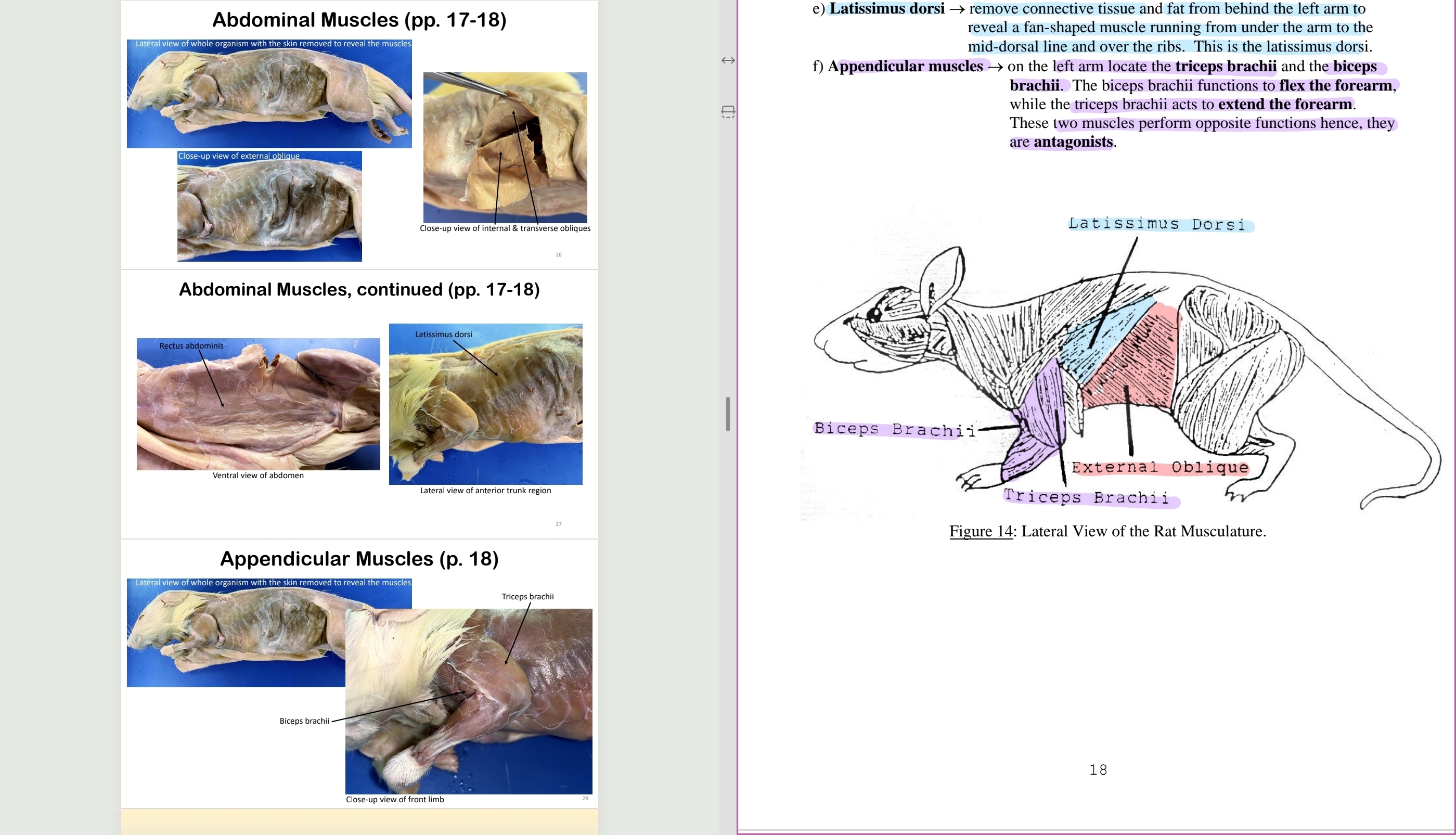
Phylum Chordata (Subphylum Vertebrata) - Rat Muscular system
The muscular system of the rat includes:
External oblique - the outer layer of the body wall
Internal oblique - found under the external oblique. Fibers run in a different direction than the external
Tranverse oblique - under the internal oblique
Rectos abdominis - Long thin muscle that runs anterior to posterior
Latissimus dorsi - found on the arm to the mid-dorsal line and over the ribs
Appendicular - consists of triceps brachii and biceps brachii
biceps brachii - functions to flex the forearm
triceps brachii - functions to extend the forearm
since they have opposite functions they are antagonists
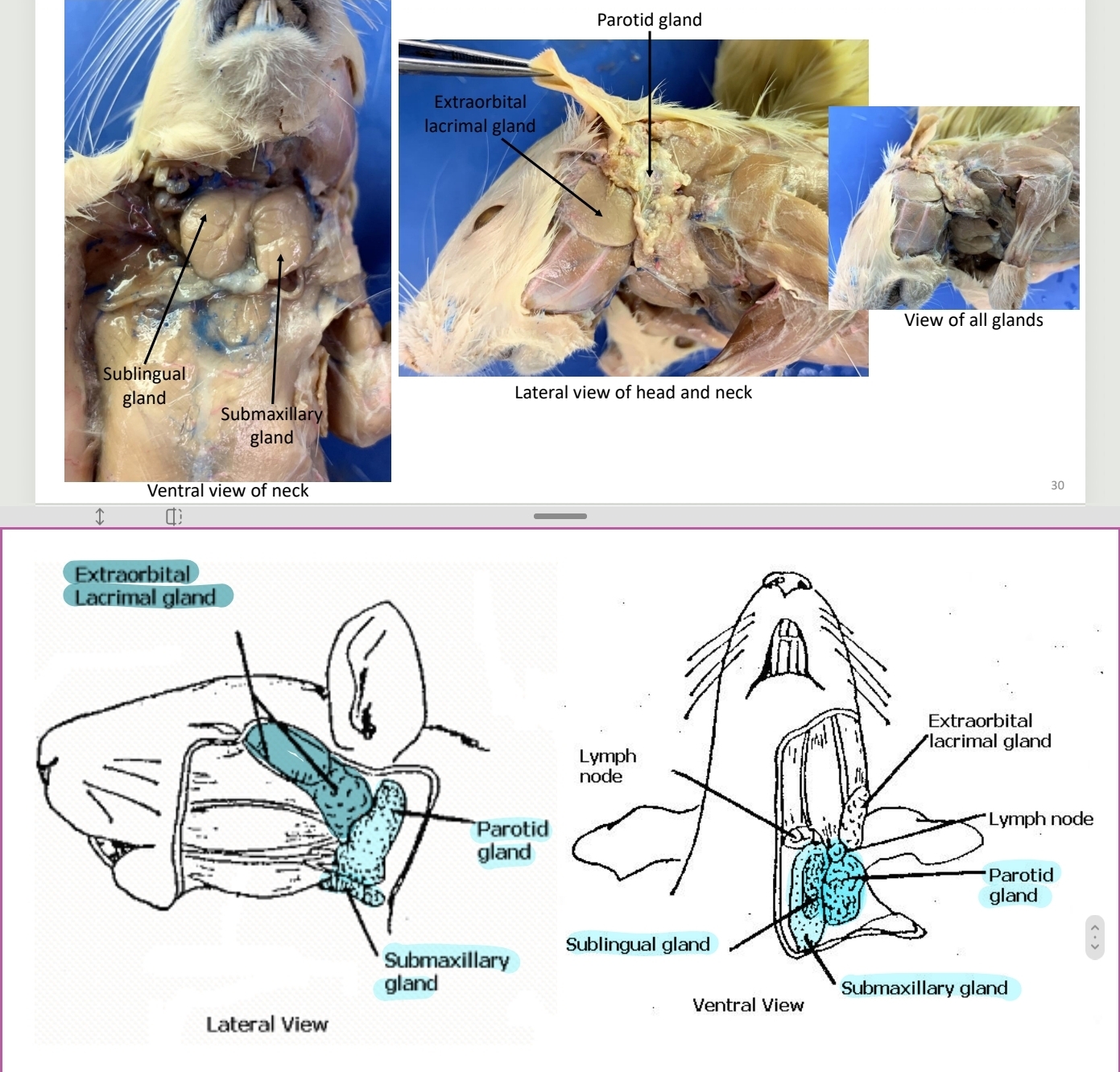
Phylum Chordata (Subphylum Vertebrata) - Rat Digestive system: Salivary glands
Salivary glands consist of:
Parotid gland - found beneath the ear
submaxillary glands - ventral to the parotids
sublingual glands - found anterior and under the submaxillary glands
Other glands: extraorbital lacrimal gland - forms tears and other eye secretions
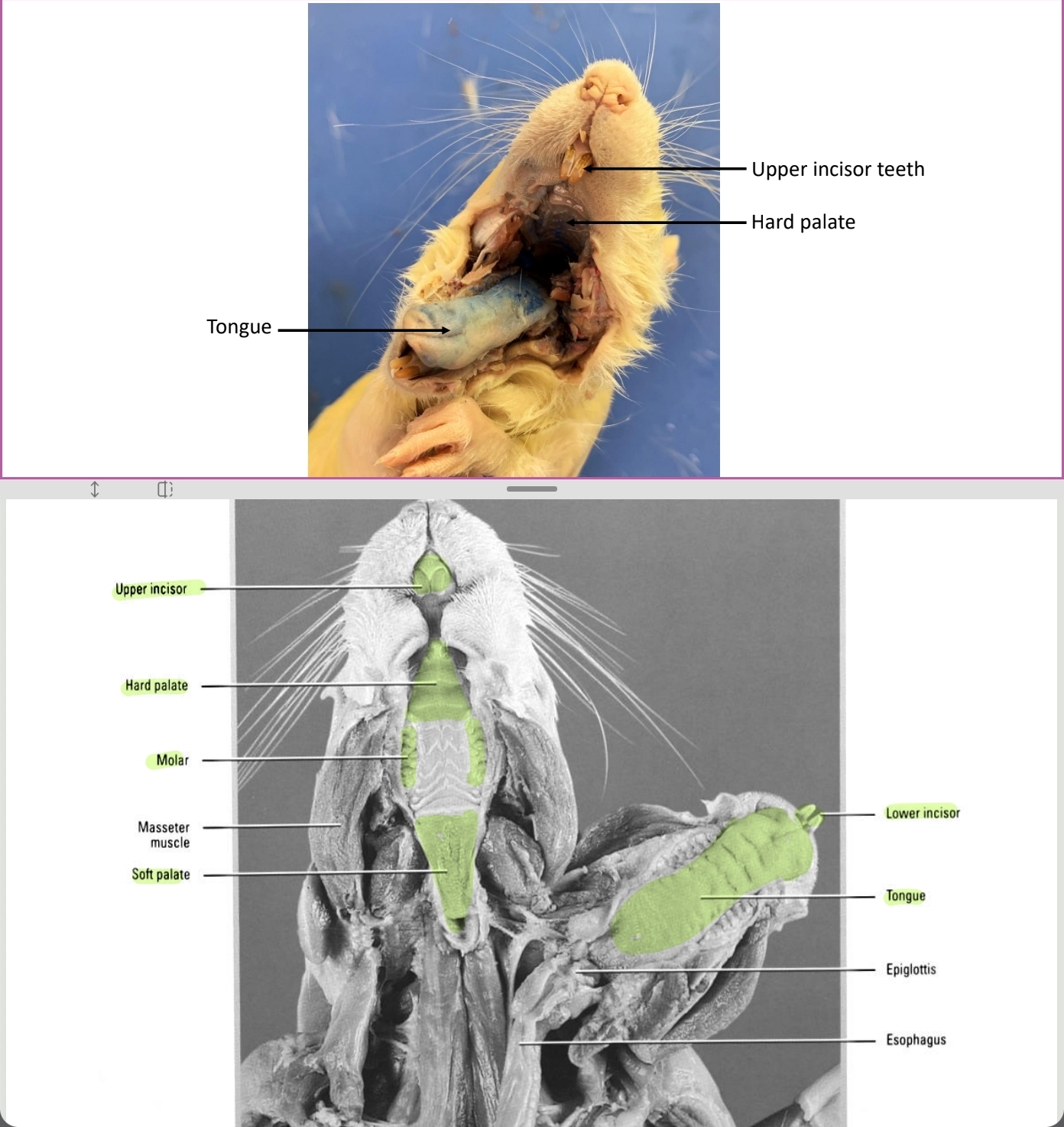
Phylum Chordata (Subphylum Vertebrata) - Rat Digestive system: Oral cavity
The rat oral cavity consists of:
Large incisor teeth, molars, tongue, hard palate (which separates the nasal and oral cavities)
rat teeth never stock growing and they do not have canines or premolars
Phylum Chordata (Subphylum Vertebrata) - Rat Digestive system: Abdominal cavity & Membranes
The coelom is the body cavity which the viscera (internal organs) are suspended
They are covered by a peritoneum, which is a membranous tissue (formed from mesoderm)
Membrane tissues include:
Mesentery proper - double layer of peritoneal membrane (dorsal body wall - viscera)
Falciform ligament - a layer of tissue, extends from ventral body wall - diaphragm - liver
Parietal peritoneum - shiny membrane that lines the body wall
Visceral peritoneum - shiny membrane that covers the viscera
Greater omentum - double walled peritoneal sac, extends from GREATER CURVATURE stomach-spleen
Lesser omentum - membrane that joins the LESSER CURVATURE stomach-liver
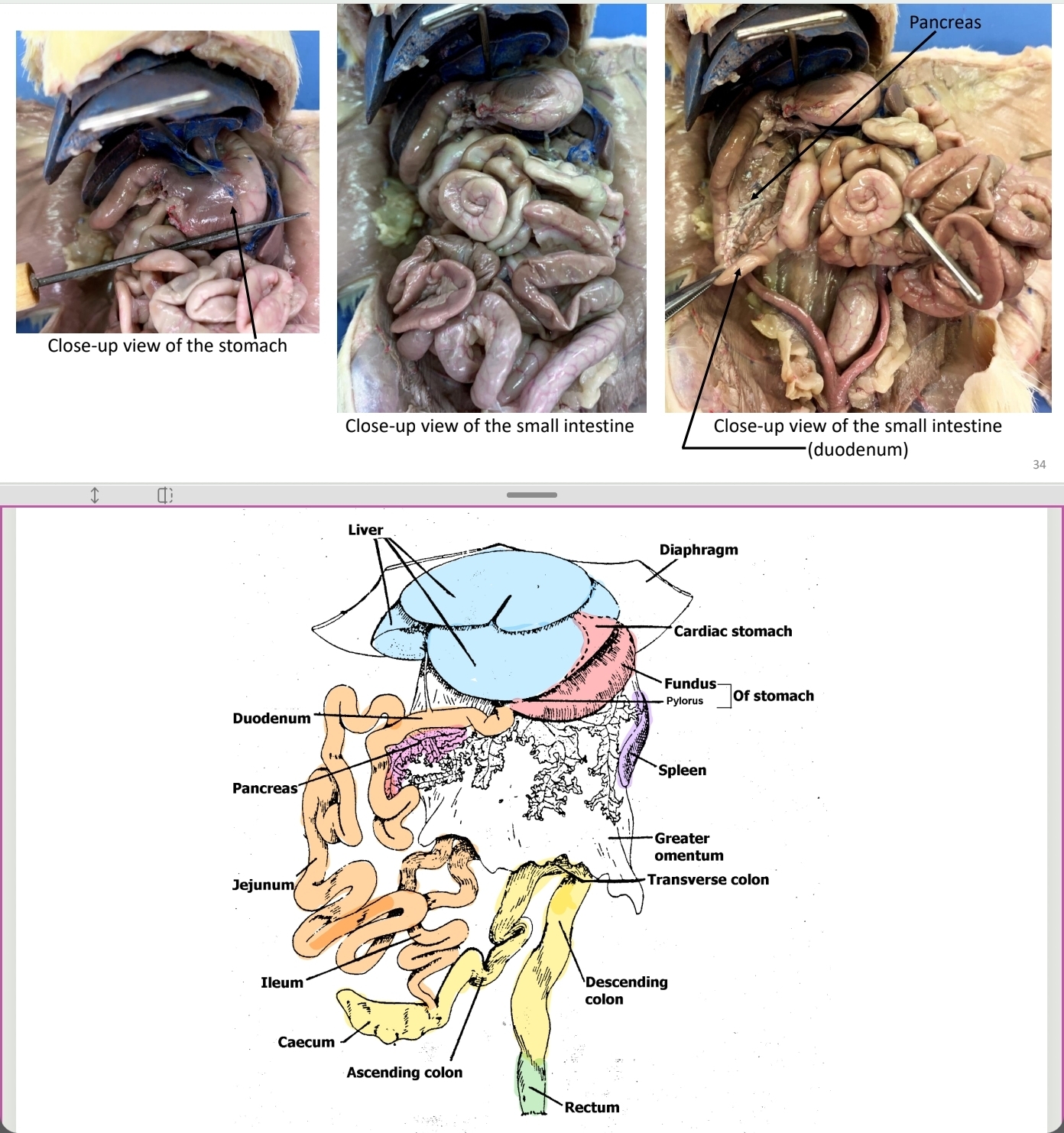
Phylum Chordata (Subphylum Vertebrata) - Rat Digestive system: Viscera; Stomach
Stomach → a sac-like structure that stores ingested food
Has 3 areas
Cardiac portion - entrance from the esophagus
Fundic portion - middle area
Pyloric portion - constricted posterior portion
Stomach opens to the duodenum through the pyloric sphincter
Stomach has rugae (folds) on the walls for absorbtion
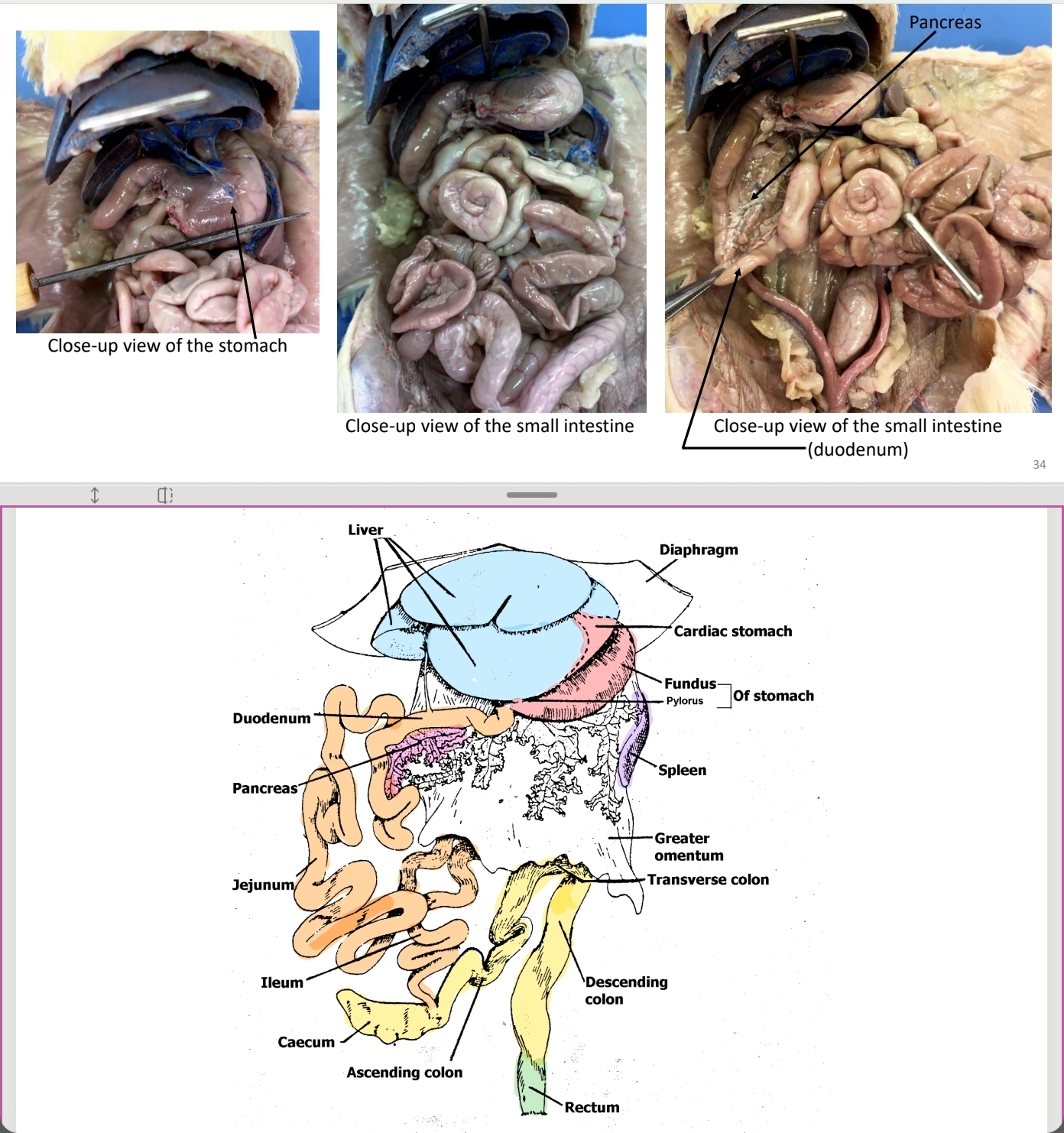
Phylum Chordata (Subphylum Vertebrata) - Rat Digestive system: Viscera; Small intestine
The small intestine is the site of the most chemical digestion & absorbtion of nutrients
There are 3 regions
Duodenum (anterior portion) receives the ducts from the digestive glands, pancreas, and liver
next is Jejunum then Ileum - absorbtion occurs in both
The small intestine is lined with villi
allow for an increased surface area for absorbtion
The ileum opens to the large intestine via the ileocolic valve.
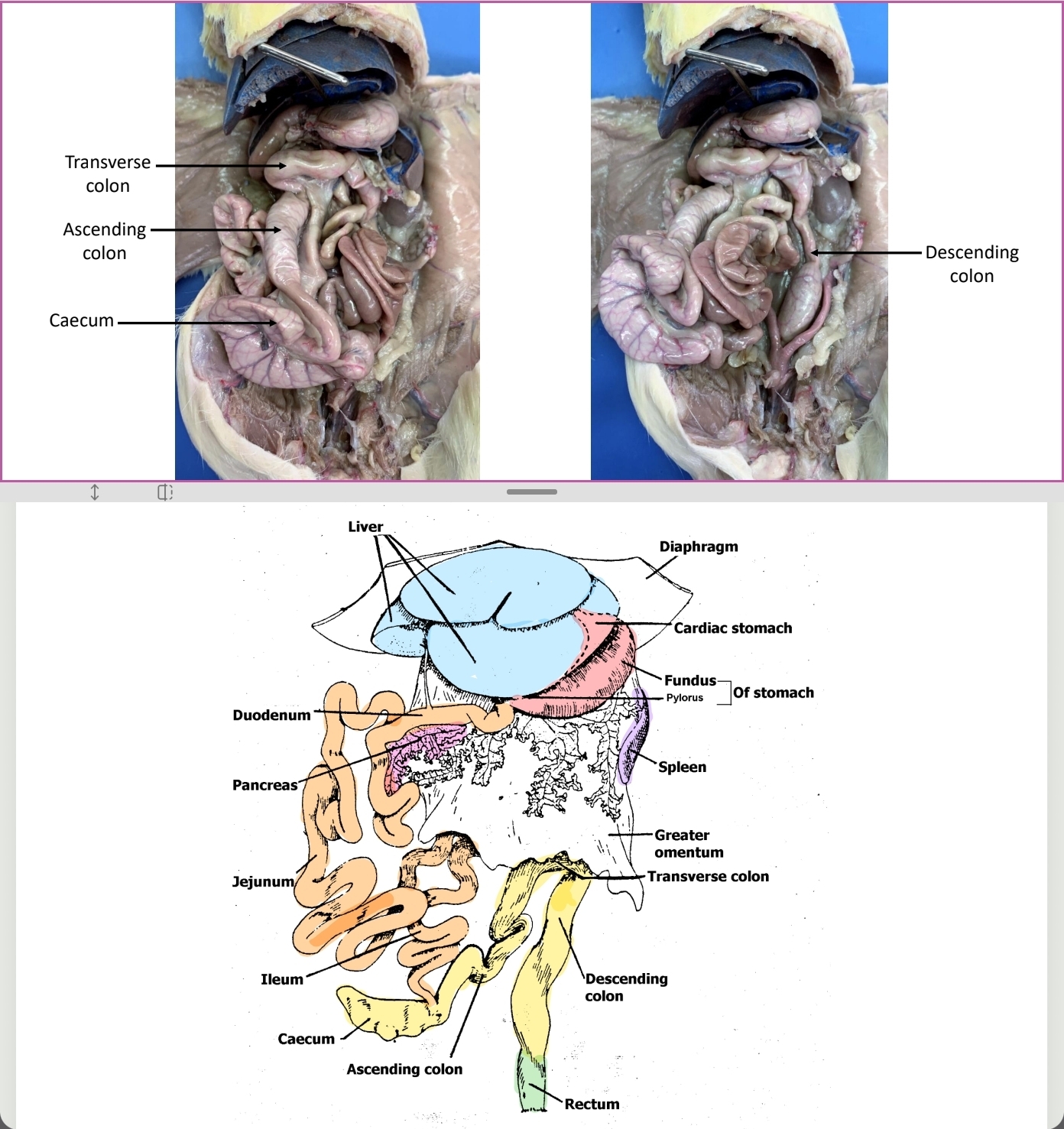
Phylum Chordata (Subphylum Vertebrata) - Rat Digestive system: Viscera; Large intestine & rectum
The large intestine functions in the reabsorbtion of the large quantities of water that was secreted into the gut
has 4 regions
large Caecum - especially large for herbivores as the caecum serves to breakdown plant material that wasn't digested
Ascending colon - right side (goes up)
Transverse colon - goes left
Descending colon - heads posteriorly (goes down)
The undigested material moves along, water being removed, until it becomes feces
The rectum is the continuation of the descending colon and where feces is stored
It ends with the anus which will open for feces to exit
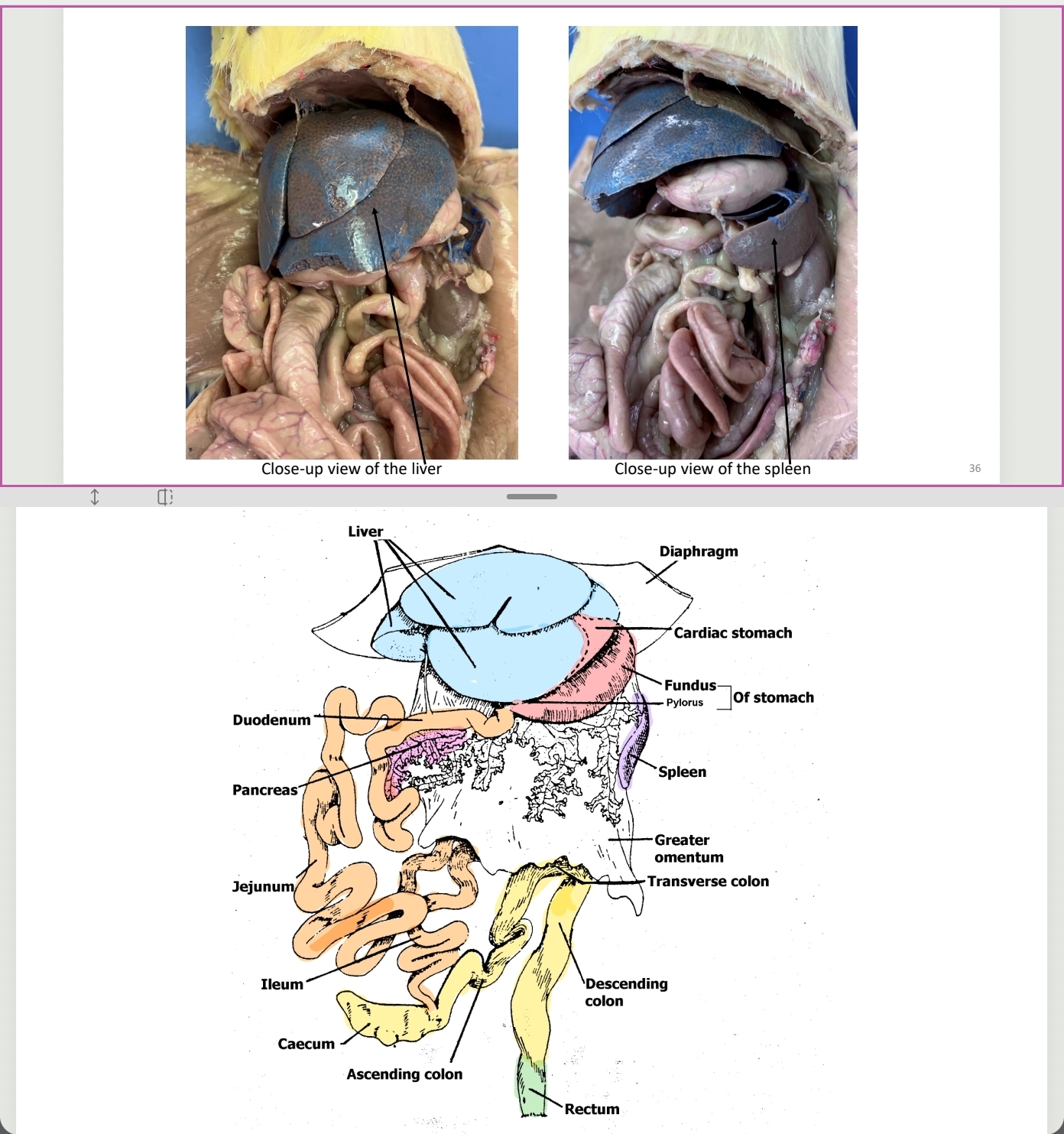
Phylum Chordata (Subphylum Vertebrata) - Rat Digestive system: Viscera; Liver
The liver functions in detoxification of certain chemicals and production of glycogen.
It also produces bile which passes directly into the duodenum by the bile duct
the gall bladder stores the bile in most animals, except the rat
Bile is needed for proper digestion of fats
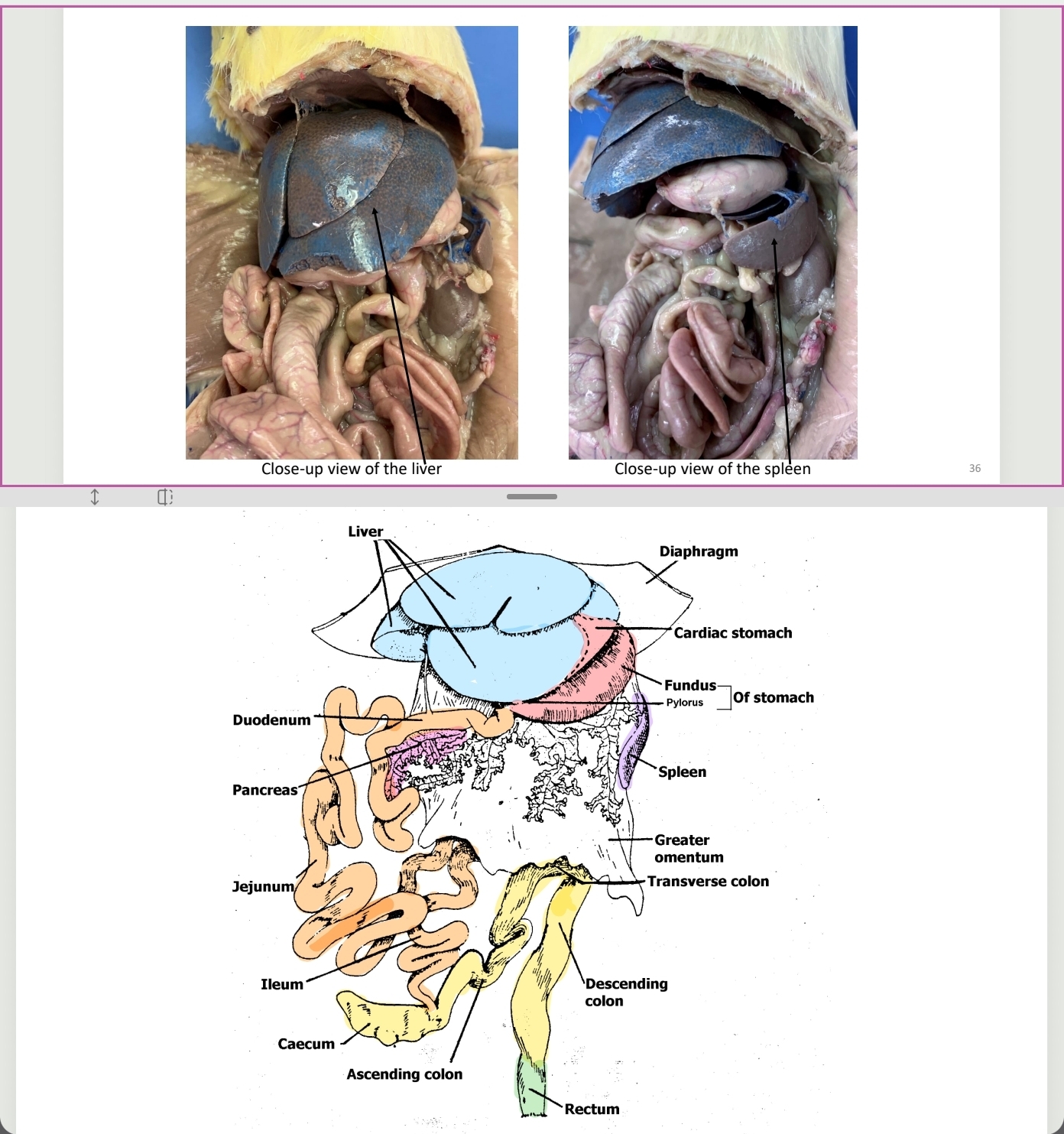
Phylum Chordata (Subphylum Vertebrata) - Rat Digestive system: Viscera; Spleen
The spleen is an elongated flattened organ
it is attached to the greater curvature of the stomach
Spleen, along witht he liver, remove old blood cells from circulation and break them down
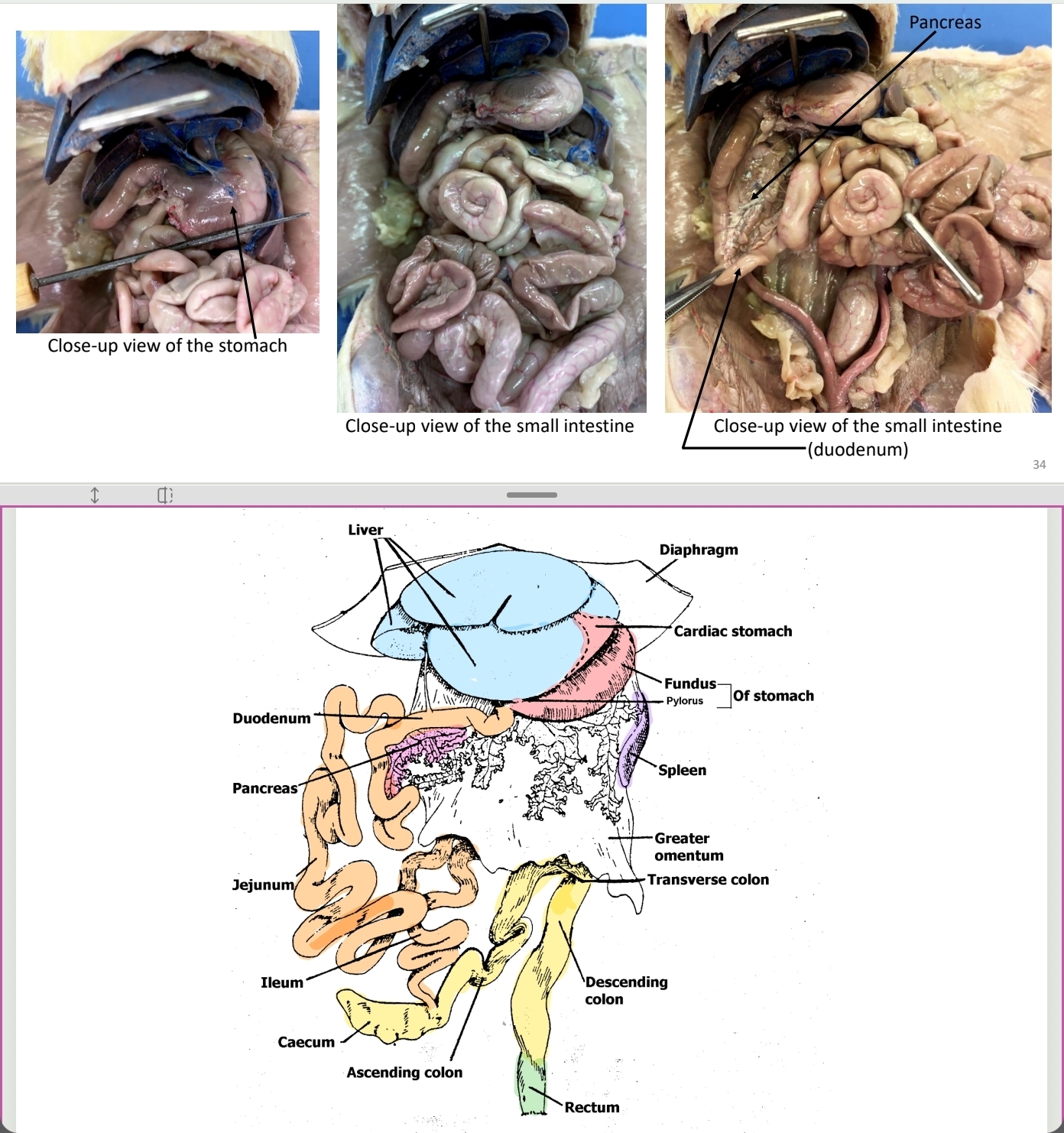
Phylum Chordata (Subphylum Vertebrata) - Rat Digestive system: Viscera; Pancreas
The pancreas secretes many digestive enzymes into the small intestine as well as hormones (insulin and glucagon) into the blood.
The pancreas is a diffuse gland that is embedded in the mesentery proper and greater omentum
it is found along the anterior edge of the duodenum
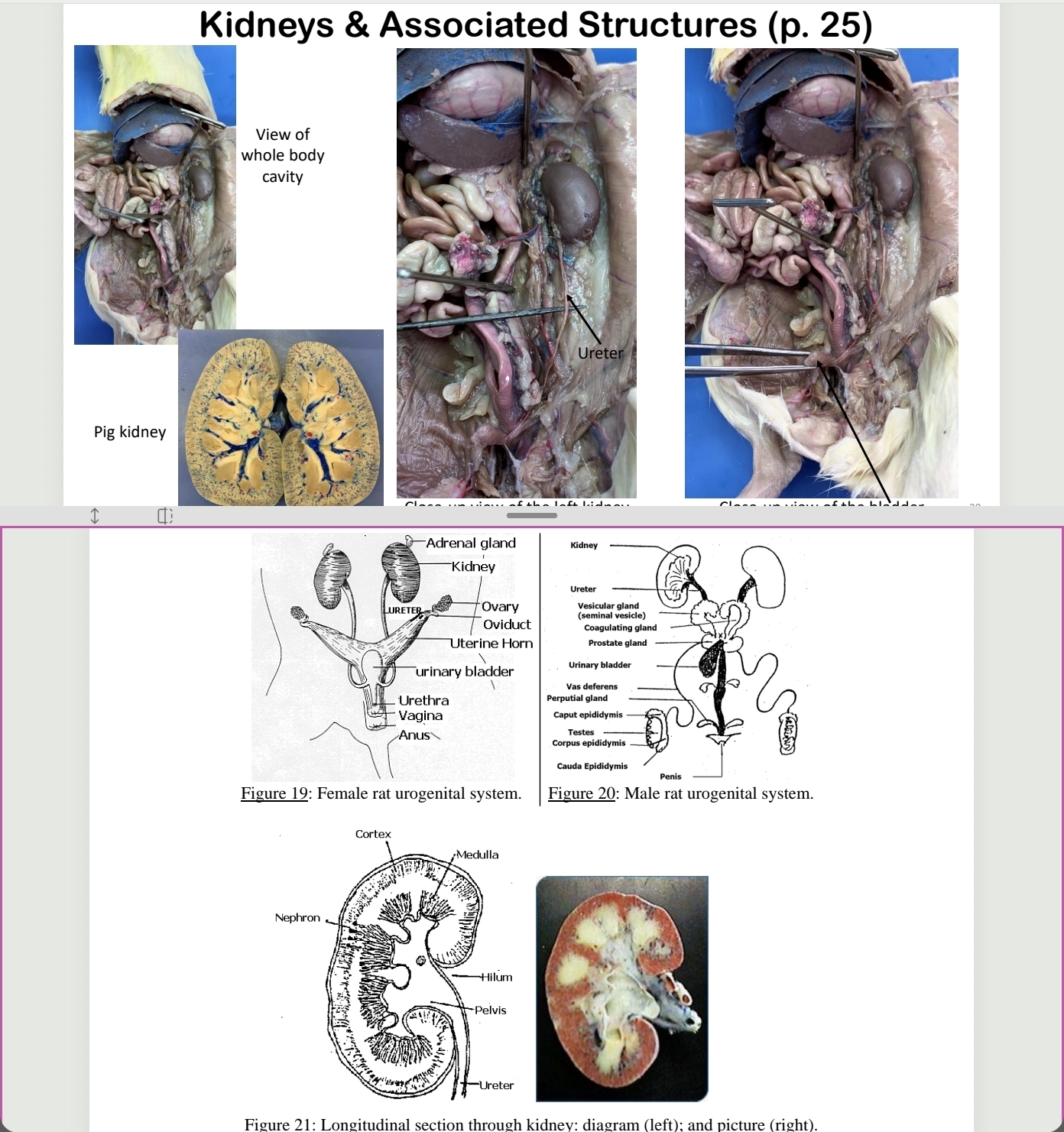
Phylum Chordata (Subphylum Vertebrata) - Rat Osmoregulatory system
The rat osmoregulatory system (in males) consists of:
The kidneys - consists of a cortex, which is the outer part, and the medulla, which is the inner part
The ureter - leads out of the kidneys
The urinary bladder - where the ureter leads to and stores urine
Urethra - this travels through the penis and ducts allow urine to travel through it.
in females the urethra is much shorter
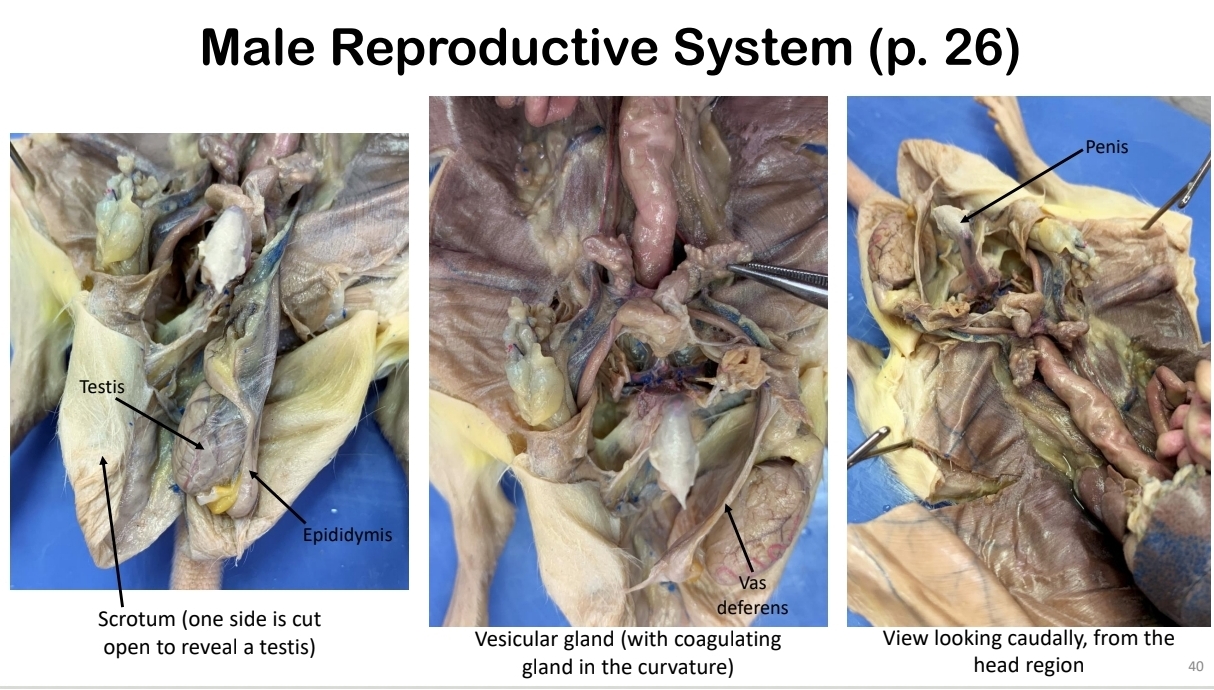
Phylum Chordata (Subphylum Vertebrata) - Rat Reproductive system: Males Scrotum
In males the reproductive system has:
The scrotum - a large sace of skin of muscle & connective tissue that houses the testes
during non-breeding the testes can be pulled into the abdominal cavity
though sperm cannot develop this way so the scrotum is necessary for the optimal temp for sperm creation
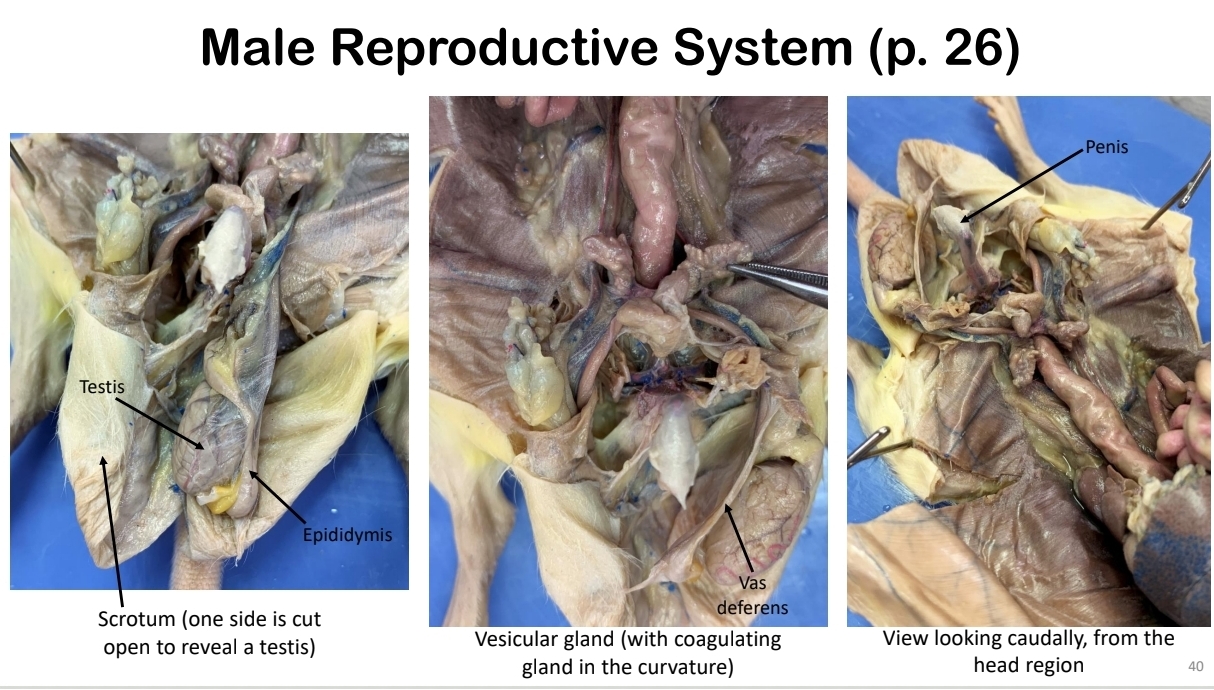
Phylum Chordata (Subphylum Vertebrata) - Rat Reproductive system: Males testes
In the male testes sperm cells are produced in the seminiferous tubules. The sperm cells are then brought to the Epididymis
Epididymis - a C-shaped structure that is long a highly coiled
from the epididymis the sperm moves into the vas deferens (a large tube)
The sperms then move from them to the urethra then exit the penis.
The prostate glands are found on either side of the urinary bladder
There are vesicular glands and coagulating glands
They secrete fluids form the seminal fluid that carries the sperm during ejaculation, provides nutrients and neutralizes the acidic environment of the vagina
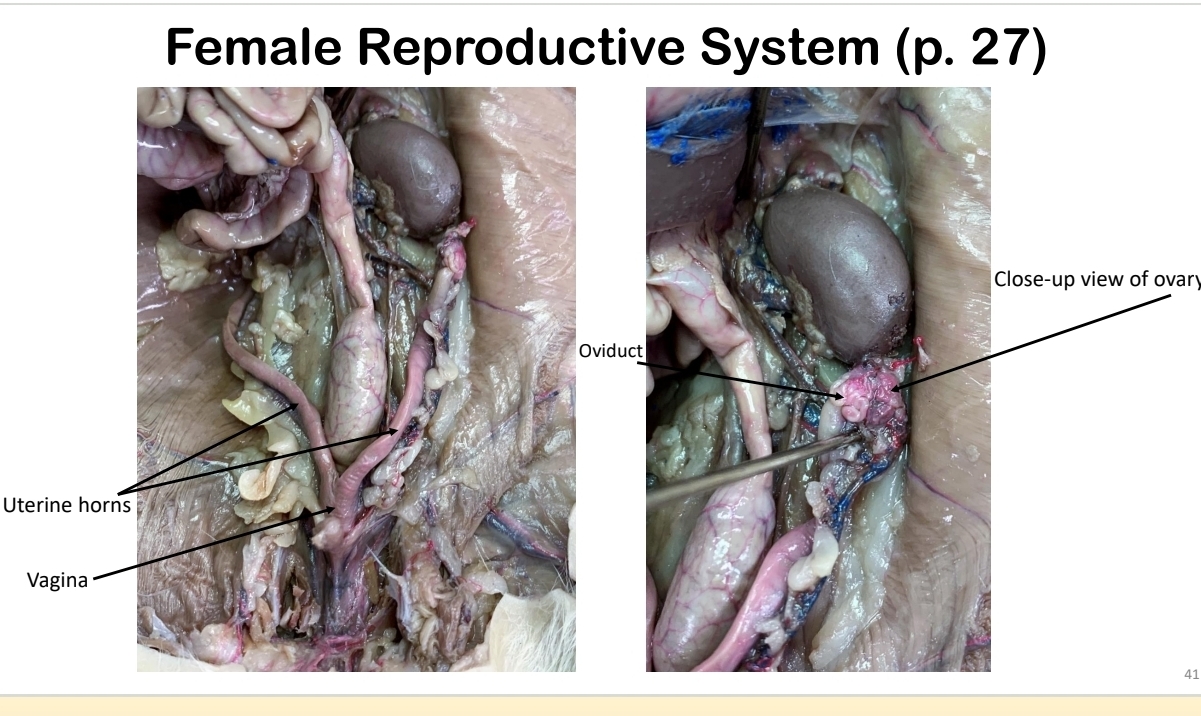
Phylum Chordata (Subphylum Vertebrata) - Rat Reproductive system: Female
The female reproductive system consists of the ovaries which produce the eggs, oviducts, uterus and vagina.
Oviducts - leads the eggs from ovaries to the uterus
Uterus - has 2 horns (cornua), a left and a right, both will unite to form the vagina
Vagina - opens to the exterior by a vaginal oriface
Phylum Chordata (Subphylum Vertebrata) - Rat Thoracic cavity & Membranes
The thoracic cavity houses the lungs, heart, and diaphragm
The parietal pleura (membrane lining) covers the wall of the cavity
the visceral pleura is a membrane that covers the lungs
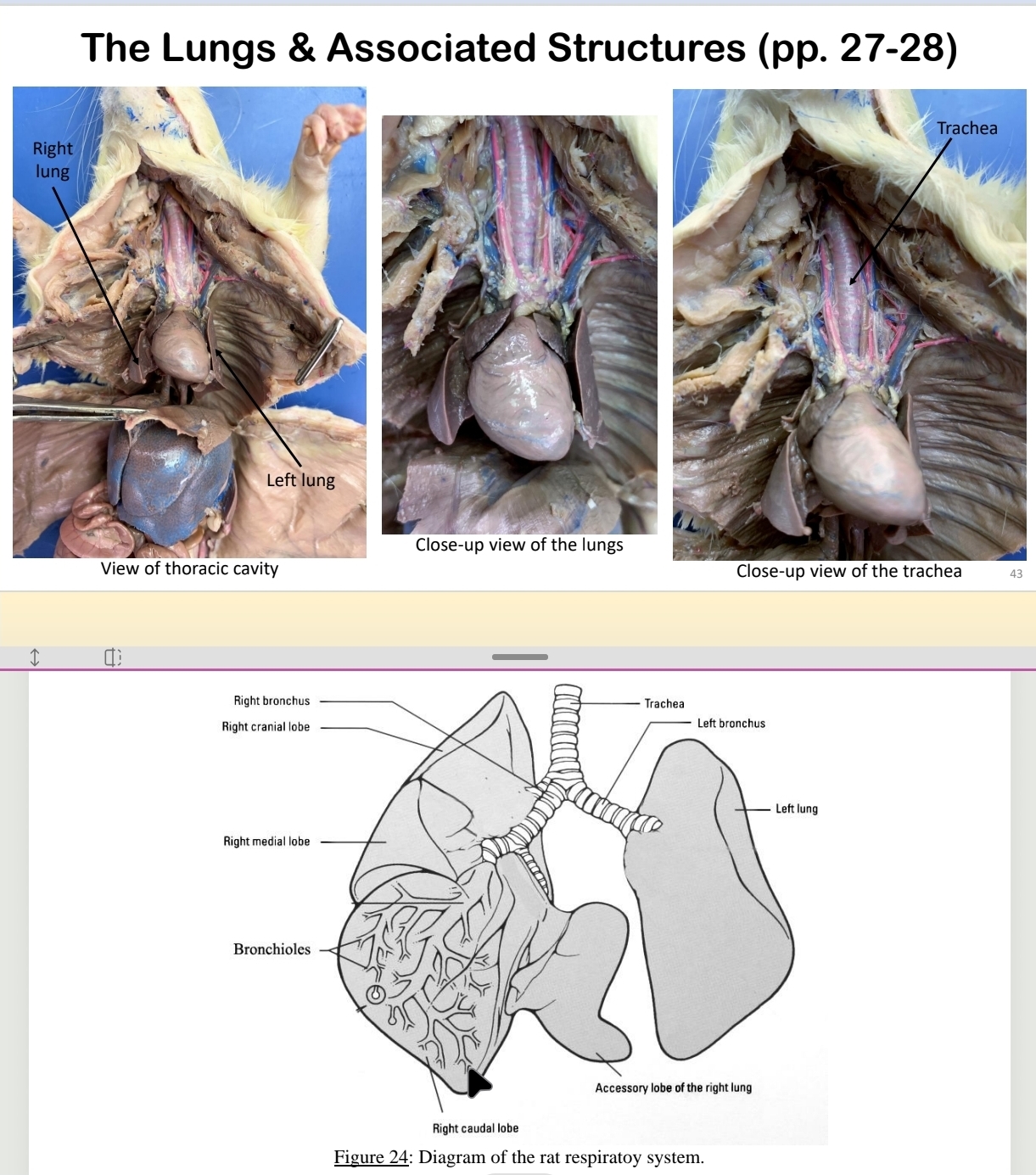
Phylum Chordata (Subphylum Vertebrata) - Rat Respirtory system: Lungs
The lungs are located on each side of the heart
The trachea leads to both the left and right lung
The right lung has 4 lobes
The left lung has 1 lobe
From the trachea leads to the each lungs bronchus
The bronchi lead to the bronchioles
Anteriorly on the trachea is the larynx
The larynx is also known as a voice box
Allows for mammals to have a vast repertoire of sounds.
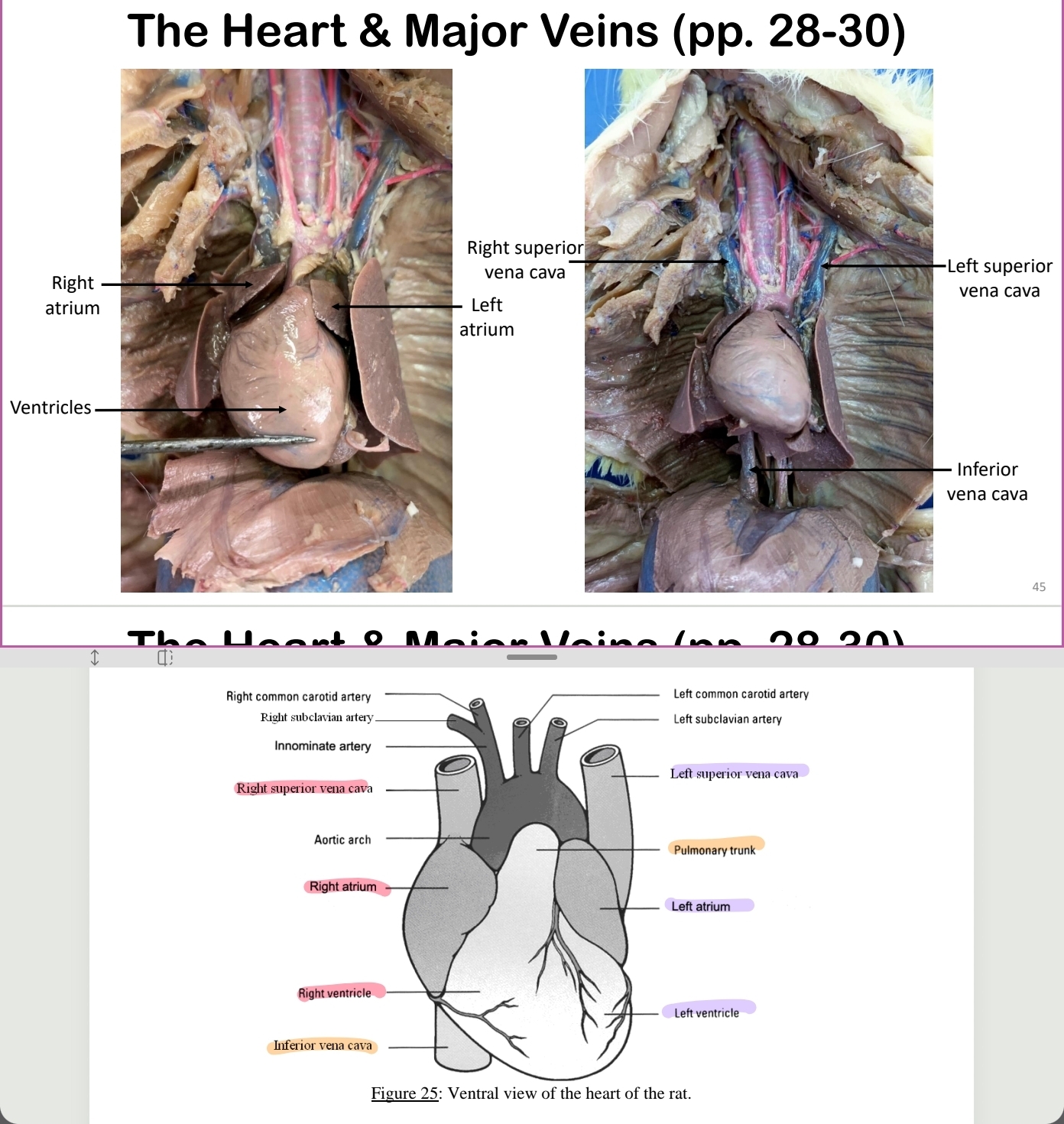
Phylum Chordata (Subphylum Vertebrata) - Rat Circulatory system
The rat circulatory system is a high pressure double circulatory system
The heart is a double pump and has two circuits of blood flow and blood is pumped through the heart twice
Pulmonary circulation - where deoxygenated blood from the body is pumped to the lungs where it is oxygenated (VEINS)
systemtic circulation - where oxygenated blood from the lungs returns to the heart where it will pumped to the rest of the body (ARTERIES)
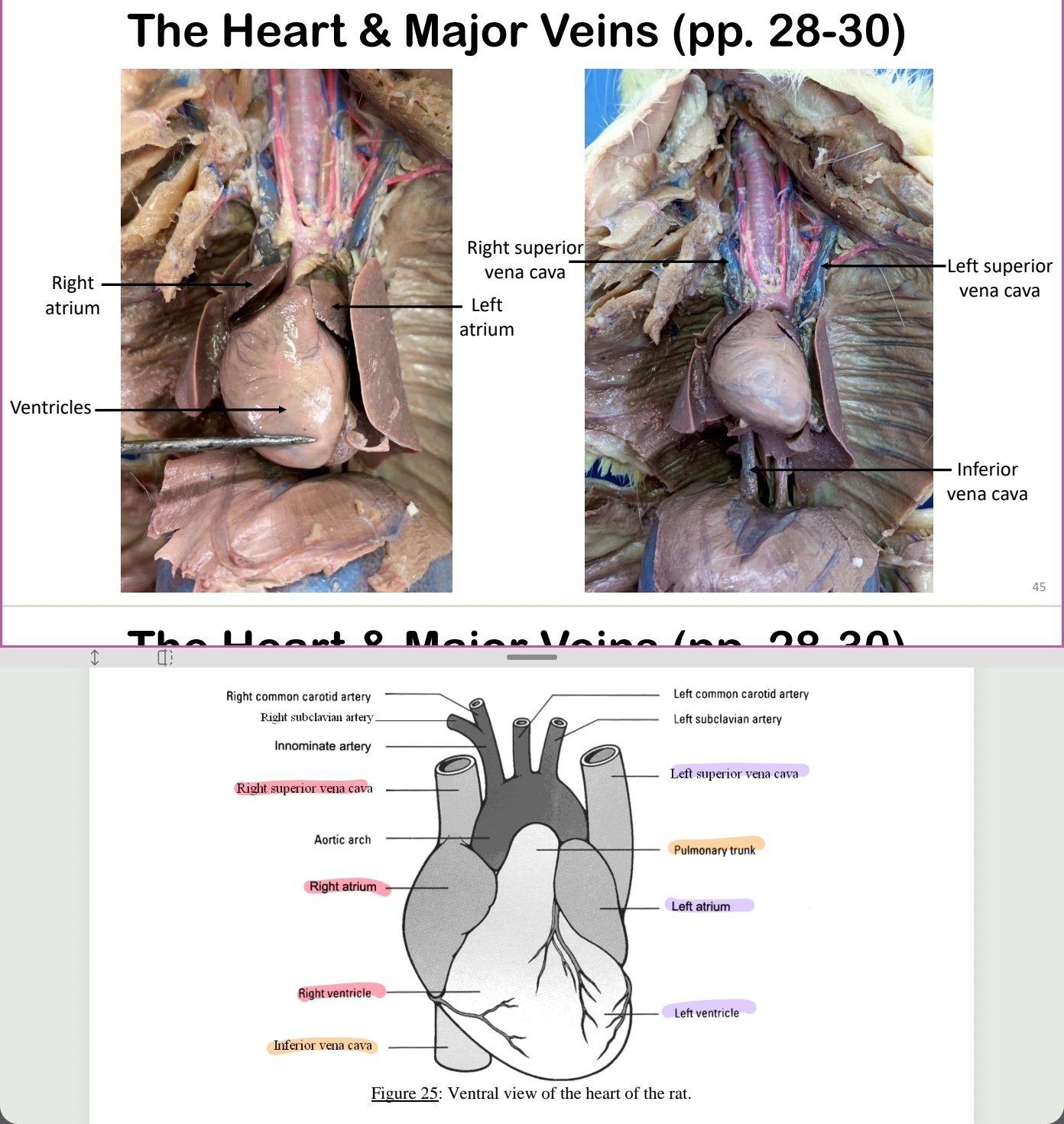
Phylum Chordata (Subphylum Vertebrata) - Rat Circulatory system: The heart chambers
The heart of the rat has 4 chambers
A Right ventricle
A left ventricle
A right atrium
A left atrium
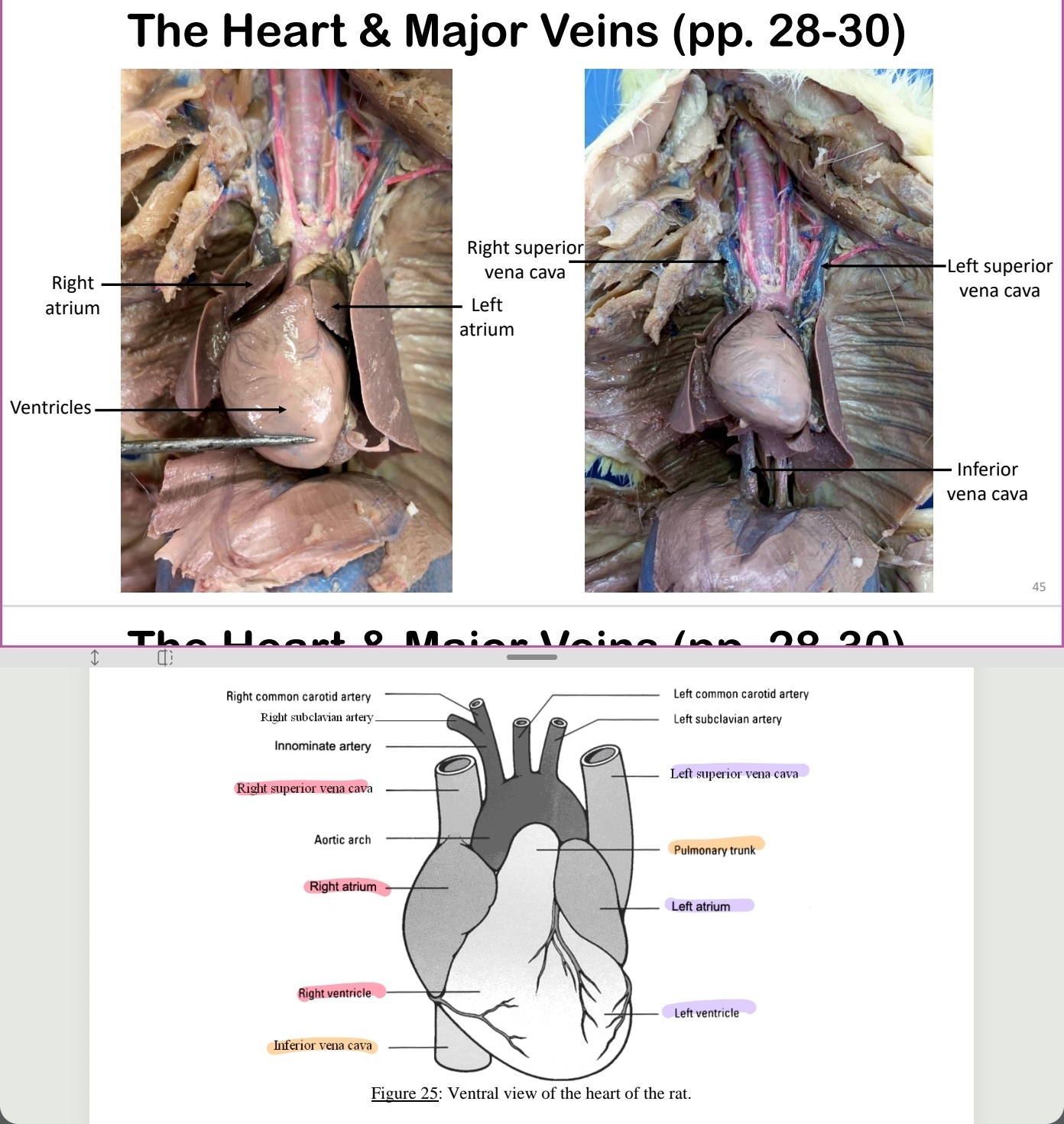
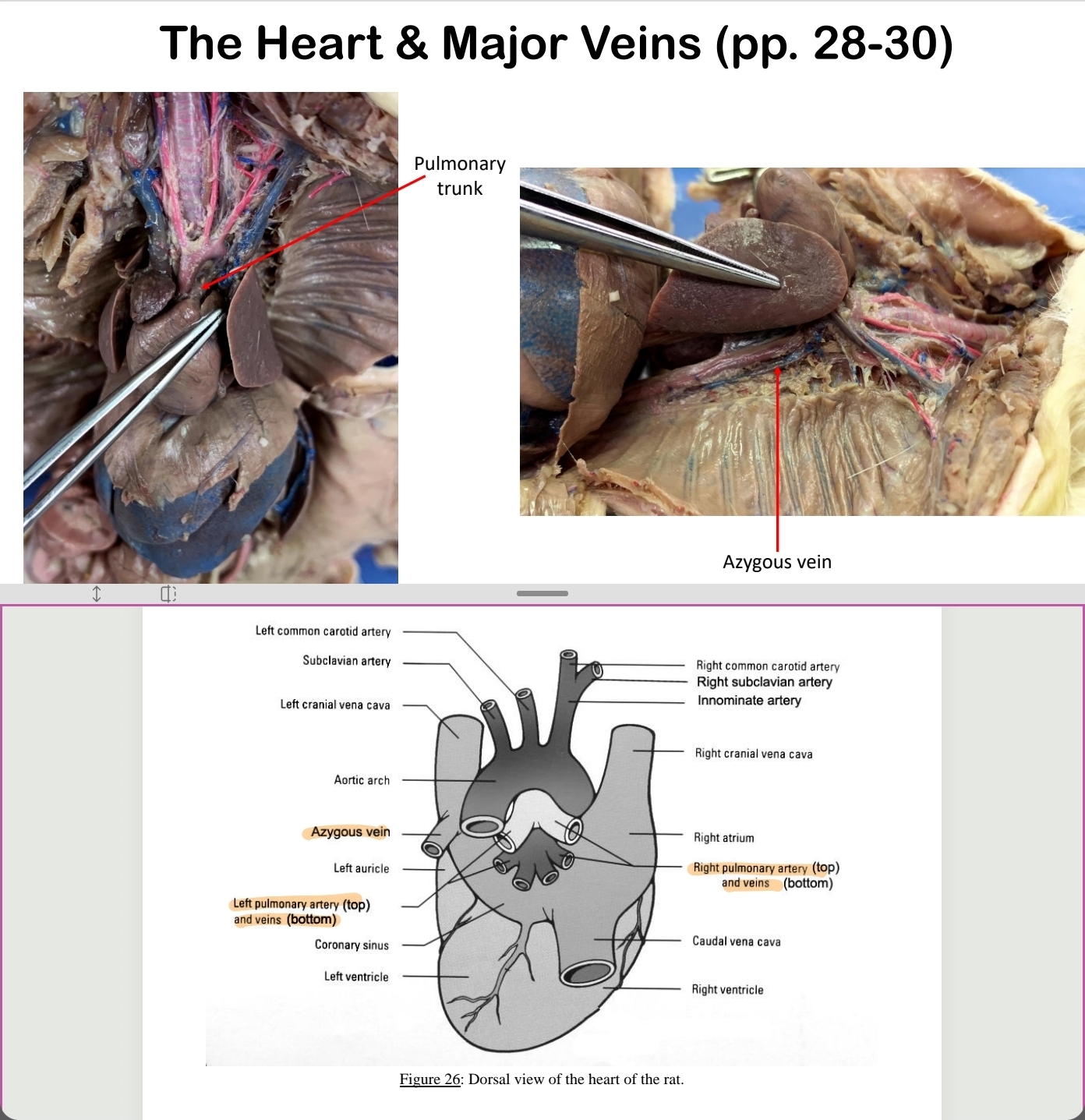
Phylum Chordata (Subphylum Vertebrata) - Rat Circulatory system: The Heart Veins
The veins of the heart are incharge of transporting deoxygenated blood to the lungs, includes:
The right superior vena cava
The left superior vena cava
Inferior vena cava
Phylum Chordata (Subphylum Vertebrata) - Rat Circulatory system: The heart Blood pathway
Inferior Vena cava brings deoxygenated blood from the lower part of the body to the heart and into the right atrium
The azygous vein brings deoxygenated blood from the thoracic cavity walls to the heart and empties into the left superior vena cava
Deoxygenated blood in the right atrium gets pumped into the right ventricle guarded by the tricuspid valve
from the right ventricle the deoxygenated blood is pumped through the pulmonary semilunar valve into pulmonary trunk
from the pulmonary trunk the blood divides into the right and left pulmonary arteries to travel to the lungs to pick up O2
from the lungs they return into the left atrium where it then is pumped into the left ventricle through the bicuspid valve

