Cell and Molecular chapters 13,14,15
0.0(0)
 Studied by 0 people
 Call Kai
 Learn
Learn Practice Test
 Spaced Repetition
 Match
Match Flashcards
 Knowt Play
Card Sorting
1/135

Earn XP
Last updated 12:35 AM on 4/3/23
Name | Mastery | Learn | Test | Matching | Spaced | Call with Kai |
|---|
No analytics yet
Send a link to your students to track their progress
136 Terms
1
New cards
What is the source of energy for cells to maintain biological order and stay alive?
Food
2
New cards
\
\n What is the process that breaks down sugars into ATP, NADH, and other activated carrier molecules in cells?
\n What is the process that breaks down sugars into ATP, NADH, and other activated carrier molecules in cells?
catabolism
3
New cards
What is the main fuel molecule that cells use to generate energy?
sugar
4
New cards
where does the energy that is stored in food molecules come from?
\
what is its purpose?
\
what is its purpose?
chemical bonds energy
\
its fuel for cells
\
its fuel for cells
5
New cards
Where does Stage 1 of cellular metabolism occur?
Stage 1 mostly occurs outside cells, although special organelles called lysosomes can digest large molecules in the cell interior.
6
New cards
Where does Stage 2 of cellular metabolism occur?
Stage 2 occurs mainly in the cytosol, except for the final step of conversion of pyruvate to acetyl groups on acetyl CoA, which occurs in mitochondria.
7
New cards
Where does Stage 3 of cellular metabolism occur?
Stage 3 occurs entirely in mitochondria.
8
New cards
What is the process by which energy is preserved in cells?
The controlled oxidation of sugar in the cell preserves energy.
\
\
9
New cards
What is the role of enzymes in oxidations that occur in cells?
Enzymes catalyze oxidations via a series of small steps in which free energy is transferred to carrier molecules - most often ATP and NADH.
10
New cards
How do enzymes control reactions in cells?
Enzymes control reactions by reducing the activation energy barrier at the temperature of cells.
11
New cards
What is the total free energy released by the controlled oxidation of glucose in cells?
The total free energy released by the controlled oxidation of glucose in cells is exactly the same as that released as heat during the direct burning of sugar.
12
New cards
What are the net products of glycolysis?
The net products of glycolysis are 2 pyruvate, 2 ATP, and 2 NADH.
13
New cards
How many enzymes catalyze the 10 steps of glycolysis?
10 steps of glycolysis is catalyzed by a different enzyme.
14
New cards
What happens in step 4 of glycolysis?
Step 4 cleaves a 6-carbon sugar into 2 three-carbon intermediates, so that the number of molecules at every stage after this doubles.
15
New cards
What is the name of the pathway that is sometimes referred to as glycolysis?
Embden-Meyerhof pathway.
16
New cards
hat is glucose converted to?
fructose 1,6-bisphosphate.
17
New cards
Are Step 1 and Step 3 reversible or irreversible reactions?
irreversible reactions
18
New cards
What is the enzyme that catalyzes Step 1?
Hexokinase
19
New cards
What is the enzyme that catalyzes Step 3?
PhosphofructokinaseWhat molecule is broken down to pyruvate during glycolysis?
20
New cards
What molecule is broken down into 2 pyruvates during glycolysis?
A fructose 1,6-bisphosphate is broken down to 2 molecules of pyruvate.
21
New cards
What are the net products of glycolysis?
2 pyruvates, 2 ATP, and 2 NADH.
22
New cards
What is the enzyme that catalyzes Step 6 of glycolysis?
glyceraldehyde 3-phosphate dehydrogenase.
23
New cards
What is the enzyme that catalyzes Step 7 of glycolysis?
phosphoglycerate kinase.
24
New cards
What is Step 10 of glycolysis and what is its significance? (2-part answer)
\-Step 10 of glycolysis is the final step, and it is irreversible.
\
\-This step involves the transfer of a high-energy phosphate group to ADP, which forms ATP, completing glycolysis.
\
\-This step involves the transfer of a high-energy phosphate group to ADP, which forms ATP, completing glycolysis.
25
New cards
What is the enzyme that catalyzes Step 10 of glycolysis?
pyruvate kinase
26
New cards
What is substrate-level phosphorylation?
Substrate-level phosphorylation is the synthesis of ATP in glycolysis. It involves the transfer of a phosphate group directly from a substrate molecule.
27
New cards
What is the input of energy required for glycolysis?
form of ATP, at the start of the process.
28
New cards
What happens to pyruvate in the absence of oxygen?
Pyruvate is converted to lactate in the absence of oxygen.
29
New cards
Why is lactate produced in muscle cells undergoing vigorous contraction?
Lactate is produced in muscle cells undergoing vigorous contraction when there isn’t enough oxygen present.
30
New cards
What is the purpose of the lactate production in muscle cells?
to restore the NAD+ consumed in glycolysis.
31
New cards
What is fermentation?
an anaerobic energy-yielding pathway in which organic compounds are partially oxidized, and pyruvate is broken down in the absence of oxygen.
32
New cards
Why does fermentation yield less energy overall than complete oxidation?
The pathway is incomplete, and pyruvate is not fully oxidized.
33
New cards
In some organisms that can grow anaerobically, what is pyruvate converted into?
carbon dioxide and ethanol.
34
New cards
What is the function of the pathway that converts pyruvate to carbon dioxide and ethanol?
converts pyruvate to carbon dioxide and ethanol regenerates NAD+ from NADH, as required to enable glycolysis to continue.
35
New cards
What enzyme converts pyruvate to acetyl CoA and CO2?
pyruvate dehydrogenase.
36
New cards
Where does the pyruvate dehydrogenase complex convert pyruvate to acetyl CoA?
in the mitochondrial matrix.
37
New cards
What molecules are generated from 2 molecules of pyruvate? ( 2 part answer)
\-2 lactates,
\
\-or 2 molecules of CO2 and 2 ethanol, plus 2 molecules of NAD+.
\
\-or 2 molecules of CO2 and 2 ethanol, plus 2 molecules of NAD+.
38
New cards
How many enzymes and polypeptides does Pyruvate dehydrogenase complex contain ?
3 enzymes
60 polypeptides
60 polypeptides
39
New cards
How are fatty acids derived from fats converted to acetyl CoA?
Fatty acids derived from fats are also converted to acetyl CoA in the mitochondrial matrix.
40
New cards
What is the structure of triacylglycerol?
glycerol portion, 3 fatty acid chains linked to it through ester bonds.
41
New cards
What are lipases and what do they do?
Lipases are enzymes that can hydrolyze ester bonds in triacylglycerol, releasing fatty acids that can be used for energy.
42
New cards
How are fatty acids coupled to coenzyme A?
Fatty acids are coupled to coenzyme A in a reaction requiring ATP.
43
New cards
What happens to the fatty acyl CoA molecule in the breakdown cycle?
Each turn of the cycle shortens the fatty acyl CoA molecule by 2 carbons.
and generates one molecule each of FADH2, NADH, and acetyl CoA.
and generates one molecule each of FADH2, NADH, and acetyl CoA.
44
New cards
Why do many metabolic pathways proceed in cycles?
Enzymatic pathways proceed in cycles to constantly regenerate the substrate, creating an abundant supply of substrate material.
45
New cards
How does this compare to non-cyclical pathways like glycolysis?
Non-cyclical pathways like glycolysis require the organism to physically replenish the substrate through various macromolecular sources.
46
New cards
How do predatory animals with high protein, low carb diets regulate carbohydrate breakdown?
\- ketogenesis
these pathways breakdown proteins
\-also, less efficient pathway
these pathways breakdown proteins
\-also, less efficient pathway
47
New cards
Where is acetyl CoA produced in eukaryotic cells?
mitochondria from molecules derived from sugars and fats.
48
New cards
Where do most of the cell's oxidation reactions occur and where is most of its ATP generated?
cell's oxidation reactions occur in mitochondria, and most of its ATP is generated here.
49
New cards
Where does the citric acid cycle take place in eukaryotes and what is directed for acetyl CoA production?
in mitochondria, in which pyruvate and fatty acids are directed for acetyl CoA production.
50
New cards
What happens in the presence of oxygen during the citric acid cycle?
pyruvate is converted to acetyl CoA plus CO2.
51
New cards
What converts the acetyl group in acetyl CoA to CO2 and H2O in the citric acid cycle?
The citric acid cycle
52
New cards
How is ATP produced using the high-energy electrons stored in NADH and FADH2?
using the high-energy electrons stored in NADH and FADH2 through a process called oxidative phosphorylation in the electron transport chain (ETC)
53
New cards
Who discovered the citric acid cycle and what did he receive for his discovery?
Dr. Hans Krebs discovered the citric acid cycle and he received the Nobel Prize in Medicine in 1953.
54
New cards
What are the 3 names for the Cycle established by Dr. Hans Krebs?
citric acid cycle
* Krebs cycle
* Tricarboxylic acid (TCA) cycle
* Krebs cycle
* Tricarboxylic acid (TCA) cycle
55
New cards
What is gluconeogenesis, and what molecules are used to synthesize glucose during this process?
\
\-Gluconeogenesis is a process in which blood glucose is synthesized from small non-carbohydrate organic molecules
\- lactate, pyruvate, or amino acids.
\-Gluconeogenesis is a process in which blood glucose is synthesized from small non-carbohydrate organic molecules
\- lactate, pyruvate, or amino acids.
56
New cards
Are the synthetic reactions carried out in gluconeogenesis energetically favorable or unfavorable?
The synthetic reactions carried out in gluconeogenesis require an input of energy, whereas glycolysis as a whole is an energetically favorable set of reactions.
57
New cards
Where does gluconeogenesis occur mainly, and why?
occurs mainly in liver cells to keep the blood supplied with glucose by using different molecules.
58
New cards
How is the balance between glycolysis and gluconeogenesis regulated?
glucose is broken down rapidly when energy reserves run low, but is synthesized and exported to other tissues when the liver cell has sufficient energy reserves in the form of pyruvate, citrate, or ATP.
59
New cards
What is the key control point in the breakdown of glucose, and how is it regulated?
\
\-The key control point in the breakdown of glucose lies in step 3 of glycolysis, the production of **fructose** **1,6-bisphosphate** by the enzyme **phosphofructokinase**
\
\-phosphofructokinase is activated by **AMP, ADP**, and inorganic phosphate (the byproducts of ATP hydrolysis), and inhibited by **ATP**, citrate, and fatty acids
\
\-other enzyme that catalyzes the reverse reaction, fructose **1,6-bisphosphatase,** is regulated in the opposite direction
\-The key control point in the breakdown of glucose lies in step 3 of glycolysis, the production of **fructose** **1,6-bisphosphate** by the enzyme **phosphofructokinase**
\
\-phosphofructokinase is activated by **AMP, ADP**, and inorganic phosphate (the byproducts of ATP hydrolysis), and inhibited by **ATP**, citrate, and fatty acids
\
\-other enzyme that catalyzes the reverse reaction, fructose **1,6-bisphosphatase,** is regulated in the opposite direction
60
New cards
What is the purpose of animal cells storing glycogen?
\-Animal cells store glycogen to provide energy in times of fasting
\- when more ATP is needed than can be generated from food molecules taken from the bloodstream.
\- when more ATP is needed than can be generated from food molecules taken from the bloodstream.
61
New cards
2. What is the structure of glycogen in animal cells and how does it compare to starch in plants?
\-glycogen in animal cells is a branched polymer of glucose
\- glycogen has many more branch points than starch.
\- glycogen has many more branch points than starch.
62
New cards
How is glycogen broken down to provide energy?
\-Glycogen is broken down to glucose 1-phosphate by the enzyme glycogen phosphorylase in liver cells,
\-hen converted to glucose 6-phosphate and fed into the glycolytic pathway to produce ATP.
\-hen converted to glucose 6-phosphate and fed into the glycolytic pathway to produce ATP.
63
New cards
How are the glycogen synthetic and degradation pathways regulated?
\- **Glycogen synthetic** and degradation pathways are regulated by **glucose 6-phosphat**e, but in opposite directions
\
\-Glycogen synthase in the synthetic pathway is **activated by glucose 6-phosphate**
\
\-**glycogen phosphorylase** that **catalyzes** the breakdown of **glycogen i**s inhibited by **both glucose 6-phosphate and ATP.**
\
\-Glycogen synthase in the synthetic pathway is **activated by glucose 6-phosphate**
\
\-**glycogen phosphorylase** that **catalyzes** the breakdown of **glycogen i**s inhibited by **both glucose 6-phosphate and ATP.**
64
New cards
5. Where does natural uncoupling occur in some specialized fat cells, and why is it important?
* Natural uncoupling occurs in brown fat cells, and it is important for protecting sensitive areas of newborn human babies from the cold. Most of the energy from oxidation in brown fat cells is dissipated as heat rather than converted into ATP.
65
New cards
4. What was the effect of DNP on patients who took it?
* Patients who took DNP experienced an elevated temperature and sweated profusely during the treatment.
66
New cards
3. What was the historical use of DNP in medicine?
* In the 1940s, small amounts of DNP were given to patients to induce weight loss.
67
New cards
1. What are uncoupling agents?
* Uncoupling agents are H+ carriers that can insert into the mitochondrial inner membrane.
68
New cards
1. What are uncoupling agents and what do they do in the mitochondria?
Uncoupling agents are H+ carriers that can insert into the mitochondrial inner membrane. They make the inner membrane permeable to protons, allowing H+ to flow into the mitochondrion without passing though ATP synthase so that ATP can no longer be made
69
New cards
2. What is the effect of 2,4-dinitrophenol (DNP) on ATP production?
* DNP prevents ATP from being made by making the inner membrane permeable to protons, which allows H+ to flow into the mitochondrion without passing though ATP synthase.
70
New cards
What happens to fatty acids in mitochondria?
Fatty acids are converted to acetyl CoA in mitochondria.
71
New cards
What is generated in each turn of the fatty acid breakdown cycle?
Each turn of the cycle generates 1 Acetyl CoA, 1 NADH, and 1 FADH2.
72
New cards
What is produced in each turn of the citric acid cycle?
Each turn of the citric acid cycle produces one molecule of GTP and one molecule of FADH2.
73
New cards
What is GTP and how is it related to ATP?
\-GTP is produced in the citric acid cycle
\-close relative of ATP
\
-ATP is the substitution of the base guanine for adenine.
\-close relative of ATP
\
-ATP is the substitution of the base guanine for adenine.
74
New cards
What is GDP and how is it related to ADP?
\
\-is a close relative of ADP
GDP and ADP is the substitution of the base guanine for adenine.
\-is a close relative of ADP
GDP and ADP is the substitution of the base guanine for adenine.
75
New cards
What is the difference between GTP and GDP?
The presence of an additional phosphate group in GTP.
76
New cards
\
What is produced during each turn of the citric acid cycle?
Each turn of the citric acid cycle produces 1 GTP and 1 FADH2.
77
New cards
What is the role of FADH2 and NADH?
FADH2 and NADH are carriers of hydrogens and high-energy electrons.
78
New cards
How is ATP produced from the high-energy electrons of NADH and FADH2?
oxidative phosphorylation
79
New cards
What is the structure of FADH2? (Hint: FAD is the oxidized form)
\- in its oxidized form (FAD)
\-FAD can accept two hydrogen atoms, along with their electrons, to form the reduced FADH2.
\-FAD can accept two hydrogen atoms, along with their electrons, to form the reduced FADH2.
80
New cards
What are the steps of the complete citric acid cycle? (in dashed points)
* 2 carbons from acetyl CoA enter
81
New cards
When fatty acids are in the form “fatty acetyl CoA “ are broken down by a cycle of reactions ,
\
What do the reactions do to “fatty acetyl CoA ?
\
What do the reactions do to “fatty acetyl CoA ?
\-Trims 2 carbons at a time from the carboxyl end
82
New cards
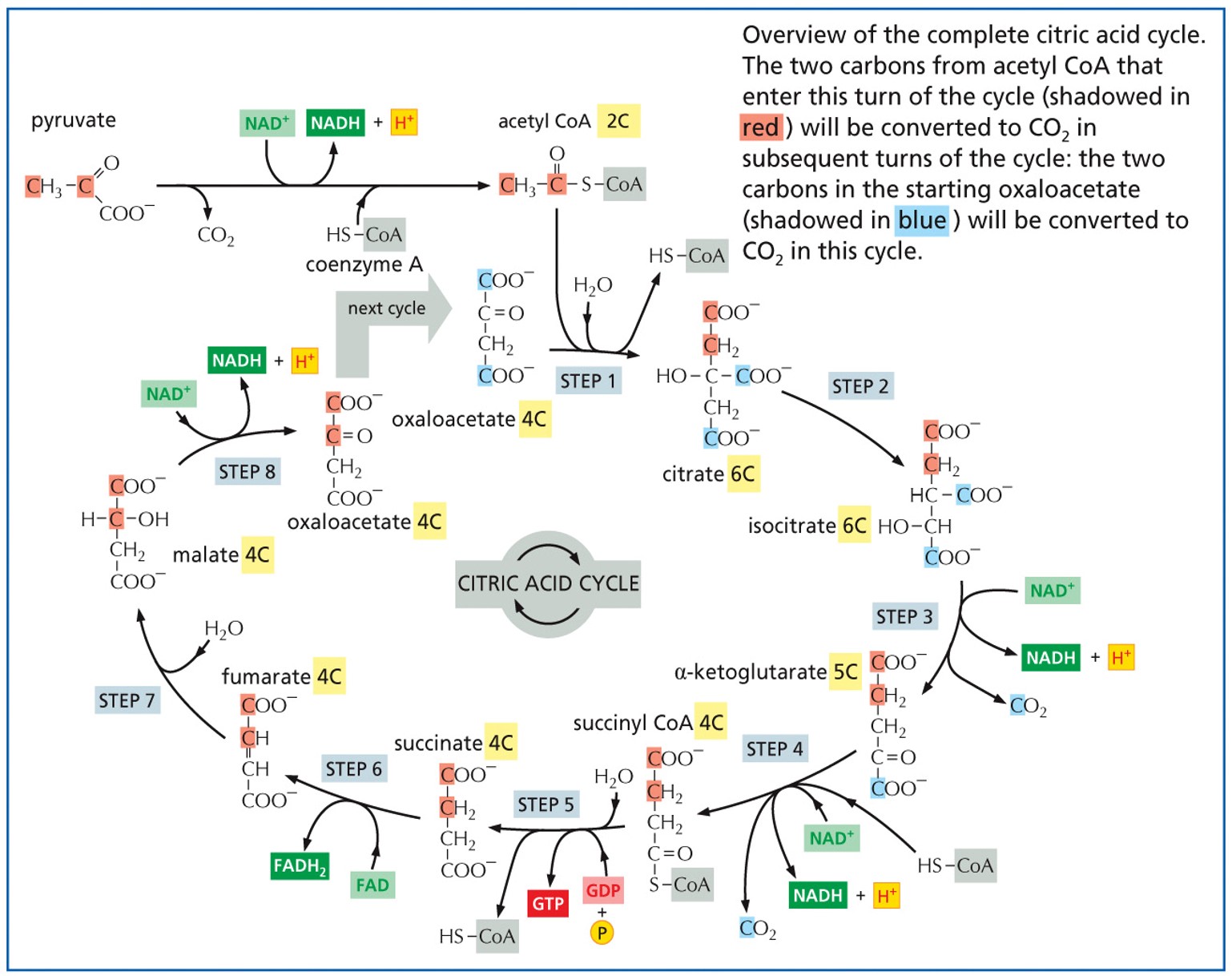
What is an overview of the complete “Krebs cycle”? (dashes used)
1. 2 carbons from Acetyl-CoA enter and combine with oxaloacetate to form citrate.
\
2. Citrate is rearranged and oxidized to form isocitrate.
\
3. Isocitrate is oxidized to form alpha-ketoglutarate, releasing one molecule of carbon dioxide and producing NADH.
\
4. Alpha-ketoglutarate is oxidized to form succinyl-CoA, releasing one molecule of carbon dioxide and producing NADH.
5. Succinyl-CoA is converted into succinate, producing GTP, which is a molecule that can be used to produce ATP.
6. Succinate is oxidized to form fumarate, producing FADH2.
7. Fumarate is converted into malate.
8. Malate is oxidized to reform oxaloacetate, producing NADH.
83
New cards
What are the precursors provided by glycolysis and the citric acid cycle?
are needed to synthesize many important biological molecules.
84
New cards
What are some examples of biological molecules that are synthesized using intermediates from glycolysis and the citric acid cycle?
amino acids, nucleotides, lipids, and other small organic molecules.
85
New cards
What happens to the intermediates formed in the glycolysis and the citric acid cycle?
are used for **biosynthetic (anabolic**) **pathways,** where they are converted into other molecules.
86
New cards
\
Why is regulation of metabolism important in a cell?
Why is regulation of metabolism important in a cell?
\-to ensure that the cell can survive and respond to its environment.
\- The choice of which pathway each metabolite will follow must be carefully regulated at every branch point to maintain order in cells.
\- The choice of which pathway each metabolite will follow must be carefully regulated at every branch point to maintain order in cells.
87
New cards
How do organisms replenish their ATP pools?
through sugar or fat oxidation.
88
New cards
Why do animals and plants synthesize food reserves?
\-Animals have only periodic access to food
\-plants need to survive overnight without sunlight.
\-This ensures that energy is available when other energy sources are scarce to synthesize food reserves in times of plenty that can be consumed later.
\-plants need to survive overnight without sunlight.
\-This ensures that energy is available when other energy sources are scarce to synthesize food reserves in times of plenty that can be consumed later.
89
New cards
What is the difference between anabolic and catabolic pathways?
\-**Anabolic pathways** : build molecules
\
\-**Catabolic pathways : build molecules** break molecules down to provide energy
\
\-**Catabolic pathways : build molecules** break molecules down to provide energy
90
New cards
What is used to control whether the correct pathway throughout cell (**anabolic or catabolic pathways)?**
Key metabolites
91
New cards
What are the "reverse" reactions that occur during glycolysis?
Gluconeogenesis
92
New cards
Why are bypass reactions needed in gluconeogenesis?
Bypass reactions are needed in gluconeogenesis to get around the steps 1, 3, and 10 in glycolysis, which are essentially irreversible.
93
New cards
What is the role of ATP synthase in oxidative phosphorylation?
1\. ATP synthase is an enzyme located in the inner mitochondrial membrane that uses the energy from the transmembrane proton gradient to convert ADP and Pi into ATP.
94
New cards
What is the function of the respiratory enzyme complexes embedded in the inner mitochondrial membrane?
1\. The respiratory enzyme complexes embedded in the inner mitochondrial membrane pump H+ out of the matrix to create a transmembrane proton (H+) gradient.
95
New cards
What is the role of NADH and FADH2 in oxidative phosphorylation?
1\. NADH and FADH2 donate high-energy electrons to the electron-transport chain in the inner mitochondrial membrane, which eventually combine with molecular oxygen (O2) to generate ATP through oxidative phosphorylation.
96
New cards
What is the function of the inner mitochondrial membrane?
1\. The inner mitochondrial membrane encloses the mitochondrial matrix, which contains many enzymes including those of the citric acid cycle, and serves as a barrier to maintain a transmembrane proton gradient.
97
New cards
What is the mechanism by which mitochondria produce ATP
1\. Mitochondria produce ATP by a membrane-based mechanism called chemiosmotic coupling.
98
New cards
What is the role of ATP synthase in oxidative phosphorylation?
1\. ATP synthase is an enzyme located in the inner mitochondrial membrane that uses the energy from the transmembrane proton gradient to convert ADP and Pi into ATP.
99
New cards
What is the function of the respiratory enzyme complexes embedded in the inner mitochondrial membrane?
The respiratory enzyme complexes embedded in the inner mitochondrial membrane pump H+ out of the matrix to create a transmembrane proton (H+) gradient.
100
New cards
What is the function of the inner mitochondrial membrane?
1\. The inner mitochondrial membrane encloses the mitochondrial matrix, which contains many enzymes including those of the citric acid cycle, and serves as a barrier to maintain a transmembrane proton gradient.
 Note
Note  Flashcards (106)