Evolution exam 2 Manual
 Call Kai
 Learn
Learn Practice Test
 Spaced Repetition
 Match
Match Flashcards
 Knowt Play
1/199

There's no tags or description
Looks like no tags are added yet.
Name | Mastery | Learn | Test | Matching | Spaced | Call with Kai |
|---|
No analytics yet
Send a link to your students to track their progress
200 Terms
Is high fecundity associated with low or high survival?
Low survival
Is low fecundity associated with low or high survival?
High survival
What are two examples of hypothetical adaptation axes?
Spatial axis, seasonal axis
In an adaptive landscape, how does natural selection move a population?
Always up peaks
In an adaptive landscape, how does drift move a population?
Any direction; randomly; random direction
True or False: sometimes drift does not happen
False (drift always happens)
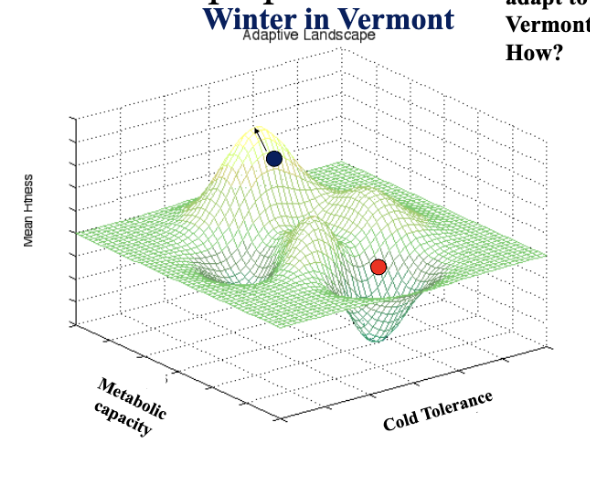
If the black dot represents a Massachusetts population of Drosophila, is it likely that these flies can adapt to winter in Vermont (reach the tallest peak)? Why? (Answer 1; Answer 2)
Yes; natural selection drives it upwards and there are no fitness valleys
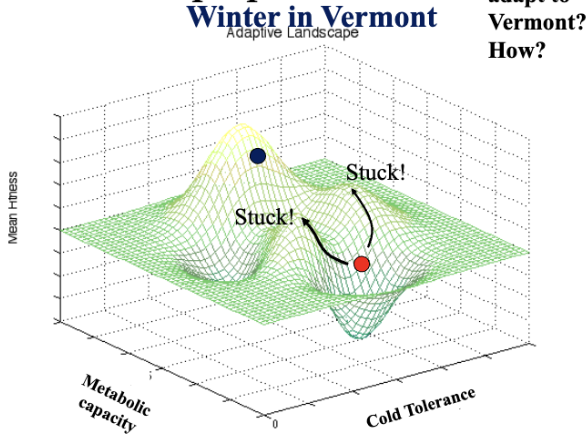
If the red dot represents a Florida population of Drosophila, is it likely that these flies can adapt to winter in Vermont (reach the tallest peak)? Why? (Answer 1; Answer 2)
No; as it moves along the axes of metabolic capacity and cold tolerance, it reaches peaks which are not the optimum
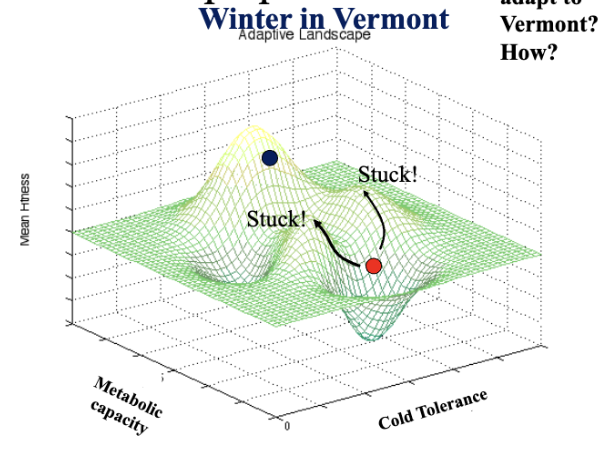
Why can a population become “stuck” on peaks of lower fitness rather than progressing towards the optimum for an environment?
Natural selection is myopic; to move past a local maximum would mean temporarily decreasing fitness
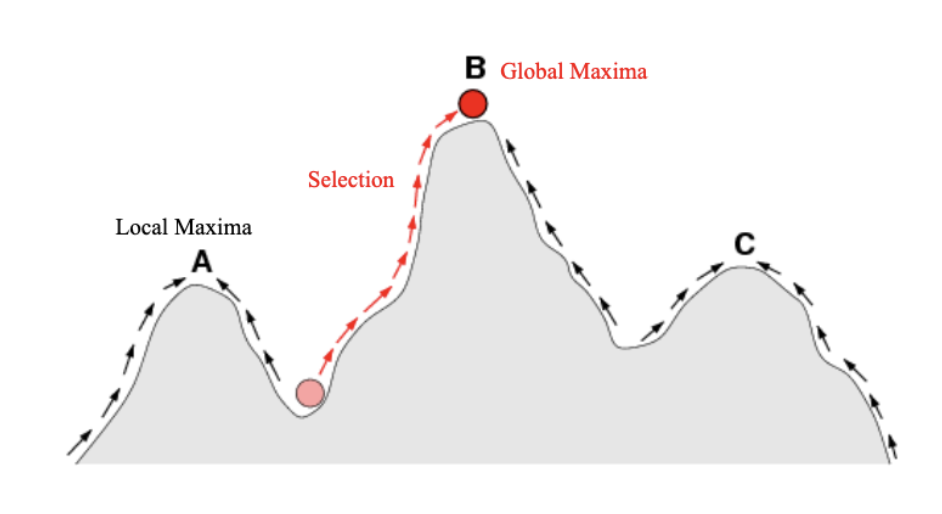
What might allow the red population to leave the global maximum?
Drift
What does the process of local adaptation represent?
The journey of a population to maximize its fitness in an environment
In a static fitness landscape, where does the population end up?
Trapped on one peak (local or global maximum)
What is CCR5-Δ32?
A rare allele common in northern latitudes that confers resistance to HIV, but weakens the overall immune system.
Is selection on the Δ32 allele in the north strong or weak? Why? (Answer 1; Answer 2)
Weak; because HIV/AIDS is rare
Is selection on the Δ32 allele in the south strong or weak? Why? (Answer 1; Answer 2)
Strong; because HIV/AIDS is common
Selection on the Δ32 allele in the south is strong, but the allele is rare (p = 0.01). What does this mean?
Response is weak
Why is response weak for the Δ32 allele in the south, where HIV/AIDS is common?
Because the Δ32 is infrequent (p = 0.01)
What does it mean to say that evolution is myopic?
Selection in an adaptive landscape may trap a population on a local peak
How can a population escape from being trapped on a local peak?
Drift may allow a population to acquire new allele frequencies and combinations that enable selection towards the highest peak; drift can allow populations to approach the domain of attraction of another peak
Sewell Wright’s hypothesis
Adaptive evolution may proceed most quickly when a population divides into subpopulations with restricted gene flow
What are the four components of Sewell Wright’s hypothesis?
Drift in local populations, intrademic selection (mass selection), interdemic selection, all demes acquire allele frequencies of “best” global peak
Why is the C allele described as being "TRAPPED" in the AC and SC genotypes (malaria)?
Because these heterozygotes have lower fitness (0.9 and 0.7) than the established AS genotype (1.0), making it difficult for the C allele to increase in frequency.
What mathematical term is used to explain why the CC genotype is almost non-existent when the C allele frequency is low?
Rare squared
Intrademic selection (mass selection)
When a population climbs a local peak
Interdemic selection
Emigrants proportional to relative fitness among demes
If deme A has much higher relative fitness than deme B, which will produce more migrants?
Deme A
Deme
A subdivision of a population consisting of closely related plants, animals, or people, typically breeding mainly within the group.
If f(A)>>f(S)>f(C) and CC is the most fit, but AS > AC > SC, what fact of adaptive landscapes prevents selection from making the CC genotype most common?
Selection has to go down hill to get CC homozygotes by getting C heterozygotes, which are the least fit
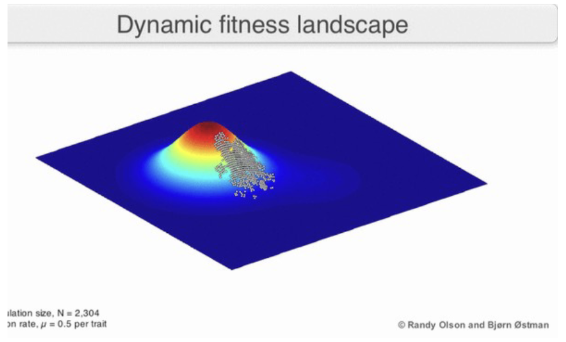
This “dynamic” landscape would lead to what kind of selection?
Directional selection
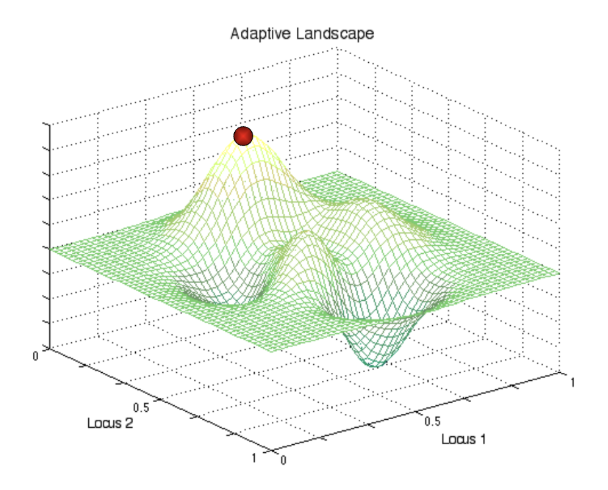
What would best describe the red population (provide the most accurate and prce4ise answer in the context of adaptive landscapes)?
Locally adapted
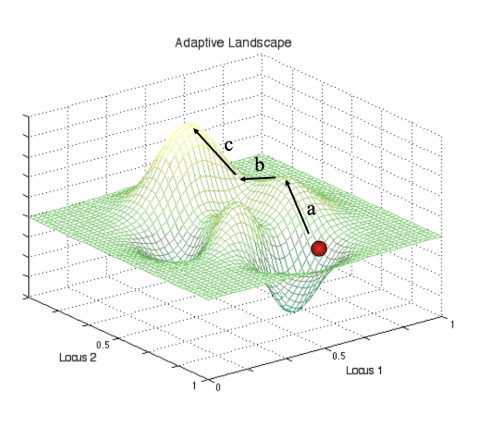
What forces are depicted here, in order (a, b, c)?
Selection, drift, selection
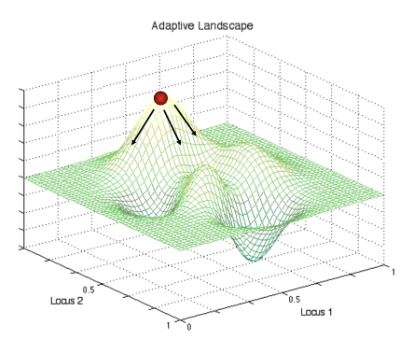
What does the evolutionary direction indicated by the arrows imply?
Drift
Polymorphism
When there are two or more possibilities for a trait on a gene
How are polymorphisms introduced?
Mutation
When a mutation reaches fixation as a result of selection, what does this result in?
Substitution
Substitution
“when the wild-type allele in a population changes from a previous one to a new one. [This is] The product of a mutation leading to a polymorphism and fixation.”
The “classical” school on new mutations
New mutations are bad
The “classical” school on the wild type allele
The wild type allele is always the best allele
The “classical” school on the effect of selection on variation
Selection removes variation
The “classical” school on new mutations and old wild-types
New mutations can enter populations to replace old wild-types
The “balance” school on new alleles
Most alleles can be beneficial
The “balance” school on fitness of mutations
Mutations can have varying fitness depending on the environment
The “balance” school on selection
Selection may “want” to preserve multiple alleles to deal with several challenges
A researcher studies a plant species distribution across a wide climate gradient. Whole genome sequencing reveals that most loci show an excess of rare young variants, but a small subset of loci show long term intermediate frequency haplotypes shared across related species. Field experiments show that these balanced loci shift fitness effects across environments, with heterozygotes favored only in drought years.
Assuming these results are true, which interpretation best integrates these results into the classic versus balance school debate?
The pattern suggests that while classic forces like purifying selection dominate genome wide, the presence of environment conditional balancing selection at specific loci reveals that both schools capture important but incomplete aspects of natural variation
What percentage of the genome codes for functional loci, and what percentage is regulatory? (functional %; regulatory %). The percentages to choose from are: 1.5-2.0%, 0.5-1.5%, 5.0-2.0%, 1.5-2.5%
1.5%-2.0%; 5.0-2.0%; 1.5-2.0; 5.0-2.0
According to Kimura, at what level do the great majority of evolutionary changes occur?
Molecular level
Kimura: what causes changes at the molecular level?
Random drift of selectively neutral or nearly neutral mutants
What view does the neutral theory of molecular evolution build on?
The “classical” school view of “purifying selection”
Rate at which new mutations appear in a diploid organism
2(Neu)
Ne (effective population size)
Number of individuals contributing to the gene pool
What is Ne multiplied by for diploid organisms?
2
The average frequency of new mutations entering populations and the probability that a new mutation will eventually become fixed in the absence of selection is
1/(2Ne)
Rate of neutral evolution (why is the rate equal to the mutation rate)
u (because 1/(2Ne) x 2Ne(u) almost entirely cancel, leaving just u)
Rate of neutral evolution is equal to what?
u
What is u (neutral evolution)?
The probability that a particular gene copy mutates to a new allele in one generation; mutation rate
Kimura’s proposition, the expression above (1/(2Ne) x 2Ne(u) = u), shows the rate of neutral evolution equals the mutation rate because the probability of fixation of a new neutral mutation is one divided by two times the effective population size, while the number of new neutral mutations entering the population each generation is two times the effective population size times the mutation rate.
Which inference best reflects the deeper evolutionary meaning of this result, according to Kimura’s theory?
Neutral substitution rates remain constant across species regardless of differences in effective population size, implying that mutation rate, not population size, determines long term molecular change
What are the three steps for measuring DNA evolution?
Align sequences, determine length of sequences, count the number of differences
What does “aa/y” stand for?
Amino acids per year
What step must be completed for calculating divergence for a single lineage?
Dividing the total divergence by two (each lineage experiences half)
According to the neutral theory of molecular evolution, what are the majority of substitutions at the molecular level?
Neutral
True or False: according to the neutral theory of evolution, amino acid differences increase linearly with divergence time
True
True or False: constraint and purifying selection are important components of the neutral theory
True
What do patterns of molecular evolution reveal (important)?
Functional constraints
What do patterns of molecular evolution cause?
Different rates of evolution
If genes have different rates of evolution (which they do), then what does this reveal that genes also have?
Different constraints
What does neutral evolution say about the rates of evolution for different genes?
They are different
What does neutral evolution say about the rates of evolution across different species?
The rate of evolution is constant
Synonymous sites
Nucleotide differences between alternative codons
Nonsynonymous sites
Amino acids replacements sites (affects phenotype)
dN
Non-synonymous changes per non-synonymous site
dS
Synonymous changes per synonymous site
A gene can be either neutral, under positive selection, or under purifying selection. If dN/dS = 1, what does this mean?
Neutral
A gene can be either neutral, under positive selection, or under purifying selection. If dN/dS > 1, what does this mean?
Positive selection
A gene can be either neutral, under positive selection, or under purifying selection. If dN/dS < 1, what does this mean?
Purifying selection
BRCA 1 role
Providing DNA repair instructions
Why is BRCA 1 inconsistent with neutral expectations?
It exhibits variation in its dN/dS ratios across a phylogeny
What is the neutral prediction (DNA tests of neutrality)
Amino acid (non-synonymous) substitution rate (dN) should be lower than silent (synonymous) substitution rate (dS)
What is one region where amino acid mutations are favored?
Antigen recognition region
Why is dN/dS > 1 for antigen recognition regions?
To promote diversity and better recognition of foreign peptides
On average, how many nonsynonymous and synonymous sites do codons have?
2 nonsynonymous sites, 1 nonsynonymous site
dN/dS = 1. What selection is this gene under?
Neutral evolution
How common are deleterious mutations? Do they fix?
Common, don’t fix
How common are positive mutations? Do they fix?
Rare, fix
How common are neutral mutations? Do they fix?
Common, fix
According to the neutral theory of evolution, what type of mutation drives DNA variation across species?
Neutral mutations
You examine a protein coding gene across ten related species. The rate of synonymous mutation substitutions is much higher than the rate of nonsynonymous substitutions, but a few specific codons show elevated nonsynonymous change relative to the background.
Which interpretation best explains these patterns in terms of functional constraints and rates of evolution?
The lower nonsynonymous rate across most of the gene reveals strong functional constraint on amino acid changes, while the few codons with elevated nonsynonymous change suggest either relaxed constraint at these positions or episodes of positive selection
What are the arrangements of nucleic acids on a protein-coding gene called?
Introns and exons
Gene
Regions that are translated into proteins (exons) and regions that are not (introns)
How are exons organized?
Into codons
Codon
Triplet code; sequence of three consecutive nucleotides
Synonymous mutation
When the nucleotide sequence is changed but they still code for the same nucleic acid
Nonsynonymous mutation
When the nucleotide sequence is changed and they code for a different nucleic acid
Synonymous mutations do not have the capacity to alter splicing efficiency, and on average, they behave neutrally. As far as selection is concerned, these mutations don’t happen. What does this mean for the rate of divergence for synonymous mutations?
The rate is 1 to 1
Does natural selection “see” synonymous or nonsynonymous mutations?
Nonsynonymous mutations
What prevents the accumulation of nonsynonymous mutations (the line is closer to 0)?
Selection
What types of selection target nonsynonymous mutations?
Purifying selection and (more rarely) positive selection
True or False: most genes tolerate many nonsynonymous mutations
False
Generally speaking, does a gene have more nonsynonymous or synonymous mutations?
Synonymous mutations
True or False: genetic response are the only tool in an organism’s toolbox for dealing with stressors
False
Predictability
Physiological tools that an organism has in order to sense future environmental change

