(1) Intro to Ecology & (2) Evolution - BIO 305
 Studied by 0 people
 Call Kai
 Learn
Learn Practice Test
 Spaced Repetition
 Match
Match Flashcards
 Knowt Play
1/79

There's no tags or description
Looks like no tags are added yet.
Name | Mastery | Learn | Test | Matching | Spaced | Call with Kai |
|---|
No analytics yet
Send a link to your students to track their progress
80 Terms
Ecology
Scientific study of the interactions that determine the abundance (how many) and distribution (where) of living things
Biotic factors
Interactions living things (predation, competition, mutualism)
Abiotic factors
Physical environment (temperature, salinity, disturbance)
Human interactions with other species and the biosphere are critical for the quality of life on Earth for ourselves and all living things
Why study ecology?
Paradigm
Set of fundamental principles in a particular field that governs how scientists view the world; represents the consensus among scientists on the known truths about the physical world
Evolution
Genetic change in population over time
4 Different Mechanisms of Evolution
- Mutation
- Gene Flow
- Genetic drift
- Natural Selection
Fitness
Survival & Reproduction; Genetic contribution of an organisim’s descendants to future generations
Katmai Bear Take away:
traits & survive and reproduce
fitness
genes
biotic and abiotic
Katmai Bear Take away:
There are many ____ that affect the ability of bears to _____ & _____ in a harsh physical environment
• Survival and reproduction determine _____
• These traits are coded by ______
• These traits are also affected by the ____ and ______ environment
• Different traits would be favored (“selected for”) in a different environment
Adaptation as a trait
Genetically based characteristic of an organism that improves its ability to survive or reproduce within its environment
Adaptation as a process
the process of evolution that leads to an adaptive trait becoming more common in a population
Natural Selection
Evolutionary process in which individuals that possess particular characteristics survive or reproduce at a higher rate than other individuals because of those characteristics
Conditions Require for Evolution by Natural Selection
Individuals in a population vary in their traits
different phenotypes
Variation in traits is heritable
Differences in phenotypes among individuals are due to differences in genotype
• Trait variation results in differences in fitness among individuals
Acts on Individuals; Outcome of that selection affects the genetic makeup of a population over generations
What does natural selection operate on?
Adaptively Evolve
Populations _____ ____
Survive & Reproduce (do not adapt or evolve)
Individuals ____ & ______
Artifical Selection
People imposing a direction; Only the tame and extremely friendly populations were allowed to breed which resulted in generations overtime to increase amounts of elite percentage populations; Eventually almost all elite
Nature vs Artifical Selection
Nature, there is no conscious, directional choice
Indiviual
What’s happening in it’s one lifespan
Population
The interacting organisms
Generation
Those line of offspring
Mouse example for evolution by natural selection
1. Individuals vary in phenotype
mice differ in color
2. individuals with different phenotypes have different fitness
mice that match their habitat better have higher survival
3. phenotypic variation is heritable
Agouti gene affects coat color
Local Adaptation (Mice ex.)
If individuals in different areas experience different selection pressures, then populations can become adapted to local conditions
Climate
most important fact determining the geographic distribution and physiological functioning of organisms
Earth’s Shape and Tilt
What determines the amount of incoming radiation in different areas of the Earth?
Equator
Where gets the most solar energy?
Variation in incoming solar radiation across the Earth’s surface
A few basic physical principles
What drives global patterns of precipitation and temperature?
decreases (gets lighter)
Physical principle 1: gases expand when heated
Air density ______ as temperature increases
rises
Warm air is less dense than cool air, therefore warm air ______
decreases (as you go up less particles more spread out)
Physical principle 2: Atmospheric pressure ______ as you go higher above the surface of the Earth
less oxygen
As you go up in elevation there is ____ oxygen available
Rising air expands
Atmospheric pressure decreases with altitude → ______
Rain
Expanding air cools → condensation → ______
Why do we see different habitats around the globe?
Differential heating of Earth’s surface combined with physical principals lead to patterns of atmospheric circulation
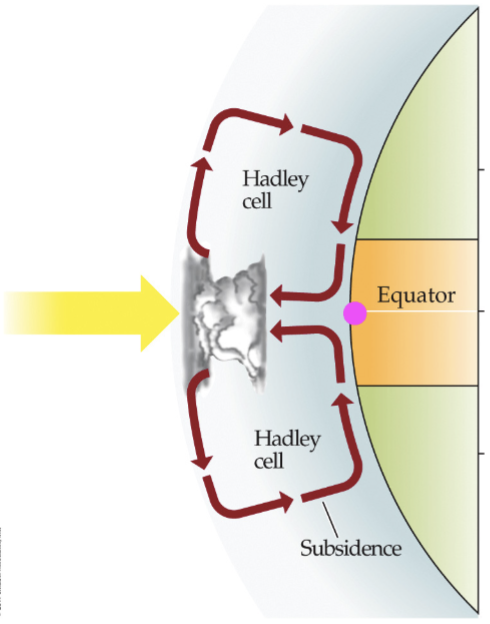
Hadley Cell
Cycle of air movement caused by incoming solar radiation striking the equator
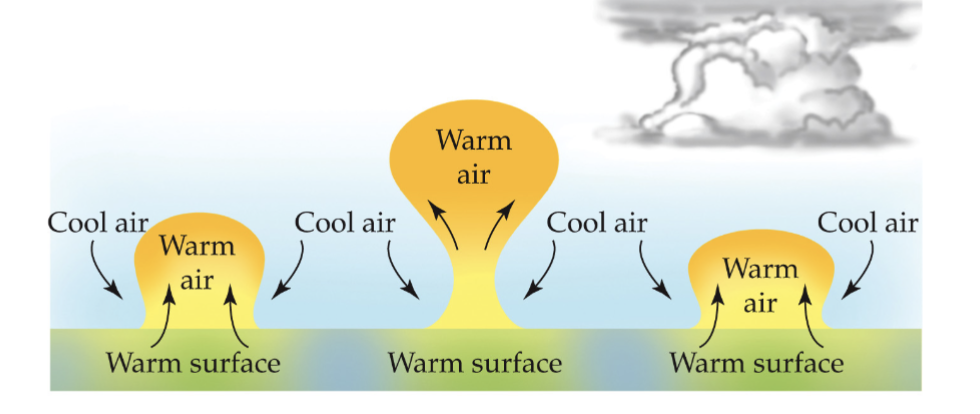
3 Steps
Warm air is less dense than cool air → warm air rises
Atmospheric pressure decreases with altitude → rising air expands
Expanding air cools → condensation → rain
Why is the equator a low pressure zone?
Air is traveling up
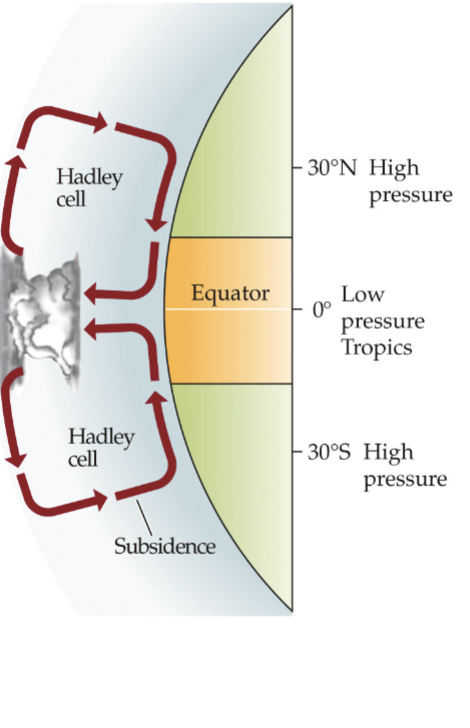
high pressure to low pressure
Wind flows from__________________ , which are created between the cells
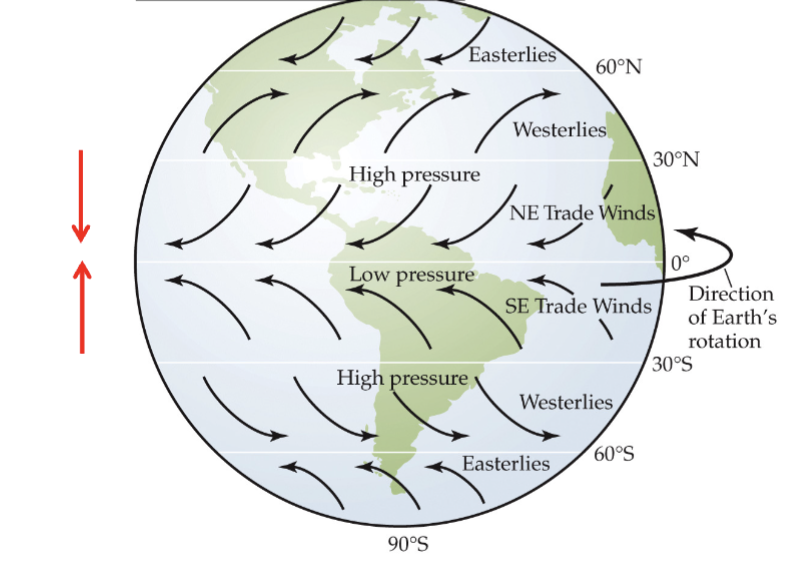
Differential heating is responsible for:
patterns of global temperature, precipitation, wind
warmer
Global pattern: _____ at the equator compared to the rpoles
How do mountains modify climate on a local scale, including rainfall in Hawai’i?
The mountains drive it’s own small-scale Hadley cell, Hawai’i’s East tradewinds make the windward side the wet side
Biomes
Large geographic areas affected by similar climatic and physical factors, leading to distinctive forms of plants and animals
Covergent evolution (convergence)
Evolution of similar traits among distantly related species in response to similar selection pressures
Temp below 0º C (water freezes)
Temp line is above precip line (too dry to grow)
Climate Diagram: When can’t plants grow?
Similar adaptations to similar physical environments; similar traits, different species
Why do we see similar life forms in different places?
Similar adaptations to similar physical environments
Why do we see similar habitats in different places?
Because they experience similar abiotic conditions, mainly climate; Imposes selection pressures on organisms, causing similar traits to evolve in species
Why do difference places on the plant have the same biome?
Tradewinds
Mountains
Rain shadows
What results in Hawai’i having a huge diversity of biomes?
Explain how changes in elevation on a mountain are similar to global patterns in biomes?
Habitats change as you go up in elevation because abiotic factors are changing; As elevation increases, temperature and oxygen change, creating biome-like patterns similar to moving toward the poles
Differential heating creates global climate patterns, and climate determines biome distribution. Natural selection then favors traits suited to each climate, producing similar biomes and adaptations in places with similar abiotic conditions.
Explain the distribution of biomes on Earth
Physiology
Study of bodily functions and cellular mechanisms at work within living organisms
Physiological ecology
Study of the interactions between organisms and the physical environment that influence their survival and persistence
Range
Environments the organisms can tolerate
Optimum
The environmental value the rate is the highest
Niche
All of the environmental conditions and resources necessary for persistence; What a population needs; includes as many axes as needed to capture all necessary environmental resources and conditions
Connect performance curves to distribution and abundance across the landscape.
Species occur where environmental conditions fall within their performance curves, and they are most abundant near their optimum
Physical Environment
Major determinant of species distribution and abundance
Ectotherms
Organism’s temperature determined by the external environment; most plants and animals (like snake example)
Endotherms
Rely mostly on internal heat generation through metabolism; birds, mammals (me)
Endothermy cost and benefits
Energetically expensive
Must eat alot
Must invest in insultation (feathers, fur, fat)
Must spend a lot of time being active
opportunity cost
risk
But, body temperature stays near optimum
wide geographic changes and activity periods
Ectothermy cost and benefits
Body temperature will often be suboptimal
Distribution more limited by environmental temperature
Acclimation
Short term, reversible, physiological changes that occur during an individual’s lifetime; changes occur within a lifetime; changes are reversible
Wood frog example
Most northern ranges, can tolerate freezing through acclimation; water flows out of the cells and turn 65% of body water to ice; occurs within a lifetime & changes are reversible; the ability to acclimate itself is an adaptation; some species have evolved over generations to tolerate freezing temperatures
Human Acclimation example
Swimming in cold water
Individuals; Populations
_______ can acclimate (short term reversible change)
____________ can adapt (change in trait frequency over generations due to
natural selection
tolerate
species can only occur in places where they can ______ the physical environment or avoid unsuitable extremes
Why is water important for living things?
Organisms must balance uptake and loss of water, and solute concentrations; Water is the medium in which all biochemical reactions necessary for life to occur; temperature control & structural support
high to low
Water moves from ____ to _____ energy
Water potential gradient
Determines Water loss rates
Why does water move from soil → plants → atmosphere?
water potential gradient — water moves from areas of higher water potential (soil) to lower water potential (atmosphere) ; from positive, to negative, to more negative
Transpiration
Process of the movement of water from soil through plants to the atmosphere as water vapor; how clouds form, how air travels
Photosynthesis
movement of water from the soil through the leaves is important for photosynthesis; Vast majority of biological available energy on Earth — including fossil fuels — is derived from the conversion of sunlight into energy-rich carbon compounds
Stomates
Where water exits plants through pores in leaves; plants can open and close
Cooling effect
Transpiration has a ________ _____ (just like sweating!)
C3 Photosynthesis
Energy efficient, but high water loss; 90% of plants; Calvin cycle takes place in the mesophyll; mostly temperate biomes
C4 photosynthesis: spatial segregation
intermediate energy efficiency and water loss; 3% of plants grasses, corn, sugarcane; C.C. takes place in bundle sheath cells; tropical or semitropical biomes, mostly grasslands
CAM photosynthesis: temporal segregation
low energy efficiency, but highest water retention; 7% of plants cati, succulents; open stomata at night, capture carbon when water loss is lower because its cooler
Connect the need for different photosynthesis strategies
Physiological trade-offs cause different photosynthesis strategies to be distributed in different biomes, shaping global patterns of plant abundance
Integrate and explain the concepts of performance curve and the niche and how this translates into the distribution and abundance of organisms
Performance curves define physiological limits and optima, the niche represents where those conditions occur in nature, and organisms are most abundant near their optima and absent outside their niche
Why are there different photosynthetic pathways?
 Note
Note  Flashcards (31)