Biology GCSE - Required Practicals
 Call Kai
 Learn
Learn Practice Test
 Spaced Repetition
 Match
Match Flashcards
 Knowt Play
1/49

There's no tags or description
Looks like no tags are added yet.
Name | Mastery | Learn | Test | Matching | Spaced | Call with Kai |
|---|
No analytics yet
Send a link to your students to track their progress
50 Terms
REQUIRED PRACTICAL ONE - What are the main steps in the microscopy practical?
1. Add a drop of water to the middle of a clean slide.
2. Cut up an onion and separate it into layers. Use tweezers to peel off some epidermal tissue from one of the layers.
3. Place the epidermal tissue into the water on the slide.
4. Add a drop of iodine solution.
5. Place a cover slip on top. Try not to get any air bubbles trapped under their, since they will obstruct the view of the specimen.
6. Clip the slide onto the stage of the microscope, use the knobs to focus in, and look at the specimen.
On a microscope, what does the coarse adjustment knob do?
To move the stage up to just below the objective lens.
On a microscope, what does the fine adjustment knob do?
Gets a clearer image of the specimen.
REQUIRED PRACTICAL 2 - For the culturing microorganisms practical, how is the agar plate made?
To make an agar plate, hot agar jelly is poured into a petri dish. When the jelly has cooled and set, inoculating loops can be used to transfer microorganisms to the culture medium, with a sterile dropping pipette and spreader also being used to get an even covering of bacteria. The microorganisms then multiply.
In school labs, why can't microorganism cultures be kept above 25°C?
Because harmful pathogens are more likely to grow above this temperature.
How can you use the agar plate to investigate the effect of antibiotics on bacterial growth?
1. You can place paper discs soaked in different types of antibiotics on the agar plate.
2. The antibiotic should diffuse into the agar jelly. Non-resistant strains of bacteria will die, creating a clear area around the paper dish.
(You should also use a paper dish soaked in sterile water as a control, to make sure that it is the antibiotics that is causing the bacteria to die).
What is the clear area around the paper dish known as?
An inhibition zone
What does a larger inhibition zone mean?
That the antibiotic is more effective against that type of bacteria
During the experiment, what are some ways that contamination can be avoided?
The petri dishes and culture medium must be sterilised before use, such as by heating them to a high temperature to kill any unwanted microorganisms.
If an inoculating loop is used, it should be sterilised by passing it through a hot flame.
After transferring the bacteria, the lid of the petri dish should be slightly tapes on to stop microorganisms from the air getting in.
The petri dish should be stored upside down to stop drops of condensation from falling onto the agar surface.
REQUIRED PRACTICAL 3 - What are the mains steps in the practical where osmosis in plant cells is investigated?
1. Cut equal slices of potato and measure their mass.
2. Place each potato slice in sugar solutions of different concentrations.
3. Leave the beakers for about 24 hours.
4. After taking the potato slices out, dry them with a paper towel and then measure the new mass. This allows the mass change to be calculated.
After drawing a graph of results, how can you find out the sugar concentration of the potato?
The sugar concentration is where the line of best fit intersects the x-axis (when the sugar concentration in the potato is equal to the sugar concentration in the water).
Which equation would you use to find the percentage change in mass of the potato slices?
Percentage change in mass = (Final mass - Initial mass) / Initial mass x 100
REQUIRED PRACTICAL 4 - The enzyme amylase breaks down starch into what?
Maltose
Which solution can be used to detect the presence of starch?
Iodine solution, as it will change from brown-orange to blue-black if starch is present.
What are the main steps in the practical that investigates how pH affects enzyme activity?
1. Put a drop of iodine solution into every well of a spotting tile.
2. Use a Bunsen burner to heat a beaker of water until it reaches 35°C.
3. Add 1cm³ of amylase solution and 1cm³ of a buffer solution with a pH of 5 to a test tube. Put the test tube into the beaker of water and wait for five minutes.
4. Add 5cm³ of starch solution to the test tube.
5. Mix the contents of the test tube and start a stopwatch.
6. Use a dropping pipette to take a fresh sample from the test tube every 30 seconds and put a drop into a well. If the solution remain brown-orange, starch is no longer present, which means that the amylase has broken down all of the starch into maltose.
7. The experiment is then repeated, but use buffer solution of a different pH.
REQUIRED PRACTICAL 5 - What does the Benedict's solution test for?
Simple sugars
How is the Benedict's test carried out?
1. Add 5cm³ of a food sample to a test tube.
2. Add about 10 drops of Benedict's solution to the test tube.
3. Prepare a water bath so that it's set to 75°C.
4. Place the test tube in the water bath and leave it there for 5 minutes.
What is the original colour of Benedict's solution?
Blue
In the Benedict's test, what colour does the solution become if simple sugars are present?
Green to yellow to orange to brick-red (depending on how much sugar is present)
What does iodine test for?
Starch
How is the iodine test carried out?
1. Add 5cm³ of a food sample to a test tube.
2. Add a few drops of iodine solution and gently shake the test tube.
What is the original colour of the iodine solution?
Browny-orange
What colour does the iodine solution become if starch is present?
Blue-black
What does biuret solution test for?
Proteins
How is the biuret test carried out?
1. Add 2cm³ of a food sample to a test tube.
2. Add 2cm³ of biuret solution and gently shake the test tube.
What is the original colour of biuret solution?
Blue
What colour does the biuret solution become if proteins are present?
Purple
What does Sudan III test for?
Lipids
How is the Sudan III test carried out?
1. Add 5cm³ of a food sample to a test tube.
2. Add 3 drops of Sudan III solution to the test tube and slowly shake it.
What happens if lipids are present in the Sudan III solution?
The mixture will separate out into two layers, with the top layer being bright red.
REQUIRED PRACTICAL 6 - What is the set-up for the practical where the effect of light intensity on photosynthesis is investigated?
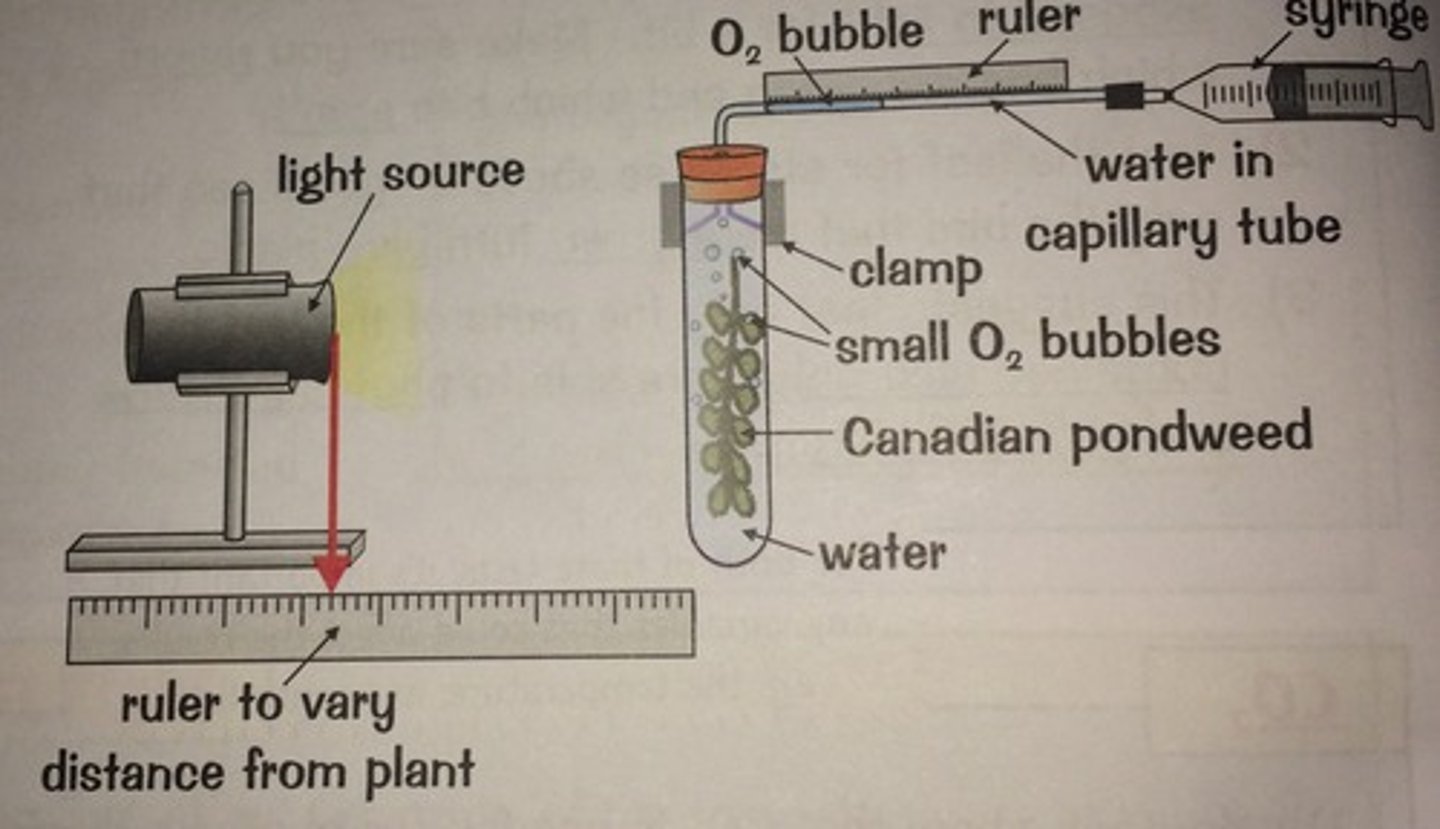
How is the practical where the effect of light intensity on photosynthesis is investigated carried out?
1. A source of white light is placed at a specific distance from the pondweed, which is in a test tube of water.
2. The pondweed is left to photosynthesise for a set amount of time. As it photosynthesises, the oxygen released will collect in the capillary tube.
3. At the end of the experiment, the syringe is used to draw the gas bubble in the tube up alongside a ruler and the length of the gas bubble is measured.
4. The experiment is repeated twice more, with the light source at the same distance from the pondweed. an average length of the oxygen bubble is calculated.
5. The whole experiment is then repeated with the light source at different distances from the pondweed, which therefore changes the light intensity.
What is light intensity measured in?
Lux
What is the inverse square law?
Light intensity is inversely proportional to the distance squared.
REQUIRED PRACTICAL 7 - What is reaction time?
The time it takes to respond to a stimulus.
What can affect reaction time?
Age, gender and drugs
How can you test the effect of caffeine on reaction time?
1. The person being tested should sit with their arm resting on the edge of the table.
2. Hold a ruler vertically between their thumb and index finger, so that the "0" end of the ruler is level with their thumb and index finger.
3. The person being tested must catch the ruler as quickly as they can once they see it fall.
4. Reaction time is measured by the number of the ruler where it's caught, with a higher number meaning a slower reaction time. You should measure above the thumb every time.
5. This test should then be repeated several times, allowing a mean to be calculated.
6. The person being tested should then have a caffeinated drink before repeating steps 1-5.
Why should the person being tested rest their arm on the table?
So that they are not tempted to move their arm down to catch the ruler.
REQUIRED PRACTICAL 8 - What is a quadrat?
A quadrat is usually a 0.25m² frame. It may contain lines to mark off smaller areas inside, such as 5x5cm squares or 10x10cm squares. The organisms underneath a quadrat, usually plants or slow-moving animals (like slugs and snails) can be counted.
How can a quadrat be used to calculate the population of a species in a given area by random sampling?
1. Lay out two long measures at right angles along two sides of the study area.
2. Obtain a series of co-ordinates by using random numbers generated by a computer.
3. Walk to the point of intersection and place the quadrat directly at your feet without looking at the ground below.
4. Record the number of organisms within it.
5. Repeat this process several times and calculate an average for the number of organisms in the quadrat.
What equation is used to calculate the population of the species?
Average number of species found in sample x (total area in m² / sample area in m²)
Why is it so important that this is done randomly?
Because by having random samples, you know that your results must reflect the true distribution of the organisms, and so any conclusions made as a result will be valid.
REQUIRED PRACTICAL 9 - If you want to measure abundance systematically rather than randomly, what can you use?
A transect
How is a transect used to measure abundance systematically?
The line transect is placed across the area you are studying. A quadrat is placed at regular intervals along the transect and the number of organisms inside it are counted. You may also record other data, such as temperature, pH or water content, so that you can make links between these factors and the distribution of certain organisms.
When might you want to measure abundance systematically?
If you were, for example, looking at the distribution of seaweed as you walk down the shore of the sea.
REQUIRED PRACTICAL 10 - How can the rate of decay be investigated?
You can investigate the rate of decay by observing the action of the enzyme lipase on a sample of milk that has been made alkaline. When the lipase breaks the milk down, the pH of the milk decreases.
What indicator does the practical investigating the rate of decay involve?
Phenolphthalein
Phenolphthalein is pink when the pH is about what?
10
Phenolphthalein becomes colourless when the pH falls below what?
8.3
What is the method for investigating the effect of temperature on the rate of decay?
1. Add 5cm³ of lipase to a test tube and label this test tube "L".
2. Measure 5cm³ of milk and add it to a different test tube.
3. Add 5 drops of phenolphthalein to the test tube containing milk.
4. Measure 7cm³ of sodium carbonate solution, and add it the solution containing milk and phenolphthalein. This makes the solution alkaline, and thus turns it pink.
5. Put both test tubes into a water bath set to 30 and leave them until they reach this temperature.
6. Once they have reached this temperature, use a calibrated dropping pipette to drop 1cm³ of the lipase solution into the milk tube, and start the stopwatch.
7. Stir the contents of the test tube with a glass rod.
8. As soon as the solution loses its pink colour, stop the stopwatch and record the time in a table.
9. Repeat the experiment for a range of different temperatures, making sure to carry out the experiment three times at each temperature, so that a mean for each temperature can be calculated.

