DNA structure and protein synthesis
 Studied by 1 person
 Call with Kai
 Learn
Learn Practice Test
 Spaced Repetition
 Match
Match Flashcards
 Knowt Play
1/48

There's no tags or description
Looks like no tags are added yet.
Name | Mastery | Learn | Test | Matching | Spaced | Call with Kai |
|---|
No study sessions yet.
49 Terms
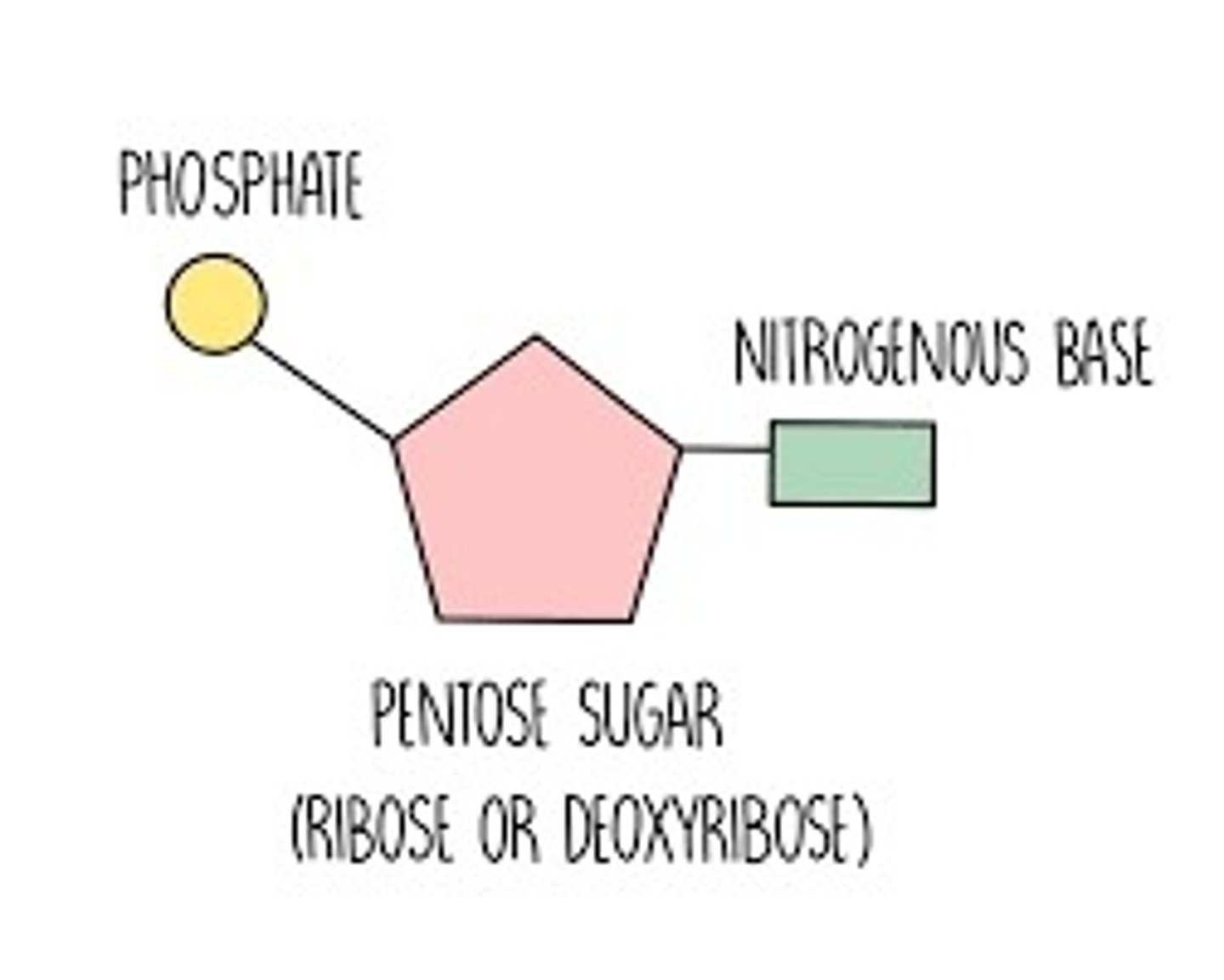
What is the structure of a nucleotide?
What are the two types of nucleic acids?
deoxyribonucleic acid (DNA) and ribonucleic acid (RNA)
What are nucleotides made of?
Pentose sugar (deoxyribose in DNA, ribose in RNA), nitrogenous base and phosphate group.
What are the bases, and what pairs with what?
Adenine pairs with Thymine (Uracil in RNA) via 2 H bonds, Cytosine pairs with Guanine via 3 H bonds.
How are the components of a nucleotide joined together?
Via condensation reactions - an ester bond forms between the phosphate and pentose sugar, and a glycosidic bond between sugar and base.
How are the bases categorised?
Purines (A and G) have a double ring structure and pyramidines (T and C, as well as U) have a single ringed structure
How are two nucleotides joined together to form a dinucleotide?
Via condensation reaction to form a phosphodiester bond between the deoxyribose sugar of one nucleotide and the phosphate group of another.
What is RNA?
Polymer made of nucleotides, quite short and has a ribose pentose sugar. One type of RNA is involved in transferring genetic info from DNA to ribosomes, another is involved in protein synthesis. Also single stranded
How was the structure of DNA discovered, and who discovered it?
Watson and Crick worked out the structure following pioneering work by Rosalind Franklin on the X-ray patterns of DNA.
What is the structure of the polymer of DNA and how does it relate to its function?
Each molecule is made of 2 strands joined by hydrogen bonds at the bases - allows for strand separation in DNA replication. Very large so it can carry immense amounts of info. It has a strong sugar phosphate backbone that is joined by strong covalent bonds which protects weak interactions between bases.
Has complimentary base pairing so DNA can be used as a template to build complimentary strands.
How would you describe the structure of DNA as a whole?
Double helix as the two strands twist around each other. The two strands run anti parallel in opposite directions.
What is the function of DNA?
Holds genetic info to pass from one generation to the next - important for evolution, and is a stable structure that only rarely mutates. Codes for protein molecules too.
How is each end of the DNA molecule described?
Either as the 5'' end - the 5th Carbon is bonded to the Phosphate or as the 3'' end as the 3rd carbon is pointing down - this is opposite for the two strands.
What are the requirements for semi conservative replication to take place?
The four types of nucleotides - each with their bases must be present, and both strands of DNA act as a template for the attachment of these nucleotides, the enzyme polymerase must be present, and a source of chemical energy.
Describe the process of semi conservative replication:
1. Double helix unwinds and unzips using DNA helicase to break the hydrogen bonds.
2. The double helix separates into its two strands, which act as a template to which free nucleotides of DNA bind by specific base pairing
3. Nucleotides are joined together in a condensation reaction by the enzyme DNA polymerase to form phosphodiester bonds between them.
4. DNA winds back up.
Why is it named 'semi conservative' replication?
Because each new DNA molecule contains one strand of the original DNA and one strand of the new DNA, so half is old.
What was the conservative model for DNA replication?
Suggested that the original model remained intact and that a separate daughter DNA molecule was built up from new nucleotides. Of the two molecules produced one would be entirely old and one entirely new.
What the process of the experiment to find evidence for semi conservative replication?
They first grew the bacteria (original DNA) on a medium of 15-N (slightly heavier than 14-N). They extracted the DNA and spun it in a centrifuge - scientists could then analyse the position of the DNA band. For the first gen the band would be near the bottom due to the heavier 15-N. They then transferred the bacteria to a medium of 14-N to allow it to replicate many times until almost all of it was 14-N - formed a thick band near the top as it is lighter. They then took a sample and grew it on 15-N and allowed DNA replication once. They extracted and spun it. They then allowed it to replicate once more on 15-N.
What were the findings of the DNA semi conservative replication experiment?
They found that the sample grown on 14-N then 15-N after one replication produced a band of DNA in between the band for 14-N and 15-N - shows one strand is 15-N and one is 14-N. So, it must have replicated semi conservatively. After another replication on 15-N, there were two bands - one in between the 15 and 14-N, and one nearer the bottom. This is because 2 of the 4 molecules contain a strand with 14-N and 15-N, and two contain only 15-N.
What would the results be if the conservative model was correct?
After one round of replication on 15-N, one molecule would be fully 15-N and one would be fully 14-N, and after two rounds, one would still be fully 15-N, but the other 3 would be fully 14-N.
What is a gene?
A section of DNA that contains coded information for polypeptide synthesis and functional RNA (tRNA and rRNA), in the form of a specific sequence of bases along the DNA molecule.
Difference between DNA in prokaryotic and eukaryotic cells?
In prokaryotic cells DNA is short and circular and not associated with proteins, however in eukaryotic cells DNA is long, linear and associated with proteins called histones.
What two molecules are chromosomes made of?
DNA which contains information carrying nucleic acid, and histones which provide a scaffold for DNA
What is a locus?
The particular position of a gene on a DNA molecule
What is an allele?
Different forms of a gene
How does a base sequence change on a gene result in a different enzyme structure?
Produces a new allele, and results in different amino acids being coded for, resulting in production of a different polypeptide and a different protein. This could change the tertiary 3D structure of an enzyme stopping it from functioning.
What was the scientists’ reasoning as to why there must be a minimum of 3 bases to code for each amino acid?
Only 20 amino acid regularly occur in proteins, each amino acid must have its own code of bases on the DNA. There are only 4 bases, and if each one coded for a different amino acid, there would only be 4 amino acids. With 2 bases, 16 amino acids are possible, and 3 produce 64 codes which is enough for 20.
What are introns?
Non coding bases within genes
What are exons?
Coding regions in a gene coding for an amino acid sequence
What is the genome?
All the genes in the cell
What is a proteome?
All the proteins coded for by genes
What are the 3 forms of RNA?
Messenger RNA (mRNA) - transports genetic code from DNA to ribosome.
Ribosomal RNA (rRNA) - forms the ribosome
Transfer RNA (tRNA) - transports amino acids to the ribosome
What are the features of mRNA?
Single stranded, all bases unpaired, linear molecule
Contains codons
Variable in length (dependent on gene length)
What are codons?
Set of 3 bases coding for individual amino acids
Features of tRNA?
Single stranded in a clover leaf shape and a standard length
Amino acid binding site called an anticodon that binds to a codon
It has intramolecular base pairing (within the same strand)
Why is genetic code denegenerate?
Most amino acids are coded for by more than one triplet
What are some of the features of the genetic code?
A few amino acids are coded for by only a single triplet, and the remaining amino acids are coded for by between 2 and 6 triplets.
The triplet is read in one direction along the DNA strand
Code is non overlapping, so each base sequence is only read once
The code is universal to all organisms
What are stop codes?
Triplets that don’t code for any amino acids and mark the end of a polypeptide chain
How are chromosomes dispersed during cell division, and normally?
Only visible as distinct structures in cell division. Rest of the time they are widely dispersed throughout the nucleus.
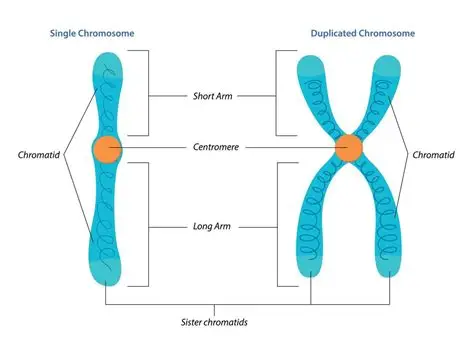
Structure of a chromosome?
Highly folded DNA, and at the start of cell division appear as two threads held by a single point. Each thread is called a chromatid.
How is DNA coiled in a chromosome?
First wound around histones, then this complex is coiled and further coiled before being packed into the chromosome. It only contains one DNA molecule, but this is very long and contains many genes
What are homologous pairs?
One chromosome of each pair is from the father, and one is from the mother due to the fusion of the egg and sperm. The pair is always two chromosomes carrying the same genes but not necessarily the same alleles for them.
What are the 2 general stages of protein synthesis?
Transcription - DNA code is transcribed to the pre-mRNA which is spliced to form mRNA.
Translation - the mRNA code, carrying the instructions for primary polypeptide structure is read and the polypeptide is assembled.
Stages of transcription including splicing?
Hydrogen bonds between base pairs break and DNA unzips. Only one strand acts as a template.
RNA nucleotides base pair with the DNA bases, following complementary base pairing rules.
RNA polymerase moves along the strand and joins adjacent nucleotides together by forming phosphodiester bonds to produce pre-mRNA.
Pre-mRNA contains both introns and exons. Splicing removes introns from pre-mRNA so only the exons remain.
Stages of translation?
mRNA attaches to the ribosome. The sequence of mRNA bases determines order of amino acids. Each tRNA molecule brings a specific amino acid (as it binds to a specific amino acid) to the ribosome. Codons on mRNA bind to tRNA anti codons. Adjacent amino acids joined by condensation forming peptide bonds using energy provided by ATP. tRNA is released, then the ribosome moves along to form the polypeptide.
What is a gene mutation?
Change in the sequence to one or more nucleotide bases, or a change in base sequences.
What is a mutation?
Change in the quantity or structure of DNA.
 Note
Note  Flashcards (89)