Selection of a Civil Engineer
 Call Kai
 Learn
Learn Practice Test
 Spaced Repetition
 Match
Match Flashcards
 Knowt Play
1/30

Earn XP
Description and Tags
Topic 4
Name | Mastery | Learn | Test | Matching | Spaced | Call with Kai |
|---|
No analytics yet
Send a link to your students to track their progress
31 Terms
Introduction
The selection and engagement of a Civil Engineer is one of the most important decisions to be made during the development of an engineering project. No two have the same training, experience, capabilities, personnel, workloads, and particular abilities. Selection of the most qualified Civil Engineer for a specific project will result in a well-planned and designed, economical and successful project. This section presents what experience has shown to be the best and, therefore, the recommended procedure for the engagement of the Civil Engineer.
Civil Engineer
plays a vital role in shaping the built environment. Pursuing a career in this field allows you to strengthen economies, create lasting positive change in communities, and help shape the world we live in. Design, build, and maintain the infrastructure that supports daily life—making the profession both impactful and deeply rewarding.
BASIS FOR SELECTION
Reputation
Consider the Civil Engineer’s reputation as reflected in feedback from previous clients. A strong track record of successful projects indicates reliability and professional competence.
BASIS FOR SELECTION
Qualification and Expertise
Review the engineer’s educational background, certifications, and specialized experience. A solid foundation in civil engineering principles and relevant technical skills is essential.
BASIS FOR SELECTION
Valid Registration
Verify that the engineer holds an active and valid license from the Professional Regulation Commission (PRC) or the appropriate licensing authority. This confirms their legal eligibility to practice.
BASIS FOR SELECTION
Staff Capability
Assess the engineer’s ability to assign qualified and experienced personnel to the project. Competent staff support is crucial for effective planning, supervision, and execution.
BASIS FOR SELECTION
Financial and Business Resources
Ensure that the engineer or firm has adequate financial and operational resources. Sufficient capacity enables timely delivery of project requirements and smooth project implementation.
CLIENT’S SELECTION COMMITEE
Free from Internal/External Pressure
The committee must operate independently to avoid bias, political influence, or favoritism. This protects the integrity of the selection process and ensures decisions are based solely on merit.
CLIENT’S SELECTION COMMITEE
Composed of at Least Three Members
A minimum of three individuals provides balanced judgment and reduces the risk of subjective decision‑making. At least one member should be a licensed professional engineer who understands technical requirements and industry standards
CLIENT’S SELECTION COMMITEE Key responisibility
Investigation
Committee members review credentials, past performance, legal standing, and compliance with licensing requirements.
CLIENT’S SELECTION COMMITEE Key responisibility
Interviews
They conduct structured interviews to assess the Civil Engineer’s understanding of the project, proposed approach, and capability to deliver.
CLIENT’S SELECTION COMMITEE Key responisibility
Evaluations
They evaluate proposals, technical qualifications, staffing plans, and resource availability using objective criteria
CLIENT’S SELECTION COMMITEE Key responisibility
Recommendations
After thorough review, the committee ranks candidates and submits a justified recommendation to the client for final approval.
Roles in QBS
The committee is central to the Qualifications‑Based Selection process.
Ensures that selection is based on competence, experience, and capability, not price.
Protects the integrity of the engineering profession.
Why Committee Matters
Ensures high‑quality engineering services.
Reduces project risks and failures.
Promotes fairness, professionalism, and public trust.
Aligns with PICE and NEDA standards.
Qualifications-Based Selection (QBS)
a competitive procurement process that prioritizes hiring design professionals (such as engineers, land surveyors, and architects) based on their qualifications and demonstrated competence. It is based on qualification and resources such as knowledge, skill, experience, performance, quality and cost effectiveness that is best suited to complete the project successfully.
a procurement method that prioritizes professional competence over cost. It ensures that the Civil Engineer selected has the expertise, experience, and capability to deliver high‑quality engineering services.
QUALIFICATION BASED SELECTION AND WHY QBS?
Focuses on competence, not price. QBS evaluates the engineer’s technical ability, experience, and understanding of the project before discussing fees. This leads to better design quality and fewer costly errors.
Ensures the engineer’s expertise is fully utilized. By selecting based on qualifications, clients gain access to the engineer’s best professional judgment, creativity, and problem‑solving skills.
Recognized by NEDA as the preferred procurement method. National guidelines endorse QBS for professional engineering services because it leads to safer, more efficient, and more sustainable project outcomes.
QBS SELECTION COMMITTEE
Members must be
Be objective
Avoid conflicts of interest
Include at least one person familiar with CE practice
QBS PROCEDURE OVERVIEW
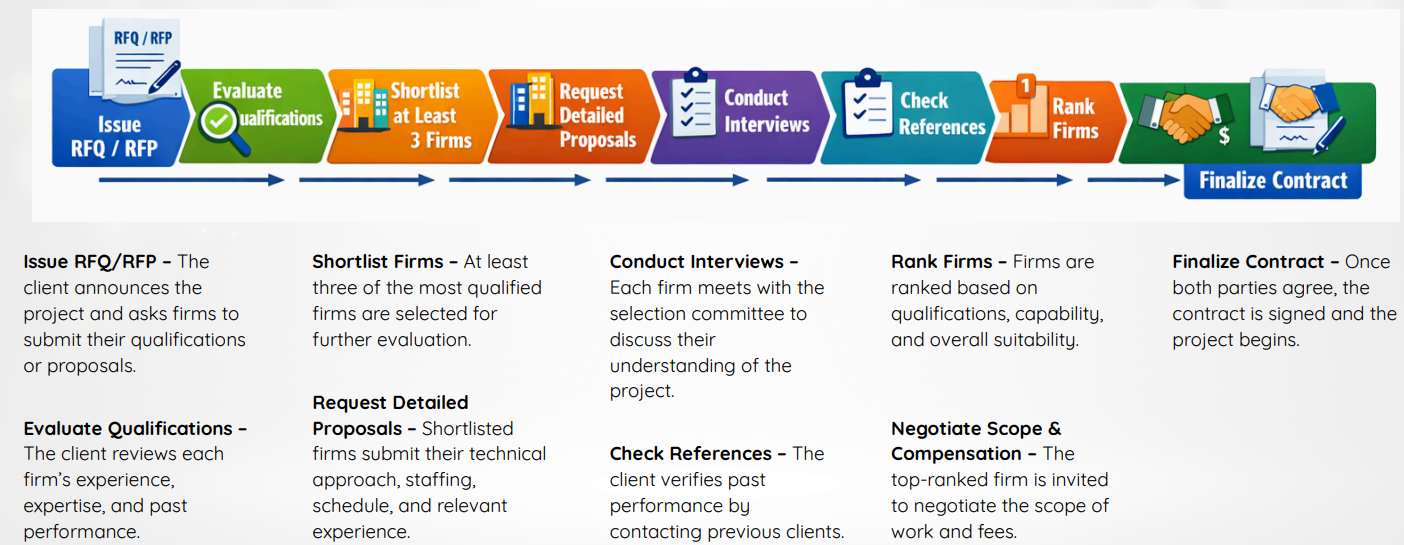
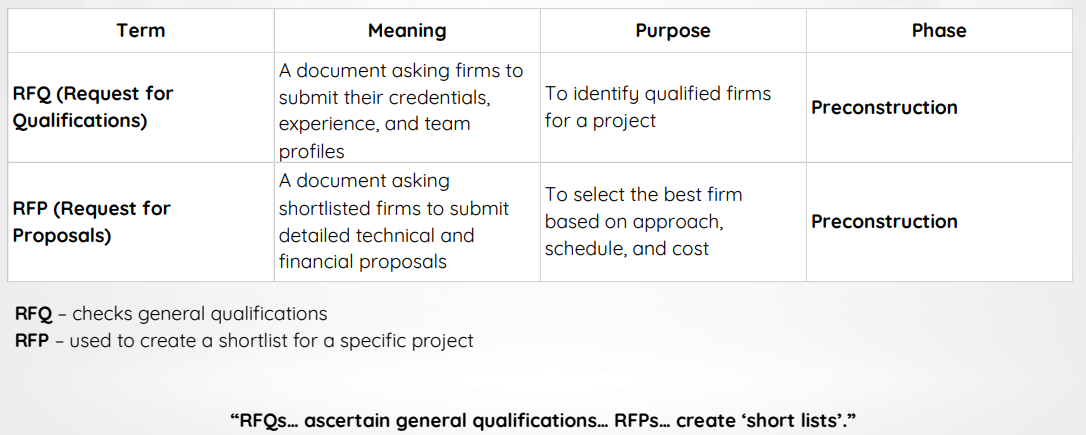
RFQ VS RFP
PROPOSAL REQUIREMENTS
Civil Engineers must submit
Management plan
Personnel assignments
Schedule
Experience with similar projects
Workload & financial standing
References
During the interview phase of QBS, the selection committee must:
Review qualifications: Examine each firm's track record, technical expertise, and relevant project experience.
Assess capability: Determine whether the firm can deliver the required services within the project timeline and budget.
Evaluate key personnel: Scrutinize the proposed team members—especially those assigned to lead or manage the project—for their credentials, availability, and past performance.
QUALIFICATION-BASED SELECTION
Ranking Criteria
Approach & Understanding. How well the firm grasps the project’s objectives, constraints, and technical requirements, and whether their proposed methodology is sound and realistic.
Reputation & Experience. The firm ’s track record on similar projects, quality of past work, and overall professional standing in the industry.
Financial Standing. Whether the firm is financially stable enough to support the project without risk of delays or performance issues.
Personnel Availability. The readiness and suitability of the proposed team members, especially key personnel who will directly handle the project.
Workload. The firm ’s current commitments and whether they can realistically allocate time and resources to meet the project schedule.
Location. Proximity to the project site, which may affect responsiveness, site visits, and logistical efficiency.
Negotation and Contract
Negotiate scope, deliverables, schedule
Agree on fair compensation
If no agreement → move to next ranked firm
Why Bidding Fails for CE Services
Does not recognize professional judgment
Scope cannot be fully defined upfront
Leads to minimum‑effort designs
Limits creativity
Causes more change orders & claims
Two-Envelope System
Technical proposal (Envelope 1)
Price proposal (Envelope 2)
Works only if price is opened after selecting the best CE
Still not recommended
Charging for Civil Engineer Services
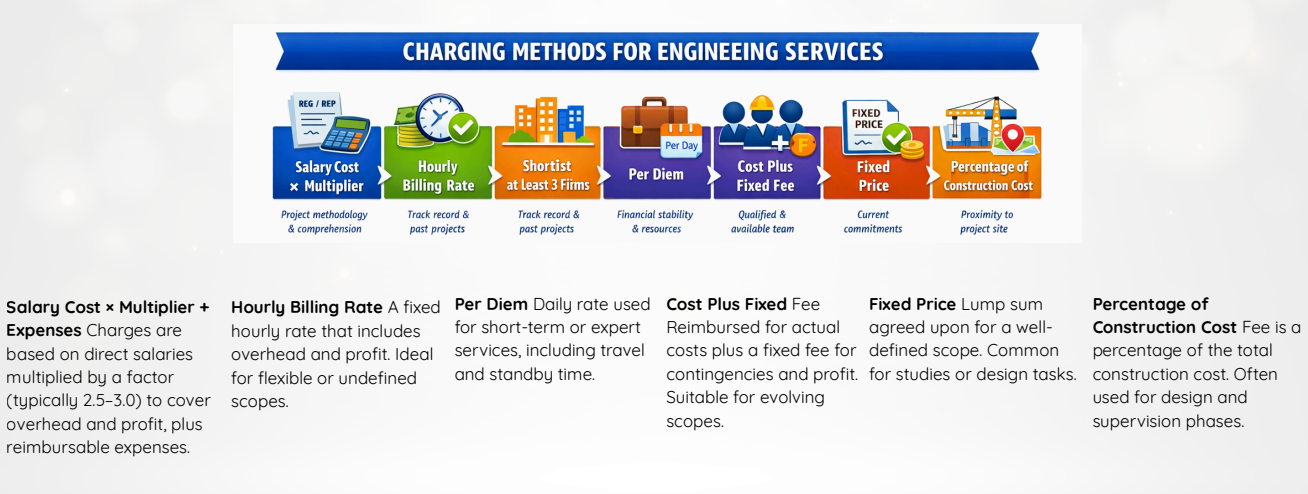
Components of Total Project Cost
Engineering Costs - These include all professional services such as studies, design, drawings, specifications, project management, and construction supervision. They represent the intellectual and technical work needed before and during construction.
Construction Costs - The actual cost of building the project—materials, labor, equipment, contractor overhead, and profit. This is usually the largest portion of the total project cost
Legal & Land Costs - Expenses related to land acquisition, right‑of‑way, permits, legal services, surveys, and documentation required to secure the project site.
Owner’s Costs - Costs borne directly by the client, such as administrative expenses, financing charges, insurance, utilities, and other project-related overhead not included in engineering or construction.
Contingencies - A reserve amount added to cover uncertainties, design changes, price fluctuations, and unforeseen conditions. Typically higher during early project stages and reduced as the design becomes more defined.
Contingency Allowance
a budget allowance added to the total project cost to cover uncertainties, risks, and unforeseen conditions that may arise during planning, design, or construction.
It is not a mistake fund—it is a planned buffer recognizing that early project stages have incomplete information. As the project becomes more defined, the contingency amount is reduced
Contingency Percentages by Project Stage
20% at Study Phase
At this early stage, project details are still vague—site conditions, design requirements, and quantities are not yet fully known.
High uncertainty = higher contingency.
10% at Final Design
By this stage, drawings, specifications, and quantities are mostly complete.
Uncertainty decreases, so contingency is reduced.
5% at Bidding
At bidding, the design is nearly final and contractors can price work accurately.
Minimal uncertainty = lowest contingency.
CONCLUSION
The Qualifications‑Based Selection (QBS) process ensures that civil engineering services are procured based on competence, experience, and professional judgment, rather than lowest cost. By following a structured evaluation—from RFQs and RFPs to interviews, ranking, and negotiation—clients secure higher‑quality outcomes and reduce long‑term project risks. Understanding the various charging methods and the components of total project cost further equips future civil engineers to plan, negotiate, and deliver projects responsibly and efficiently. Ultimately, QBS promotes quality, accountability, and value, strengthening both engineering practice and public trust.

