Statistics - Class 16 (Confidence Intervals)
 Call Kai
 Learn
Learn Practice Test
 Spaced Repetition
 Match
Match Flashcards
 Knowt Play
1/11

There's no tags or description
Looks like no tags are added yet.
Name | Mastery | Learn | Test | Matching | Spaced | Call with Kai |
|---|
No analytics yet
Send a link to your students to track their progress
12 Terms
Point Estimate
a single value that is our best estimate for the parameter of interest
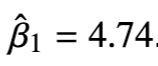
Confidence Interval
a plausible range of values for the population slope (β1) using the point estimate
the entire interval must be less than or greater than a value
wide interval = not very informative
Margin of Error
aka: wiggle room in the estimate
this reflects how accurate the sample statistic is as an estimate for the parameter
Common Form of a Confidence Interval
Statistic + / - Margin of Error

Standard Error
We expect the point estimate to be about ______ away from the population slope.
Critical Value
t*
a _____ that controls how sure we are that the population parameter (β1) is inside the interval
a _____ for the density curve with n - 2 degrees of freedom to obtains the desired confidence level
Plausible Confidence Interval
an interval that is narrow enough that we can actually use the interval in an informative way
doesn’t consider every possibility
Confidence Level
the percent of samples that we could draw from the population which, if we created a confidence interval on those samples, would contain β1
aka: the most extreme samples we could get
we are never 100% confident
Confidence Level Interpretation
“___% of those intervals would contain the true population slope (β1).”
qt ( )
a function (code)
calculates the t-score with a specified area to its left
Confidence Interval Interpretation
“We are ____% confident that if the number of [ X ] increases by 1 [ X unit ], the number of [ Y ] increases between [ min. value ] and [ max. value ], on average.”
Hypothesis Tests
Confidence Intervals and _____ almost always agree as long as the two methods use equivalent levels of significance/confidence
A two-sided hypothesis with a significance level of ⍺ is equivalent to a confidence interval with:
CL = 1 - ⍺

