Lecture 3 - Why has econ not always included experimental
 Call Kai
 Learn
Learn Practice Test
 Spaced Repetition
 Match
Match Flashcards
 Knowt Play
1/17

There's no tags or description
Looks like no tags are added yet.
Name | Mastery | Learn | Test | Matching | Spaced | Call with Kai |
|---|
No analytics yet
Send a link to your students to track their progress
18 Terms
Standard theory vs Endowment effect
ST
preference captured by indifference maps
Constraints captured by feasible separate sets of consumption bundles
Choice will be same if same feasible set offered
Endowment effects
People more attached to something if they already have it
Preferences depend on endowment + feasible set not only aspect driving choice
Endowment effect example - design
Random assignment into groups
- Group 1 given mugs but allowed to swap for choc
- Group 2 given chocolate but allowed to swap for mugs
- Group 3 allowed to choose either
Endowment effect example - Standard Theory prediction
Proportion of subjects who end up with a mug should be the same in each group, but for random sampling variation
Endowment effect example - Result
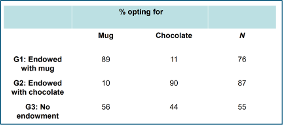
Observed effect known as endowment effect (Goes against ST that preferences do not vary with endowment)
Benefits of experimental econ
- Isolation from extraneous influence
- Different treatments can be identical apart from 1 aspect
- Random assignment of treatment – allows for causal interpretation
- Experiments can be replicated to reduce chance that treatment effect is by chance
3 uses of experimental control
Holding things constant across treatments - nothing varies except initial endowment / treatment difference
Manipulating systematically - presence / absence + nature of endowments/treatment
randomising - Random assignment of treatment reduces SB
Methods of control often used in tandem
Internal validity
Design warrnats reliable conclusions about an effect that occurred in the experiment
External validity
Design warrants reliable conclusions about an effect that would operate outside of the experiment
Experiments & validity
Well controlled experiments have high internal validity but external validity is always more questionable
Artificiality concern of lab experiments
experimenters look at differences between treatments rather than treatment vs no treatment – makes it more valid
Incentives in experiments
- Not just to gain/retain attention of subjects.
- To create close relationship between lab objects and theoretical concepts
- To create real mini-economic systems in lab, showing that “artificial” does not imply “unreal”
Induced values overview
Vernon Smith’s approach to find out S&D curves
Hard to know in real markets (econometrics helps) – we know p & Q but not curves
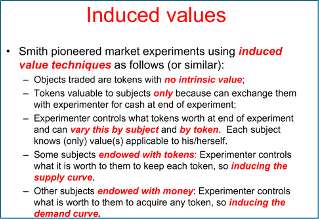
Induced value - experiment
By using induced values, experimenter can create a market in the lab where D&S curves known to experimenter before trading begins
Then compare observed p and Q in this market to theoretical prediction
given by intersection of induced demand and supply curves.
Method uses financial incentives attached to intrinsically worthless objects, so subjects have no unobserved reason to want the tokens
Induced value results
Initial subjects don’t know the induced S&D curves so often announce p initially not at actual convergence levels
However experiments show they converge to induced equilibrium relatively quickly (even with few traders on either side of market)
Against ST
Experiments in Econ
Huge growth since 80s
even in top 5 journals
Both lab & field (lab more)
Artificiality concern in Econ
artificial lab environments simply irrelevant to economics
Friedman (1953) view of prediction success (not including in artificial environments)
artificial (lab) environments have internal validity but do not generalise and so liable to be misleading about other contexts
Lab subjects may behave differently than agents outside lab would
Unrepresentative samples + Unfamiliar tasks + Behaviour distorted by experimenter demand effects OR effect of being observed
Artificiality concern in Econ addressed
Experimental research often focussed on treatment differences rather than treatment vs no treatment
Factors held constant across treatments should notaffect treatment differences
F(53) view fell out of favour in modern econ - experiments showed artificial(lab) markets can be real markets.
F53 vs Hausman
Hausman uses a parody in the same form as F53’s argument to undermine conclusion of the latter
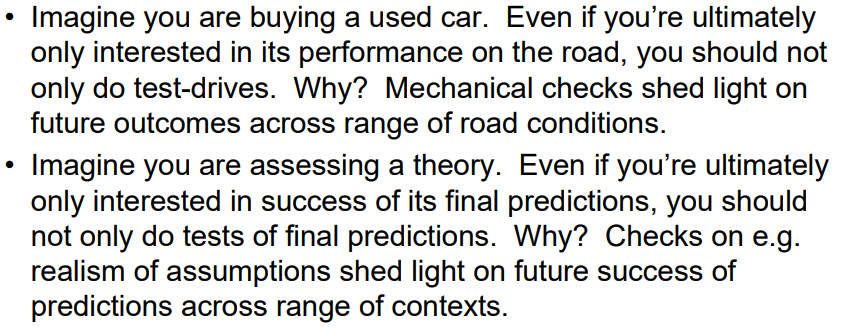
Vernon Smith & experiments
“The experimental laboratory .... consists of a …. more complex set of circumstances than is parameterised in our theories. Since the abstractions of the laboratory are orders of magnitude smaller than those of economic theory, there can be no question that the laboratory provides ample possibilities for falsifying any [such] theory”
If lab environment has more complex realistic detail than is described in a (given) theory, then the lab environment is realistic enough to test that theory
“Lab richer than theory” requirement often met (esp. in his market experiments)

