Armed Force I
 Call Kai
 Learn
Learn Practice Test
 Spaced Repetition
 Match
Match Flashcards
 Knowt Play
1/10

There's no tags or description
Looks like no tags are added yet.
Name | Mastery | Learn | Test | Matching | Spaced | Call with Kai |
|---|
No analytics yet
Send a link to your students to track their progress
11 Terms
Key Themes For This Lecture
1. Use of Force – Background
2. The Treaty-Based Prohibition
3. Customary International Law
Historical Trends On the Use of Force
• The use of force under international law is separated into two categories:
• Jus ad bellum (the lawfulness of employing force); and • Jus in bello (the law governing the conduct of armed hostilities)
• Both areas have become increasingly subject to international legal norms.
• The prohibition on the use of force began to emerge in the first few decades of the 20th Century, with the Kellogg-Briand Pact being a notable example.
• The prohibition formally emerged with the signing of the UN Charter.
The Basis of the Prohibition
• The prohibition on the use of force is grounded both in treaty and in custom.
• The treaty based prohibition is grounded in Art. 2(4) of the UN Charter
• In Nicaragua, the ICJ held that the prohibition also derived from customary international law, and cited inter alia General Assembly Resolution 2625
• Some scholars believe the prohibitions amounts to a jus cogens norm (Nicaragua at para. 190)
• Is there an advantage to grounding it in one or the other?
• This question comes up again in the context of self-defence
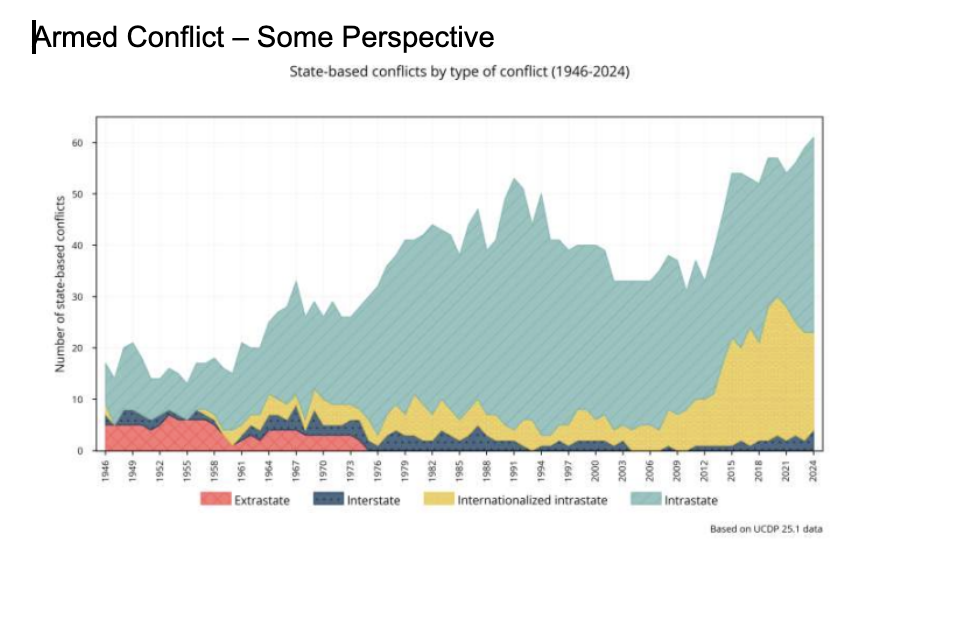
Armed Conflict – Some Perspective
Treaty-Based Perspective
Art 2(4) of the UN Charter states:
• All Members shall refrain in their international relations from the threat or use of force against the territorial integrity or political independence of any state, or in any other manner inconsistent with the Purposes of the United Nations.
The 1970 Declaration on Friendly Relations indicates (but not binding):
• No State or group of States has the right to intervene, directly or indirectly, for any reason whatever, in the internal or external affairs of any other State. Consequently, armed intervention and all other forms of interference or attempted threats against the personality of the State or against its political, economic and cultural elements, are in violation of international law.
• No State may use or encourage the use of economic, political or any other type of measures to coerce another State in order to obtain from it the subordination of the exercise of its sovereign rights and to secure from it advantages of any kind. Also, no State shall organize, assist, foment, finance, incite or tolerate subversive, terrorist or armed activities directed towards the violent overthrow of the regime of another State, or interfere in civil strife in another State.
The Vocabulary Issue
• The UN Charter’s references to the use of force are not quite consistent.
• Art. 2(4) speaks of “the threat or use of force”
• The coercive powers under the UN Charter in Arts. 41 and 42 are premised on the Security Council establishing the existence of a “breach of the peace, or act of aggression.”
• Art. 41 gives the Security Council to use measures short of “armed force”
• Art. 42 deals seems to define the Council’s compulsive power vis-à-vis action by “air, land and sea forces”.
• Art. 51 defines the right to engage in self-defence, and that right is engaged only in the event of an “armed attack”.
Exceptions to Art 2(4)
Art. 42 of the UN Charter states:
• Should the Security Council consider that measures provided for in Article 41 would be inadequate or have proved to be inadequate, it may take such action by air, sea, or land forces as may be necessary to maintain or restore international peace and security. Such action may include demonstrations, blockade, and other operations by air, sea, or land forces of Members of the United Nations.
Art. 51 of the UN Charter states:
• Nothing in the present Charter shall impair the inherent right of individual or collective self-defence if an armed attack occurs against a Member of the United Nations, until the Security Council has taken measures necessary to maintain international peace and security. Measures taken by Members in the exercise of this right of self-defence shall be immediately reported to the Security Council and shall not in any way affect the authority and responsibility of the Security Council under the present Charter to take at any time such action as it deems necessary in order to maintain or restore international peace and security
UN Authorized Force
The UN Security Council has become less willing over time to issue blanket authorizations to use force
The post-Cold War era saw some increase in express authorizations (Kuwait, Rwanda, East Timor, etc)
Trend has been to limit the scope of authorizations (i.e., no ground troops, or other restrictions)
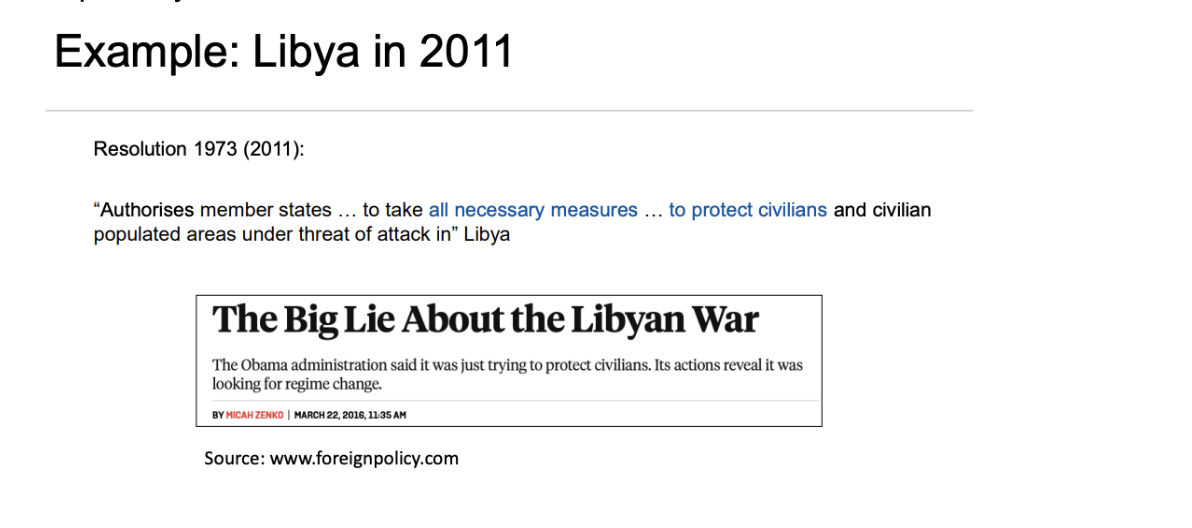
Example: Libya in 2011
Customary Law and Use of Force
• Customary international law layers on two additional requirements on the use of force:
• Necessity - can be assessed temporally or in terms of the targets struck – Nicaragua). In Oil Platforms – US striking Iranian oil platforms was not necessary because no evidence that the platforms were involved in the complained activity (mining of waters)
• Proportionality - In Oil Platforms, US actions in response of the mining of a single warship, US attacked multiple Iranian naval vessels and oil complexes: As a response to the mining, by an unidentified agency, of a single United States warship, which was severely damaged but not sunk, and without loss of life, neither “Operation Praying Mantis’’ as a whole, nor even that part of it that destroyed the Salman and Nasr platforms, can be regarded, in the circumstances of this case, as a proportionate use of force in self-defence.

