Clinical Medical Assistant Exam Review – Key Vocabulary
 Studied by 0 people
 View linked note
 Call Kai
 Learn
Learn Practice Test
 Spaced Repetition
 Match
Match Flashcards
 Knowt Play
1/71

Earn XP
Description and Tags
Vocabulary flashcards covering major clinical concepts, procedures, and regulations discussed in the lecture notes. Use these for rapid review before the exam.
Name | Mastery | Learn | Test | Matching | Spaced | Call with Kai |
|---|
No analytics yet
Send a link to your students to track their progress
72 Terms
Appropriate intramuscular-injection site
Upper lateral thigh
Blood-pressure cuff sizing consideration
Select cuff size based primarily on the patient’s weight
Antihistamine used to relieve allergies
Example of an indication (therapeutic use) for the drug
Maslow level for spontaneity & creativity
Self-actualization
Quality control for CLIA-waived tests
Perform routine in-house testing for accuracy
Minimum chest-compression rate in CPR
At least 100 compressions per minute
Time frame for an urgent referral
Within 24 hours
Hormone detected by pregnancy tests
Human chorionic gonadotropin (hCG)
Eye-rinse duration after chemical splash
Rinse for 15 minutes
Buffered / enteric-coated tablet characteristic
Coating reduces stomach irritation
Plane dividing body into upper & lower parts
Transverse plane
Organelle that produces cellular energy
Mitochondria
Korotkoff sound representing systolic BP
First tapping sound heard
Acceptable pulse-oximetry site
Clip probe to the earlobe
Key item on wound-culture requisition
Recent antibiotic use
Wave scheduling
Three patients booked at the same time and seen in arrival order
Body language – arms crossed, leaning back
Often signals anger or defensiveness
OSHA exposure-control plan requirement
Provide personal protective equipment at no cost
ICD alphabetical-index lookup term
Use the main term from the diagnostic statement
Goal of patient-centered care
Include patients and families in team communication
Airborne-precaution disease example
Measles
24-hour Holter monitor instruction
Avoid getting the electrodes wet
Instrument for contact-lens evaluation
Ophthalmoscope
Medical term for hair loss
Alopecia
Bandage providing ankle support
Figure-eight bandage
Ground electrode in a 12-lead ECG
Right leg (RL) lead
Effect of reinforcing medication teaching
Improves patient compliance
Procedure that requires glove use
Removing a cyst (minor surgery)
Maintaining a sterile field – package opening
Open packages away from your body
Sharps-container disposal step
Place container into a secondary biohazard waste container
Test for flank pain and dysuria
Urinalysis (UA)
First imaging test when multiple studies ordered
Chest X-ray
Failed urine-dipstick control action
Verify the reagent’s expiration date
First insurance verification for new patient
At the time of scheduling the appointment
Lab test for menopausal symptoms
Follicle-stimulating hormone (FSH) level
Pharmacokinetic term: drug to target tissue
Distribution
Key step when removing sutures
Lift the knot toward the wound before cutting
Hand hygiene for aseptic technique
Use an alcohol-based rub if hands are not visibly soiled
Ensuring accurate ECG on sweaty patient
Clean and completely dry the skin before electrode placement
Essential diabetes follow-up result
Hemoglobin A1C
Joint Commission safety goal example
Identify patients correctly
Chronic diabetes complication
Retinopathy
Cleaning a contaminated jagged wound
Irrigate with sterile normal saline
Best communication with hearing-impaired patient
Use written communication directly with the patient
Chain-of-custody urine test step
Seal the specimen container in front of the patient
Possible cause of mid-back pain
Pyelonephritis
Sterile packs with no expiration date
Reprocess and re-wrap the instruments
Most abundant white-blood-cell type
Neutrophils
Pre-pulmonary-function-test instruction
Refrain from using bronchodilators beforehand
Universal outpatient claim form
CMS-1500 form
Pharmacokinetic process affected by liver disease
Metabolism
Procedure typically done by respiratory therapist
Arterial blood draw
Appropriate response to treatment refusal
Restate the patient’s concern and ask a clarifying question
Greatest venipuncture risk for dizzy patient
Syncope
Purpose of hemostasis
Promotes coagulation to stop bleeding
Instrument needed for suture removal
Sterile thumb dressing forceps
Start time for glucose-tolerance test
When the patient finishes drinking the glucose solution
First action on entering lab with seated patient
Identify the patient
Likely test for fever, aches, cough
Influenza test
Component of the chain of infection
Reservoir host
Drugs that lower body temperature
Antipyretics
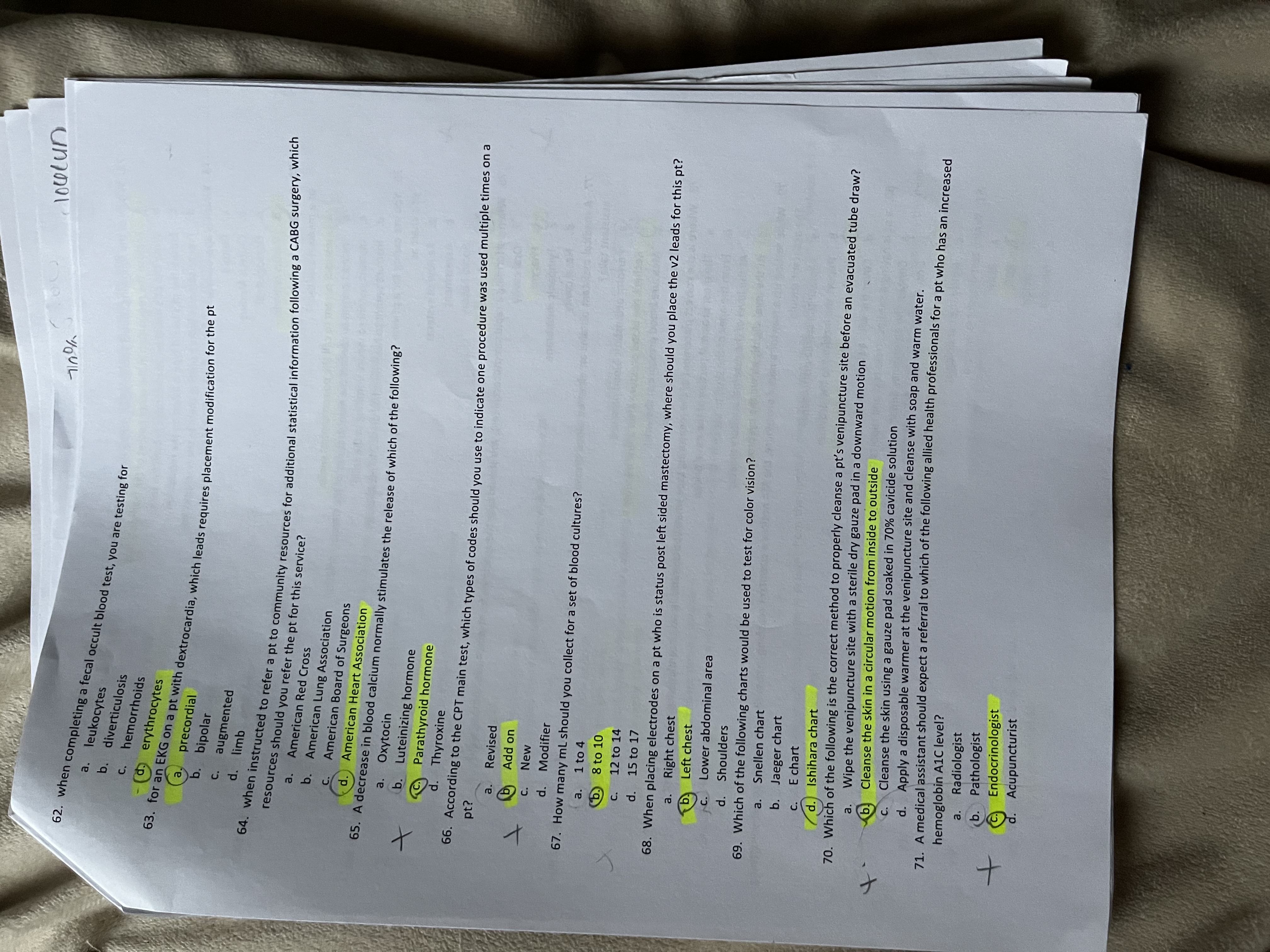
Fecal occult blood test detects
Erythrocytes (hidden blood)
EKG lead modification for dextrocardia
Adjust precordial leads
Resource for post-CABG statistics
American Heart Association
Hormone released when blood calcium drops
Parathyroid hormone (PTH)
CPT code type for repeated procedure
Modifier
Blood-culture collection volume
8–10 mL per bottle (set)
V2 lead placement after left mastectomy
Right chest
Chart for color-vision testing
Ishihara chart
Proper skin antisepsis for venipuncture
Clean in a circular motion from center outward
Referral for elevated hemoglobin A1C
Endocrinologist
 Flashcards (31)