Clinical management of psychosis and schizophrenia
 Studied by 0 people
 Call with Kai
 Learn
Learn Practice Test
 Spaced Repetition
 Match
Match Flashcards
 Knowt Play
1/36

There's no tags or description
Looks like no tags are added yet.
Name | Mastery | Learn | Test | Matching | Spaced | Call with Kai |
|---|
No study sessions yet.
37 Terms
Describe public attitudes to mental health
Public attitudes towards mental health have worsened.
More people are unwilling to live next door to someone who is mentally unwell (more than 1 in 10)
Fewer people are comfortable about mental health services being delivered in their communities 70% in 2015 to 63% now (2025).
14% of people are frightened of people with poor mental health living in their neighbourhoods, up from 8% in 2017
How much of NHS spending goes towards mental health services?
10% of NHS spending
What is schizophrenia?
A long term mental health condition which is characterised by disturbances in multiple mental modalities.
Symptoms must have persisted for at least one month in order for a diagnosis of schizophrenia to be assigned.
What is psychosis?
When people lose some contact with reality.
This may involve hallucinations and or delusions
What are the two different types of psychosis?
Positive psychosis: experiences which add to reality e.g. hearing voices
Negative psychosis: the loss of normal responses or experiences
What are the 3 main symptoms of psychosis?
1. Hallucinations
2. Delusions
3. Disordered thinking and speaking: when thoughts and ideas come very quickly, which can make their speech fast and confusing
What are hallucinations?
When someone sees, hears, smells, tastes or feels things that do not exist outside their mind. The most common hallucination is hearing voices.
This can occur with insight that the hallucination isn't real or without insight.
What are delusions?
When a person has an unshakeable belief in something untrue.
The belief is not related to culture or to religion.
What are symptoms of schizophrenia?
- Hallucinations
-Delusions
- Muddles thoughts or speech
- Losing interest in everyday activities
- Desire to avoid people
- Feeling disconnected from feelings or emotions.
What are the different types of delusions?
1. Non-bizarre: when delusions are beliefs which could happen in real life
2. Bizarre: beliefs that are impossible in our reality
Describe hearing voices in schizophrenia
Hearing voices is different for everyone (heterogenous experience).
Often the voice is derogatory but some people report the voice being nice.
It may be familiar, male or female, could be an adult or child
The voice could be heard inside your head or outside your head (e.g. on shoulder).
- Different people have different interpretations of what the voices signify
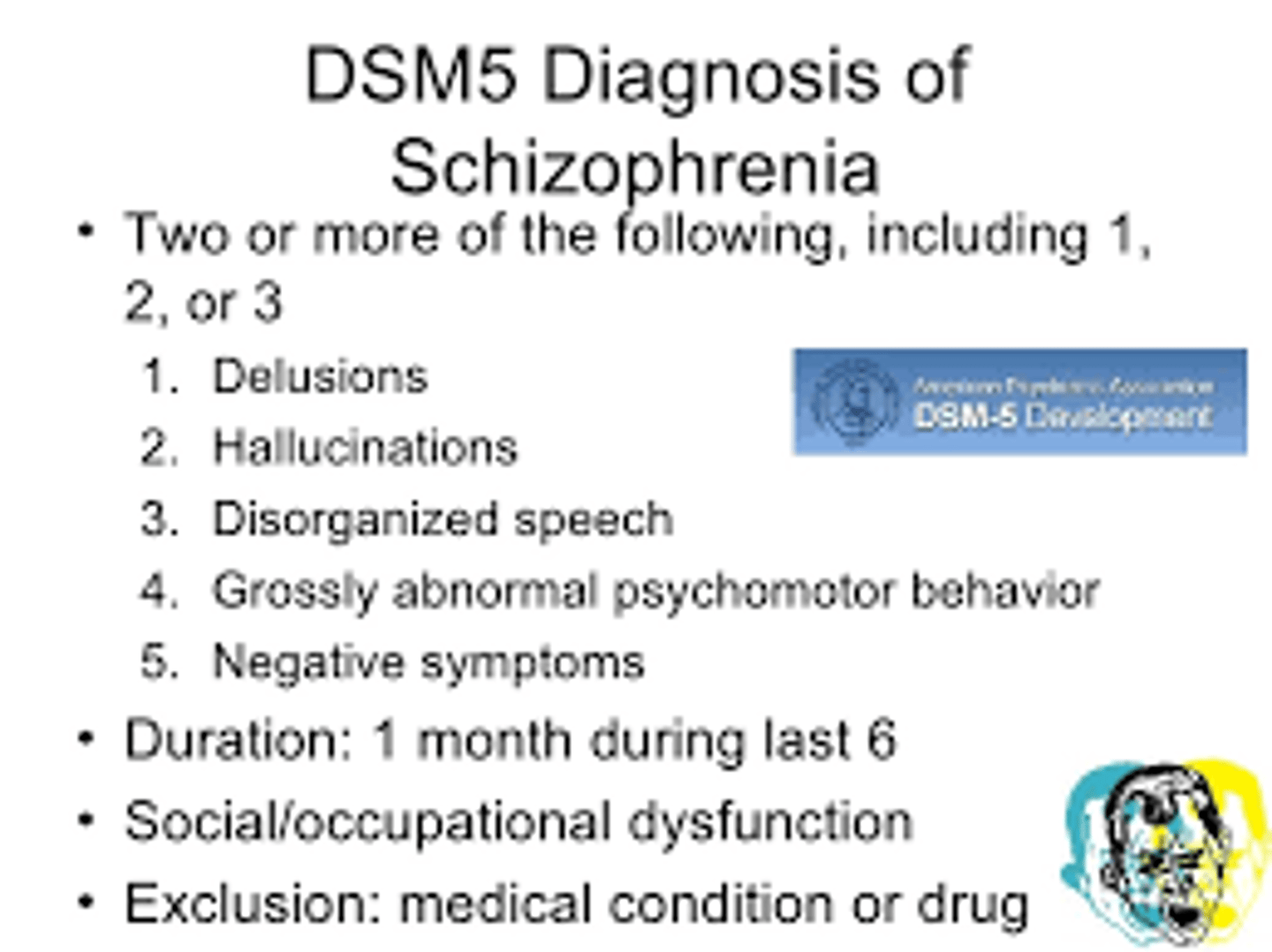
How is schizophrenia diagnosed?
There is no single test for schizophrenia
It is usually based on set diagnostic criteria from internationally recognised sources such as the DSM-5, ICD-10 or ICD-11
Usually present with one of the following symptoms (among others):
delusions, hallucinations, or disorganized speech.
The psychiatrist plays a key role in the diagnosis.
Diagnosis is not an easy process.
What are the aims when treating patients with schizophrenia?
1. Remission - resolve symptoms
2. Prevent relapse/ future episodes
3. Restore function - psychosocial and physical
How do the mental health act relate to schizophrenia
It gives clinicians the right to section, detain and treat patients without their consent. Treatment can be given without consent using proportionate force if necessary
What class of drugs is used to treat schizophrenia?
Antipsychotics
What are the different types of antipsychotics?
1. Typical antipsychotics
- the first generation of antipsychotics developed in the 1950s
2. Atypical antipsychotics
- the newer-generation antipsychotics developed in the 1990s. These are more selective than typical antipsychotics.
Give an example of a typical antipsychotic
Haloperidol
Give an example of an atypical antipsychotic
Clozapine, olanzapine, risperidone, aripiprazole, quetiapine
What are the side effects of typical antipsychotics?
1. Shaking
2. Trembling
3. Muscle twitches
4. Muscle spasms
5. Prolactin elevation
Typical antipsychotics tend to have side effects related to movement disorders (EPSEs).
What are EPSEs?
Extrapyramidal side effects
- side effects related to movement
What are the side effects of typical and atypical antipsychotics?
1. Drowsiness
2. Weight gain (this is more prominent with some atypical antipsychotics)
3. Lack of sex drive
4. Blurred vision
5. Constipation
6. Dry mouth
Atypical antipsychotics tend to have side effects related to metabolic disorders.
What monitoring is required for antipsychotic medication?
1. Blood cholesterol (can rise while taking antipsychotics)
2. Blood glucose
3. Blood pressure (could rise or fall)
How is an agreement reached about what antipsychotic a patient should take?
The patient and the healthcare professional (HCP) make the decision together. The HCP informs the patient about the likely benefits and possible side effects of each drug.
According to the NICE guideline, no one antipsychotic is better than another, hence why no antipsychotic is recommended first line.
What is the general mechanism for antipsychotics?
They block dopamine through D2 receptors and block 5-HT through 5-HTa receptors.
How do side effects arise with antipsychotics?
They block all dopamine pathways. Therefore, does not only affect "reward pathway" (mesolimbic), also affects other dopamine pathways including the nigrostriatal pathway which is important for motor control (movement).
What is neuroleptic malignant syndrome (NMS)?
A life threatening extreme reaction to use of a dopamine receptor antagonist medication. It is likely to cause death if untreated.
We would refer to 999
What is the main risk factor of neuroleptic malignant syndrome (NMS)?
A prescription of an antipsychotic
- especially given via IM injection, at high dose and/or rapid dose escalation
What are symptoms of neuroleptic malignant syndrome (NMS)?
- Fever
- Encephalopathy (altered mental state)
- Vital signs dysregulation (autonomic instability)
- Enzyme elevation (creatinine kinase)
- Rigidity (lead pipe rigidity)
Why do schizophrenic patients have a reduced life expectancy?
1. They are less likely to discuss physical health problems
2. Physical and mental health are divided so patient isn't treated holistically
3. Dismissal of physical symptoms
4. Unequipped teams
5. Lack of consensus to where change should be provided between physical and mental health units
6. Reluctance to change drug despite metabolic adverse effects - there can be a reluctance to change if person is stable
7. Benefits of improved lifestyle e.g. smoking cessation aren't fully explained to schizophrenic patients
How many years does schizophrenia reduce life expectancy by?
10-20 years
How many years does heavy smoking reduce life expectancy by?
8-10 years
Can more than 1 antipsychotic be prescribed at the same time?
The general consensus is not to combine antipsychotics.
This is because there is no evidence of added benefits with 2 antipsychotics; there is only evidence of added side effects from combined use of antipsychotics.
The only times we would use more than 1 antipsychotic is when:
- we are swapping from one antipsychotic to another (reduce dose of old one, increase dose of the new one)
- augmenting clozapine.
Describe the use of long acting injectable antipsychotics
These are injections can be given in intervals ranging from fortnightly to every 6 months.
They work by creating a depot of medication in the injected muscle. This is then slowly released into the body over weeks or months.
We should ensure that the person has a test dose before treatment dose in case they have an allergic reaction to the medication.
In the UK, 30% of patients with schizophrenia are prescribed antipsychotic long-acting injections
What are the benefits of using long acting injectable antipsychotics?
1. 44% reduction in suicide attempts
2. 37% fewer all-cause hospitalizations
3. 48% fewer psychiatric hospitalizations
4. 12% reduction in hospitalizations for cardiovascular diseases
5. 14% reduction in extrapyramidal symptoms.
6. LAIs have also been associated with lower risks of treatment failure compared with oral antipsychotics
What was the first atypical antipsychotic medication prescribed?
Clozapine
Describe the use of clozapine as an antipsychotic
It blocks histamine receptors, muscarinic receptors, 5-HTa receptors and 5-HTc receptors.
It is used when other antipsychotics fail (in patients with "treatment resistant")
However, it has a risk of serious blood disorders and other adverse effects (occurred in 0.1% of patients). Because of this, it was originally removed from the market, but has since been re-added at patients' request.
Side effects must be monitored strictly in order for patients
How long are antipsychotics supposed to be used for?
Most guidelines recommend 1-2 years on antipsychotics.
But, after discontinuing 75% of people relapse between 12-18 months.
Therefore, we don't know the long term effects of antipsychotic treatments beyond the initial 2 years.
On one hand antipsychotic treatment raises CDV risk factors. On the other hand, long term treatment of antipsychotics is associated with lower mortality rates compared to no long-term treatment.
 Note
Note  Flashcards (51)