the evolution of the reading brain lit psych
 Studied by 0 people
 Call Kai
 Learn
Learn Practice Test
 Spaced Repetition
 Match
Match Flashcards
 Knowt Play
1/19

There's no tags or description
Looks like no tags are added yet.
Name | Mastery | Learn | Test | Matching | Spaced | Call with Kai |
|---|
No analytics yet
Send a link to your students to track their progress
20 Terms
The Importance of Plasticity
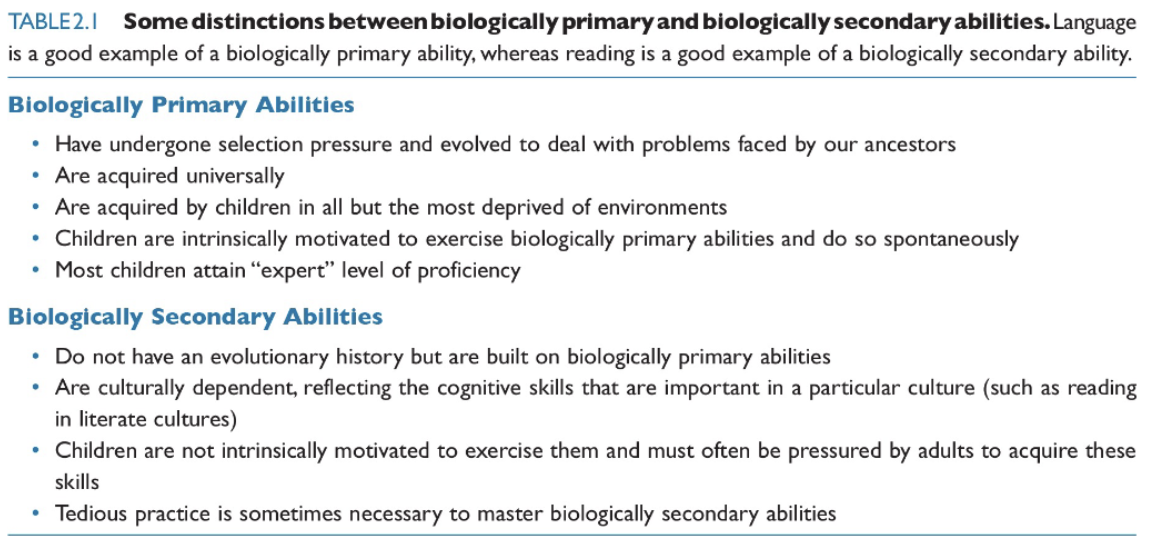
Humans have evolved to speak, but not to read
Speaking and listening are primary language skills
Does not require explicit instruction to learn
Already has brain pathways evolved to handle it
Reading and writing are secondary language skills
Requires explicit instruction to learn
Does not have brain pathways evolved to handle it
Each child’s brain must evolve its own pathways for reading
The brain is more flexible in children
Plasticity decreases with age
As the processes of synaptogenesis and pruning are completed
Plasticity at the age of reading instruction is important to learning
Developmental Processes
Biologically Primary Abilities utilize experience-expectant development
General, species-typical development that requires the same basic, common human experiences to develop normally. The brain expects this development and is set up to develop it through regular development.
Biologically Secondary Abilities utilize experience-dependent specialization
the brain develops specific, efficient neural pathways and functions in response to an individual's unique experiences throughout life. It involves the creation and reorganization of synaptic connections that are not pre-programmed but are sculpted by specific environmental input
Neuronal Recycling (Dehaene)
Each person’s brain has to create its own reading circuit by recycling parts of the brain previously used for other purposes
The brain repurposes existing neurological networks that are cognitively or perceptually related to the new needs
Reading areas in humans use recycled/repurposed areas used for visual perception in other primates
“Neuronal recycling” is constrained by biology
Like the recycling of trash materials is constrained
Recycled glass or paper cannot be turned into ANY object
The materials have intrinsic physical properties that make them more suitable for certain uses than for others
Visual Adaptation
The brain divides visual work into categories, each of which is processed by a different part of the cortex
Distinct zones or “microterritories” have groups of neurons that are specialized to detect different categories: faces, tools, animals, vegetables, digits or letters
Brain lesions suggest that damage to a particular area can very specifically impact knowledge of a particular category
Adaptation of the Visual Word Form Area (VWFA)
As we learn to read, this area adapts and transforms
This brain region was originally used to recognize faces and objects, and continues to serve this function in non-readers
In readers, face recognition gets moved to the right side of the brain
Ventral Pathway
Neurons along the ventral pathway make higher-level determinations about what is being viewed
Particular areas along this route become specialized for particular objects to identify
Primate Visual System
Fine-grained neuronal code for visual objects in monkeys
Neurons in the monkey’s brain can be remarkably selective to the sight of particular objects, faces, or scenes
Among the 100 images that were presented to this neuron, only the sight of a chair strongly enhanced its firing
Neurons are specialized to the point of recognizing a single object or person
“The Grandma Cell”
Neuron in the visual cortex
Neurons in the visual cortex are feature detectors–they respond selectively to specific features (e.g., lines, edges, angles)
Lateralization
Millisecond-by-millisecond time course of brain activity during recognition of faces vs. letters
Initially, the face and letters evoke similar visual activation
By about 150 milliseconds
Letters routed to “letterbox” in left hemisphere
Faces routed to a symmetrical region in the right hemisphere
What happens when we view faces?
(This is an underside view of the brain, so the hemispheres look reversed)
Bilateral activation to faces
Greater activation in right hemisphere
Makes sense, given the VWFA has taken some space in the left hemisphere
History of Alphabetic Systems
Reading is evolutionarily new, dating back less than 6,000 years
Difficulty of determining the “first alphabet”
Various systems were created
Clay tokens from Tello
Incan Quipas from South America
Then cultures began to use writing systems
Hieroglyphs from Egypt
Cuneiform writing from the Sumerians
Features of Alphabetic Systems
Symbolic representation
Symbols convey meaning
Logogrpahic
Symbols represent a whole word (or morpheme = word part)
Pictorgraphic
Pictorial symbols are use to represent objects, ideas, or concepts
Rebus principle
Symbols represent language sounds in a general way
The word for life “til” was represented by an arrow (pronounced “ti”)
Alphabetic principle
Each sound in the speech stream could be separated and represented by a letter
Limits of Pictorgraphic Systems
Elaborate pictures take time to reproduce
Demotic script (script of the people) was introduced in Egypt, which included more simplified symbols than traditional hieroglyphics
Pictographic systems aren’t immediately understandable without training
Especially when pictures are intended to convey more abstract ideas
They could be interpreted differently by different individuals and cultures
Importance of the Greek Alphabet (750 BC)
The great accomplishment of the Greek alphabet was the awareness of speech sounds
First to use the alphabetic principle
Each sound in the speech stream could be separated and represented by a letter
Allowed ease of understanding and new access to the masses
Could be used to express ideas without confine
Led to changes in writing and thought
Cognitive benefits of the new alphabet
Cultural memory
People no longer had to carry the cognitive load of remembering and orally passing down the culture’s history
Individual knowledge
Greater access to information
Better ability to convey one’s own thoughts
New ability to build on established knowledge and ideas
Creativity
Writing facilitated a new creativity (and still does)
We read the writings of others, and we create from there
The creation of the Greek alphabet was followed by one of the most prolific periods of writing, art, philosophy, theater, and science in all previously recorded history
Resistance to Change
But the Greek alphabet took almost 400 years to gain acceptance because of:
Adherence to their oral traditions
Worries about how it might negatively affect the masses
Differences in Brain Activation
Some languages (e.g., Chinese, Japanese Kanji) use logographic characters–depicting words or word parts instead of individual sounds
Readers are required to memorize each symbol rather than word-sound associations
These alphabets activate the right hemisphere to a relatively greater degree
Ease of Learning the Alphabet
There are cross-cultural differences in how well phonemes (sounds) map onto graphemes (words)
In English, spelling rules are relatively complicated
About 45 speech sounds that map onto 26 letters
Many sounds need to be indicated by a combination of letters
Spelling is complicated
It gives clues to meaning
I and eye
You and ewe
To, too, two, and stew
It shows a word’s root
“Muscle” retains a c to reflect its Latin root “musculus” and its relationship to other words (e.g., “muscular”, musculature”)
In Italian, the sounds made by letters are relatively consistent and predictable
Only about 30 speech sounds that map onto 21 letters
Learning to read happens much more quickly and with less effort
Dyslexia is experienced much less often
Proto-Letters
The monkey’s brain is made up of neurons that respond to different fragments of shape, whose combination can describe any complex form
Proto-letters are basic shapes that constitute a generic “alphabet” that can be combined to make up any natural scene
Proto-letters are non-accidental shapes because they are unlikely to occur accidentally
If you threw a bunch of matches on the floor, you would be unlikely to see these distinct shapes form
Tend to be places where surfaces join
Cues the visual system, they are likely a part of an object present in the outside world
This is what has been recycled to account for our human ability to learn an alphabet of symbols!
Non-accidental Properties
Our memory doesn’t store fully detailed images of objects
Instead, it extracts the non-accidental properties and their spatial orientation in relation to each other
If non-accidental properties are preserved, identification of the object is pretty easy
If the non-accidental properties are deleted, it becomes harder!
When the non-accidental properties are in place, our brains can’t help but to see it as a coherent, whole object!
 Note
Note  Flashcards (56)