AHIS1011: ALL WORKS FOR FINAL (IDENTIFIERS + NOTES + ARTICLE NOTES) (copy)
 Studied by 1 person
 Call Kai
 Learn
Learn Practice Test
 Spaced Repetition
 Match
Match Flashcards
 Knowt Play
1/117

Earn XP
Description and Tags
4 finalll lolz
Name | Mastery | Learn | Test | Matching | Spaced | Call with Kai |
|---|
No analytics yet
Send a link to your students to track their progress
118 Terms
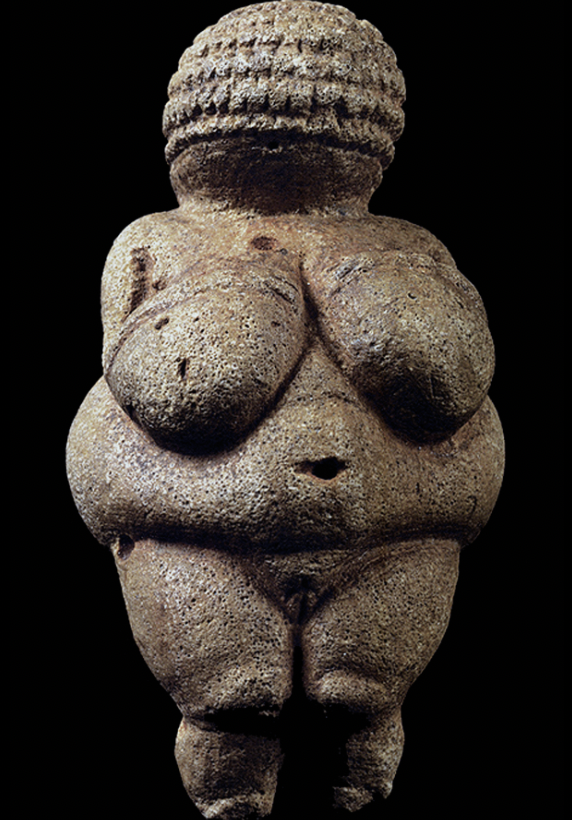
Woman from Willendorf (so-called “Venus”)
Austria, c. 24,000 BCE, Limestone

Woman from Willendorf (so-called “Venus”) - NOTES
accentuates female attributes —> could be a self-portrait or fertility goddess
engaging in self-portrait as they have time, and to document your body throughout your stages fo life (aerial, frontal, posterior view, shortened persepctive)
The user can hold the object while looking at themselves
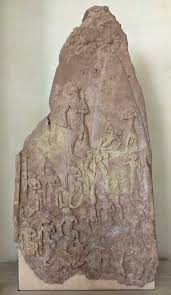
Victory Stele of the Akkadian King Naram-Sin
Limestone, c. 2220 BCE, Sumero-Akkadian

Victory Stele of the Akkadian King Naram-Sin - NOTES
Commemorating military victory, stylistically different from pieces leading up to this
Ground line is diagonal, so all the figures are moving upward —> figures in foreground are less organized, scene is part of the stone itself
fusion is the subject matter, people are climbing up that type of rock
Lower vs. Upper Register: figures are getting larger
Left vs. Right: right people are falling down the mountain, indicating loss of control, subject to gravity, left people are orderly walking up the mountain without losing control
GeneraL: higher-relief compared to figures below, also larger, has composite view of divine-like figures,
assuming identity of Gods, ascending into heaven on account of his military prowess
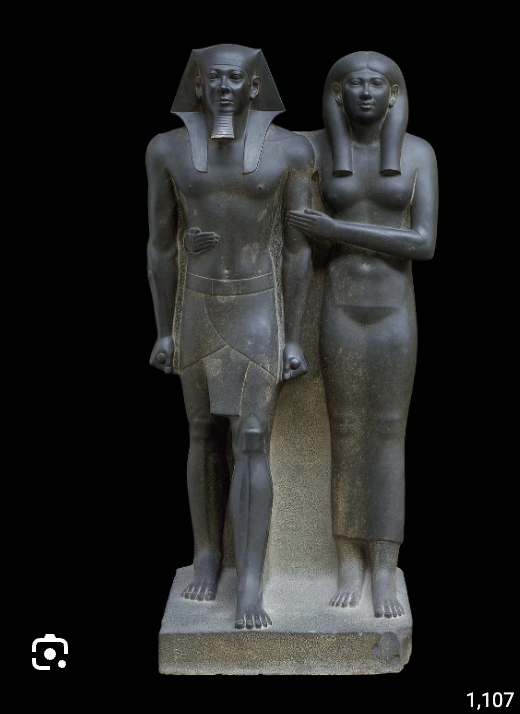
Pharaoh Menkaure (Mycerinus) and his Wife
Egyptian, grey sandstone, from Giza, 4th Dynasty (c.2500 BCE)

Pharaoh Menkaure (Mycerinus) and his Wife - NOTES
Both of their left feet (our right) are forward, indicating that this is a funerary object
Both faces are slightly turned off to the side, countering symmetry of sculptures we see everyday —> communicating stillness with slight movements
Indicating how in Ancient Egyptian civilizations they would need to the lure the spirit of the gods back to their statues through a highly controlled process
had to make it seem like these sculptures were not fully available to the spirits of the rulers passed, and demonstrated only slight kinetic potential
The primary function of these funerary statues, placed in the king's pyramid complex, was to serve as a substitute "home" for the king's life force if his mummified body was damaged. For the spirit to inhabit the statue for eternity, the figure needed to be stable and enduring, not dynamic or fleeting.

Iktinos and Kallikrates (Phidias directed the sculptural program) Parthenon
Athens, c. 447, terms: stylobate, column, shaft, capital, fluting, entablature, frieze, triglyph, metope, pediment, entasis

Iktinos and Kallikrates (Phidias directed the sculptural program) Parthenon - NOTES
resurrection of the victory of the Greeks against the Persians
dedicated to Athena
Design: prizes human potential, faithful representation of the human form except for purposeful deviations
Entasis: architectural feature where the columns slightly bulge in the middle rather than running perfectly straight (imperfection creating visual perfection and avoiding columns looking concave)
Doric columns
Optical Refinement: Floors (stylobate) around the edge of the building and center curve slightly upward (convex curve), looks flat but it isn’t —> had to take into account this would be seen by a moving viewer
harmonious visual ideal is acheived for the gods
Acropolis was once fully painted
Meant to hold the panathenaic procession
Expressionism: deviation from how something actually looks but is till recognizable (transitioning to the hellenistic period)

Pantheon, built by Hadrian
c. 125-128 CE, Rome - Italy
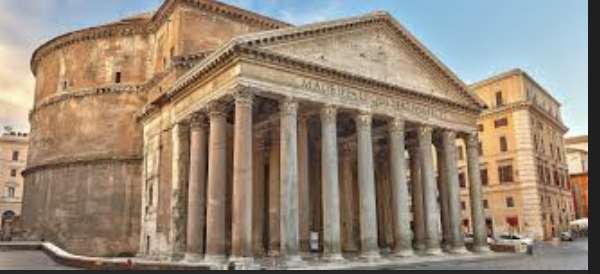
Pantheon, built by Hadrian - NOTES
Columns are single pieces of stone spooled into columns
spoils were from Egypt (testament to conquering Egypt)
Contains tiny tabernacles with smaller rooms in between them (visual alternation)
would’ve contained shrines or sculptures to the gods, dedicated to the pantheon of all ancient roman gods
Design
a lot of symmetry in placement of niches (to reduce load bearing weight of dome), alternating windows —> hypnotic repetitive forms
Dome was much thicker on bottom than top, oculus at the top
coffers remove some of the weight from the ceiling
Dome used to create a perfect sphere, and create that sense to worshippers entering the space
the light from the oculus is constantly moving, proof of the movement and existence of the cosmos (confining all light to the top means that the light position changes all year)
Not a mastery over gods, manipulating mastery and nature for gods to reveal themselves
showing Emperor Hadrian’s power is linked to the cosmic order, strength of Rome with egyptian spoils, roman favor as being home to all the gods
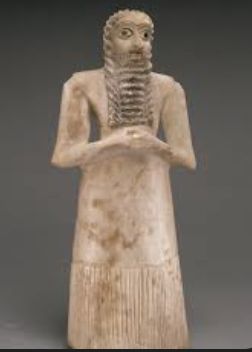
Standing male worshipper, from Eshunna (modern Tell Asmar)
alabaster and shell, c. 2900 BCE, Sumerian

Standing male worshipper, from Eshunna (modern Tell Asmar) - NOTES
Made out of very precious materials —> at first glance, many people thought these figures were God
not meant to be the recipient of worship, depiction of figure having a visionary experience themsleves
eyes are disproportionately large
A variation of a votive figure called a donor figure (commissioned)
hands are prepped for prayer, statue in perpetual state of prayer
Typically found in groups

The Palette of Narmer
slate, from Heirankopolis (Egypt), 1st dynasty c. 3000 BCE
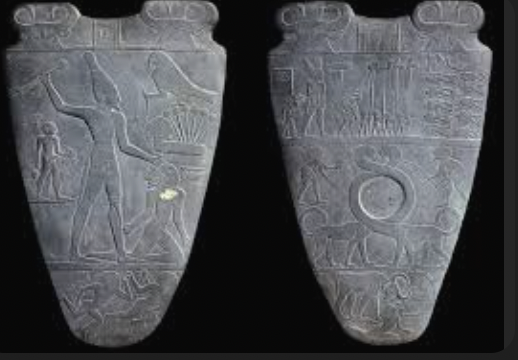
The Palette of Narmer - NOTES
hierogylphics for Namer
Namer is depicted wearing crown of Upper + Lower Egypt (pre-dynastic)
embodiment of falcon God Horus: indicating Namer has reached deification
Namer carries a ceremonial mace, striking the kneeling figure
Details: carved in very low relief, the crown depicted is known as the “white” crown worn by royals in Upper Egypt.
Use: Attendant shown carrying Namer’s sandals, indication of sacred space (can’t walk barefoot)
object was used for a ceremonial purpose —> well and reservoir for powdered makeup (eyes)
Concept of here + now: recording political hegemony important in the present and hereafter
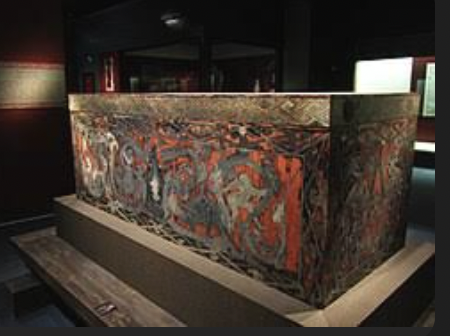
Tomb of the Marquise of Dai
c. 180 BCE, Han Period China, silk and ink
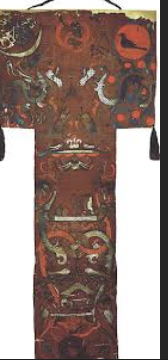

Tomb of the Marquise of Dai - NOTES
Depicts afterworld topography, with 2 people guarding a heavenly-like gate that she’s meant to ascent into
Depicting Dai’s ethereal life in the hereafter: more creatures in an interlocking pattern through a white circular disk
uses as medians between the material and celestial word, circular attribute of interconnectedness


Terra Cotta Army for Qin Shihuan Mausoleum
sculpture, c. 221 BCE, Xi’an - China

Terra Cotta Army for Qin Shihuang Mausoleum - NOTES
defended the mausoleum that housed Qin Shihuang
currently 4 hangars of soldiers
Meaning: potentially how he wanted to be viewed in the afterlife
no: warriors are just servants in the afterlife just for his
Spirit vessels: Ming Qi: an ancient example of down the line manufacturing
Terracotta soldiers were molded and painted: new level of individuation
not trying to create individuality, just trying to create a comprehensive human mold (but not imitating it)
Shihuang was so scared that the artisans would reveal where he was buried, poisoned soil w/ mercury, trapped artisans in city
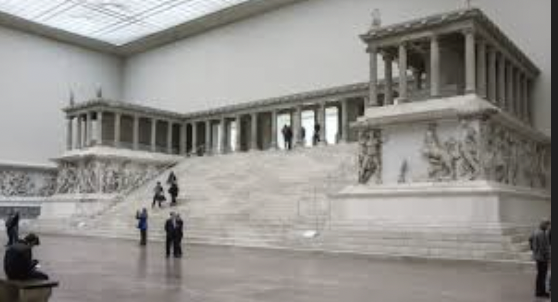
Altar of Zeus Pergamon
Hellenestic Baroque, Greek, erected c. 180 BCE, marble

Altar of Zeus Pergamon - NOTES
Shows Athena fighting Gaia’s sons while Gaia emerges from below, details Zeus and his companions during battle against Giants
Composition: overlapping figures and items in the center more towards the left
contrasting diagonals, contrasting light and dark areas depending on carving
Second relief shows idealization of the male body (male bodies corded with muscle)
Context: Hellenistic Period, built after the conquering of Persia (bringing Greek culture elsewhere)
Takeaways: masterpiece of greek hellenistic art, commemorating victor over Galatians, showing Pergamon’s divine favor

Spotted Horses and Human Hands
cave painting, Pech-Merle Cave (France), Horses c. 25,000 BCE, Hands c. 15,000 BCE

Spotted Horses and Humand Hands - NOTES
negative and positive space: emphasizes touch —> direct contact to art
an indirect trace of the hand, unmediated contact
contact may have helped people meet with supernatural forces
Managing tnesion of the worlds, conductor, mediator of this world and other world
Recording experience of trying to commune with what lies beneath the surface

Arch of Constantine
Roman Forum, 312-315 CE
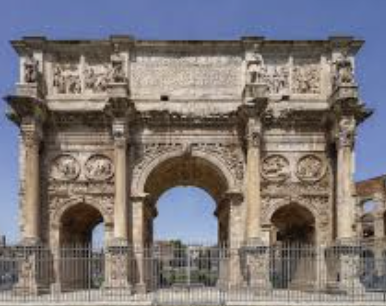
Arch of Constantine - NOTES
“Adventus” from the lost arch of Marcus Aurelius
reproducing romans carrying the spoils of war throughout the imagery of arch
constantine then has a vision that converts him to Christianity
corresponds to the Edict (act) of Milan: tolerates the practice of christianity in Rome (many people were previously persecuted for practicing above ground publicly)
Monument with many spoils all over it, hard to classify
The closest hint of christianity is in the detail of reliefs on the east side: the unconquered son arrives on the chariot everyday (viewed under a pagan lens)
one of the first times we see christianity mapped over pagan forms and concepts
Being produced in a time when there is lots of civil unrest in Judea, and Christianity is first emerging
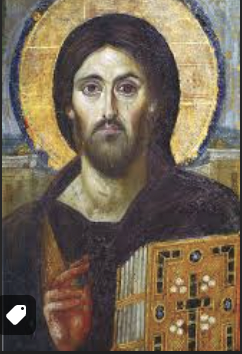
Icon of Christ Pantokrator
6th century CE, encaustic (wax-based) paint on pane, Sinai - St. Catherine’s Monastery

Icon of Christ Pantokrator - NOTES
One of the oldest Byzantine religious icons
Content
An anxiety of depicting hands
Assymetrical face = fully fivine but also fully human
Problematizing iconography
Idol = a false depiction of god
Worshiping the dead material or the idol, not the god
Eastern Orthodox

Annunciation Icon
late 12th century, paint and gold ground on panel, St. Catherine’s Monastery (Mount Sinai), Byzantine
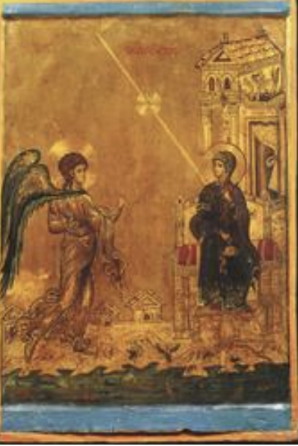
Annunciation Icon - NOTES
Icons: Christ and Buddah
Era: Byzantine
Content: buddha is human, not fully enlightened; Christ is suffering
Garnished and polished parts
Halo = signify saint, holiness
Bird = holy spirit
Ray of light = presence of divinity
Wax silk = signature of virginity
Greek inspiration
Background: gospel of new Testament
God is flesh in making, beginning of the gospel John

Theotokos and Child
c. 867 CE, Hagia Sophia, Istanbul, mosaic

Theotokos and Child - NOTES
Artist: Theotokos
Mosaic int he apse
Mary and Christ
Shoulders: mointain of robe
Humanity of Mary
How to show the divine baby, holding a scroll
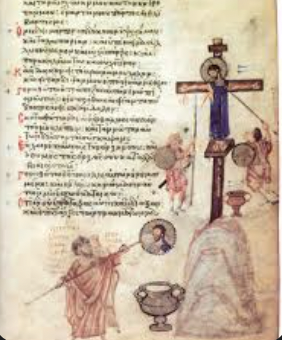
Chludov Psalter - “Crucifixion and Iconoclasts”
illuminated manuscript, c. 850 CE, Byzantine
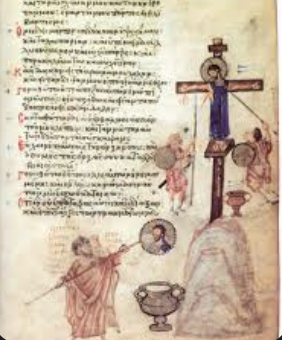
Chludov Psalter - “Crucifixion and Iconoclasts” - NOTES

Seated Bronze Buddha
late 6th to early 7th century, India, Grupta Period

Seated Bronze Buddha - NOTES
Lakshana
“Mark” or “sign”
In Buddhist art = 32 physical marks of a Buddha that indicate enlightenment and psiritual perfection, including
Long earlobes
Long earlobe shows that he used to wear many jewelry but he has now renounced adornment
The urna
Small dot or tuft of hair between eyebrows
= spiritual insight, the third eye, see beyond the physical world
Ushinisha
craniel bump on the Buddha’s head
= expanded wisdom or enlightenment
In this sculpture: the bun-like part of his hair
Confrontation of self, journey of renunciation and enlightenment
Long earlobes = once lived in luxury = no more
Compare with Christianity = the suffering is internal, not explicit
Transcendence, inner change

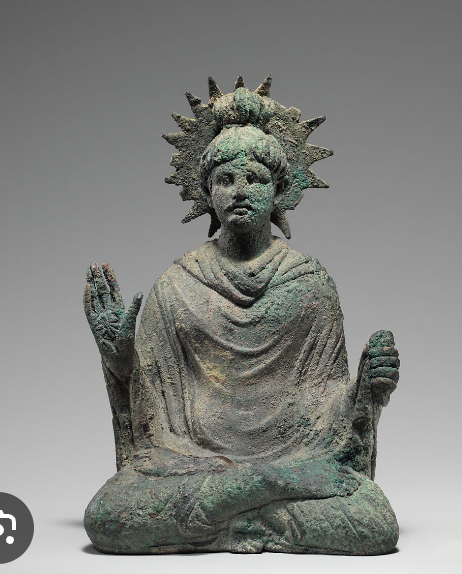
Seated Buddha Pakistan
ancient region of Gandhara, 1st to mid 2nd century
Seated Buddha Pakistan - NOTES
Every human has potential of enlightenment, becoming Buddha
Greco-Roman Influence: Unlike earlier abstract depictions, Gandharan Buddhas show classical Western traits like realistic facial features, wavy hair, and flowing robes with heavy folds, reflecting Hellenistic artistic traditions from Alexander the Great's conquests.
This Buddha shows closer affinities to Roman sculpture than any other surviving Gandharan bronze.
emblamatic of cultural exchange

Portraits of the Four Tetrarchs
from Constantinople, st. Marks (Venice), porphyry, c. 305 CE

Portraits of the Four Tetrarchs - NOTES
Four Tetrarchs: Diocletian, Maximianus, Galerius, Constantius
difference between the office of Augustus vs. Caesar: these are not individualised faces, and many art historians took this as a sign of artisitc decline (not rendering the leaders naturally)
why would the carves not have have shown idiosyncratic faces?
2 augustus’ have facial hair —> more powerful rulers with the higher offices
Schematic vs. Naturalisitc: rendering objects and reducing them to barely recognizable forms
Ex. not how robes and drapery look in real life: reduced
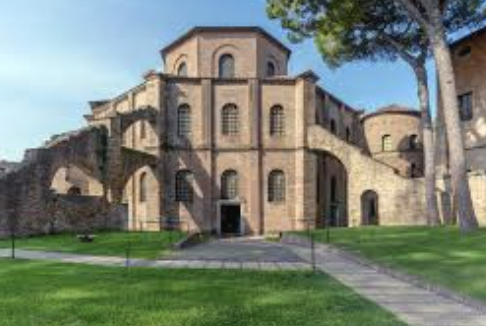
San Vitale
consecrated 547 CE, Ravenna (Italy), architecture and apse mosaics

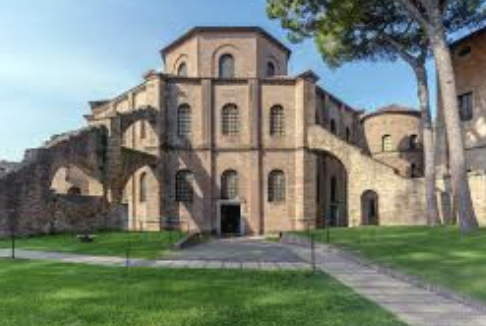
San Vitale - NOTES
Semi-circular niches on either side of the apse are shallower than it is (making apse clearly appear as the apse)
Massive thick stone piers are what keep the building standing
The black circles seen on the plan are the columns within the structure
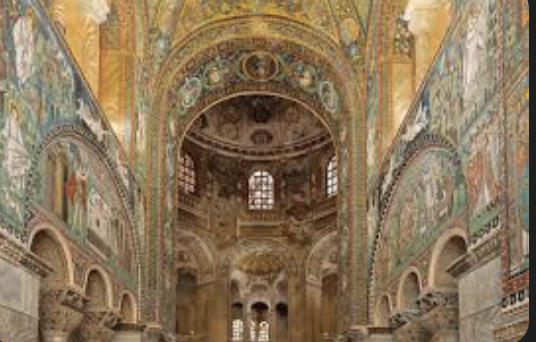
we can see massive space between the columns (thinness of columns allows light to pass directly into the space)
Light is able to pass through the inner sanctuary because of the clerestory
San Vitale Clerestory: refers to the upper windows of the octagonal church, a masterpiece of Byzantine architecture famous for its vibrant mosaics. These windows provide light to the upper part of the building, where mosaics from the 6th century depict scenes like Christ enthroned and biblical narratives, symbolizing divine authority and the Church’s connection to the imperial power of Justinian and Theodora
Jesus on furthest roof of apse: halo imagery, sitting on the orb of the world, hold a crown towards san vitale in one of his hands —> when you arrive in heaven you are crowned by a heavenly light
Cloak of Christ would’ve originally been purple, quoting antique visual language
Transubstantiation → on this table, the substance of it, contain christ in both
Why we see in every part of this program images of Christ, the moment that the priest consecrates it is transformed from blood and bread
All these images depict what is happening on the table

Equestrian Statuette of Charlemagne or Charles the Bald
9th century, Carolingian, bronze

Equestrian Statuette of Charlemagne or Charles the Bald - NOTES
Equestrian portrait of emperor: reinvigorating earlier roman depictions
linking him to ancient Roman emperors through the imagery of ruling the world (with the orb) and adopting classical artistic forms during the Carolingian Renaissance
portraying him as a divinely sanctioned ruler, a mighty warrior, and a bringer of peace and civilization, even if stylized to emphasize his spiritual and earthly authority.
From the holy roman empire, produced a very idiosyncratic image of his nose

Bishop Bernward’s doors for Hildesheim Cathedral
made c. 1015, Ottonian, bronze, Hildesheim (Germany)
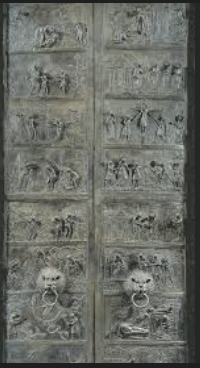
Bishop Bernward’s doors for Hildesheim Cathedral - NOTES
doors are massive and in high relief, figures are totally disengaged from the ground
building on previous bronze doors that charlemagne had but were flat
Doors chronicle biblical typology, connects old and new testament that have common patterns in order to prove christianity as the ‘right’ religion, and that Jesus Christ was the last prophet
differentiated by right and left
Right: God is shown as christ (cruciform halo), and eve being made from adam’s rib, God as a matchmaker for adam and eve, includes the fall of man (when eve plucks the apple), includes the archangel coming to push them out of paradise
this image shifts all the blame onto eve, with adam acting clucless (holding the apple over her breast, her organs are completely minimized until she commits the original sin —> reason behind amplifying her sexuality)
left: the representation of Christ at the temple with mary and joseph (went from genesis to new testament), the arrest of Christ + his sentencing, and his crucifixion - read in tandem with the scene of the original sin on the right

Cave 254 of the Magao Caves
Dunhuang - China, wall painting and sculpture, c. 500 CE, Northern Wei Dynasty,
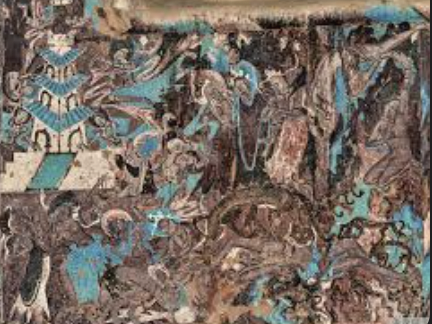

Cave 254 of the Magao Caves - NOTES
Jataka Legend of the Tiger: Starving tigress wanted to eat her own cubs. The prince decided to save the cubs by feeding himself to the tigress, next image shows him stabling himself in the neck on the edge of a cliff and falling into the mouth of the tigress (his brothers are wailing in grief
One of the only caves that has the central pillar, eastern niche has a cross-legged buddha
In this cace there are 1235 buddhas
Main Chamber, North Wall: has music-making figures at the top that possess wings, have stars around them: asparas —> winged celestial beings (buddhist angels)
asparas shown playing at least 200 different kings of instruments, based on a type of female spirit (have traits of nymphs or fairies, fugitive but benevolent)
Main Chamber, South Wall: Previous version of buddha and his two brothers, all the episodes conflated into one picture


Tokali Kilise (Church of the Buckle)
end of the 10th or early 11th century, Cappadocia, Turkey
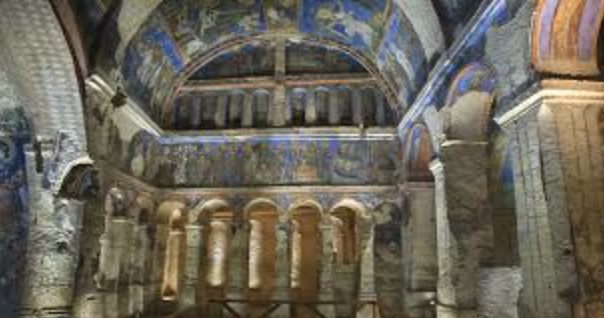
Tokali Kilise (Church of the Buckle) - NOTES
he blue here is made fram Lapis Lazuli
Modern reinforcement of architecture that is carved into the volcanic rock, thought to be the principle sanctuary of the large monastic center of Cappadocia - decorated with frescos in several areas
reflects the wealth of the christian community that made them
metropolitan style —> very wealthy style
Plan: similar to the plan of St. peter, shares certain parts of a roman basilica, deatures a hermitage for the solitary monk (an anchoress for a woman), —> these spaces are only for the monk, where they have a privileged view through the eastern end where the fixed position of the cell would provide the recluse with a view of the apse
offers monk a divine look
Vault: blues are so rich and deep, shows us scene from the infancy of Christ, gabriel always comes in from the left, strating Mary with his presence,
in this byzantine edition we have Christ bathing
View of nave: shows entry into Jerusalem where he knows he will face his death (on Palm sunday)
shows last supper where he stages the giving of bread and wine as the giving of his body and blood
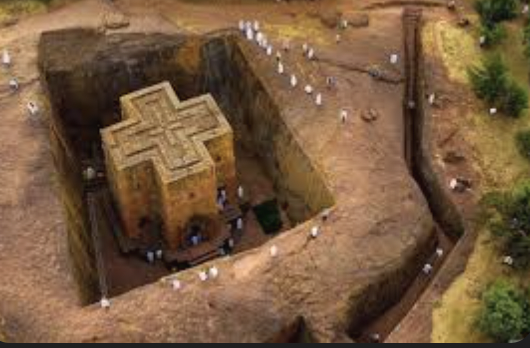
Church of St. George - Bete Giyorgis
rock-cut chirch, late 12th, or early 13th century (late Zagwe dynasty), Lalibela - Ethiopia
Church of St. George - Bete Giyorgis - NOTES
Monolithic structure, wanted to create a new ethiopian jerusalem
churches are clustered in 2 major groups: one represents the earthly jerusalem, and the other represents the heavenly jersualem
all churches are accessible to each other through a series of elaborate tunnels
Lalibela: built up by building down
height achieved by digging into matter —> bringin light into groung, inviting tension between earthly and heavenly jerusalem that the king wanted to evoke
St. George: church is carved out of and into the ground, shaped from the inside out, all the churches are composes of one unbroken piece of stone from one volcanic rock
these cave sanctuaries evoked a feeling of being held by the earth as an interior connection with God rather than power
King was called Lalibela because swarming bees were around him one day when he was younger, was called Lalibela as she believed he would rule one day

Night Attack on the Sanjô Palace
Illustrated scrolls (emaki), of the Events of the Heiji Era, Japanese, Kamakura Period, second half of the 13th century
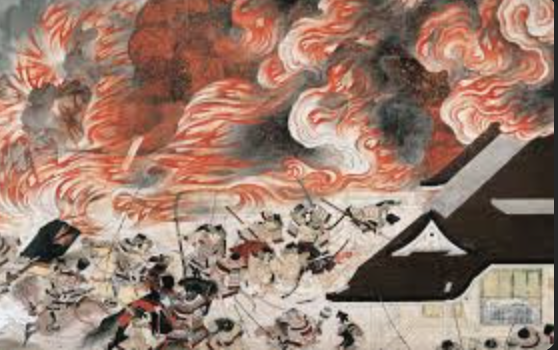
Night Attack on the Sanjô Palace - NOTES

Gislebertus, Last Judgement Tympanum, Church of Saint-Lazare
Autun - France, relief sculpture, c. 1120-30 CE

Gislebertus, Last Judgement Tympanum, Church of Saint-Lazare - NOTES
emblematic of romanesque architecture
figures are not naturalistic (very expressive), differing from empiricism to emphasise the emotive quality of figures —> unnaturalistic, often showing scene of the apocalypse from the last judgement
Compositions are dedicated to amplifying feelings of fear so that worshippers want to be in heaven, using interpolation (very Marxist) artworks that do ideological work
making viewers want to donate to the church in order to avoid repercussions of sine
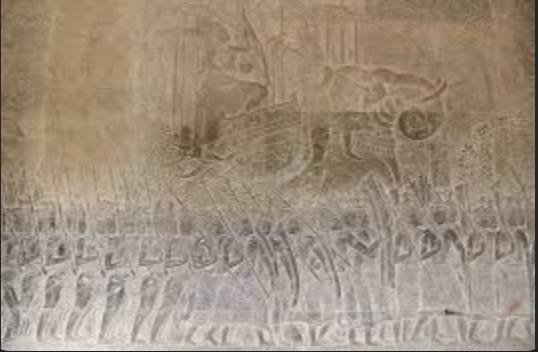
Relief Sculpture, Angkor Wat
Cambodia c. 1110-50

Relief Sculpture, Angkor Wat - NOTES
Churning of the Sea Milk: tug-of-war creation story, about trickery, harmony and collaboration, Churning the primordial ocean to release the elixir of immortality
asuras and devas gods would pull on either side to froth the milk from the sea, as this is happening vishnu turns himself into his turtle avatar
gods (Devas) and demons (Asuras) cooperating to churn a cosmic ocean for the elixir of immortality (Amrita). They use Mount Mandara as a churning rod, Vasuki (the serpent) as the rope, and Vishnu as a tortoise (Kurma) to support the mountain as it sinks. The relief illustrates this epic tug-of-war, revealing treasures like the goddess Lakshmi and ultimately the Amrita, symbolizing the victory of good over evil and the creation of the universe.
The Last Judgement: minions of Yana’s judgement are carrying out his judgements for this hellscape, battered, hung upside down in chains, being pulled and clubbed, all at the hands of Yana’s minions
a temple with a massive structure in the middled, composed with 3 concentric galleries that frame the temple, crowned by 4 towers around the main one (represent the sacred mountain (mount Meru) that is said to be the center of all spiritual universe)
structure is surrounded by lake moats that are 800 feet wide
Causeways: all ralings are made of snakes, central to cosmology at angkor
Bas reliefs (low reliefs): entryway, patio that is protected by a roof but that is open air
technical distinction in relief between cambodia and france: reliefs in cambodia are carved in the stone after the temple is built, in europe reliefs are carved then used in construction

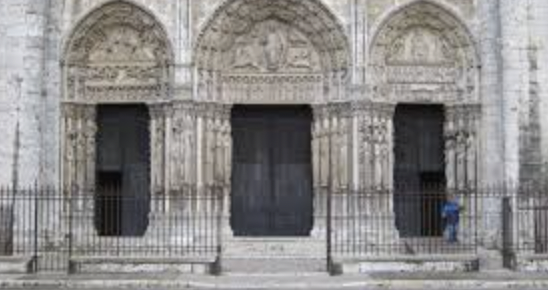
Royal Portal (west façade), Chartres Cathedral
relief sculpture, finished by 1145 CE
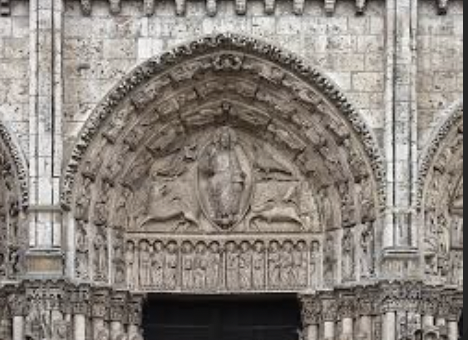
Royal Portal (west façade), Chartres Cathedral - NOTES
prototype for monumental gothic sculpture and carving
There are 3 actual portals
Gothic style: Chartres features four symbols of the evangelists that are very legible, and it also includes a full-body halo around each. People are in their own niches, not looking beyond themselves. Christ is in higher relief, has the 12 apostles at the bottom, and the 24 elders are on the top of the portal
very legible
engaging with a plan outside of their own world (virtual vs. reality)
greater degree of naturalism
is 3D
Gothis supports architectural distinctions: every archivault piece is carved, then placed in its very precise position
Emblematic of what is happening in Chartres: it had the best philosophers and scientists in Europe, celebrating the natural world as one sees it, but modulated by Christian principles
Celebrating the world in which we live as a mirror, but a product of God’s cosmological order (creation)
The ideas are encyclopedic in knowledge
The columns behind these figures are made from the same piece of stone - these people are carved onto the columns (technically high-relief), literally and figuratively, these forms are the fabric in how the church stands
Woven, engraved into the church, that is discreet and legible
Scholasticism: meant to bring new legibility to theology → we still emanate out from God
Figures are unnaturally tall - deliberate deviation from scale to form the column
Even in their bodily comportment, we can see a higher priority in rendering how fabric looks in real space
What is the content? - theophanic vision of the 24 elders from the book of revelation
Think about compositions iconography: deciphering what you are looking at, and what the form means: reducing a picture to text.
Left Portal: the world before Christ portal - people thought it was ascension because it shows angels holding something that looks like a cloud → recent studies show this is Christ separated from the earth before he arrives
The non-sacred themes are being depicted on the entrance to the cathedral
Right Portal: the incarnation portal, Christ on Mary’s lap -
Christ is the center of all these compositions
Broad coverage of intellectual disciplines
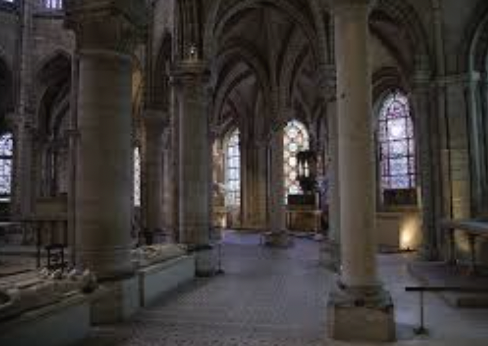
St. Denis Ambulatory
In Abbey Church, Abbot Suger began restoration around 1135, St. Denis (near Paris) - France

St. Denis Ambulatory - NOTES
All about death on the interior
All you want when you die is money because you can go closer to the altar, a beautiful tomb that pilgrims see and pray to, as each time they pray, your soul rises a little more, and you can escape purgatory quicker
Saints and crusader knights go straight to heaven if they die fighting
HELLA FRENCH ROYALTY WAS BURIED HERE!!!!!!
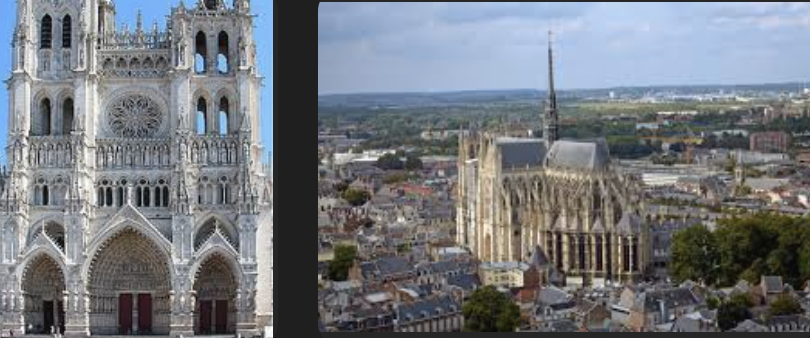
Amiens Cathedral
begun 1220 CE, nave and ambulatory complete by 1240s CE

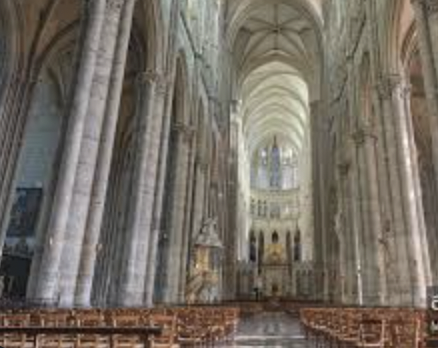
Amiens Cathedral - NOTES
The altar is completely suffused with light
The arches are pointed, the vaulting between the 2 arches is webbed ribbed vaulting, looking like a spiderweb
Has 3 stories: main arcade, triphorium, then the clerestory
Architectural Innovation:
have to isolate the places where masonry is opaque because we want the walls to be hacked through and filled with glass
The sun directly penetrates the inside
Maximization of exposure to direct light in a Gothic church
Hollowing out the walls, because the part of the building that performs all of the structural work is outsourced to the exterior → flying buttresses (all pushed out), flyers are the buttresses at the top that keep the church standing
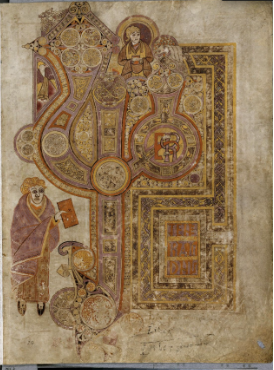
The Book of Kells (Chi Rho monogram page)
manuscript illumination, c. 760-820, British Isles

The Book of Kells (Chi Rho monogram page) - NOTES
Showing how Christ came to be born, thematizing the moment that word becomes flesh and image, larger symbol is the Chi, smaller letter/symbol is the Ro
Why disguise the letters? → you have to really get close to the image to understand it and find the signature
Letters are not abstract graphemes, but carry real literal meanings, thematizing the concreteness of the word of scripture
The icon, picturedness, plasticity of the word is very loaded in this book
Images: show angel Michael, shows 2 butterflies grasping onto a LOZENGE (similar to what we saw on page 3)
Butterflies reference transubstantiation (metamorphosis) bread and wine becoming Christ’s body
Images: near the bottoms there are 2 sets of animals - shows cat and mice
Mice are bothering monks who produce these images, cats with kittens on their back are tempting the sinfulness of man
Christ has to be protected from the devil (can’t be detected as more than human) Joseph has to be a good father and protect him
Shows anxiety around the host once consecrated, in order to avoid host desecration
Images: otter
Displays story of recluse monk who received a fish a day from the recluse otter
All these images are referring to the eucharist

Qu’ran fragment (from the Morgan Library)
in Arabic, before 911 CE, probably in Iraq, ink on parchment

Qu’ran fragment (from the Morgan Library) - NOTES
Writing in the Quran must be pleasing aesthetically: how can written words approximate the holy when they are written by a lowly human?
Standardization of beautiful handwriting, no trace of the scribes individual hand, if this is done correctly (scribe disappears behind handwriting and calligraphy)
Huge emphasis on the written word from religious and beauty standard as well
Revelations of Muhammed were first written on random materials, would be several years before his revelations were collated, systematized, and spread around the Islamic World
Quran: recitation
Acoustic nature of speaking and writing these books,
The act of copying beautifully was thought of as a reward for copying beautifully
Quran is divided into 114 chapters, organized from longest to shortest
Fragment: 2-page spread of a chapter in the Quran
First style of arabic writing originating in Iraq (read from right to left)
Each of these letters would change slightly, shape and meaning would change, the red marks distinguish these letters in their pronunciation
Pyramids of gold dots separate the verses
Titles of each sura are written in gold and surrounded by a rectangle (indicates the beginning of each)
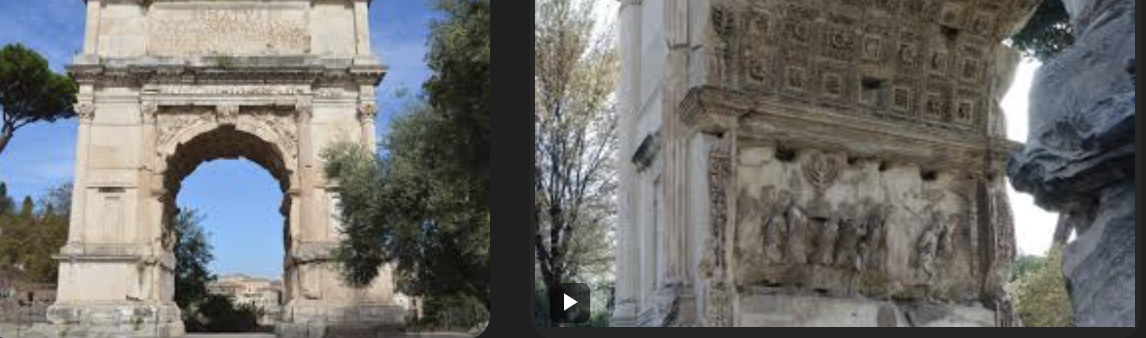
Arch of Titus
81 CE, Rome
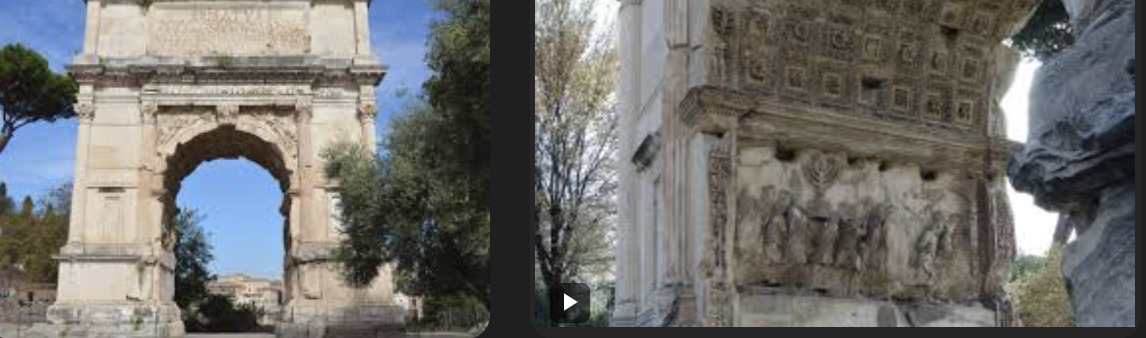
Arch of Titus - NOTES
Dome of the rock is actually built on a single rock (monolith) protected by western wall
Rock was believed to be the location for ancient islamic history: this was the rock that Isaac was placed on by father abraham to sacrifice him/murder him
The test that god sets for Abraham - will intervene at the last second
Site of the 1st and 2nd Jewish Temples
1st was built by King Solomon in 10th century BCE (preceding Christianity and Islam) - was destroyed by the Babylonians, then rebuilt
2nd was destroyed by the Romans
Romans needed to occasion this destruction (under Titus) with an arch

Dome of the Rock
687-692 (Umayyad), Jerusalem (Temple Mount or Haram al-Sharif)

Dome of the Rock - NOTES
Function: not a mosque, a shrine → marker point of contact between human and divine (God coming down to intervene on Abraham’s sacrifice, then Muhammad’s literal springboard into heaven)
Literally commemorating a giant boulder
Is a building and a rock that you can inhabit
Cavernous crevices inside the rock itself
Moses and Abraham are common in all major 3 monotheistic religions (abrahamic religions)
Built by the Umayyads, built away from the Christians
Early Islamic Monument
Built in the Noble Sanctuary (The Temple Mount) - on Haram al-Sharif
Site of the 1st and 2nd Jewish Temples
1st was built by King Solomon in 10th century BCE (preceding Christianity and Islam) - was destroyed by the Babylonians, then rebuilt
2nd was destroyed by the Romans
So much figural art, so many figural stories described, very dense specificity especially to the altar right below these human-like depictions
Has very similar style mosaic, but dome of the rock doesn't have narrative - still a very holy space
Has mostly organic imagery (non-iconic)
What is the effect of non-figural imagery?
In the Dome of the Rock brings you into the ambience of paradise - oblique associative form of significance (giving us some organic imagery of paradise)
Allows us to open our mind to make personal associations with paradise for ourselves - what would your paradise look like? Directly relating that to heaven
What images come into the eye of your mind (immaterial, meditative images that are higher forms of imagery)
Opening our mind to wander through our own imagined paradise, less about specificity PARADISE IS ABSTRACTED
What does it mean? → art historians don’t believe this can just mean paradise
References to an empire of Persia (imploded under the Byzantines)
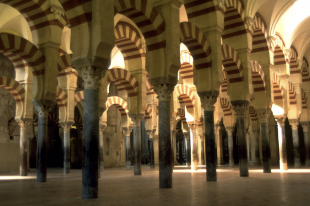
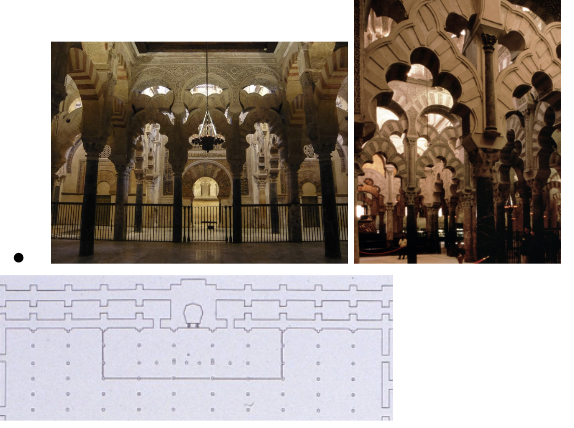
Great Mosque of Cordoba
Spain, 784-990 (Umayyad)
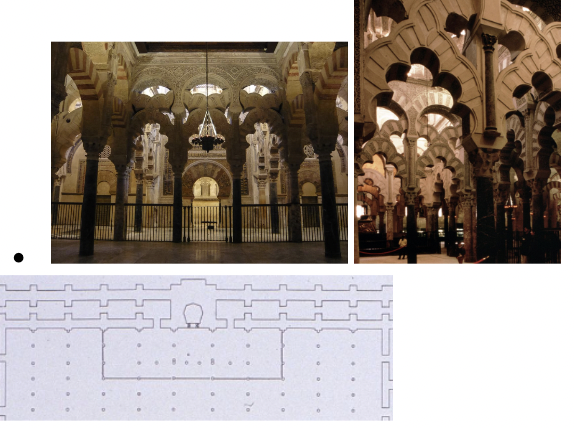
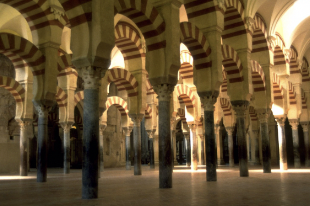
Great Mosque of Cordoba - NOTES
hypostyle prayer hall: large, columned space for worship, most famously seen in early Islamic mosques and ancient Egyptian temples, where rows of columns support a ceiling or roof. This architectural style, meaning "under pillars," creates vast interiors for prayer and gathering by using multiple vertical supports
maqsura: compartment in front of the mihrab —> guides your vision to the direction of Mecca
mihrab: the part of the mosque that faces Mecca (the cavity)
Built from ancient roman recycled columns, made out of stone and red brick that create this rich sense of movement and colliding column → featured the same style columns we saw under constantine
Gives a kinesthetic effect when you are walking through the hypostyle: culminates when you get towards the mihrab and maqsura
Maqsura/Mihrab
Alternating colors around the arch, as well as alternating media (such as colored glass, and extremely intricate stucco, carved marble in the top 2 intesserated inscriptions)
Black and Gold tesserae, with more inscriptions on top of them
Inlaid gold spirals in the corners of the marble → declares thanks to God and the patron of the mosque
Sumptuously decorated cupula
Non-figural geometric art: How does this convey spiritual truths?
Conveys order to the world Allah created, as well as the cosmos
What can we abstract away from geometry: geometry and symmetry induce surrealism and hypnotic effect (harmony, balance, order)
Beauty that has the ability to approximate God's essence (signs to his being, rather than direct - oblique depictions rather than direct depictions)
Approximating him through abstract language
THEME OF LIGHT - IMMATERIAL INSTANTIATION OF GOD - closest immaterial we have to divinity
Seashell Vault over Mihrab
IN THE MIHRAB: polylobes come down to earth and take the form of a shell (animal form/motif) compares one's devotion to the formation of a pearl in the shell, iridescence of pearls is compared to the light of God
The pearl itself is only obliquely referenced, framed in a space that is framing and facing Mecca - the origin of sacred space for all of Islam

The Kaaba
granite masonry, covered with silk curtain and calligraphy in gold and silver-wrapped thread, pre-Islamic monument, rededicated by Muhammad in 631-632 CE
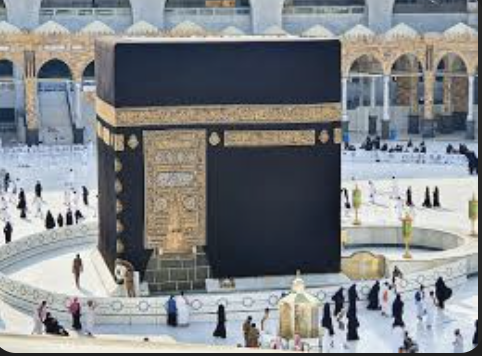
The Kaaba - NOTES
Answers what drove antipathy towards figural representation in Islamic Art
A shrine to monotheism
To an iconophobic single-god (antipathy to portraiture)
Was draped in precious cloth, ancient significance to the black stone that Gabriel gave to Abraham
Was the site of various pilgrimages to Mecca, hajj was made every lunar year (allowed to worship their respective Gods inside the Kaaba and trade with each other respectfully)
Their idols were inside the Kaaba → this infuriated Muhammad
1620: the early muslims are driven out after destroying and cleansing the Kaaba of Idol
Muhammad return in 1630: brings islam to the area, key moment that drives the prohibition of portraiture → specifically anthropomorphic imagery of Muslim idols and images
Silk veils covering it have changed several times throughout the centuries -> demonstrates the Kaaba’s infernal immateriality
The element that is special about this is the spot/the point in which monotheism was ritually restored (cube) → memory of what transpired here is more important than material elements framing the cube
The Kaaba is the terminus of the Hajj → pilgrimage that all muslims aspire to complete
Kaaba is an empty, material marker of invisibility
Allah cannot be represented in our lowly earthly terms, instead we have a cube, also represents the most important site for Muhammad, where he destroyed idols, and where he died in 1632
All mosques on earth are oriented towards the Kaaba
The Dome of the Rock and The Kaaba are points of contact between the heaven and the earth

The Great Stupa at Sanchi
patron King Ashoka, founded 3rd century BCE, enlarged c. 150-50 BCE, India

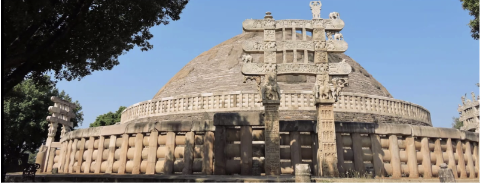
The Great Stupa at Sanchi - NOTES
East Torana (“The Great Departure”) of the great stupa: 1st century BCE - 1st century CE, sandstone
Monumental reliquary, container for relics
Stupa is a solid semihemispherical structure
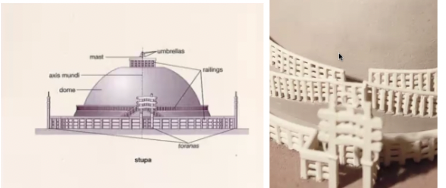
There are 4 baffle gated entries that mark the cardinal directions to enter the main stupa complex, in front of each of these entries is an elaborately carved free standing gateway called a toruna???
The baffle gating is that you cannot see directly through, have to turn left then turn right before getting inside (multiple right angles)
Inside remains private and obscured
2 important concepts (that will be in this original model than copied): the wheel and circumambulation
The Wheel: in an early sutra (collection of saying from Buddha) he gave the appropriate method for his remains to be buried, the unmoving hub of the wheel - the place of enlightenment → if one thinks of the stupa as the wheel, then the impossible limit as you reach the center would be unmoving, symbolizing the locust of enlightenment
In this place, the practitioner achieves stillness and peace, when the Buddhist is fully understood and achieves
The Axis Mundi: echoes the central spine that bisects the human body, and in this manner, Buddha's body buried in his meditative pose allows the body to act as the pinnacle of the universe
Through bisecting Buddha's spine and the past, we can imagine the wheel spinning as well as seeing the center of the mast
Circumambulation: the practitioner does not enter the stupa, instead the practitioner walks around the stupa as a medical practice → suggests endless cycles of rebirth leading to knowledge
Like a spiral with an ever decreasing radius, one will eventually reach the center of the wheel and reach enlightenment
Buddhism was never actually shown (callback to early Islamic art)
In the dark/shadows: showing by negating and concealing, quintessential Buddhist and Christian negative theology, because something is unrepresentable
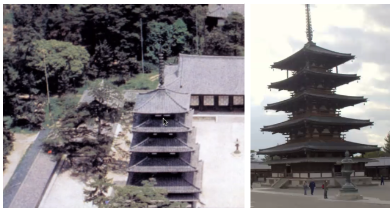
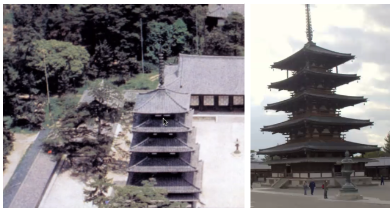
Horyu-Ji Pagoda
c. 607 CE, Nara - Japan, metalwork joints and cypress wood
Horyu-Ji Pagoda - NOTES
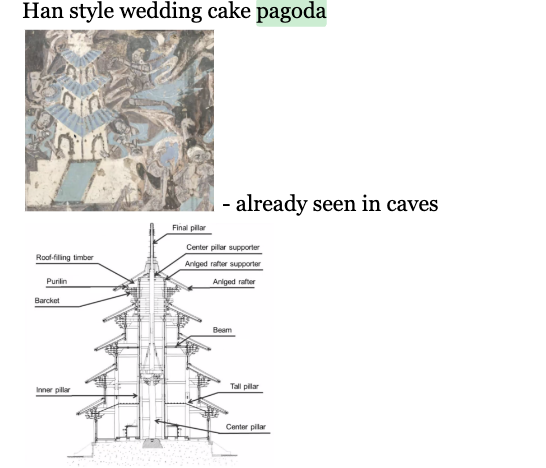
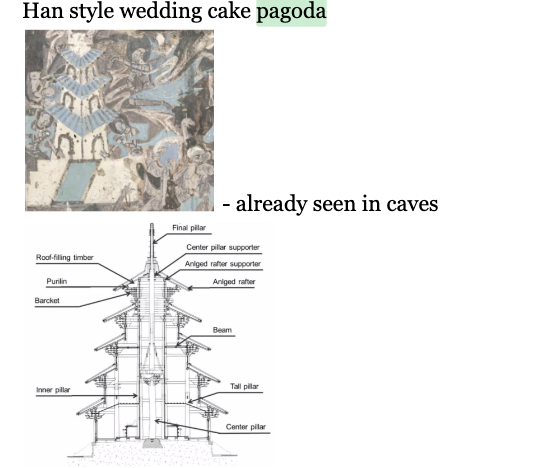
Stupa becomes a pagoda, like a tower → very tall with multiple eaves that come to a central peak, each eave is of a smaller and smaller diameter (wedding cake style pagoda) imported/appropriated from Han Dynasty Chamber
Chambers served as a relic chambers and symbols of Buddha and his teaching
It takes 1,000 years before this structure reaches japan, reaches through Korea - political struggle in this period between buddhism and local religion (buddhism ends up prevailing)
Nara is the center of buddhism of Japan of the entire archipelago, Nara later rebuilds after a fire
Japan gets a lot of earthquakes, design is an example of earthquake proof architecture
Each style is a box that flows freely around a central pillar
When there is an earthquake, each box can shift and slide around the central pillar that prevents it from falling down

Purse reliquary (bursa) of St. Stephen
southwest Germany, c. 800-830, now in Vienna - Schatzkammer
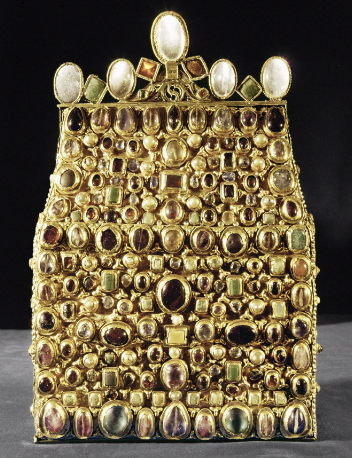
Purse reliquary (bursa) of St. Stephen - NOTES
Typical in the Carolingian period (think Charlemagne) - these types of reliquaries are called purse/burse reliquaries → thought of as safe
Made in the early 9th century
Earlies forms of these containers work like an iconic way (similar to islamic art) in an associative and oblique manner
How would anyone know this contains something divine/heavenly?
Spiritual jewels (referenced in the book of Revelation) - all represent a heavenly Jerusalem
Closest approximation we can get on earth to what heaven looks like
Indexal traces to heaven with St. Stephen’s remains - semantically holier than lowly earthly jewels
Christian signifiers: a cross between the jewels pattern (formally) → the size and placement of jewels + use of rubies represents the blood of Christ (mimics the blood shed on the cross), even the color of the jewel in the center is flesh-colored
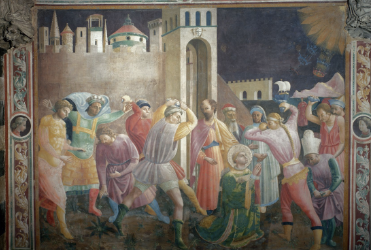
References to St. Stephen: (gems reference how he was murdered) - he was stoned to death


Nicholas of Verdun and workshop, shrine of the Three Magi
Cologne Cathedral, Germany, c. 1181-1230 CE
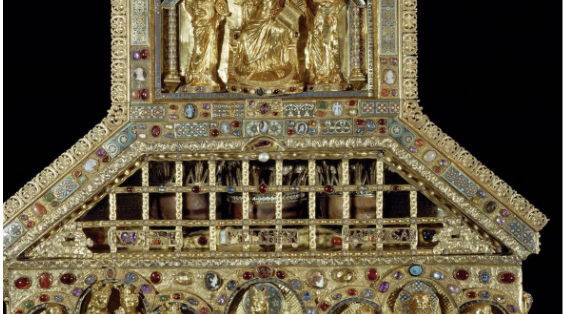

Nicholas of Verdun and workshop, shrine of the Three Magi - NOTES
Becomes a backdrop to mass, not only a container, but also this artistic backdrop to the drama of the liturgy (can be seen from far back in the church)
3 wise men (skeletons are inside this reliquary) - this style was popular for only very important people
Former emperors, Charlemagne’s remains were put into a reliquary like this, Frederick the 2nd
It is because of Frederick the 2nd that the 3 wise men’s bones are in a life-size reliquary: he extended his empire into northern Italy, took the 3 wise men's bodies out of Mila,n and brought them into Cologne
The 3 crowns are everywhere in Cologne
The 3 wise men are depicted at the bottom: Casper, Melchior, and Balthaza
The 3 wise men are 3 foreign kings from the far east, are kings that studied the stars (physical heavens). Through studying the stars, they were able to ascertain that the real Son of God is Christ (called the star of Bethlehem) - also includes a cameo of Bethlehem
The moment the 3 kings come to see Christ (Christ has to be circumcised before they see him) bc the 3 kings must see him as a Jewish baby
Takes place on January 6th - the Epiphany - bring gifts to Christ’s mother Mary
The 3 kings bring gold, frankincense, and myrrh
Has Old Testament prophets around the top edges
Le Cruset metalwork: make the forms by hammering on the other side + chasing: inscribing and etching on the front end, then you gild it
On January 6th, this becomes a changing backdrop - the front of the door opens and the 3 skulls of the 3 wise men are visible

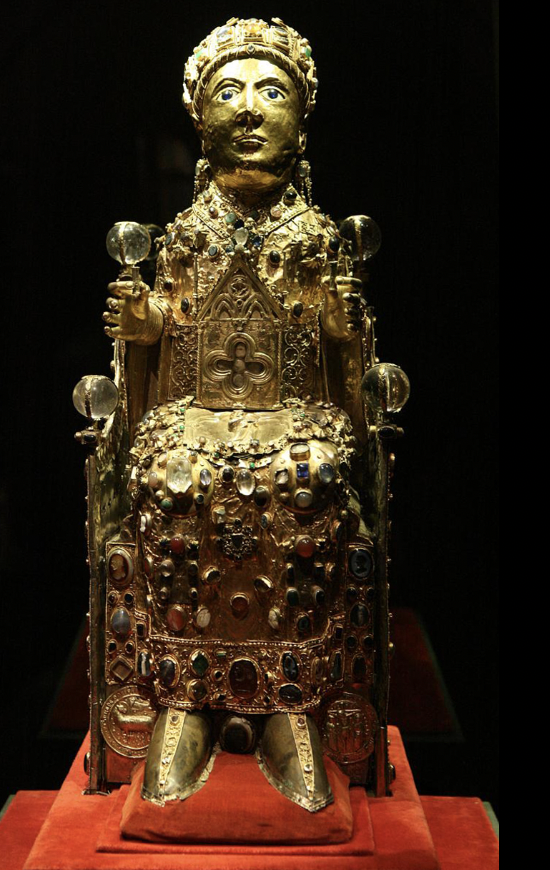
Reliquary Statue of St. Foy
Conques - France, 9th century core with embellishments from 11th-13th centuries
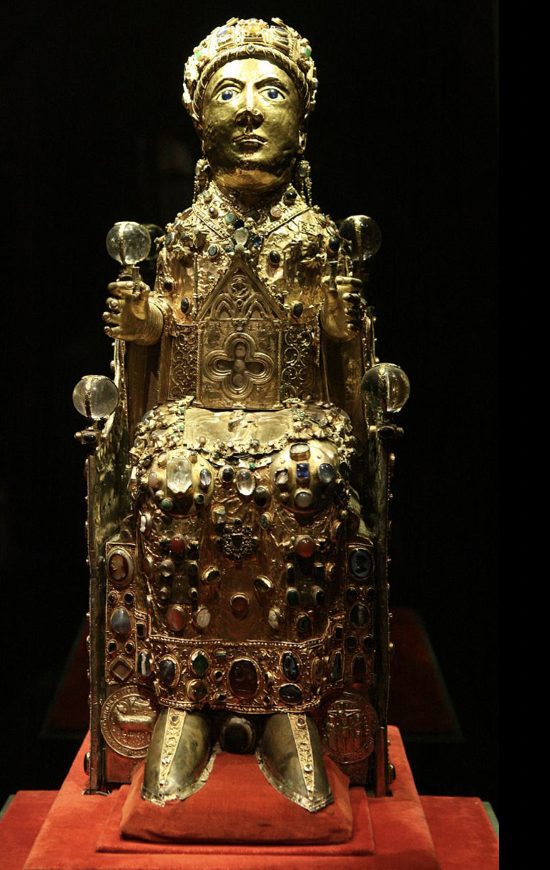
Reliquary Statue of St. Foy - NOTES
Why is praying to Sainte-Foy not idolatrous (partial presence): the statue is the work of human artists and is made up of inanimate materials, never worshipped for its own sake - never identified with the saint, the statue is not St. Foy though there is a close connection
What concerns the statue concerns the saint - any disrespect is transferred onto St. Foy
Idol allows St. Foy to defend the honor of her image, as it encourages more gifts to her sanctuary, further embellishing the importance of her statue
The presence of her image allows prayers to be heard, and within her sanctuary in medieval France allows miracles to occur
Rendering Sainte-Foy
Eyes: enlarged, important (think about votive figures and the gaze they hold) - if she’s meant to be an intermediary between the pilgrims and God, she is forever in a state of revelation/spiritual moment to be able to grant her blessing
Significance of medieval experiences of gold and gems: this intense ornamentation gives ‘life’ seems to animate the statue, increasing the depth of connection worshipper feel between the status and heaven (precious materials, reinforcing the idea that in this sanctuary when worshipping this statue the unimaginable can happen?)
Original surface of the majesté of st. foy was gold, enriched with golden bands and jewels, had later additions of crystal balls and lower sleeves + hands → original was made for the head → current skull is encased in silver
These rich materials help render the icons as reverently enshrines
Gold is entirely woven across her dress, completely adorned with jewels, fit with a jewelled crown
Material splendor of reliquary - relating to the heavenly sphere
What could be idolatrous about using gold and precious gems? - gives idea of exclusivity, saints are regular people, she didn’t go around her life adorned in jewels, attempting to represent something heavenly with materials in the physical world
Martyrs become saints (St. Foy) was a young girl who was burned → you must die before you become saints
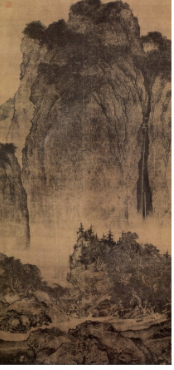
Fan Kuan, Travelers Amid Mountains and Streams
c. 990-1030 CE, ink on silk, Song Period, Chinese

Fan Kuan, Travelers Amid Mountains and Streams - NOTES
Just ink on silk
The great painting by Fan Kuan
Northerner, stern character - myth said he live in the mountains to be surrounded by nature
Fan kuan was able to evoke the spirit of both the Li and the Qi
The idea that painting can substitute for the real scene, transports you from the optical reality and the ambience
Very particular angle, an amalgamation of many vantage points
Not trying to capture a photographic frame
COMPOSITION: Has a foreground (secular characters), middle ground (rising bluff/templs and trees), and a great peak rising above that
Middle ground carries the mass of the paint
Foreground: emphasizes daily life, shows mule train
Capturing the Li and the Qi in an unmannered way, as it would emerge in reality
Nature’s drama is on display in this scene
Perspective:
Not quite a birds-eye view, you wouldn;t be able to see people in the foreground from the front as well as the rocks,
Notional, rather than accurate → atmospheric perspective
Departing what the eye sees, focusing more on capturing the Li
Hypostatic reality, rather than how the surface is truly in every single way
Doesn't reduce the composition to a photographic optical naturalism
Monochromatic
Buddhist monastery hidden in the ravine
Pilgrim on other side of mountain
Your eyes voyage mirror the voyage of the buddhist pilgrim
Brushstrokes:
Leaves pattern rendered (in relation to branches: unclear which leaves are attached to each branch, avoiding redundancy in composition, desire for visual excitement, never slipping into repetitiveness
Branches stand out because they are irregular, not try to capture the non man-made aspect of nature
Difference in texture of the rock, especially compared to water
Utilizing negative space, utilizing the silk itself as the mediating device
Viscosity of the ink is as low as possible, encapsulating the flow of water


Scenes from the Prato Haggadah
c. 1300, manuscript illumination, Spanish
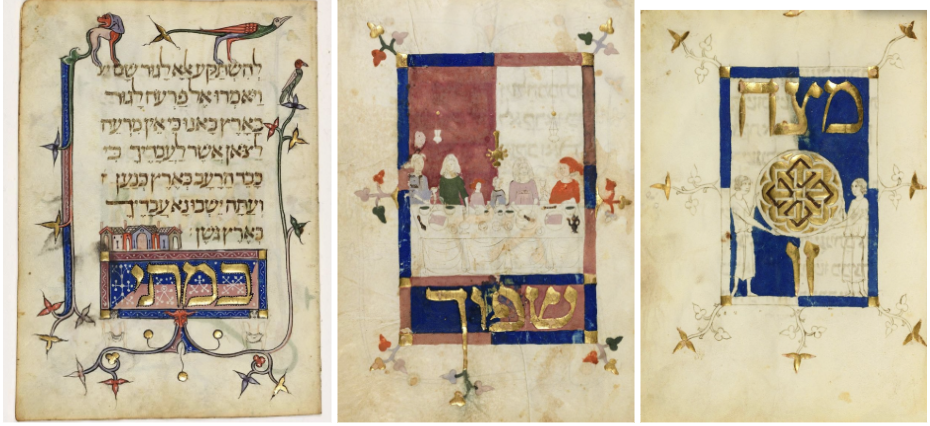
Scenes from the Prato Haggadah - NOTES
Haggadah is are book that is rich in visual figural imagery - in the vein of Islamic art
Haggadah: used at passover to tell the story of the exodus, used on your home dinner table → not a liturgical object, many that survived are oily from people’s hands
Prato Haggadah is lavishly stunning
Is unfinished
These are used, dog-eared, loved by families and passed down from generation to generation (domestic family affair)
Hebrew letters: without the writing/lettering, the design of these pages feels very French-Gothic (use of gold leaves to make accents)
Because the style is so similar across the board, so often → Jewish artists who made these cohabitated with Christian monks, evident in shared style (learned each other's techniques)
Made by Jewish itinerant artists
The last page of the manuscript is called a colophon - they are short books
Looks like/riffing on a last supper page, looking for pre-existing visual vocabulary for people eating a meal indoors

Synagoga and Ecclessia from Bamberg Cathedral
North Flank, Princes Portal c. 1220-30

Synagoga and Ecclesis from Bamberg Cathedral - NOTES
Jewish forms are now on every major Cathedral in Europe
This cathedral is so high gothic
Figures on either side (installed on massive column bases): left side: ECCLASIA has a woman wearing a crown and dress on the mantel, always has her pendant (ecclasia and synagoga)
Right side figure: SYNAGOGOA has a staff, and the tablets of the law (10 commandments), old law, didn’t recognize Christ for who he was, has a bandage around her eyes (she cannot see the truth)
The foot of SYNAGOGA is exposed; it seems literally less physically connected to the church
Synagoga has lost composure, lost her ability to stand upright, falling off the tablets (disintegration) made human
The toes hanging from the column → synagoga is in the midst of falling
If we follow Synagoga’s column down, we can see the depiction of a Jewish aristocratic man having his eyes poked out (noble gesture of a man holding the collar of his mantle → thumbing their nose at the Jewish community, poking fun at the idea that the Jewish enclave in Bomberg thought their messiah would come → doubling down on the idea of being blind, not only inscripture but also in reality)
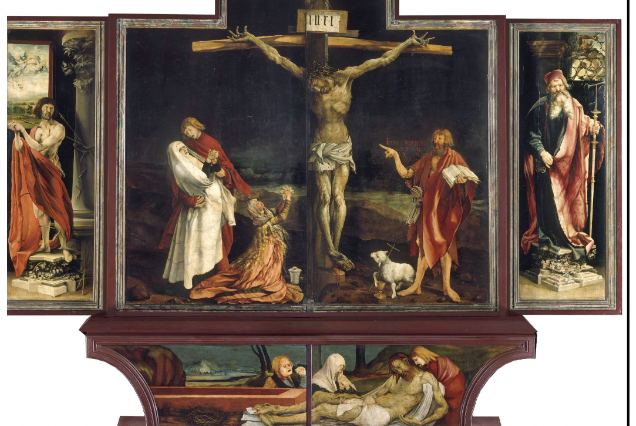
Matthias Grünewald, Isenheim Altarpiece
painted wings, oil on panel, c. 1512-1516 CE
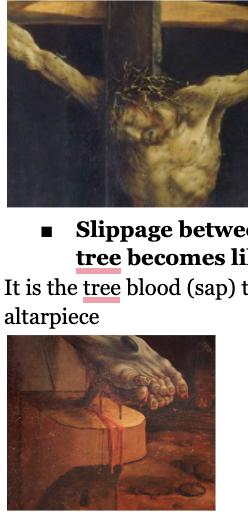

Matthias Grünewald, Isenheim Altarpiece - NOTES
We are viewing it in its closed state
St. Anthony (had his own league of monks); main practical reason for monks existing were doctors, trained to treat specifically St. Anthony’s fire
St. Ant’s fire: protracted from eating fungal wheat/rye would get gangrene, if you had this illness you would die, it was only a question of time
The altarpiece was oriented towards these monks and the victims of St. Anthony’s fire
Christ’s crucifixion: we can see the tree nature of the crucifix, Christ’s body is literred with twigs - look like they are sticking out of him
Slippage between the wood of the cross and Christ’s body, as tree becomes like a person, Christ becomes like a tree
It is the tree blood (sap) that treated the people who would look at this very altarpiece
Just how Christ is bleeding, so is the tree in order to treat these people
The tree’s blood wasn’t valued because trees are meant to be healers, this tree provides medicine because it portrays the ideal nature of the wood of the cross


Inner “Grand” Shrine (Naiku)
dedicated to goddess Amaterasu, c. 2013, (20 yr rotation, since 7th century CE) Ise - Japan
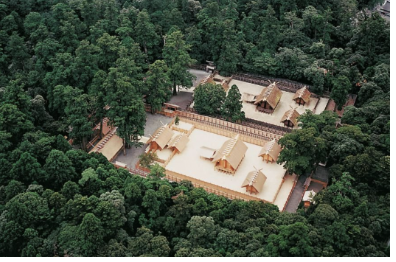
Inner “Grand” Shrine (Naiku) - NOTES
Important concepts to know about Shinto:
Shinto is often framed as a pre-Buddhist religion in Japan
Quasi-pantheistic belief system
Pray to your ancestors to better manage them
Shrines of Shinto were built with cypress trees; shrines would be built to maintain the material integrity of the tree, which was believed to have very important spiritual value to believers of Shinto
There is in an inner and outer shrine
A lot of what we think we know about Shinto was actually invented by nationalists, to prove there was a strong religious culture in Japan before the arrival of Buddhism (nationalistically coded) - 15th-century ideals
Naiku was dedicated to the sun goddess Amaterasu
The great shrine is rebuilt every 20 years as a testament to the sustainability of the area
Exploitation of nature to explain what it means to be Japanese, pre-Buddhism
Romanesque vs. Gothic
Romanesque: makes you feel, more schematic and cherishes mystery —> trying to make worshippers feel emotion on a plane that is distinctly separate from them
Gothic: makes you think, aims to inspire you into believing rather than scaring you, embodies ideas of scholasticism (greater degree of naturalism), very legible
Horshoe Arch
Very Islamic Spain, Iberian, Medieval
Represents the idea of living together (true of all monotheistic religions)
Spain was a true medieval melting pot

Filippo Brunelleschi and Lorenzo Ghiberti, Sacrifice of Isaac (competition panels for the doors of the Florence Baptistery)
c. 1401, bronnze, gilding, commissioned by the Arte del Calimala (the wool merchants gild)

Filippo Brunelleschi and Lorenzo Ghiberti, Sacrifice of Isaac (competition panels for the doors of the Florence Baptistery) - NOTES
Produced on a gothic frame, 4-leaf foil
Which one wins??? → Which one do the cloth guilders choose?: GHIBERTI
Brunelleschi: unequivocal about what the story is about: Isaac and Abraham are centered
More clear-cut
Other figures serve to frame the middle, not detracting from the purpose of the story
Mimics discrete units being put together
We are at the moment where Abraham has begun to kill his son, and the angel has a grasp on his hand
Ghiberti: What are the effects of having Abraham and Isaac off-kilter?
Prompted by the composition to find the story that is happening, almost like creating a narrative world
In terms of narrative, we are further away from the angel getting to Abraham’s son; we are locked in Abraham’s facial features
Because Ghiberti uses a unified composition, he can hollow more material out, more economical
A liberation from the medieval PERIOD
QUATREFOIL: There is a sense that the composition on the right - Ghiberti - is pushing out of this frame, pushing out of convention, Brunelleschi stays within these borders.
Both artists are employing classic elements, the ideal body (doryphorus)
Muscular abdomens (Ghiberti)
A figure removing a thorn from his foot (direct citation from Spinario - stemmed from the pagan period, sexualizing youth in a way that is very Greek)

Robert Campin, The Mérode Altarpiece (Annunciation Triptych)
ca. 1427-32, Netherlandish, oil on panel
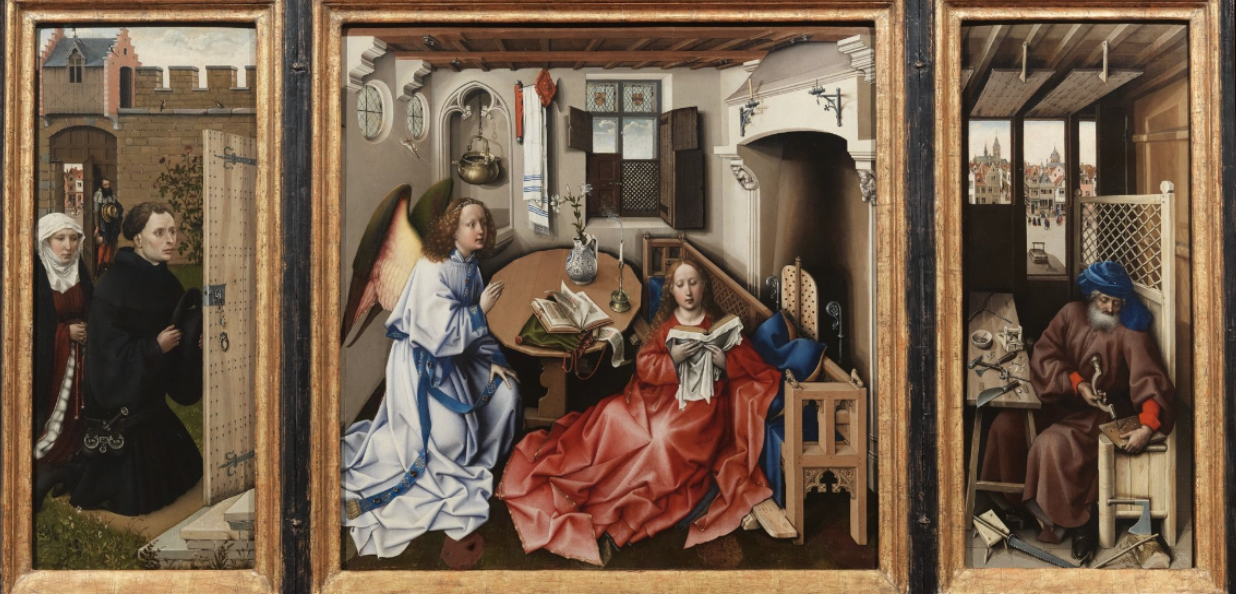
Robert Campin, The Mérode Altarpiece (Annunciation Triptych) - NOTES
Same artist as woman and child + firescreen
The color of her drapery isn’t just red, but has white and brown to give such rich depth
Gradation of color: this is something that oil can get that tempera and encaustic cannot
Oil doesn’t dry, it hardens → polymerization
Oil allows you to paint with translucent layers of glass that harden over time
Multiple layers of paint, sculpting the elements of this over time, in real life, have intense depth
Light bounces off the deepest layer and then through the layers
Oil paintings would take a long time, to let the last layer dry and to apply new color and textural effects
Specular reflections (ex., reflecting light)
One of the first times we see medieval artists using white, using white from outside the plane, representing an exterior light source
Exterior light source was a foreign ideal
Shows liturgical, basin, and cloth, Netherlandish lilies →Mary’s attribute as the lily of the valley held in a regular Netherlands vase
Motivated disguise symbolism
Depicting a moment → Mary is not pregnant yet, Gabriel is here, but he hasn’t spoken
The translucency of the smoke (we can see the brown through the white)is very intentional to depict the artist as a master of this new medium
With Gabriel speaking, she becomes pregnant, an acoustic metaphor, Jesus will get into to Mary through her ear
Sound goes into your head, something enters your body and lives and grows without compromising your body → high theological idea
Every day but not
 Note
Note  Flashcards (25)