GIT intro and peritoneum
 Call Kai
 Learn
Learn Practice Test
 Spaced Repetition
 Match
Match Flashcards
 Knowt Play
1/38

There's no tags or description
Looks like no tags are added yet.
Name | Mastery | Learn | Test | Matching | Spaced | Call with Kai |
|---|
No analytics yet
Send a link to your students to track their progress
39 Terms
The abdominal cavity extends from the _________ ______ to the ___________, and houses components of the __________ system, ________ system, ___________, and the _______
Inferior thoracic aperture, pelvic inlet, gastrointestinal, urinary, reproductive, spleen
Major elements of the gastrointestinal (GI) system that are considered abdominal viscera include… (7)
Caudal end of the esophagus
Stomach
Small intestines (duodenum, jejunum, ilium)
Large intestines (ascending, transverse, and descending parts are part of the abdominal viscera; sigmoid colon and anal canal are in pelvic cavity)
Liver
Pancreas
Gallbladder
Components of the urinary system included in the abdominal viscera include…(2)
Kidneys + suprarenal glands
Ureters
Name the structures of the path that food goes through, from the oral cavity to the anal canal.
Oral cavity → esophagus → stomach → small intestine (duodenum, jejunum, ilium) → large intestine/colon (ascending, transverse, descending, sigmoid) → rectum → anal canal
Define digestion
The process of turning food into nutrients your body can use
In other words, mechanically and enzymatically breaking down food into substances for absorption into the bloodstream
T/F: Digestion starts as soon as food enters the mouth
True
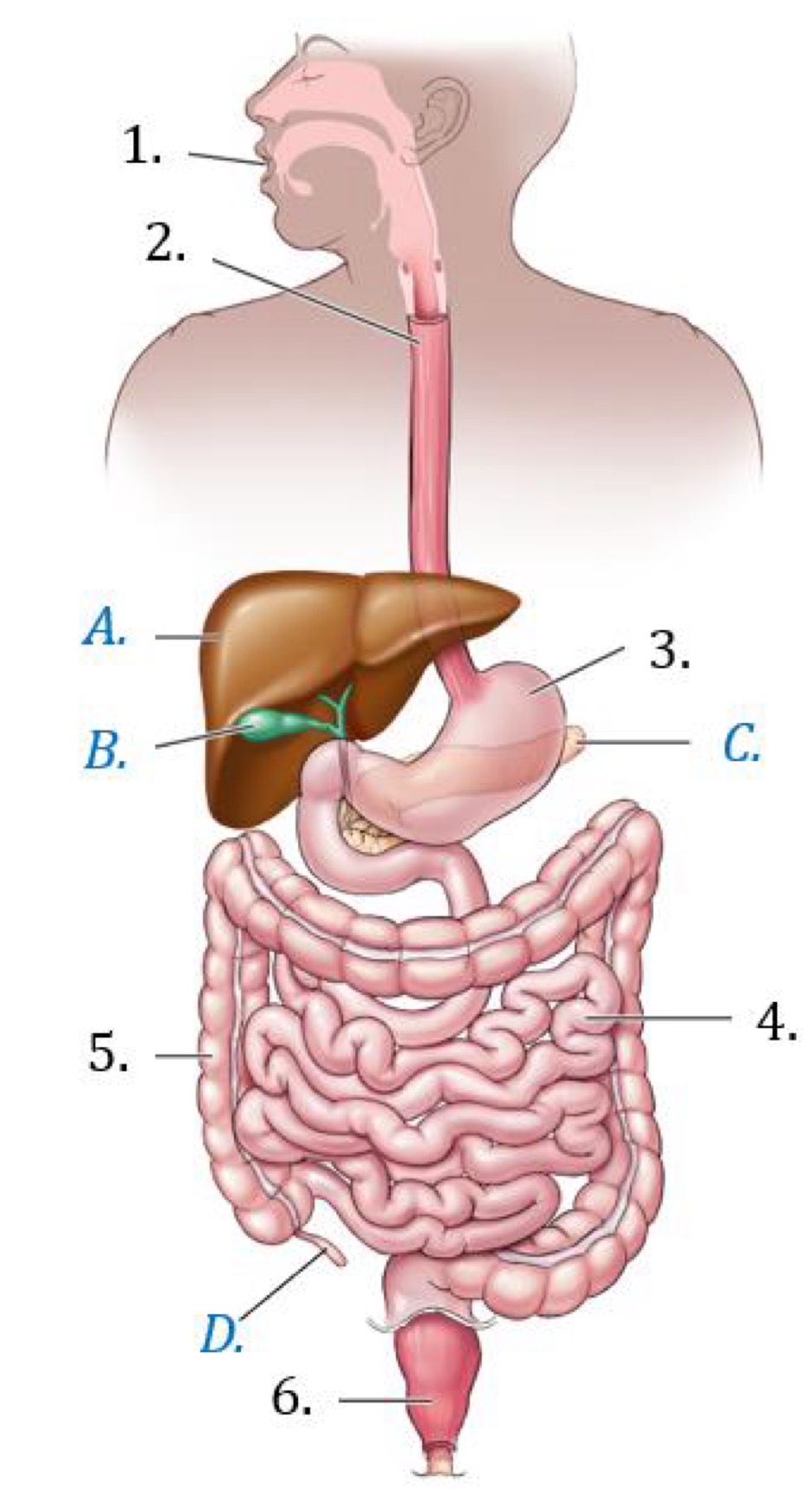
Identify
Oral cavity
Esophagus
Stomach
Small intestine
Colon
Rectum
A. Liver
B. Gallbladder
C. Pancreas
D. Appendix
Initially (early development) the GIT is straight and suspended by ____________, which attaches to the _________ abdominal wall. The ___________ connects only the anterior stomach and the liver to the _________ abdominal wall
Dorsal mesentery, posterior, ventral mesentery, anterior
What happens to the GIT from fetus/baby to adult?
First, the stomach rotates 90° counterclockwise, bringing the posterior side to the left, and the anterior side to the right
The ventral mesentery forms the greater omentum
Further rotation of 180° distal to stomach
For the foregut:
What organs are part of it?
It is supplied by which artery/ies?
Which nerve(s) bring(s) parasympathetic innervation?
Which nerve(s) bring(s) sympathetic innervation?
Esophagus, stomach, pancreas, liver, gallbladder, proximal duodenum
Celiac trunk (left gastric, splenic, common hepatic arteries)
Vagus
Greater Splanchnic nerves (T5-T11)
For the midgut:
What organs are part of it?
It is supplied by which artery/ies?
Which nerve(s) bring(s) parasympathetic innervation?
Which nerve(s) bring(s) sympathetic innervation?
Everything between (rest of) duodenum and the proximal 2/3 of transverse colon
Superior Mesenteric Artery (SMA)
Vagus
Lesser and least splanchnic nerves (T11-12)
For the himdgut:
What organs are part of it?
It is supplied by which artery/ies?
Which nerve(s) bring(s) parasympathetic innervation?
Which nerve(s) bring(s) sympathetic innervation?
Distal 1/3 of transverse colon → anal canal
Inferior Mesenteric Artery (IMA)
S2-4 pelvic splanchnic nerves
Lumbar splanchnic nerves (L1-2)
The celiac trunk is found at level ___, and its major branches are…
T12
Left Gastric Artery
Splenic Artery
Common hepatic Artery
The Superior Mesenteric Artery (SMA) is found at level ___ (~1cm inferior to the celiac trunk), it is located just superior to the __________ vein that crosses over the abdominal aorta; its major branches are…
L1, left renal
Inferior pancreaticoduodenal artery
Jejunal and ileal arteries
Middle and right colic arteries
Ileocolic arteries
The Inferior Mesenteric Artery (IMA) is found at level __, and its 3 major branches are…
L3
Left colic artery
Sigmoid arteries
Superior rectal artery
The abdominal cavity is lined by a serous membrane (fluid secreting) called the __________ Describe it.
Peritoneum
An epithelial-like single layer of cells (mesothelium) together with a supportive layer of connective tissue
Serous membrane formed of simple cuboidal epithelium, rich in microvilli
Similar to the pleura and serous pericardium in the thorax
What are the two layers of the peritoneum?
Parietal peritoneum: lines the abdominal wall
Visceral peritoneum: covers suspended organs
What’s found between the two layers of the peritoneum?
The peritoneal space → a minimal space that allows the two layers of the peritoneum to glide over one another (filled with serous fluid, 5-20 mL)
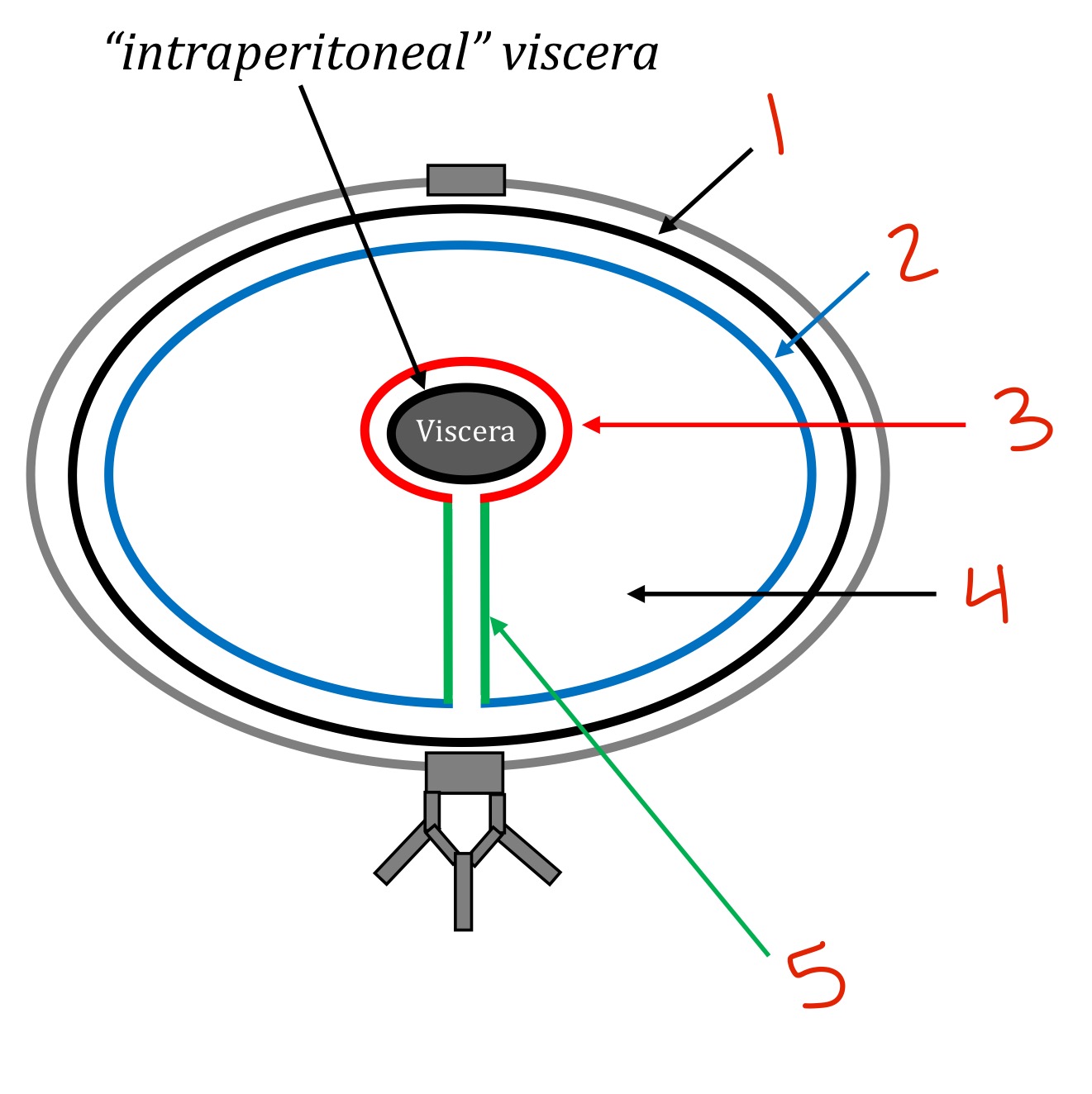
Identify
Transversalis fascia
Parietal peritoneum
Visceral peritoneum
Peritoneal cavity
Dorsal mesentery
What are mesenteries? What is their function?
Double layers of elongated visceral peritoneum
Provide a pathway for neurovasculature
Connects intraperitoneal organs with posterior abdominal wall - also allows mobility for IP organs
Storage for adipose tissue
What is the difference between dorsal and ventral mesenteries (location wise) ?
The dorsal (posterior) mesentery runs along the entire length of the system
The ventral (anterior) mesentery is only at the proximal regions of the gut tube
What are the three most important mesenteries?
Mesentery proper — small intestine
Mesocolon — colon
Mesoappendix — appendix
What are omentums? What are the two most important?
The are sheets (4 layers, or 2 double layers) of visceral peritoneum
Greater omentum
Lesser omentum
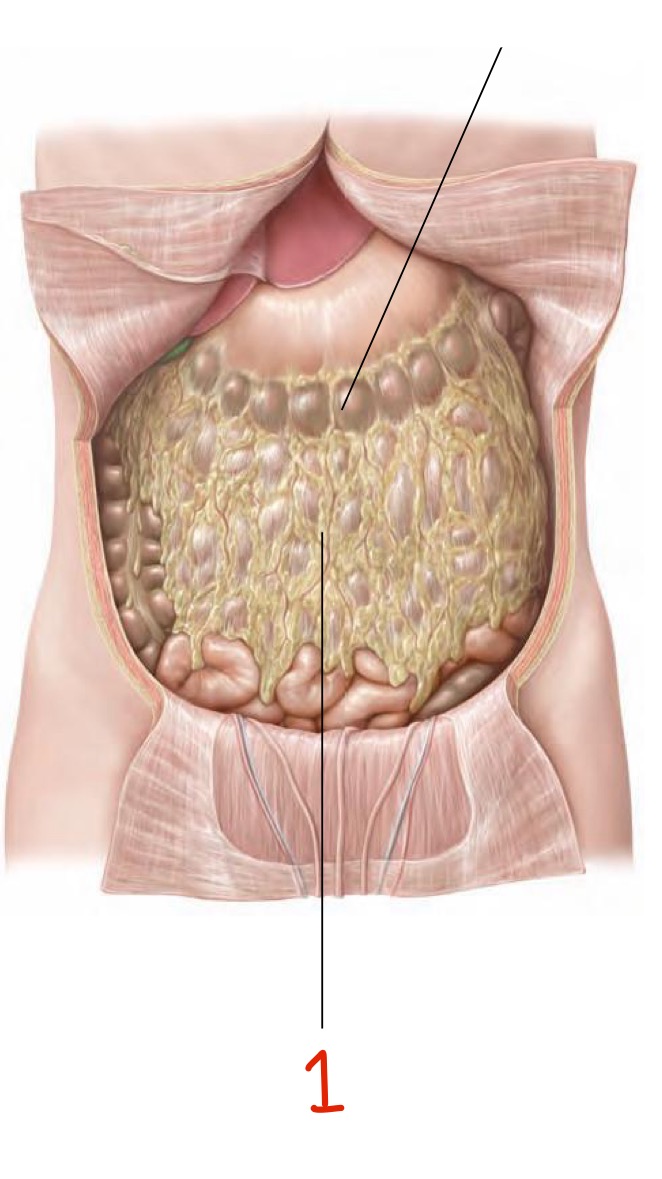
Identify
Greater omentum
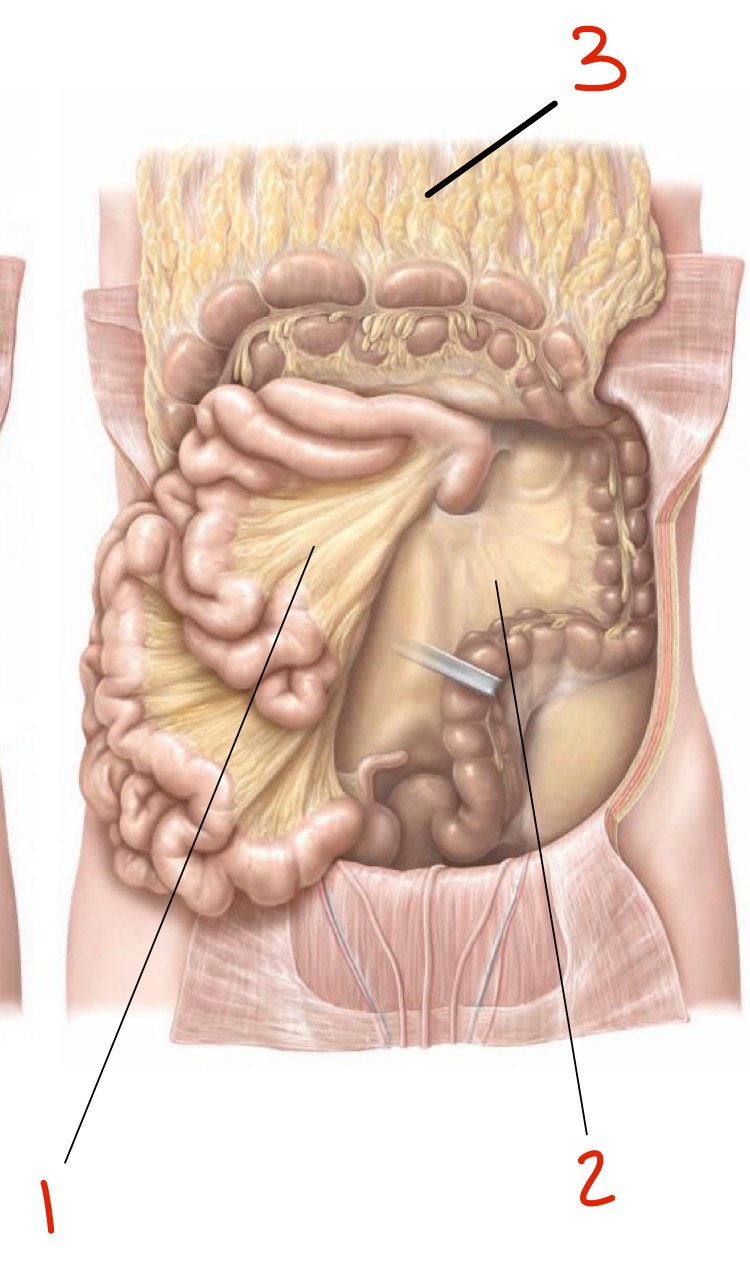
Identify
Mesentery proper
Mesocolon
Greater omentum
Give characteristics of the greater omentum.
Originates from greater curvature of stomach and proximal duodenum → runs inferiorly to distal end of abdominal cavity → wraps around itself → goes back up and attaches to transverse colon
Thin, degenerated in elderly (sometimes absent)
Big role in immunity → moves with movements of viscera, wraps itself around inflamed viscera, thereby protecting other organs
Have many milky spots — contain immune cells that provide innate immunity
Give characteristics of the lesser omentum.
Originates from the lesser curvature of stomach and proximal duodenum → attaches to liver
Derived from mesogastrum
Also called hepatogastric ligament → connects stomach to liver
Associated with epiploic foramen and hepatoduodenal ligament
What is the hepatoduodenal ligament?
A thick, peritoneal fold that forms the right edge of the lesser omentum
connects the liver to the proximal duodenum
Is a surgical landmark for surgeons to access the livers blood supply
Contains the portal triad : hepatic portal vein, hepatic artery proper, and bile duct
What is the epiploic foramen?
A right-sided passageway behind the hepatoduodenal ligament into the lesser sac, or omental bursa
Also called Foramen of Winslow
What is the lesser sac / omental bursa?
A potential space posterior to the lesser omentum, and posterior to the liver and stomach
Usually collapsed in healthy patients
What’s the function of the omental bursa?
To allow unrestricted movement of the stomach
Can also act as a barrier to block pathological processes, but can also be a channel for disease spread
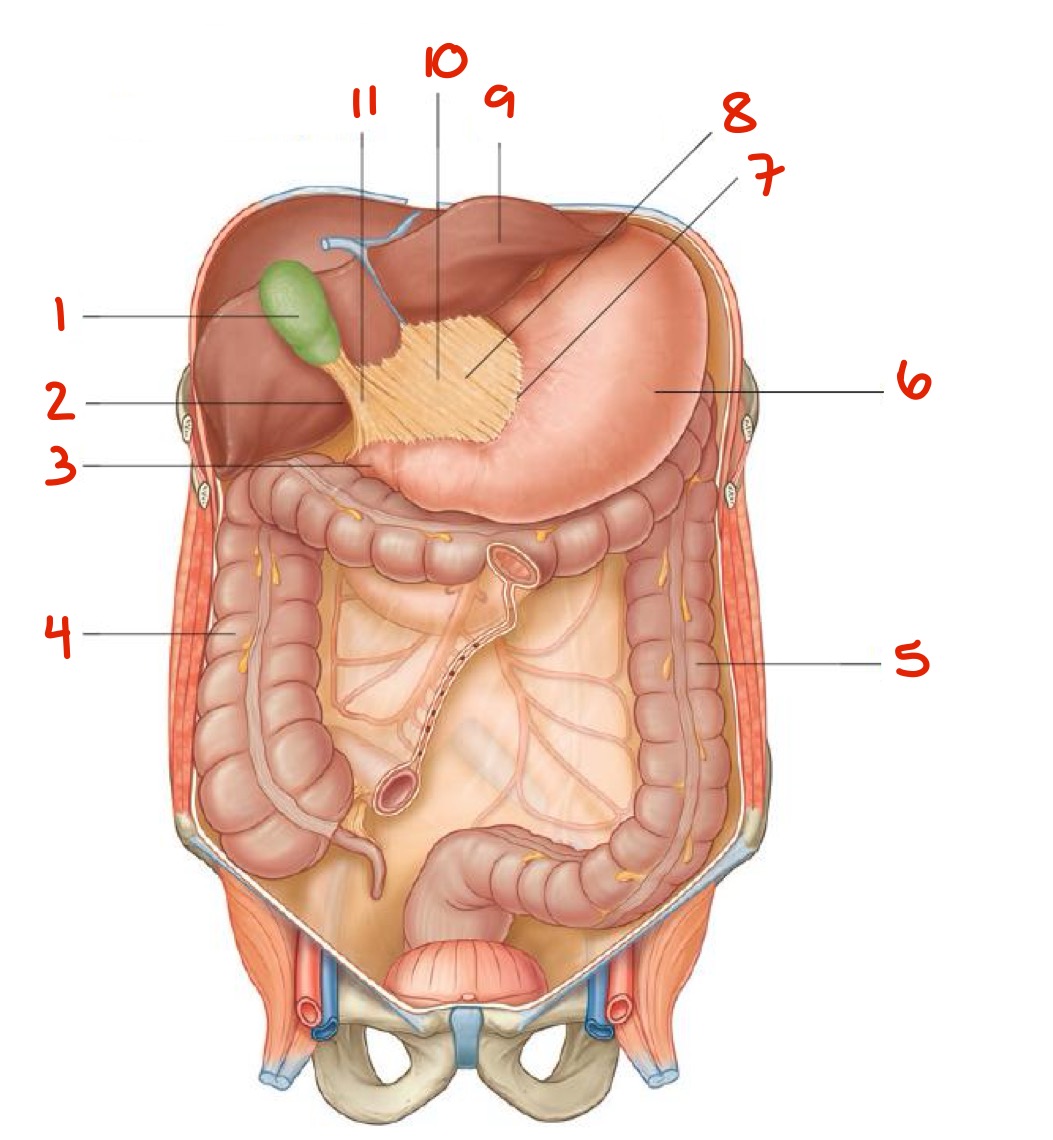
Identify
Gallbladder
Omental foramen
Duodenum
Ascending colon
Descending colon
Stomach
Lesser curvature
Lesser omentum
Liver
Lesser omentum (again)
Hepatoduodenal ligament
What are intraperitoneal vs retroperitoneal organs?
Intraperitoneal = enveloped by visceral peritoneum (anterior and posterior)
Retroperitoneal = visceral peritoneum only on anterior side, not suspended in mesentery, and lie between parietal peritoneum and posterior abdominal wall
What are the intraperitoneal organs?
SALTD SPRSS
Stomach
Appendix
Liver
Transverse colon
Duodenum (1st part)
Small intestine (jejunum and ileum)
Pancreas (tail only)
Rectum (upper 1/3)
Spleen
Sigmoid colon
What’s the difference between primary and secondary retroperitoneal organs?
Primary = developed and remained outside of the parietal peritoneum, never had a mesentery
Secondary = developed intraperitoneal with a mesentery, then migrated posterior to the parietal peritoneum
Why are secondary retroperitoneal organs surgically considered intraperitoneal?
Because the peritoneum is very thin
What are the retroperitoneal organs?
SAD PUCKER
Suprarenal glands
Aorta/IVC
Duodenum (2 - 4th parts) — secondary
Pancreas (except tail) — secondary
Ureters
Colon, ascending/descending — secondary
Kidneys
Esophagus (thoracic part)
Rectum (distal 2/3)
The subperitoneal space is _______ to the peritoneum, and contains organs such as the _______, ____________, and _________
Inferior, bladder, distal rectum/anal canal, uterus (females)
Name some muscles of the retroperitoneal space?
Diaphragm, psoas major/minor, iliacus, quadratus lumborum

