Plant Sci, Genetics & Evolution
 Call Kai
 Learn
Learn Practice Test
 Spaced Repetition
 Match
Match Flashcards
 Knowt Play
1/64

Earn XP
Description and Tags
Lesson 8. Ch. 12, 13.
Name | Mastery | Learn | Test | Matching | Spaced | Call with Kai |
|---|
No analytics yet
Send a link to your students to track their progress
65 Terms
Genes
A segment of DNA that produces a functional product (protein/enzyme)
Alleles
Different forms of the same gene
Genes: Alleles
Cake Recipe: Flavor Variation of Recipe.
Analogy for the relationship between genes & alleles. If Genes are the recipe for a cake, an allele is a “chocolate” or “vanilla” version of that same recipe
Characters
Property of an organism (E.g. flower color, plant height)
Trait
A specific, observable variant of a character (e.g. red flower color. Tall height.)
Haploid (1n)
Contains one set of chromosomes, with one chromosome from each pair.
Diploid
Contains two sets of chromosomes, forming homologous pairs (one from each parent); Two letters, PP, Pp, pp
Mendelian inheritance Generations
P, F1, F2.
P Generation (Parental)
The starting generation in Mendel’s experiments, which were true-breeding (homozygous) for specific traits, such as yellow (YY) or green (yy) peas
F1 Generation (First filial)
The offspring of the P cross, which are heterozygous (Yy) and display the phenotype of the dominant allele only.
F2 Generation (Second Filial)
The offspring from the self-pollination or crossing of F1 individuals. This generation typically displays a 3:1 phenotypic ratio (dominant: recessive) and a 1:2:1 genotypic ratio (YY: Yy: yy) as the recessive trait re-emerges
Law of Segregation
During gamete formation, each parent passes only one of their two alleles to their offspring.
Law of Independent Assortment
Different traits are inherited independently of each other, assuming they are on different chromosomes.
Dominance
The dominant allele masks the recessive one in the generation. Written out as a capital allele: P
Traits can be _ or _
Dominant, Recessive
Alleles can be _ or _
Homozygous, Heterozygous
Genotype
Genetic makeup of an organism
Phenotype
Observable physical expression of the genes, influenced by genetics & environment
Particulate theory of inheritance
Traits are passed from parents to offspring through discrete, separable particles (now known as genes); Genetics passed down from generation to generation
Homozygous
Having 2 identical alleles (versions) of a specific gene inherited from both parents. Such as AA (dominant) or aa (recessive)
Heterozygous
Having two different alleles (versions) of a specific gene, one inherited from each parent. Such as Aa.
Recessive
A version of a gene that only expresses its associated phenotype when two copies are present, otherwise remains hidden or masked by the presence of a dominant allele. Written out as a lowercase allele: p
Mendelian Inheritance Criteria
The character is controlled by one gene
The gene has only two alleles
One allele is completely dominant
When two or more genes are involved, they are not linked.
Complex patterns of inheritance
Polygenic inheritance
Pleiotropy
Incomplete dominance
Linkage
Environmental influence
Polygenic inheritance
Multiple genes control one character
Pleiotropy
Single gene controls multiple characters
Incomplete dominance
neither allele for a trait is completely dominant, resulting in a heterozygous offspring with a blended or intermediate phenotype
Linkage
Genes occur on the same chromosome and are inherited together
Environmental influence
altering gene expression and phenotypic outcomes without changing the underlying DNA sequence.
Meiosis
Cell division essential for sexual reproduction. Divides twice and results in four haploid daughter cells
Mitosis
Cell division that creates identical body cells. Divides once, creates two diploid daughter cells.
Mnemonic device for Mitosis vs Meiosis
Mitosis: “My toesies are growing,” meaning mitosis is responsible for body cells replicating
Meiosis: “Meiosis made me,” meaning meiosis is responsible for creating sex cells
Meiosis I Phases
Prophase I: Chromosomes condense, homologous chromosomes pair up (synapsis), and crossing over occurs, swapping genetic material.
Metaphase I: Homologous pairs line up in the middle of the cell.
Anaphase I: Homologous chromosomes are pulled apart to opposite poles.
Telophase I & Cytokinesis: Two haploid daughter cells are formed, but chromosomes are still doubled.
Meiosis I - Reduction Division
Separates homologous chromosomes.
Meiosis II - Equational Division
Separates sister chromatids, similar to mitosis.
Meiosis II Phases
Prophase II: Chromosomes condense again.
Metaphase II: Chromosomes line up individually at the equator.
Anaphase II: Sister chromatids are pulled apart.
Telophase II & Cytokinesis: Four unique haploid daughter cells are produced.
Gene Expression
the fundamental process by which cells convert genetic information from DNA into functional products
Transcription
Synthesize or transcribe messenger RNA (mRNA) from a gene
Translation
Synthesize protein by translating mRNA information
Biopharming
Genetic engineers introduce “designer” genes into the plant genomes and use GM plants to produce proteins in large quantities
Natural Selection
Individuals in a population vary in size because of their traits
Only a small percentage of offspring will survive and reproduce
Individuals compete for limited resources
Individuals best adapted to an environment will survive and reproduce in greatest numbers
Evolution is the change in…
genetic traits of a population where certain traits are inherited and increased in frequency by following generations
allele frequencies from one generation to the next
What does Population Genetics study?
All genes and their alleles occuring in all individuals of a population
how often certain alleles occur
how they change over time
what might be the cause for the change in allele frequency
Fitness
The potential of an individual to reproduce and pass on its alleles to the next generation (How well it can sexually reproduce)
Adaptation
Describes a genetic trait that is passed on to the next generation and improves the survival and reproduction of an individual under certain conditions
Acclimation
An organism changes in response to slow changes in the environmental conditions but this does not affect evolution (does not influence genotypic changes).
Ex. Plant species expand their range, some plants become acclimated to higher elevations
Does acclimation influence the genotype of future generations?
No.
How can a population’s genetics change?
Mutation
Gene flow
Genetic drift
Nonrandom mating
Natural selection
Mutations
Random changes in the genetic composition of an organism
Gene Flow
Occurs when individuals leave or join a population
What are changes in population defined by?
Shifts in allele frequency. The proportion of different gene variants within a population’s gene pool. Changes in population = changes in allele frequency
Genetic Drift
Caused by random events affecting genotypes of a population (bottleneck effect and founder effect)
Nonrandom mating
Occurs when individuals with certain phenotypic characteristics are preferred over other individuals without
Natural selection
Favors individuals in a population that are better adapted to their environment than others.
Types of Natural Selection
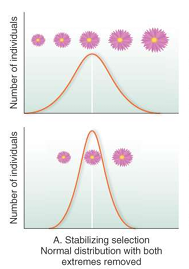
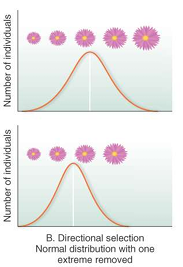
Stabilizing, Directional, Disruptive
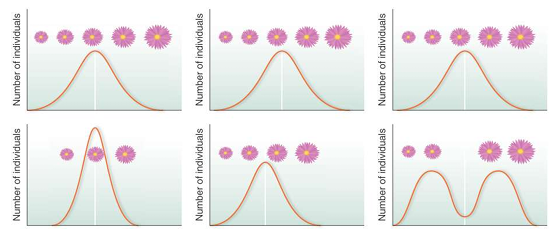
Stabilizing Natural Selection
Normal distribution with both extremes removed
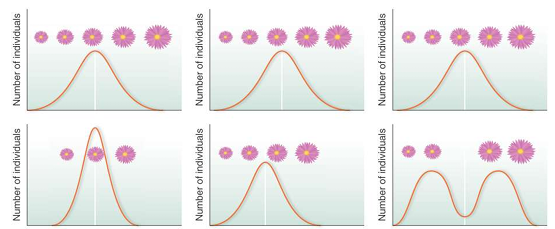
Directional Natural Selection
Normal distribution with one extreme removed
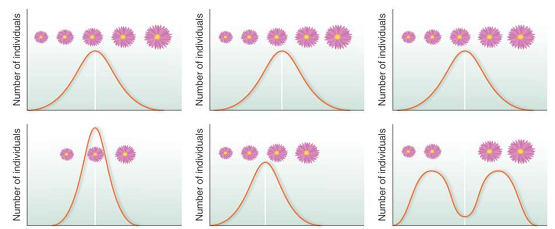
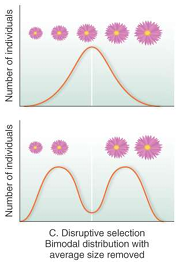
Disruptive Natural Selection
Bimodal distribution with average size removed
Microevolution
Changes in the gene pool of a population. Rapid.
Macroevolution
Small changes add up over many generations and results in the formation of new species. Over a long period of time.
Punctuated Equilibrium
Eldredge and Gould, an evolutionary theory stating that species experience long periods of stability (stasis) interrupted by brief, rapid bursts of change and speciation. Ex. Tolerant bent grass on mine tailings, herbicide-resistant weeds
Darwin
Slow and gradual change over time through natural selection
Adaptive Radiation
An evolutionary event when a species rapidly produces several new species with diverse adaptations. When plants or animals colonize an island or an area where they have no competitors. Ex. The Hawaiian silversword and 27 other species from a common tarweed ancestor
Two Criteria:
1. Emergence of many new species from a common ancestor in a short period of time. 2. Adaptation by natural selection.
Convergent Evolution
Unrelated organisms with similar appearance which developed independently
Co-Evolution
when two or more species are co-evolving they influence each other’s adaptations and become interdependent

