5.2 Operations methods
 Call Kai
 Learn
Learn Practice Test
 Spaced Repetition
 Match
Match Flashcards
 Knowt Play
1/37

There's no tags or description
Looks like no tags are added yet.
Name | Mastery | Learn | Test | Matching | Spaced | Call with Kai |
|---|
No analytics yet
Send a link to your students to track their progress
38 Terms
Operations methods
Specific methods of production
4 operations methods
Job production
Batch production
Mass / flow standardized production
Mass customization
Job production
Manufacturing a unique individual product / one-off job
Completed by 1 person or team of ppl (tailor / architects)
Made to meet specific needs of customer
Eg haircut / wedding dress
Is job production labor or capital intensive
Labor
Labour accounts for largest proportion of firms production costs
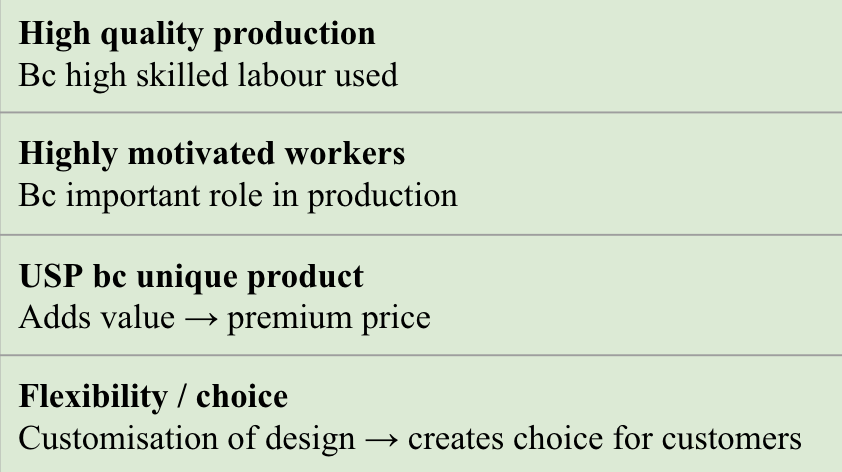
Pros of job production
High quality production bc high skilled labor
Highly motivated workers
USP bc unique product
Flexibility / choice
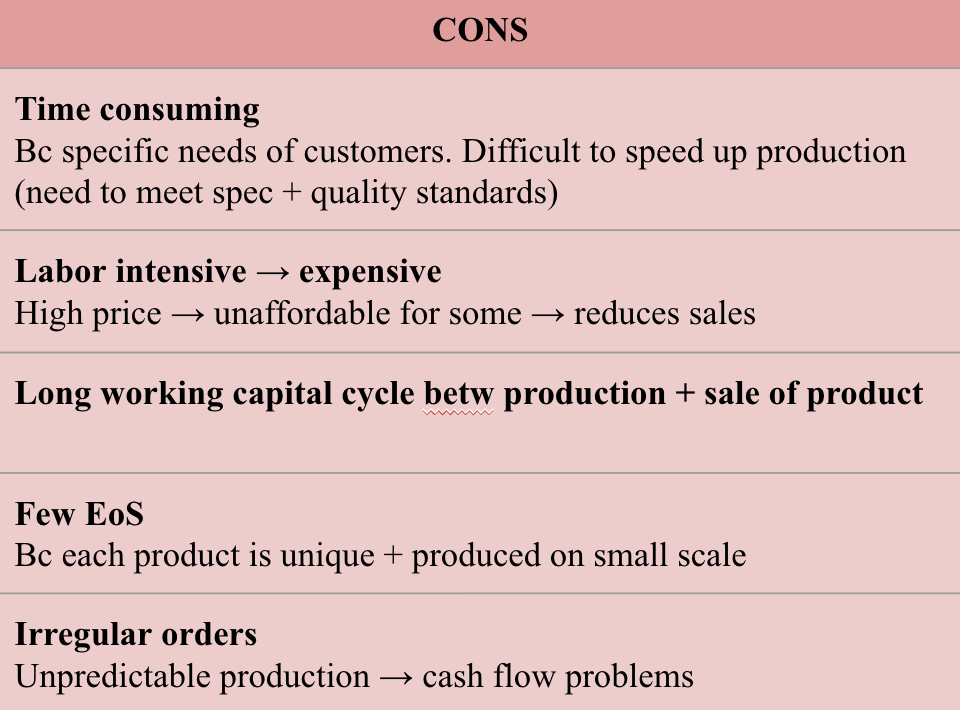
Cons of job production
Time consuming bc specific needs
Labor intensive → expensive
Long working capital cycle
Few EoS bc small scale production
Irregular orders → CF problems
Batch production
Produce a limited no. of identical products
Fully complete work on each batch before production switches to a new batch
Use same team of workers, machinery
Which businesses is batch production highly suited for?
That produce a range of products
Eg bakery. Finish cupcake production before moving onto cookies
When is batch production normally used?
Unclear level of demand
So estimate sales volume + adjust output
Is batch production only for small quantities being produced?
No- can be for large
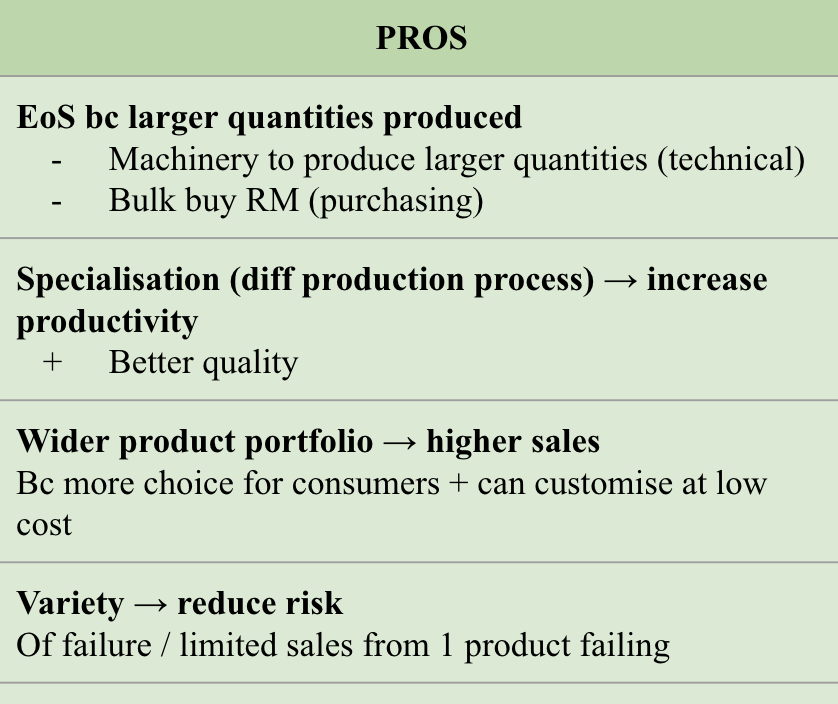
Pros of batch production
EoS bc larger quantities
Specialisation → increase productivity
Wider product portfolio → higher sales
Variety → reduces risk
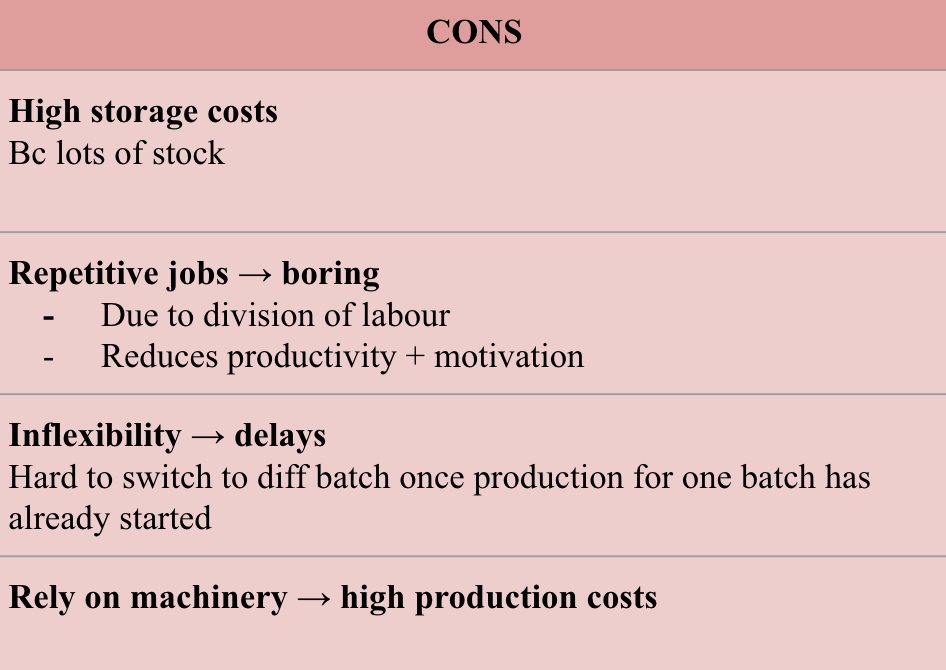
Cons of batch production
High storage costs
Repetitive jobs → boring
Inflexibility → hard to switch to other batch
Rely on machinery → high production costs
Mass production
Manufacturing a standardized product on a large-scale
Relatively low unit CoP
Capital intensive, relies on automation
Involves assembly of individual components
Is mass production capital or labour intensive?
Capital
Labour intensive
Production relies heavily on labor inputs
Cost of labour accounts for largest proportion of firms overall production costs
Common in provision of personalised services
Capital intensive
Production relies heavily on machinery + equipment
Cost of capital accounts for largest proportion of firms overall production costs
Eg automated production system
In mass production why are average CoP low?
EoS- specialisation
Increases productivity
Use specialised capital equipment + skilled labor ro perform diff functions in production process
Batch vs mass production
Mass- standardized products produced on larger scale
Standardization
Producing identical (homogeneous) products in large quantities
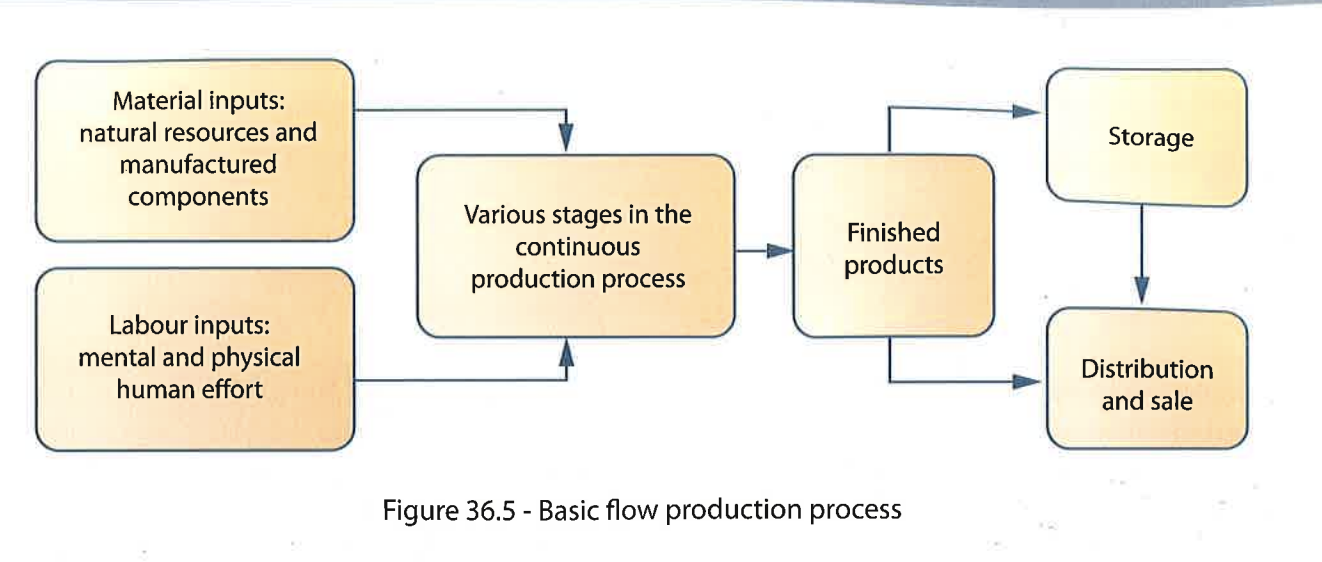
Flow production
Form of mass production
Diff operations are continuously + progressively carried out in sequence, with a v large volume of output.
1 task complete- → next stage of production starts immediately
Relies on entirely automated systems. V few workers needed
Eg water bottles
What does flow production use continuous production processes to do?
Manufacture standardized products in large quantities
Purpose of flow production (running 24/7)
Maximise output
Eliminate waste (extra costs of starting + stopping production process)
Basic flow production process diagram
Pros of mass / flow production
Large volume of output
Capital-intensive → technical EOS
Worker specialisation → low defect rate
Unskilled workers → low labour costs
Standardized quality
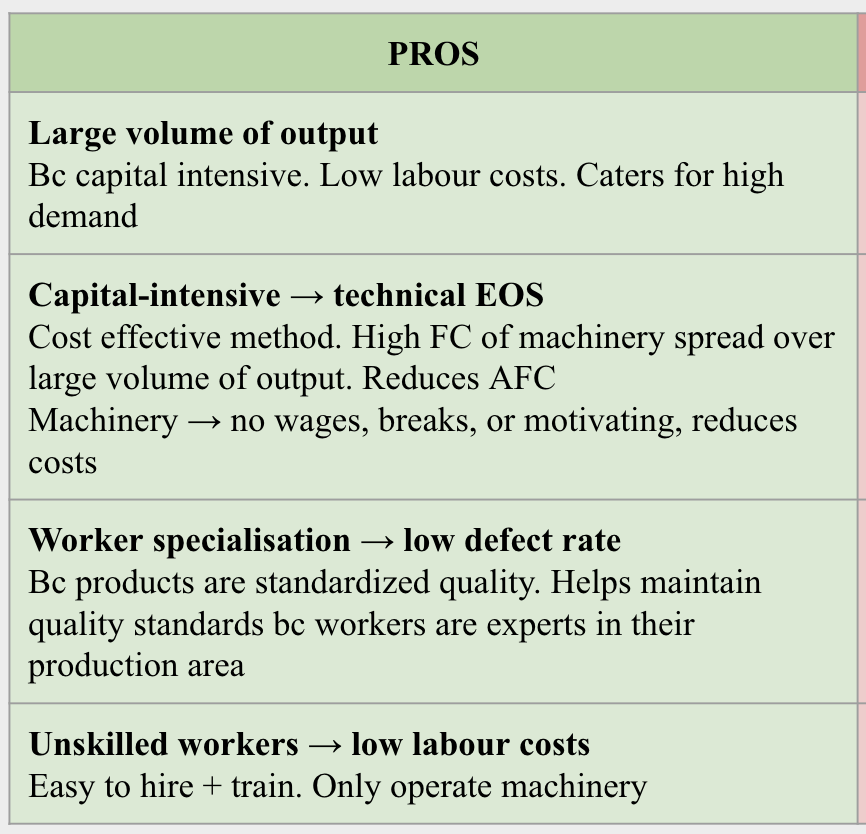
Why is using machinery less expensive than labour?
No wages, breaks, or motivating → reduces costs
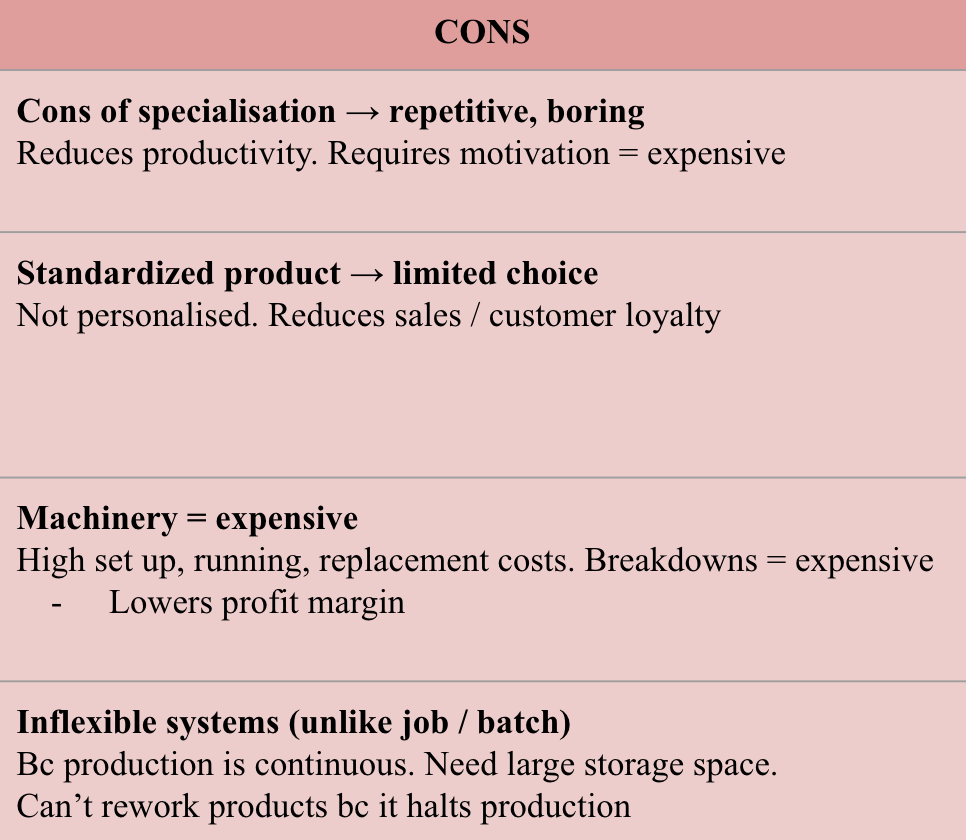
Cons of mass / flow production
Cons of specialisation → repetitive, boring
Standardized product → limited choice
Machinery = expensive
Inflexible systems
Breakdowns → delays
Large amount of stock = large storage system
Mass customization
Uses flexible manufacturing systems to mass produce products that that meet individual customers n+w
Which businesses use mass customisation?
That produce large quantities of goods via batch or mass/flow production
But products are tailored to meet customers’ needs
Pros of mass customization
Low unit costs (like mass production)
Flexible- individual customisation
Pros of labour intensive production
Can offer personalised services
Which firms is labour intensive production v suited for?
Make highly customised products
In tertiary sector
Operate farming in economically developing countries
Pros of capital intensive production
High levels of output
Cons of capital intensive production
Identical products → no USP from customisation
No premium price → lower PM
Which firms is capital intensive production v suited for?
Have goods that can be batch / mass producted AND
Operate in large markets that demand large volumes
AND/ORHave ambitious growth objectives.
Type of operations method (labour/capital) depends on?
Size of market
Relative costs of labour + capital
Corporate aims / objectives
How does size of market affect type of operations method chosen?
Large = capital intensive → mass / flow
Small = batch / job
How does relative cost of labour + capital affect type of operations method chosen?
High labour costs → use capital intensive methods (batch / mass)
How does corporate objectives affect type of operations method chosen?
Profit → operate in mass market → capital intensive (to minimise ACoP)
Survival during recession → smaller scale → easy to control costs

