PSK4U Biomechanics unit 3
 Studied by 0 people
 Call Kai
 Learn
Learn Practice Test
 Spaced Repetition
 Match
Match Flashcards
 Knowt Play
1/36

There's no tags or description
Looks like no tags are added yet.
Name | Mastery | Learn | Test | Matching | Spaced | Call with Kai |
|---|
No analytics yet
Send a link to your students to track their progress
37 Terms
Biomechanics
The science concerned with the internal and external forces acting on the human body and the effects produced by these forces.
Kinematics
variables which describe both linear and angular motion
Displacement
is the length and direction of the path an athlete transverses from the start to finish of a performance or a portion thereof
angular displacement
measures the direction of and smallest angular change between the rotating body's initial and final position
Velocity
measure of the displacement per unit of time
Angular Velocity
the measure of an angular displacement per unit time, or how fast a body is rotating
Acceleration
the rate of change of velocity
angular acceleration
the change in angular velocity divided by the time needed to make the change
What is Newton’s first law of motion (the law of inertia?)
a body or object will maintain constant velocity or stay at rest unless acted upon by external forces
What is Neuton’s second law of motion (the law of acceleration?)
the acceleration of an object is proportional to and in the same direction as, the force that causes it
ie. the greater the force, the greater the acceleration
F=mxa
What is Neuton’s third law of motion (the action reaction law?)
For every action force, there is an equal and opposite reaction force
Principle #1: Stability
The lower the centre of mass, the larger the base of support, the closer the centre of mass to the base of support, and the greater the mass to the base of support, the more stability increases.
Centre of Gravity
the point where an object could, in theory, be suspended and remain in perfect equilibrium, regardless of its position

Explain how someone doing a high jump alters their C of G
- people can only raise their C of G to a max height
- high jumpers arch their backs so that their C of G leaves their body
- limb by limb, they are launched over the bar
- C of G travels below the bar
Principle #2: Summation of Joint Forces
the production of maximum force requires the use of all joints that can be used
Principle #3: Continuity of Joint Forces
production of maximum velocity requires joints to be used in order of largest to smallest, and proximal to distal, as well as being perfectly timed with each other
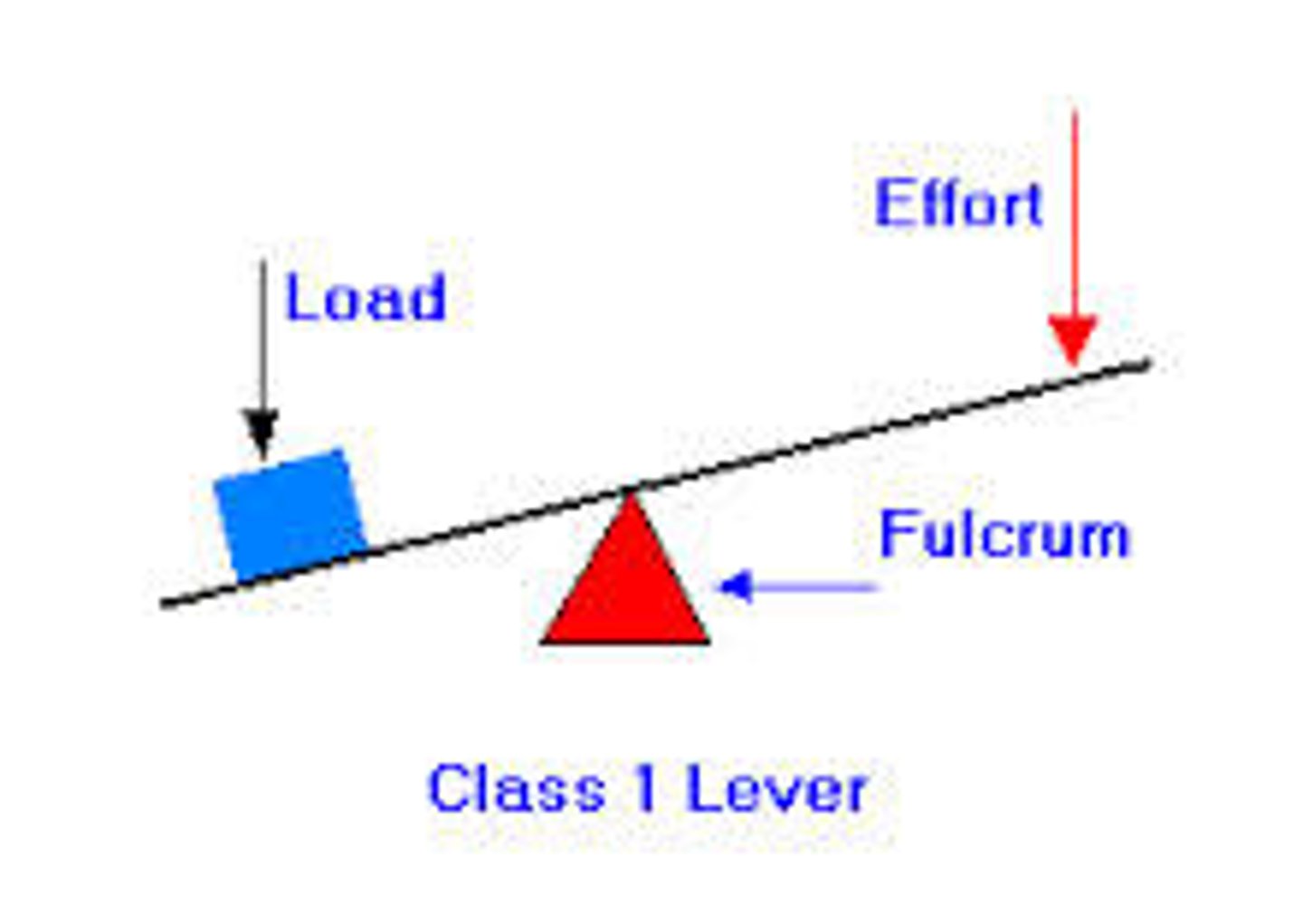
What is a first class lever?
- when the applied force and the resistance are located on opposite sides
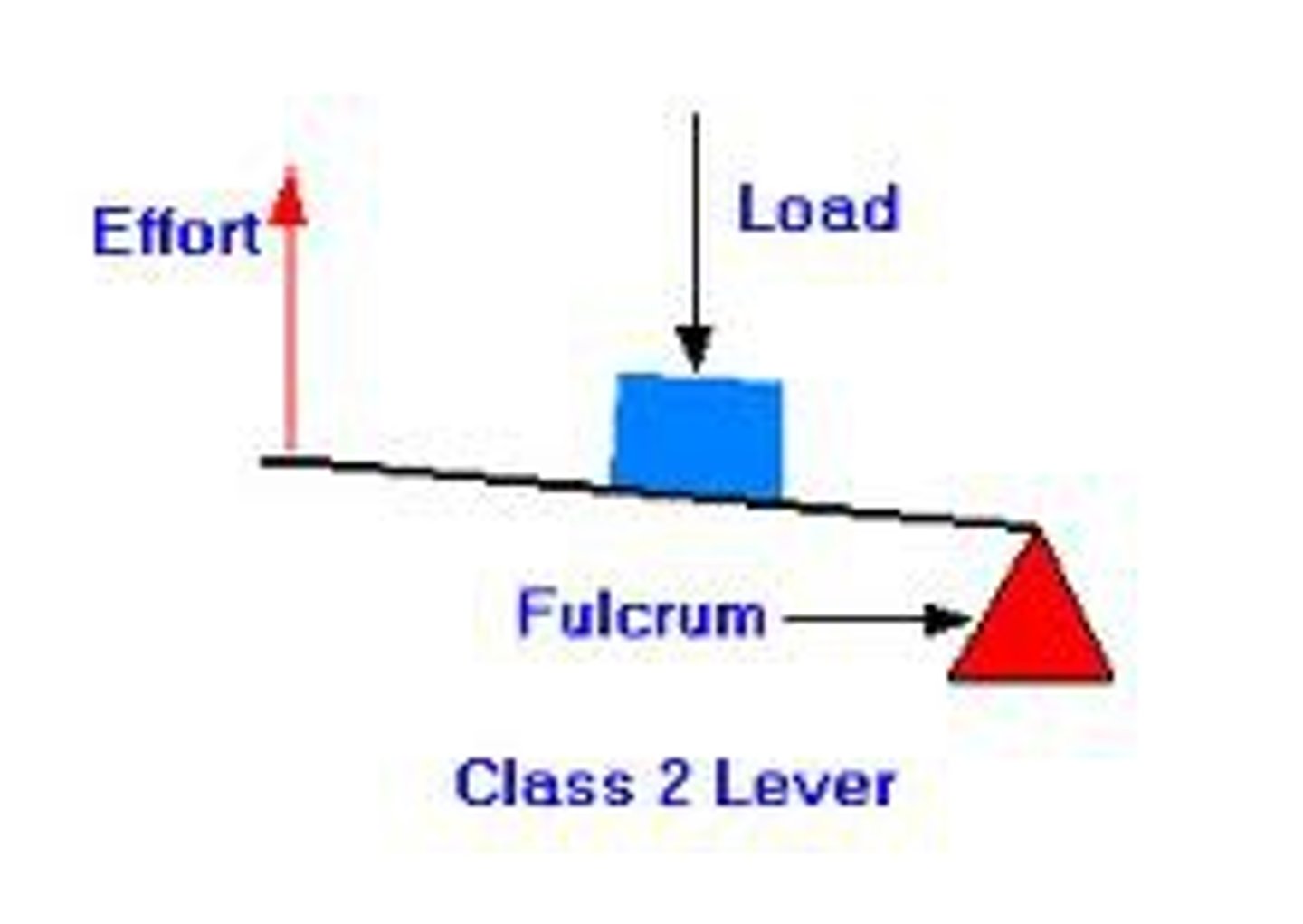
What is a second class lever?
the applied force and resistance are located on the same side of the axis
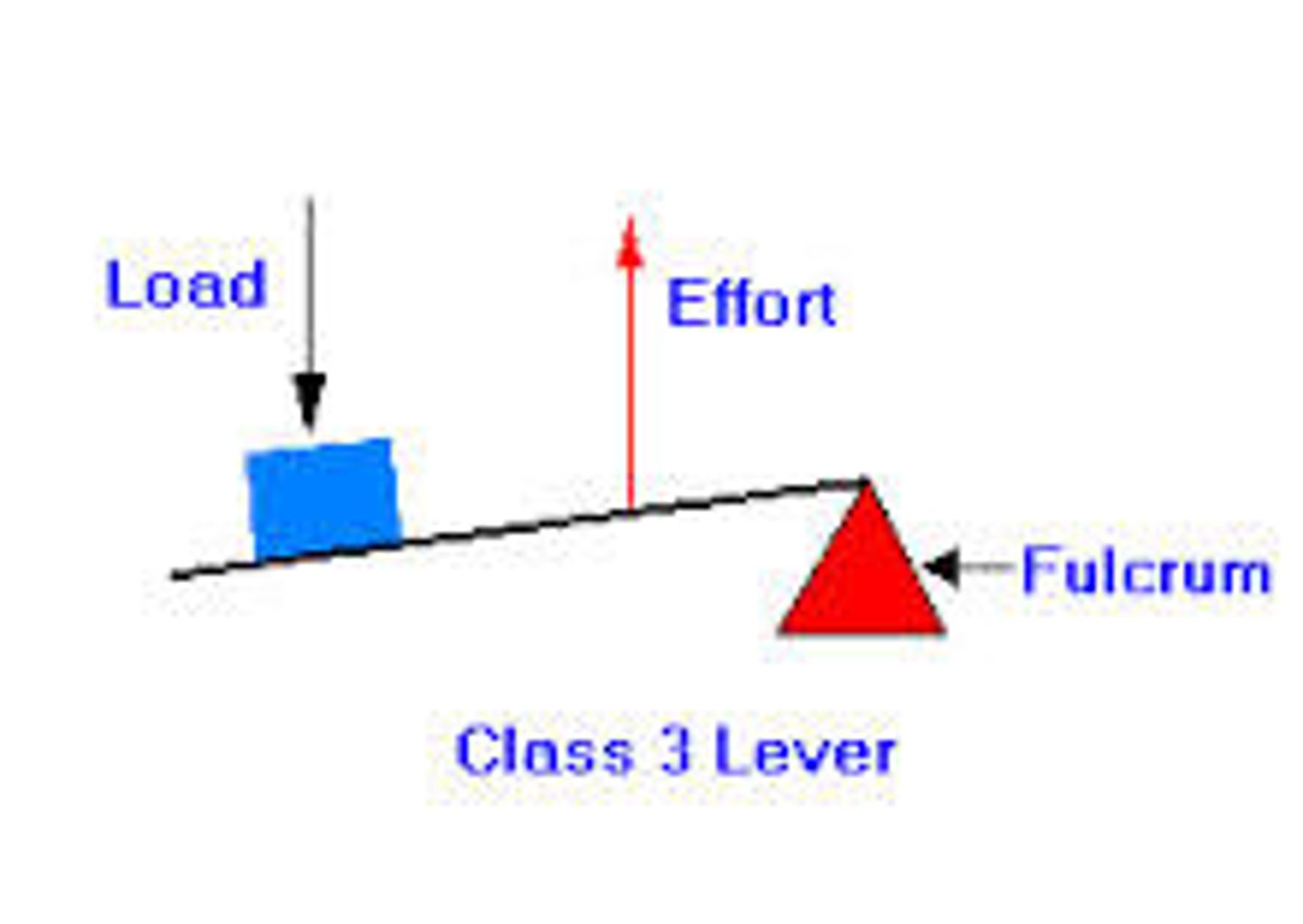
What is a third class lever?
the applied force and the resistance are on the same side of the axis, but the applied force is closer to the axis
Give an anatomical example of each type of lever and state which type is most and least efficient.
1st Class: skull nodding up and down (most efficient)
2nd Class: ankle joint
3rd Class: elbow joint when hand picks something up (least efficient)
What are the three types of motion and give an example for each?
1. Linear: C of G travels in a straight line (ex. gliding on skates)
2. Angular: when an object/body rotates about an axis (ex. gymnast rotating around a high bar)
3. General: a combination of the two, as in the C of G moves in a straight line, but the arms and/or legs are rotating (ex. running, or wrestling)
Principle #4: Impulse
- the application of force over a period of time
impulse = force x time
- greater the impulse, the greater the acceleration
-athletes who move joints through a larger range of motion are able to apply force for a longer period of time
- Force = mass x acceleration
if the mass is greater, acceleration is less
if the mass is lighter, the acceleration is
greater
Principle # 5: Momentum
- the amount of motion that an athlete or object has developed
- factor of mass and velocity
- M = m x v (units: kg . m/s)
- during impact situations, generally the person with more momentum is likely to continue from the impact ( disregarding stability factors)
Principle # 6: Angular Motion
- the angular acceleration of an object is proportional to and in the same direction as the torque which is applied to it
-Essentially, this means that when a force is applied in a rotational manner (torque), it will cause the object to accelerate in its rotation
Angular Velocity equation
w = degrees / second
Angular Acceleration Equation
α= degrees / second^2
Torque
force causing angular motion (Newtons)
Equal and Opposite Law
For every torque that is exerted by one body onto another, there is an equal and opposite force exerted as well
Linear Motion formula
F = mxa
Angular motion formula
Torque= mxr²
m= moment of inertia
Why does the radius matter more in angular motion formulas?
Increasing the mass of something requires more torque to spin it, however, increasing the radius of something requires A LOt more torque to spin it
Torque formula
T = m x r^2 x a
Torque = mass x radius^2 x acceleration
Angular momentum
H = m x r^2 x w
(Recall: momentum is M = m x v)
w= angular velocity
Principle #7: Angular momentum is constant during free falls
- In free falls, angular momentum is held CONSTANT and it does not change ( law of inertia)
- Likewise, in all future spinning examples, H will be assumed to be constant, (ie. we are ignoring forces like friction, air resistance, etc.)
State the four factors which can affect range of projectiles
1. Take off velocity
2. Angle of release (45 is best)
3. Take off v.s. Landing height
4. Air resistance
Describe profile drag and give examples
- Profile drag is caused by the size of the object and the air turbulence produced by it's shape as it moves through the air.
- Examples include: size, shape, roughness, relative air flow, and density of the air, or liquid
Describe skin friction/drag
caused by the surface's roughness as it moves through the air or liquid
 Note
Note  Flashcards (78)