EEB Exam 3
0.0(0)
 Studied by 0 people
 Call Kai
 Learn
Learn Practice Test
 Spaced Repetition
 Match
Match Flashcards
 Knowt Play
Card Sorting
1/277

Earn XP
Description and Tags
Last updated 8:24 PM on 11/7/22
Name | Mastery | Learn | Test | Matching | Spaced | Call with Kai |
|---|
No analytics yet
Send a link to your students to track their progress
278 Terms
1
New cards
trophic interactions
consumer is eating a resource (+,-)
2
New cards
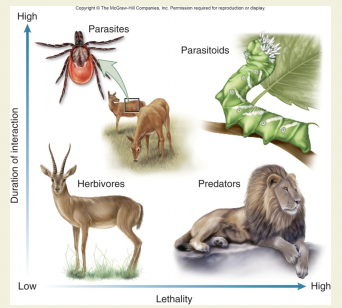
true predators
Consume whole, live animals or plants: mostly carnivores, seed-predators, and filter feeders. Short association.
3
New cards
parasitoids
offspring consume and eventually kill live organisms from the inside out. long association.
4
New cards
number of parasites per host
one- expect for hornworm
5
New cards
Behavior manipulating parasitoids
cordyceps and dinocampus coccinellae
6
New cards
brood parasites
one egg-laying species benefits by having another raise its offspring. host's offspring normally die
7
New cards
Grazers
Animals that eat grasses or leaves of other plants. short association. does not kill plant directly
8
New cards
browsers
more woody version of grazing where food is eaten above the browse line. does not kill plant directly. short assosciation
9
New cards
itinerant licker
does not kill host directly
10
New cards
Suckers
does not kill host directly
11
New cards
parasites
organisms that live on or in a host and cause it harm. does not kill host directly. long association
12
New cards
Consumers of whole organisms
invariably cause death of the victim (true predators, parasitoids, behavior manipulation, brood parasites)
13
New cards
Consumers of parts of organisms
usually do not directly cause the death of the victim. (grazers, browsers, itinerant lickers, suckers, parasites)
14
New cards
Adaptations of Victims
selection for defense against consumption
15
New cards
protective adaptations
behavior, morphology, chemistry
16
New cards
Protective behavior
escape, avoid, hide, startle, alarm call
17
New cards
Protective morphology
reduce ability to capture, attack or handle prey. shells, spines, tusks, horns, hair, deciduous appendages
18
New cards
cryptic shape or coloration
transparency, camouflage
19
New cards
Aposematism
warning colorations that advertise chemical defenses
20
New cards
Batesian mimicry
A type of mimicry in which a harmless species looks like a species that is poisonous or otherwise harmful to predators.
21
New cards
Mullerian mimicry
two or more unpalatable species resemble each other
22
New cards
protective chemistry
digestibility as a defense. plants produce compounds that limit digestibility or interfere with proteins
23
New cards
quantitative defense chemicals
amount present can vary. difficult to digest
24
New cards
qualitative defense chemicals
either present or absent toxic compounds. many are absent unless induced by herbivore feeding
25
New cards
nitrogen defense
alkaloids >[3000]. often qualitative
26
New cards
Terpenoids
menthol and citronella >[10000]. both qualitative and quanitative
27
New cards
Phenolics
tannins, flavonoids, ligin. normally quantitative
28
New cards
cost of defenses
-reduced feeding
-refuge crowding
-energetically expensive
-reduce growth, development, reproduction
-refuge crowding
-energetically expensive
-reduce growth, development, reproduction
29
New cards
Adaptions of consumers
behaviors, morphology, chemistry
30
New cards
consumer behavior
finding, capturing, subduing, ingesting or entering, deceiving victims
31
New cards
consumer morphology
teeth, claws, spines, grabbers, tentacles, filters, fancy tongues, etc. Also, cryptic coloration to sneak up on victims.
32
New cards
consumer chemistry
venoms and digestive chemistry
33
New cards
general strategy to capture prey
detect, pursue, catch, handle, consume
34
New cards
ambush predators
rely on stealth rather than speed
35
New cards
Cursorial predators
chase down prey using high speed or endurance
36
New cards
high speed locomotion
short or long distances, movement of whole body or just one part
37
New cards
feeding anatomy
how tooth layout and skull are designed to eat adapted foods
38
New cards
Eye placement
-predators: eyes in front
-prey: eyes on side
-prey: eyes on side
39
New cards
venom
it bites you
40
New cards
posion
you bite it
41
New cards
top-down control
when the abundance of trophic groups is determined by the existence of predators at the top of the food web
42
New cards
Mesopredators
relatively small carnivores that consume herbivores
43
New cards
predator-prey population cycles
an interaction between prey with periodic cycles and predators. As the population expands, there is more food available for predators. As it contracts, there is less food available for predators, putting pressure on their population numbers.
44
New cards
dN/dt=rN
observed population growth rate
45
New cards
prey equation (lotka-volterra)
dN/dt=rN-cNP
N- Number of Prey
P- Number of Predators
r- Intrinsic per capita growth rate
c- death rate of prey by predators
N- Number of Prey
P- Number of Predators
r- Intrinsic per capita growth rate
c- death rate of prey by predators
46
New cards
predator equation (Lotka-volterra)
dP/dt=acNP-mP
N- Number of Prey
P- Number of Predators
r- intrinsic per capita growth rate
c- death rate of prey by predators
a- conversion rate of prey to predator pop. growth
m- per capita predator death rate
N- Number of Prey
P- Number of Predators
r- intrinsic per capita growth rate
c- death rate of prey by predators
a- conversion rate of prey to predator pop. growth
m- per capita predator death rate
47
New cards
isoclines
lines representing all points when the predator or the prey population has zero growth
48
New cards
Coevolution
Process by which two species evolve in response to changes in each other
49
New cards
Symbiosis
A relationship in which two different organisms live in close association with each other. mutualism, parasitism, and commensalism
50
New cards
Resource Aquisition
trade on resource for another
51
New cards
dispersive
Trade movement for food
52
New cards
defensive
guarding or shelter in return for food or service
53
New cards
Carl Huffaker Experiment
predator (walkers) and prey (jumpers) mites living on oranges
54
New cards
habitat complexity
impeded predator dispersal and prey refuge-- creates cycles
55
New cards
numerical response
change in the abundance in response to prey abundance
56
New cards
feeding rate units
number of prey consumed per predator per unit time
57
New cards
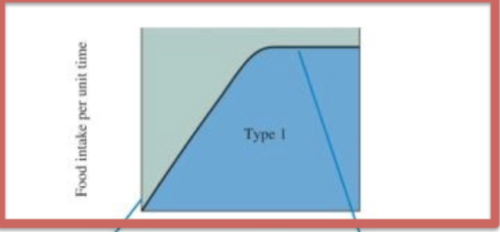
Type 1 functional response
feeding rate=cN (linear). unrealistic with no handling time/limit to predators. some filter feeders
58
New cards
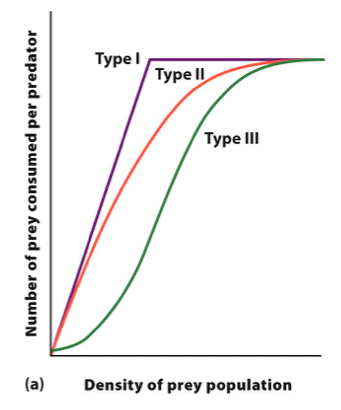
Type 2 functional response
A functional response in which a predator's rate of prey consumption begins to slow down as prey density increases and then plateaus when satiation occurs. ends at value 1/h. specialist predator
59
New cards
handling time
the amount of time that a predator takes to consume a captured prey
60
New cards
specialist predators
predators that show a strong preference for certain prey species
61
New cards
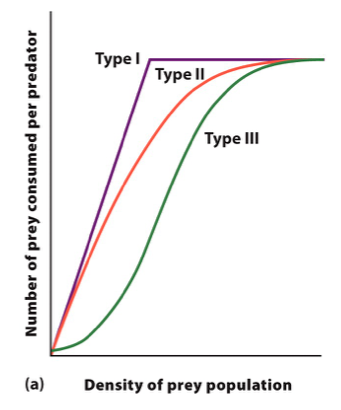
Type 3 functional response
when a predator exhibits low, rapid, and slowing prey consumption under low, moderate, and high prey densities, respectively. generalist
62
New cards
prey switching
predators focus on most abundant prey species
63
New cards
search image
a learned mental image that helps the predator locate and capture food
64
New cards
Generalist
Species that does not rely on a single source of prey
65
New cards
pollinator
An animal that carries pollen from one plant to another of the same species, enabling plants to reproduce.
66
New cards
generalist pollinators
can feed from the flowers of many different species and plants pollinated by many species
67
New cards
specialist pollinators
can only feed from flowers belonging to one or a few species
68
New cards
plants and mycorrhizal fungi
mutualism. plants get nutrients/water while fungi het carbohydrates
69
New cards
plants (legumes) and rhizobium
plant gets fixed nitrogen bacteria get carbohydrates and living space
70
New cards
large seeds
dispersed by animals. animals get fruit and seeds are indigestible
71
New cards
facultative
not essential for survival or reproduction of one or either species
72
New cards
obligate
Required for the survival or fitness of one or both species
73
New cards
intimate
consistent spatial and temporal association. same individuals interacting
74
New cards
intermittent
inconsistent across time/space. possibly different individuals
75
New cards
mutualism and conservation
Loss of dispersers can result in a reduction in plant abundance
76
New cards
joint evolution
selection pressures adapting species together in close ecological interaction over time
77
New cards
tight joint evolution
reciprocal evolution of two closely interacting populations
78
New cards
diffuse joint evolution
adaptations in one population promote adaptation in one or more co-occurring populations
79
New cards
Coevolution Outcomes: Mutualism
positive reinforcement
prevention of cheating
prevention of cheating
80
New cards
Coevolution Outcomes: Competition
increase in competitive ability
decrease in niche overlap
decrease in niche overlap
81
New cards
Coevolution Outcomes: consumer-resource
Arms race between predator (consumer) and prey (resource)
Parasites and hosts: Already covered the red queen hypothesis
Parasites and hosts: Already covered the red queen hypothesis
82
New cards
cheating
occurs when one species receives a benefit but does not provide one in return
83
New cards
resource partitioning
sympatric species avoid competition by exploiting different resources
84
New cards
Sympatric
geographically overlapping
85
New cards
character displacement
traits differ more when species are sympatric than when they are allopatric
86
New cards
increased competitiveness
ability to outcompete over time
87
New cards
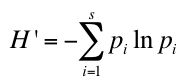
Shannon's Diversity Index (H')
accounts for both abundance and evenness of the species present. -E(Pi*ln(Pi))
range=0-ln(s)
s=# of species
range=0-ln(s)
s=# of species
88
New cards
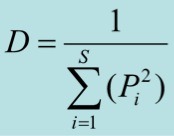
Simpson's Diversity Index (D')
( N-(N-1) ) / ( total n (n-1) )
N = total number of organisms
n = number of individuals of each species
1/EPi^2
range=1-s
N = total number of organisms
n = number of individuals of each species
1/EPi^2
range=1-s
89
New cards
primary succession
An ecological succession that begins in an area where no biotic community previously existed
90
New cards
consumer-resource interactions
Interactions in which organisms gain their nutrition by eating other living organisms or are eaten themselves.
91
New cards
browse line
The point up to which deer have been eating foliage
(ex: white tail deer)
(ex: white tail deer)
92
New cards
smaller organism
shorter predator-prey cycle
93
New cards
Prickly Pear Cactus
invaded australia because there was no predator
94
New cards
biocontrol
The use of a species to control the population growth or spread of an undesirable species
95
New cards
parasite
obtains nutrients from a living host but usually does not kill host. lowers fitness and increases probability of death
96
New cards
pathogens
disease causing agents
97
New cards
alternate host
a substitute primary host for a parasite with low specificity
98
New cards
transmission vector
the thing that will carry the pathogen (water, air, blood/body fluid, animal)
99
New cards
Ectoparasites of animals
Parasites that feed on external surface of host. consume blood/body fluids
100
New cards
alpha diversity
Species diversity at the local or community scale.
 Note
Note  Flashcards (20)