biological psychology lectures 5-8
 Studied by 0 people
 Call Kai
 Learn
Learn Practice Test
 Spaced Repetition
 Match
Match Flashcards
 Knowt Play
1/77

There's no tags or description
Looks like no tags are added yet.
Name | Mastery | Learn | Test | Matching | Spaced | Call with Kai |
|---|
No analytics yet
Send a link to your students to track their progress
78 Terms
dendrotoxin
a toxin from snakes
blocks potassium channels
tetrodotoxin
a toxin from pufferfish
blocks sodium channels
what is the benefit of these toxins?
treatment of diseases like MS and spinal cord injuries
reduced risk of developing Parkinsons
what is the uploaded graph telling us?
what happens to the membrane during AP
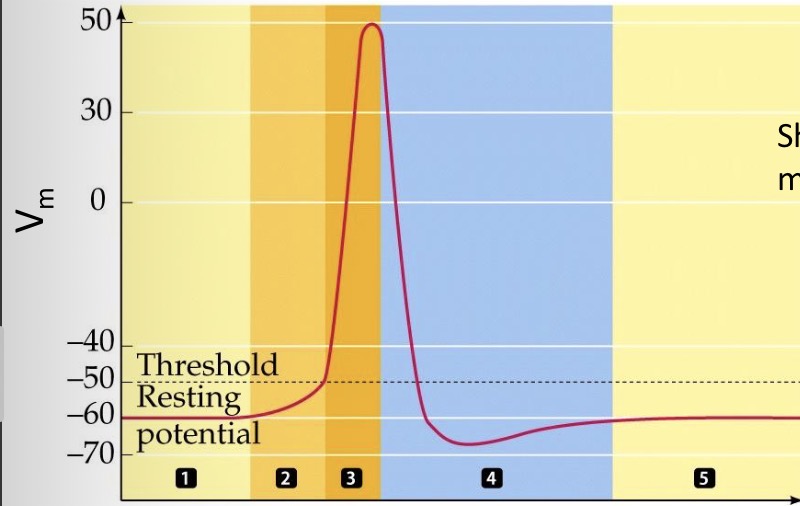
what is the uploaded graph telling us?
what happens to the flow of ions during a change in membrane potential
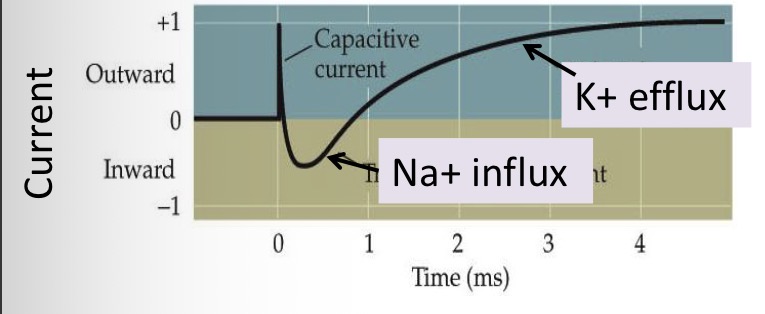
threshold definition
the rate of sodium entry and potassium exit into neurons
refractory period
the time from the onset of AP and when it can fire again
absolute refractory period
nothing will happen, no matter how much current is injected
what determines how the charge flows?
leak out of the cell (Rm)
flow through the cytoplasm (Ri)
stored by the membrane(Cm)
does action potential require active and passive flow? what is the difference?
it does require both
active is the opening of gated ion channels
active is all or none
passive is movement along the axon
passive decays over distance
what is conduction velocity?
the speed at which APs travel along a nerve fiber
what 3 properties does it rely on?
membrane resistance
leakiness
membrane capacity
charge needed to activate AP
internal resistance
things inside the cell
what is the vertebrae solution to increasing AP velocity?
myelination
this covers the holes and keeps the charge inside
myelin
made by glial cells
increases the conduction velocity
increases membrane resistance
decreases membrane capacity
are myelin sheets continuous?
No
the spaces between are called nodes of Ranvier
sodium channels cluster in the nodes
saltatory conduction
the action potential jumps from node to node
the current is regenerated at each node, forcing it to continue along
Multiple Sclerosis
a chronic inflammatiory CNS disease
a demyelinating disease
affects the brain, optic nerves and spinal cord
Schwann Cells
glia that provide the myelin wrap for PNS
oligodendrocytes
glia that provide myelin wrap for the CNS
What happens in MS?
T-cells and macrophages attack the myelin sheath
they do this through the blood-brain-barrier
What happens to the BBB in MS?
normally, the CNS is inaccessible for immune attacking agents
however, this barrier is broken down, allowing said immune attacking agents to cross over and attack the myelin sheaths
what is the BBB?
blood-brain barrier
a collection of cells that control the passage of blood to the CNS
serves as a protective layer from infection
how does MS affect the CNS?
it interrupts the AP conduction
exposed axons can sever, leading to permanent damage
what is excitotoxicity?
a process that releases glutamate
this causes an excess calcium influx
the excess Ca++ triggers cell death
MS demographics
there are around 200 cases diagnosed weekly
1 million individuals affected in the US
diagnoses between ages 20-50
affects those ages 25-35
MS region of origin globally
the highest risk areas are Canada, San Marino, Denmark
in the US
North: 110-140 cases for every 100,000 people
South: 57-78 cases for every 100,000 people
genetic risk for MS
up to 19% of patients have affected relatives
monozygotic twins: 25-30%
dizygotic twins: 3-4.5%
child: 1.9%
sibling:0.9%
environmental risks
sunlight
diet
life experiences
MS types
benign
relapsin-remitting
symptoms last days to weeks, followed by symptom free periods
secondary progressive
follows the schedule of relapsing-remitting
each episode leaves some type of permanent damage
primary progressive
the slow worsening of symptoms
the symptoms never truly get better
symptoms
optic nerve inflammation: 14-29% incidence
poor balance (ataxia): 2-18%
dizziness (vertigo): 2-9%
muscle weakness: 10-40%
double vision (diplopia): 8-18%
bladder dysfunction:0-14%
pain: 21-40%
sensory loss: 13-39%
how is MS diagnosed?
neurological exam
MRI scans
demyelination shows up as bright lesions
white lesions indicate fresh inflammation
lumbar puncture
tests CSF’
evoked potential tests
an MS brain response less actively to stimulation
the decreased activity reveals demyelination
blood tests
lesions in different areas
temporal lobe
cognitive impairments
depression
right optic nerve
loss of vision
reduced visual activity
brainstem
clumsiness, poor balance
impaired speech
cervical spinal cord
weakness, stiffness
painful muscle spasms
treatment and management of MS
drug therapy
immunosuppressants
calcium channel blockers
immunomodulating drugs
the drugs treat new attacks and prevent future ones
they slow/prevent disease progression
treat chronic symptoms
physical therapy
psychosocial support
what is the uploaded image showing us?
how MS is monitored via MRI scans

what is the axon hillock?
the site of AP initiation
the axon is far from the terminal
synapses
chemical synaptic transmission
neurotransmitter
electrical synaptic transmission
gap junction
what is the gap junction?
good for
synchronization of networks
coordinated hormone release
coordinated breathing
fast escape behaviors (in animals)
connexins
channels that form a pore to connect cytoplasm
this allows direct ion flow
Loewi’s experiment
demonstrates chemical neurotransmission
before 1921, people believes the nervous system operated solely on electrical signaling
chemical synapse
presynapse: site of release
synaptic cleft: the space between pre and post sites
synaptic vesicle: stores neurotransmitters
postsynaptic density: opposite the release site
stimulus secretion coupling
depolarization by an AP opens voltage gated calcium channels of the axonal terminal
in simple terms, a cell translates external signals to release stored products
chemical synaptic transmission
Ca++ dependent neurotransmitter release
AP travels to terminal
AP depolarizes axon terminal
depolarization opens the Ca++ channels
Ca++ influx
triggers neurotransmitter release
this is vesicle fusion
vesicle fusion
vesicle docks
the entering Ca++ binds to synaptotagmine (main calcium sensor for neurotransmitter release)
SNARE complexes form to pull membranes together
Ca++ bounds synaptotagmine catalyzes fusion
endogenous ligands
made inside
neurotransmitters
hormones
exogenous ligands
made outside
drugs
environmental toxins
agonist vs antagonist
agonist activates receptor and produces a response
antagonist blocks receptor and suppresses a reaction
affinity vs efficacy vs potency
affinity is how well a ligand binds to a receptor
efficacy is the ability of a drug to produce an effect
potency is a measure of the amount of ligand needed to make an effect of a certain magnitude
what are the two major receptor classes?
ionotropic
neurotransmitter gated ion channels
metabotropic
G. proteins coupled receptors
neuromuscular junction
a specialized chemical synapse between motor neurons and skeletal muscle cells
motor neurons released ACh (acetylcholine which encourages neurons to fire)
what is an NAChR
an ACh gated receptor
ACh bimds
the Na+ channel opens
the membrane depolarizes
nicotonic acetylcholine receptors
contain 5 subunits
what breaks down the ACh signal in the synaptic cleft?
AChE (acetylcholinesterase)
Aldicarb
a neurotoxin
used as a pesticide
blocks AChE
Myasthenia Gravis
an autoimmune disease that causes muscle weakness
symptoms
eyelid dropping
impaired speech
difficulty swallowing
double vision
easily fatigued
waddling gait
antibodies bind to the post-synaptic ACh receptors on the motor end plate
leads to receptor inflammation/desctruction
motor end plate atrophy
MG treatment
cholinesterase inhibitors
immunosuppressants
corticosteroids
glutamate
excitatory neurotransmitter in the CNS
its receptors are glutamate gated Na+ channels
EPSP process
glutamate binds to R
Na+ channel opens
depolarization
EPSP vs IPSP
EPSP is an excitatory post synaptic potential
depolarizes the neuron
this makes it more likely to fire AP
IPSP is an inhibitory post synaptic potential
IPSP hyperpolarizes the neuron
this makes it less likely to fire AP
IPSP process
GABA binds to R
GABA is an inhibitory neurotransmitter
gamma-aminobutyric acid
Cl- (chloride) channel opens
hyperpolarization
axodendritic vs axosomatic
axodendritic connects the axon to the dendrite
axosomatic connects the axon to the soma (cell body)
what is the type of PSP dependent on?
the type of channel present in the post synapse
spatial summation
PSPs arriving on different dendrites or from different axons
multiple inputs at the same time
temporal summation
they arrive at slightly different times
learning
the acquisition of new information and knowledge
a behavior change based on experience
memory
the retention of information
ability to store and recall experiences
what are the two types of memory?
implicit/procedural
skills and behaviors
require practice
performed without conscious recall
declarative
facts and events
consciously recalled
easy come, easy go as Dr. Ingemi says lmao
synaptic facilitation
enhancement of sensory neuron
motor neuron synapses
increase in neurotransmitter release
the cause of sensitization
sensitization
an enhanced response to a stimulus
synaptic depression
weakening of the sensory neuron
motor neuron synapses
decrease in neurotransmitter release
this causes habituation
habituation
the gradual decrease of a response due to repeated exposure
Hebb’s Postulate
coordinated activity of the pre and post synaptic neuron strengthens the synapse as a whole
synchronized=strengthened
not synchronized=not strengthened
what are the two types of glutamate receptors?
AMPA
amino-3-hydroxy-5-methyl-4-izoxazole proplonic acid
NMDA
N-methyl-D-aspartate
selective to Na+, K+, and Ca++
AMPA receptors
bind glutamate
channel opens
Na+ influx
depolarization
EPSP
NMDA receptors
bind glutamate
nothing happens
what happens during high frequency stimulation for AMPA receptors?
bind glutamate
more channels open
large Na+ influx
strong depolarization
big EPSP
what happens during high frequency stimulation for NMDA receptors?
bind glutamate + strong depolarization
channel opens
influx of Na+ and Ca++
why is the magnesium block relevant?
at resting potential, the pore of the NMDA receptors is blocked by magnetism ions
upon DP, the magnesium ions are removed, the channel can now pass current
what happens when Ca++ enters through NMDA receptors?
activates long-lasting changes to the AMPA receptors
the number of receptors increases
the existing receptors increase their permeability
this creates a larger EPSP
what is long term potentiation?
the long term strengthening of synaptic connections
however, it requires an NMDA receptors
 Note
Note  Flashcards (62)