Colour management
 Call Kai
 Learn
Learn Practice Test
 Spaced Repetition
 Match
Match Flashcards
 Knowt Play
1/39

There's no tags or description
Looks like no tags are added yet.
Name | Mastery | Learn | Test | Matching | Spaced | Call with Kai |
|---|
No analytics yet
Send a link to your students to track their progress
40 Terms
What is Colour phenomenon?
A Psychophysical response of the physical interaction of light energy with an object and the subjective experience of an individual observer
What are factors influencing the perception of colour? (3)
Light source: Illuminates the object
Object: reflects, absorbs or transmits the light to the observer
Observer: perceives reflected light
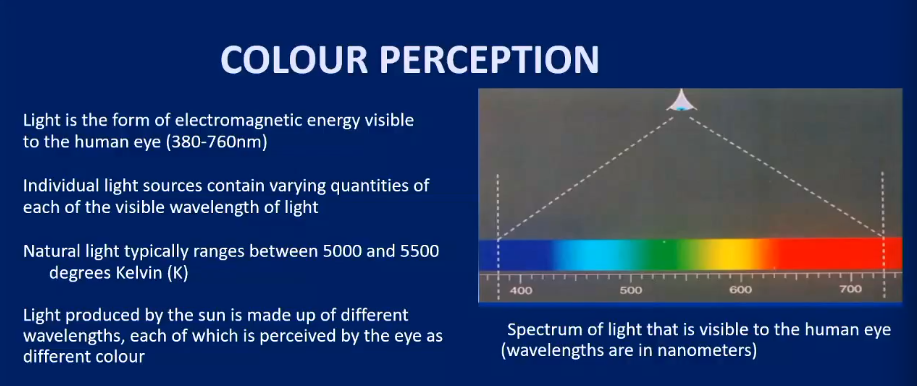
What nm and Kelvin (K) is the light that is visible to the human eye?
Light is the form of electromagnetic energy visible to the human eye = 380-760 nm
5000-5500 degrees Kelvin
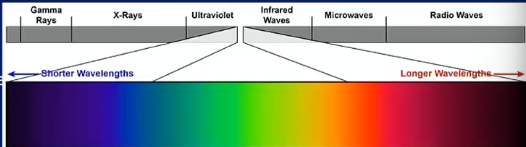
light produced by the sun is made up of different wavelengths, each of which is perceived by the eye as different colour
What is the shortest and longest wavelengths visible to the eye?
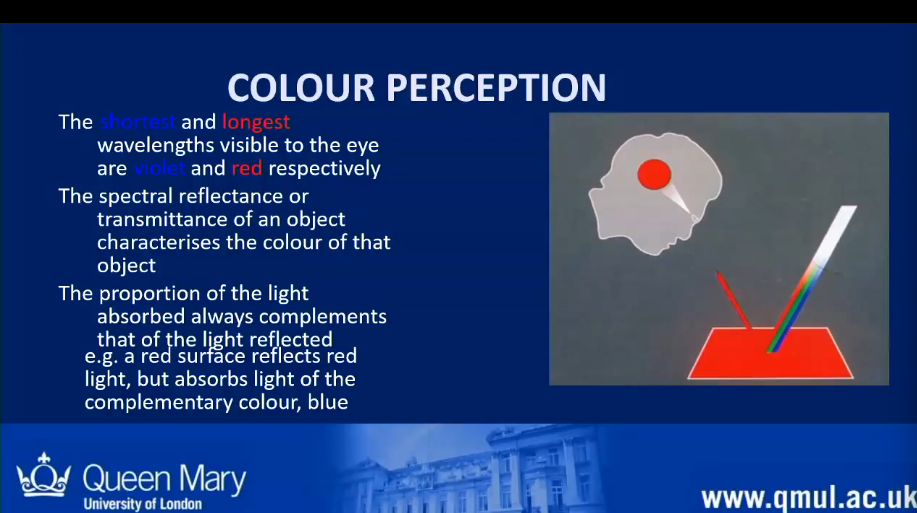
Violet - shortest
Red is the longest
What characterises the colour of an object? (2)
The spectral reflectance or transmittance of an object
The proportion of the light absorbed always complements that of the light reflected, what does this mean?
A red surface reflects red light, but absorbs light of the complementary colour - blue
What colours can the human eye distinguish but cannot what?
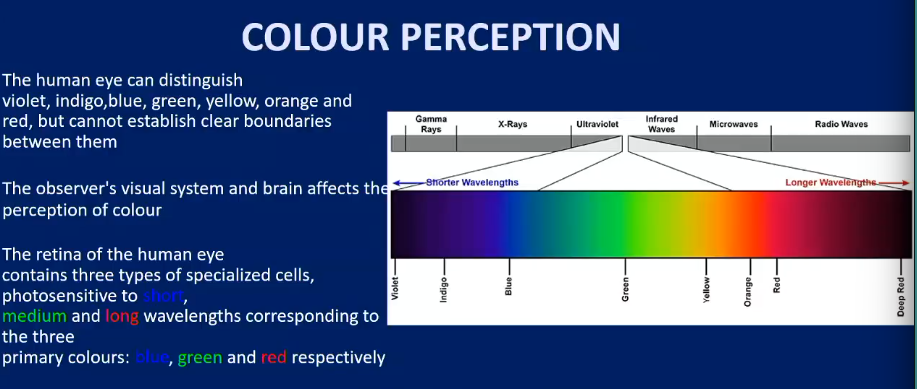
Can distinguish: Violet, Indigo, Blue, Green, Yellow, Orange and red but cannot establish clear boundaries between them
Again, what will affect the the perception of colour? (1)
The observers visual system and brain affects the perception of colour
What does the retina contain?
three types of specialised cells that are photosensitive to long, medium and short wavelengths corresponding to red, green and blue respectively
Spacial classification of colour: What are the 3 ways in which colour is defined as ?
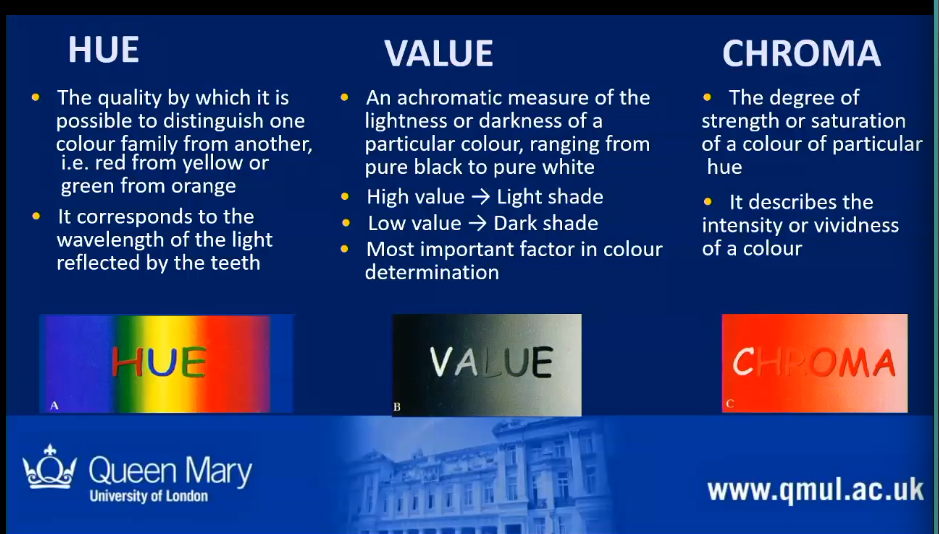
Hue, Value and chroma
What is Hue, Colour and Chroma?
Hue: Corresponds to the wavelength of the light reflected by the teeth, distinguish one colour family from another
Value (most important in determining colour: measure of lightness or darkness of a particular colour, ranging from pure black to pure white - the higher the value the lighter the shade
Chroma: the degree of strength or saturation of a colour of a particular hue - the intensity or vividness of a colour
How can colour be used for shade selection
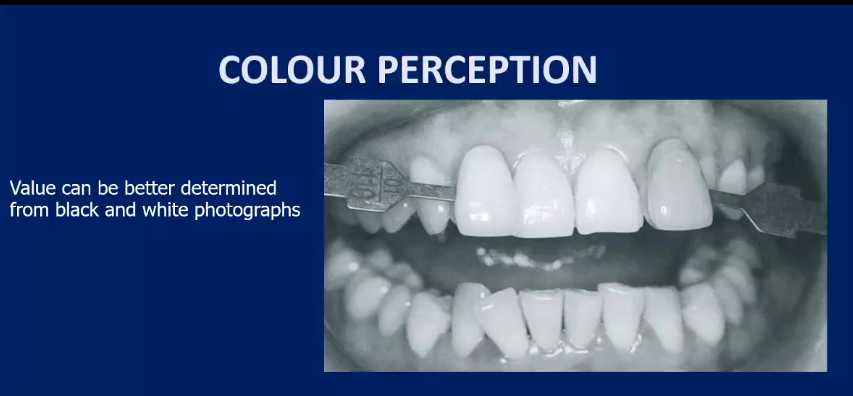
clinicians take photographs using black and white filter
in hue they are correct, but using black and white, one of the teeth has a better match as it has more lightness
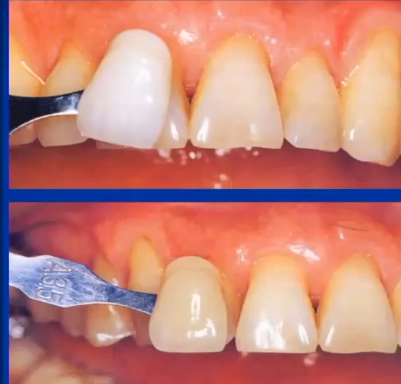
What is the value and chroma of both of these shade matches?
Shine and gloss reduces perception on what the actual value and chroma is
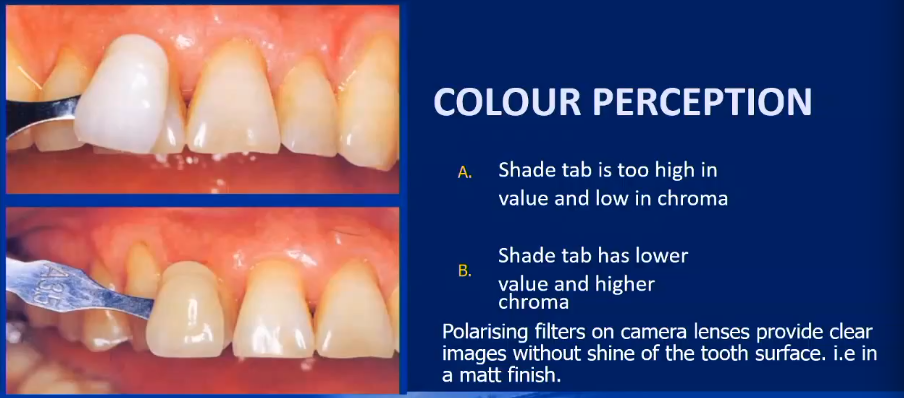
What aspect of pictures can interfere with shade matching and how to resolve?
Polarising filters on camera lenses provide clear images without shine of the tooth surface e.g a matt finish
What is translucency?
Light is permitted to pass through the object but is dispersed rather than absorbed or reflected
yellow on a blue background with high transparency will cause a greeny hue white 100% opacity gives a yellow hue
Affects the hue
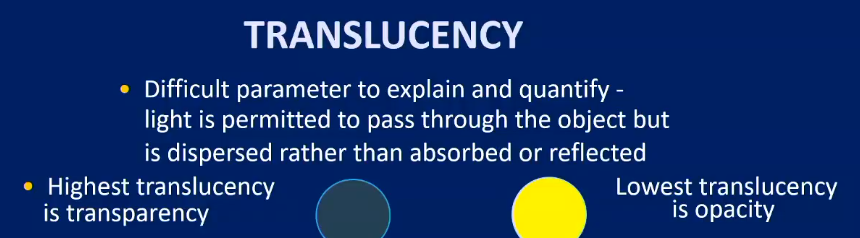
How does translucency vary? (2)
What does translucency depend on?
Varies between individuals and teeth
Susceptible to changers with age
Depends on the thickness of enamel and dentine
More yellowing of teeth with age
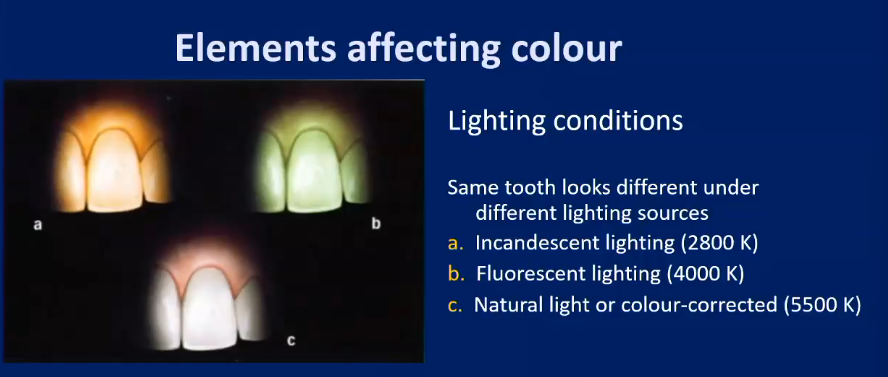
Same tooth looks difference under different lighting sources? What are 3 different light sources?
Incandescent lighting
Fluorescent lighting
Natural light or colour-corrected
WC and Gd has colour corrected - switch off the bay light
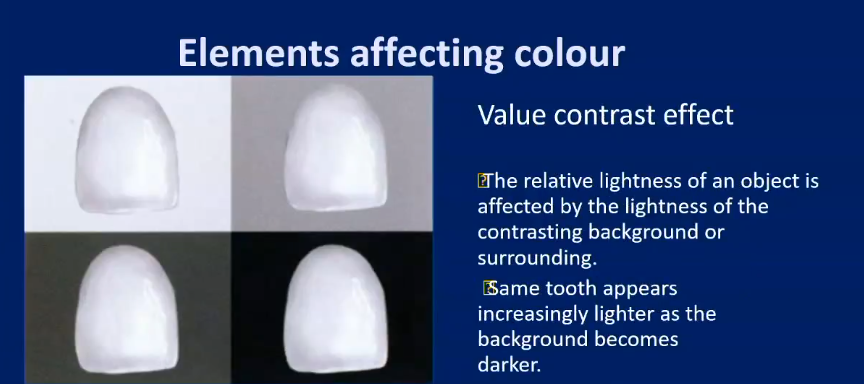
What is Value contrast effect?
The relative lightness of an object is affected by the lightness of the contrasting background or surrounding
Tooth appears increasingly lighter as background becomes darker
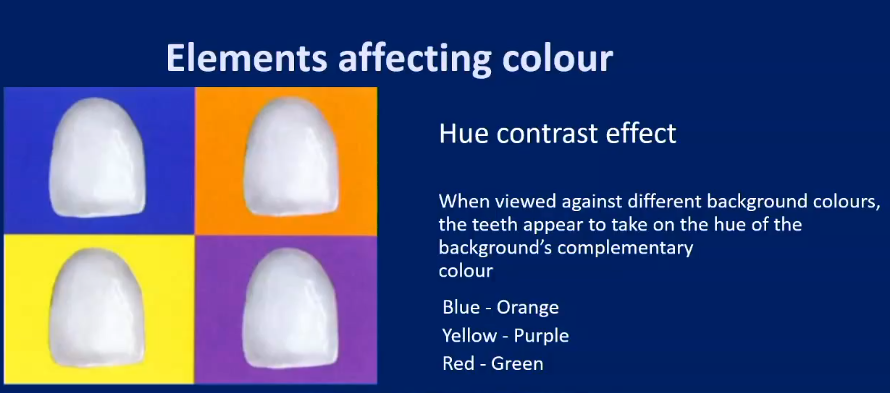
Hue contrast effect?
When viewed against different background colours, the teeth appear to take on the hue of the background’s complementary colour
What is metamerism?
Phenomenon when 2 objects appear to have the same colour under certain lighting conditions and different under changed lighting conditions due to non matching spectral analysis curves
What is Opalescence?
Light scattering phenomenon caused by the presence of fine particles - opalisers
opalescence - reflects light
What is fluorescence?
Emission of visible light by an object when exposed to UV light
Physical factors affecting colour? (3)
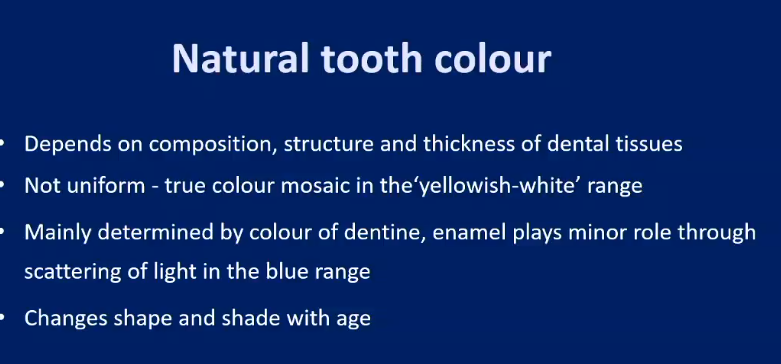
Natural tooth colour
Surface texture
Special characteristics
Natural tooth colour depends on? (3)
Is tooth colour uniform?
What is colour mainly determined by - enamel or dentine?
With age what 2 aspects of teeth changes?
Composition, structure and thickness of dental tissues
Not uniform
Dentine colour, enamel - through scattering light in the blue range
Shape and Shade
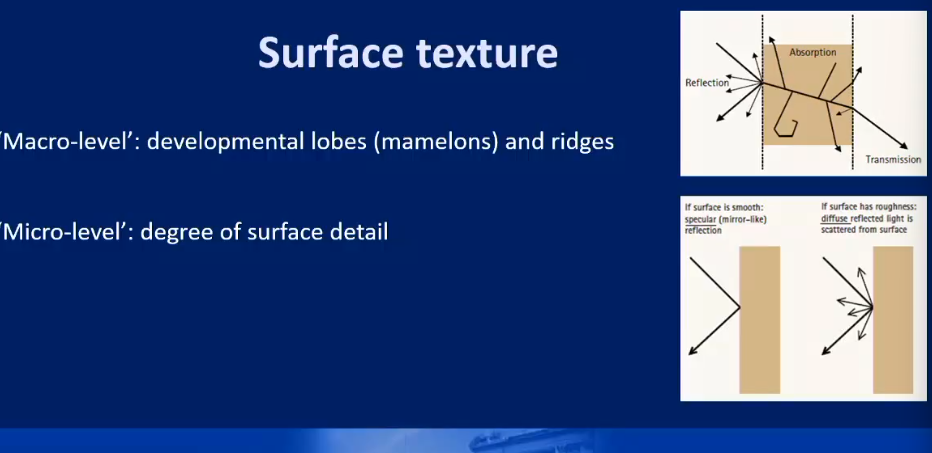
Surface texture:
Macro-level:
Micro-level:
Developmental lobes (mamelons) and ridges
Degree of surface detail - smooth - specular reflection, rough - diffuse reflectance of light - from surface
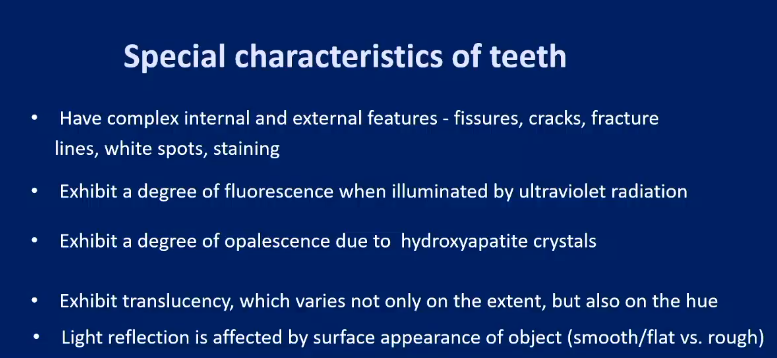
Special characteristics of teeth: (5)
Complex internal/external features: Fissures, cracks, fractur lines, white spots, staining
Fluorescence when illuminated by UV
Opalescence due to HAP crystals
Translucency
Surface appearance - smooth vs rough - on light reflectance
Tooth colour:
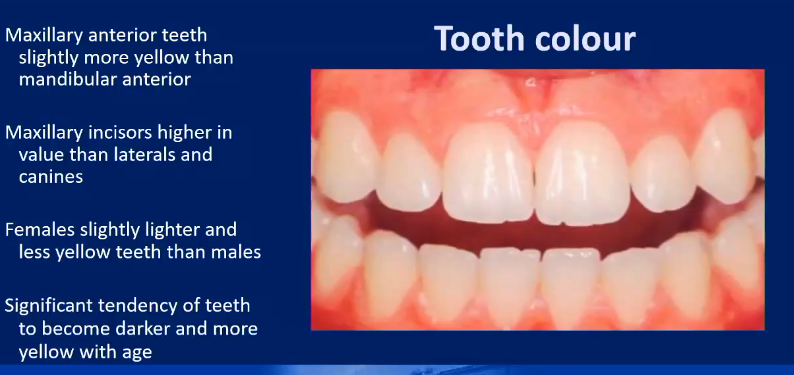
Maxillary anterioir teeth vs mandibular anterioir teeth
maxillary incisors/laterals/canines - value?
male vs females?
as you age, teeth?
More yellower
Higher value in maxillary incisors than laterals and canines
Females slightly lighter and less yellow teeth than males
Tendency of teeth to become darker and more yellow with age
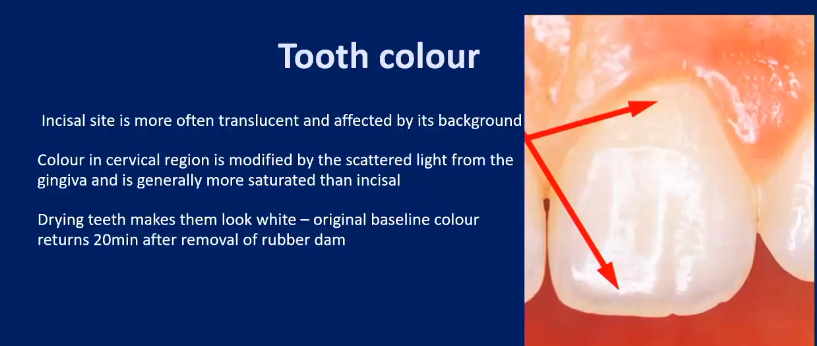
Compare the incisal edge with the cervical region of the tooth?
What condition of teeth - dry or wet make them look more white?
Incisal site: is more often translucent and affected by its background
Cervical: modified by the scattering of light from the gingiva and is generally more saturated than incisal (dentine underneath - thinner enamel here)
when dry - so get patient to lick their teeth
Measurement of tooth colour
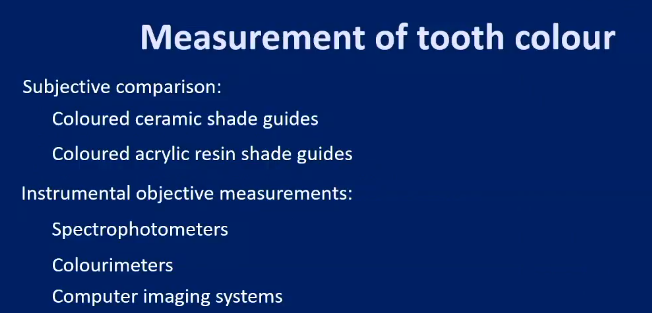
2 types of methods
Subjective comparison: coloured ceramic/acrylic resin shade guides
Instrumental objective measurements: spectrophotometers, colourimeters, computer imaging systems
3 types of shade guides?
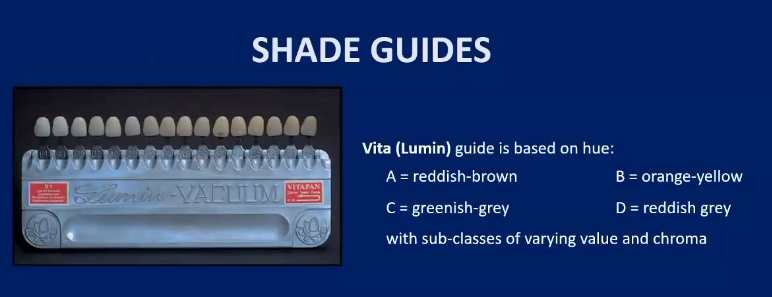
Vita Lumin
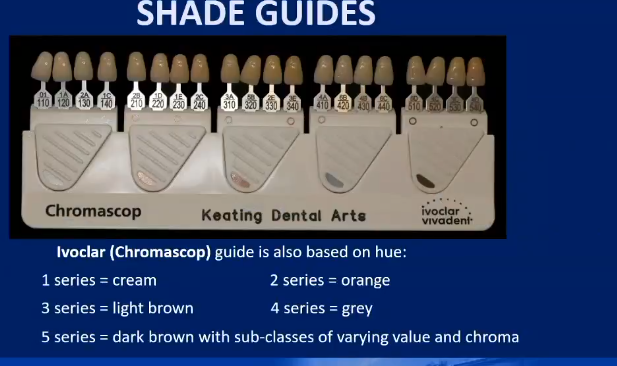
Ivoclar chromoscope
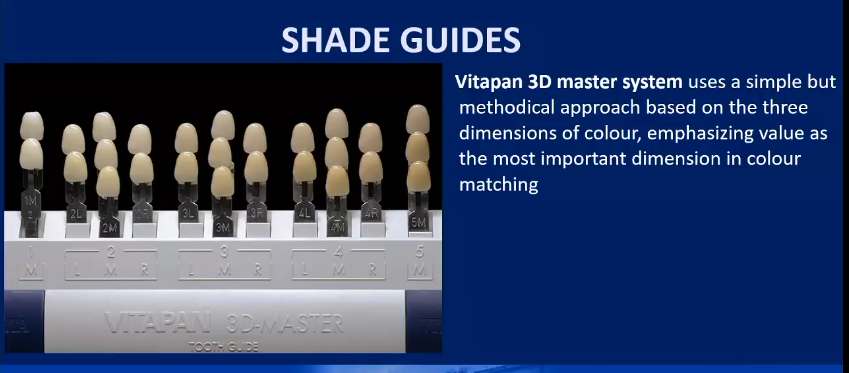
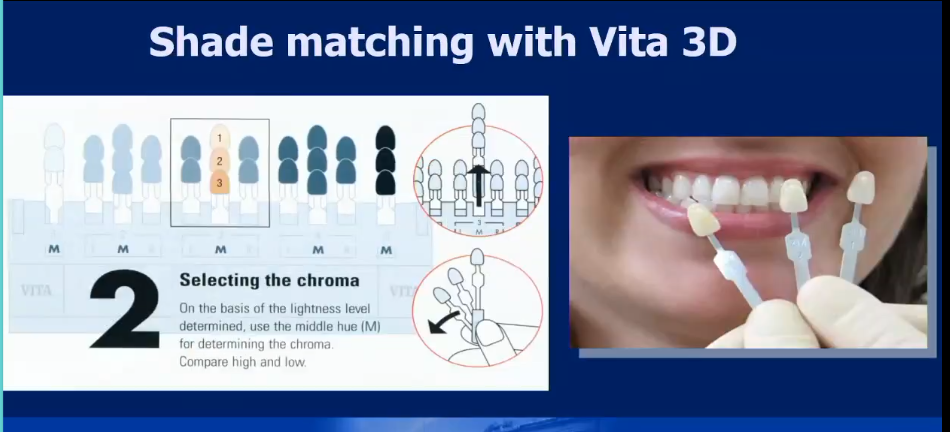
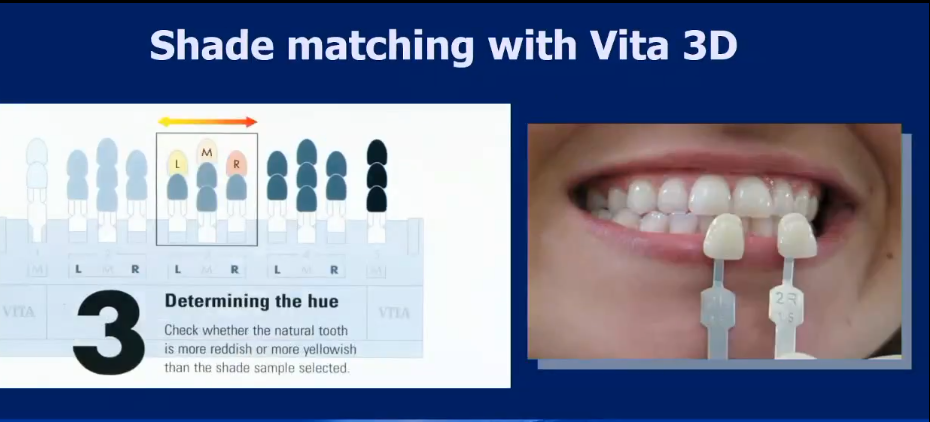
Vitapan 3 master system
What is Vita Lumin based of of?
Based on Hue with subclasses of value and chroma
What is Ivoclar Chromoscop based on?
Hue with subclasses of varying value and chroma
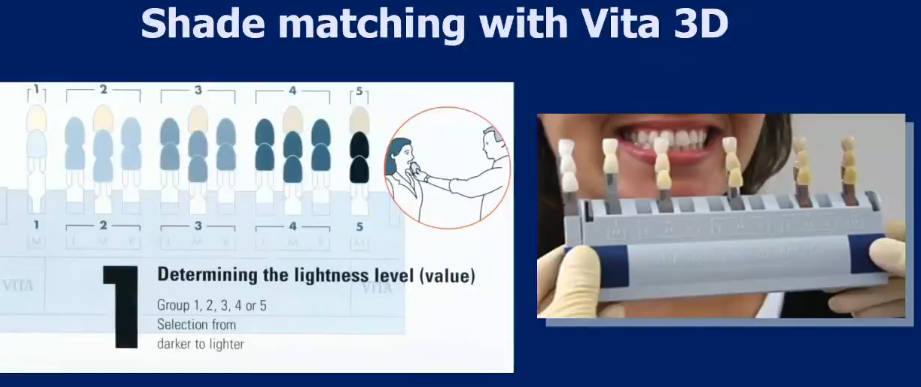
Vitapan 3D master system?
Most important dimension in colour matching - emphasis on value
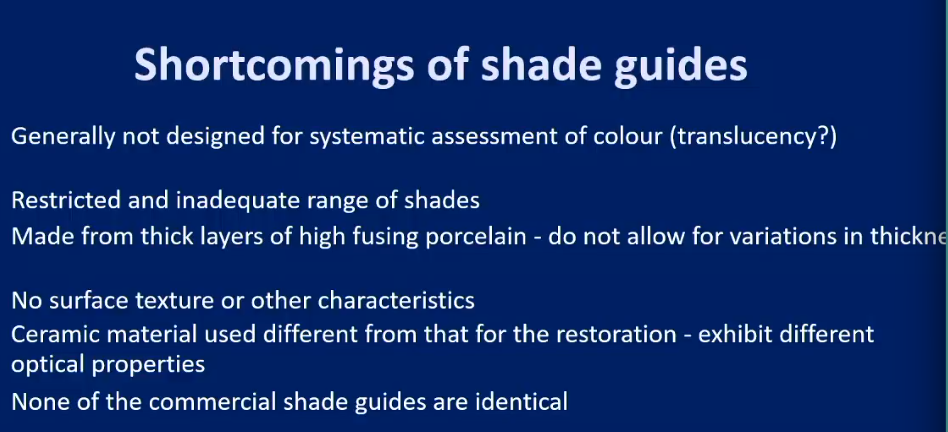
Shortcomings of shade guides? (6)
Generally not designed for systematic assessment of colour
No surface texture or other characteristics assessment of colour
Restricted and inadequate range of shades
Made from thick layers of high fusion porcelain - do not allow for variation in thickness
Ceramic material used different from that for restoration - exhibit difference optical properties
None of the commercial shade guides are identical
Shade matching technique:
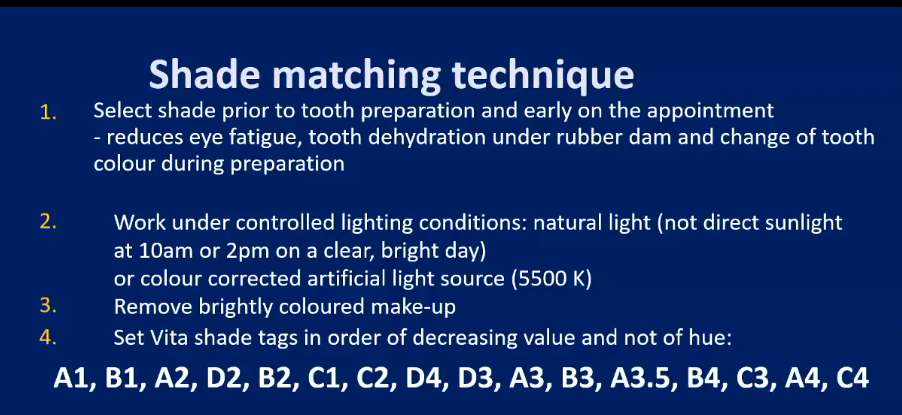
In relation to tooth prep when do you do shade selection
Under what lighting conditions?
What should be removed due to hue contrast effect
Set Vita shade tags in what order?
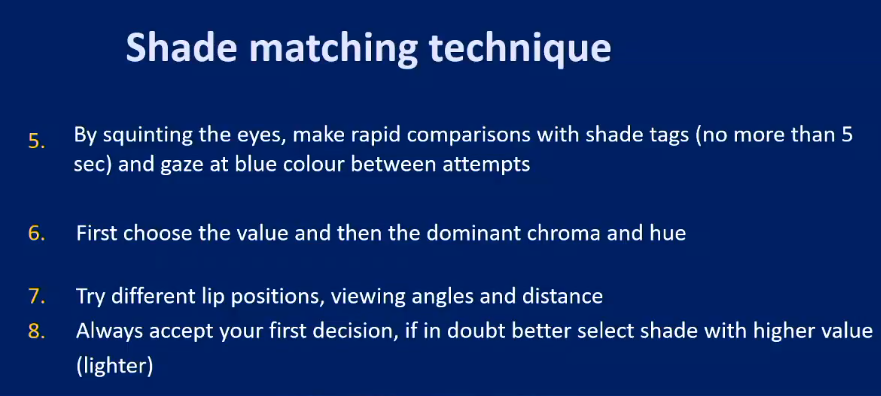
How to select vita shade guides?
What can you do to the lip?
Which choice is often the right one?
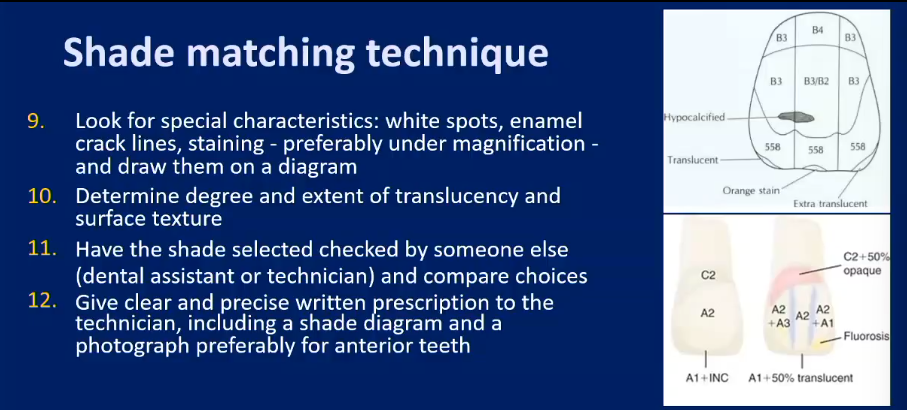
What can you look for on the teeth and include on a diagram?
Does it have to be only you to select the shade?
What else in addition to shade diagram you can give
Select shade prior to tooth preparation
under controlled lighting - colour corrected or natural light
Remove brightly coloured make-up
Select Vita shade guides in order of decreasing value (getting darker)
Squint eyes, make rapid comparisons with shade tags and gaze at blue in between, pick 3
pick based on value first then the chroma/hue
Try different lip positions, viewing angles and distances
Always accept the first decision, if in doubt select shade with higher value (lighter)
Look for special characteristics - could use magnification
Determine degree and extent of translucency and surface textures
Have the shade selected checked by someone else
Give precise instructions including shade diagram, and photographs
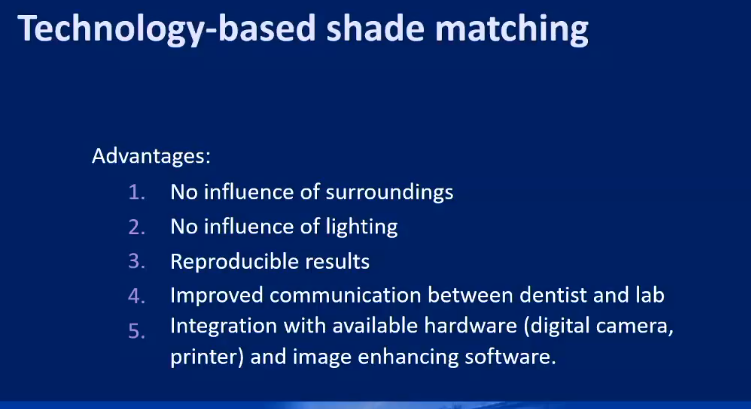
Technology-based shade matching: (5 adv)
No influence of surrounding (hue/value contrast)
No influence of lighting
Reproducible results
Improved communication between dentist and lab
Integration with available hardware - digital camera, printer and image enhancing software