Bone Formation and Growth
 Call Kai
 Learn
Learn Practice Test
 Spaced Repetition
 Match
Match Flashcards
 Knowt Play
1/18

There's no tags or description
Looks like no tags are added yet.
Name | Mastery | Learn | Test | Matching | Spaced | Call with Kai |
|---|
No analytics yet
Send a link to your students to track their progress
19 Terms
Ossification
the replacement of other tissues with bone
calcification
the deposition of calcium salts
Endochondral Ossification
replaces existing cartilage with bone
Intramembranous Ossification
replaces mesenchyme tissue with bone
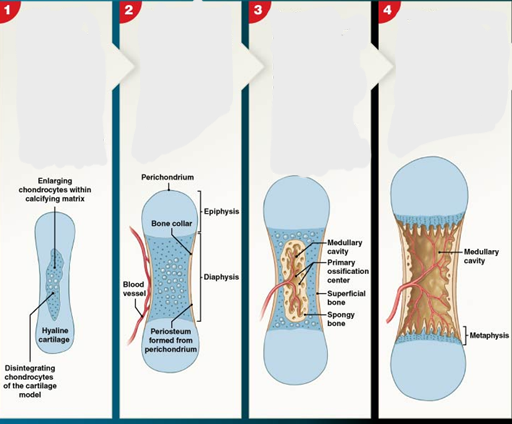
Step 1 of Endochondral Ossification:
chondrocytes and lacunae expand and calcify in what will be the future diaphysis; the chondrocytes die and leave a space behind
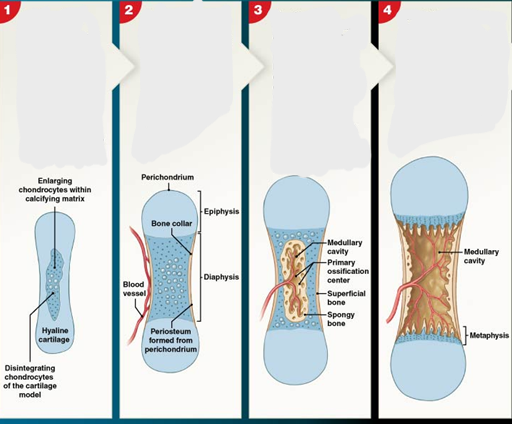
Step 2 of Endochondral Ossification:
blood vessels grow into the perichondrium around shaft; cells differentiate into osteoblasts and calcify surface
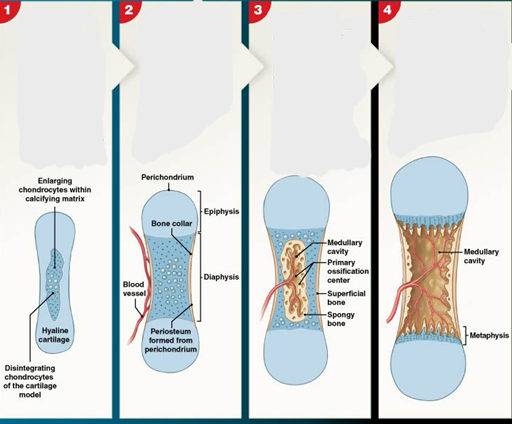
Step 3 of Endochondral Ossification:
capillaries and fibroblasts migrate into the interior; fibroblasts differentiate into osteoblast and begin producing spongy bone at new primary ossification center
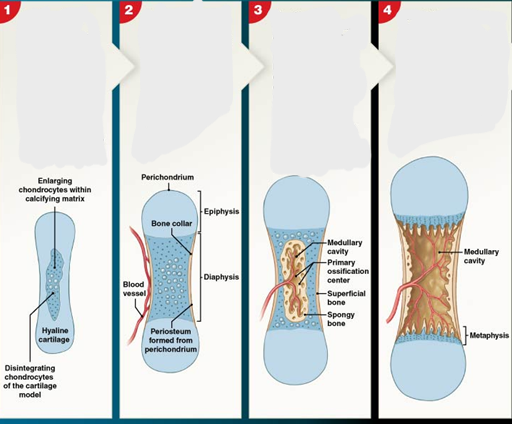
Step 4 of Endochondral Ossification:
osteoclasts remodel spongy bone into a medullary cavity; outer layer remodeled into compact bone
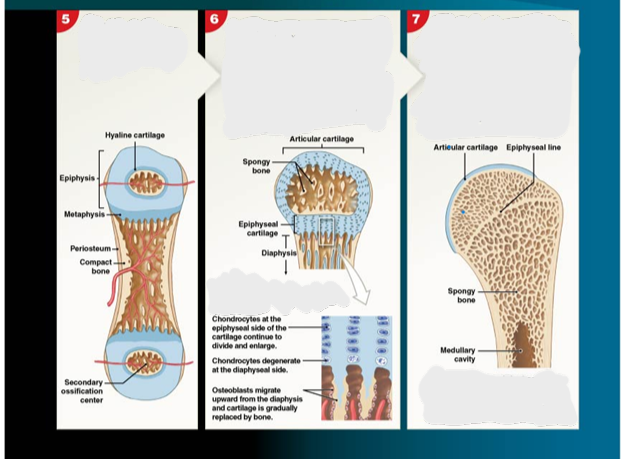
Step 5 of Endochondral Ossification:
capillaries and fibroblasts migrate into epiphyses; where secondary ossification centers are then created
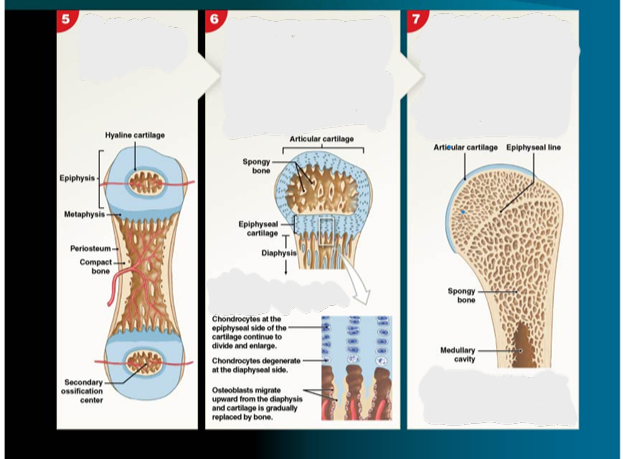
Step 6 of Endochondral Ossification:
the epiphyses fill with spongey bone; only the articular and epiphyseal zones of cartilage remain
articular cartilage
the surface exposed to joint cavity
epiphyseal cartilage
space at metaphysis; bones elongate from this region until puberty is over
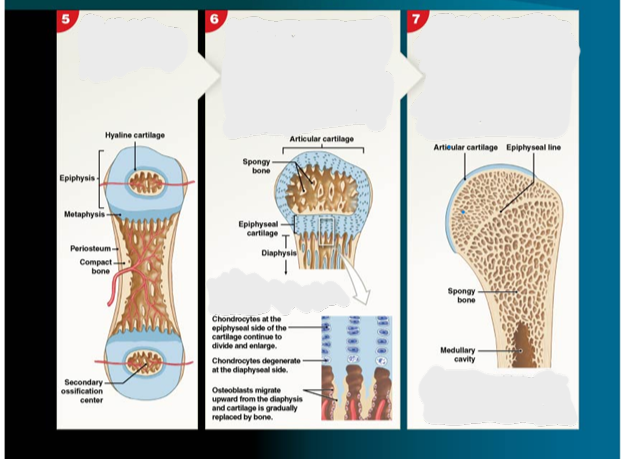
Step 7 of Endochondral Ossification:
the epiphysial cartilage zone keeps producing cartilage and converting it into osteoblasts, elongating the shaft, until the space closes
Step 1 of Intramembranous Ossification
mesenchymal cells cluster and secrete minerals that calcify into osteoid, and differentiate into osteoblasts
Step 2 of Intramembranous Ossification
osteoid is calcified to form spicules
spicules
small shards of bone inside the tissue
Step 3 of Intramembranous Ossification
blood vessels grow into the tissue; spicules connect to form a branching network around the blood vessels
Step 4 of Intramembranous Ossification
spongy bone is formed by osteoblasts
Step 5 of Intramembranous Ossification
spongy bone near the surface is remodeled into compact bone; connective tissue and osteoblast at the surface become periosteum

