2.2.4 Transport systems in plants
 Call Kai
 Learn
Learn Practice Test
 Spaced Repetition
 Match
Match Flashcards
 Knowt Play
1/17

There's no tags or description
Looks like no tags are added yet.
Name | Mastery | Learn | Test | Matching | Spaced | Call with Kai |
|---|
No analytics yet
Send a link to your students to track their progress
18 Terms
what is translocation
transport of assimilates from source to sink in the phloem
what is a source + give examples
site of photosynthesis
green leaves/stem
food stores in seeds
storage organs
what is a sink + give examples
site of assimilate storage
roots
dividing meristem
developing seeds
outline the process of translocation: LOADING of sucrose into phloem via apoplast route
companion cells contain lots of mitochondria that provide the energy used to actively pump protons out into surrounding tissue
protons move back into CC, down the conc gradient via a co-transporter protein
sucrose is co-transported with the protons into the CC —> inc sucrose conc in CC + decreases water potential
sucrose diffuses into STE via plasmodesmata from an area of high to low conc
Water diffuses into CC by osmosis (down wp gradient)
this increases turgor pressure
water diffuses into STE
outline how sucrose is unloaded from phloem
sucrose diffuses from phloem into surrounding tissue
this increases the water potential inside STE
water diffuses out of STE by osmosis down wp gradient —. some water enters transpiration stream
outline LOADING of sucrose into phloem via symplast route
PASSIVE route
sucrose diffuses from source to STE down conc gradient
this decreases wp in STE
so water diffuses into STE by osmosis down wp gradient
this generates a hydrostatic pressure that moves sucrose through phloem —> MASS FLOW HYPOTHESIS
define transpiration
the loss of water vapour by diffusion from the underside of the leaf via stomata
State the 3 forces that play a role in transpiration and explain their importance
cohesion - water molecules are attracted to each other due to hydrogen bonds
tension - evaporation of water molecules from walls of PMC to mesophyll air spaces —. generates a suction that pulls more water into leaf
adhesion - water molecules are attracted to cellulose walls of the xylem vessels + hydrophilic parts of lignin
describe transpiration at the leaves
Water evaporates from the cellulose cell walls of the mesophyll cells + into mesophyll air spaces
Water vapour then diffuses to the sub-stomatal air spaces where the wp is highest
water diffuses down wp gradient through the open stomata to the surrounding air
Describe how water moves through the xylem during transpiration
Xylem vessels transport water up the stem from the roots to the leaves due to a difference in water potential at the top of the stem compared to the bottom
water is drawn up via capillary action
water moves up xylem via cohesion forces in a continuous column
water leaves the xylem via apoplast pathway
what is the apoplast pathway
water moves through cellulose cell walls
cell walls are freely permeable —> little resistance to mass flow of water so most water travels via this pathway
what is the symplast pathway
water travels through cytoplasm and moves from 1 cell to the next via the plasmodesmata
when water reaches endodermis, there’s a layer of suberin that’s waterproof —> forms casparian strip
forces all water to travel through symplast pathway —> toxins are filtered out as membrane is partially permeable
what is the vacuolar pathway
water moves via vacuole
what adaptations do RHC have?
extended cytoplasm —> increase SA for uptake of water + mineral ions
thin cell wall —> short diffusion distance for water + ions
lots of mitochondria —> provides energy for AT of ions
no chloroplasts —> no PHS occurs
how does stomata open + close
abscisic acid binds to receptors on guard cell membranes
Ca2+ channels open and Ca2+ enter
activates proton pumps
influx of H+ generates a PMF
PMF opens voltage-gated K+ channels
K+ leave via facilitated diffusion
w.p. of cytosol increases
∴ water leaves via osmosis down w.p.g.
cells become flaccid –> closed stoma
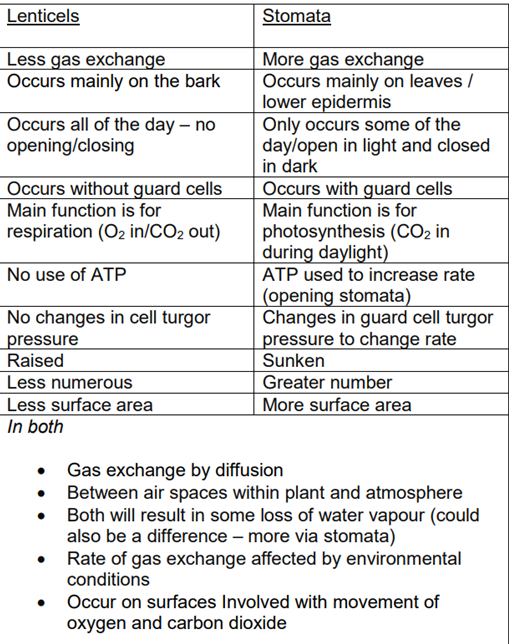
EQ: Compare and contrast gaseous exchange in stomata and lenticels.
PAG: investigating transpiration rates
Control: type of plant, temp, light intensity, wind flow, humidity
cut shoot underwater at a 45o angle
connect potometer to shoot underwater
ensure apparatus is airtight using vaseline as a seal
dry surface of leaves —> reduces humidity
allow shoot time to acclimatise
allow air bubble to form
record initial position of bubbl
time using a stopwatch and measure distance travelled by bubble per unti time
rate of water uptake = vol of water/time
vol of water absorbed = area of tubing x distance moved

