Bio1110 Digestive Tracts
 Call Kai
 Learn
Learn Practice Test
 Spaced Repetition
 Match
Match Flashcards
 Knowt Play
1/68

There's no tags or description
Looks like no tags are added yet.
Name | Mastery | Learn | Test | Matching | Spaced | Call with Kai |
|---|
No analytics yet
Send a link to your students to track their progress
69 Terms
Function of the gastrovascular cavity
food particles are brought into the GVC and enzymes are held in the cells and also released into the GVC with the food particles where they are digested, after food particles are smaller they are absorbed by cells
Function of the alimentary canal
the pathway and machinery for processing food, includes mechanical and chemical digestion in the mouth, absorption, propulsion, and elimination (overall, moves food through the body and carries out every major step of digestion - from entry to exit
Alimentary canal includes the …
oral cavity, stomach, small and large intestine, rectum, and anus
Accessory digestive glands are
things/organs that don’t have food pass through them, and they include the salivatory glands, gall-bladder, liver, and pancreas
Function of the mouth
mechanical digestion (chewing) and the start of chemical digestion through saliva
What is included in saliva?
salivary amylase, mucus, buffer, and antibacterial compounds
What does salivary amylase do?
begins break down of starch
What does mucus do?
lines and protects the oral cavity (also moistens the food)
What does the buffer do?
helps keep the acids from breaking down teeth since they are mineralized
What do antibacterial compounds?
kill things we don’t want entering our digestive system
What does the pharynx do?
directs food into the esophagus, is a shared pathway for air and food
Sphincter =
ring of muscles guarding an opening, we have an esophageal sphincter
What are the sphincter muscles and why are they important?
act as valves, prevents back flow (stops stomach acid from rising into the esophagus) regulates passage of food
What is the uvula
part of the soft palate, forms a moveable seal between the mouth and the nasal cavity, contains the salivatory glands and muscle fibers that help it change shape during swallowing
What does the uvula do?
triggers the gag reflex, helps with speech, keeps the throat moist, and prevents food and liquid from entering the nose
Where does digestion begin?
the mouth
What is the epiglottis?
made of elastic cartilage, and its shape and flexibility let it swing like a hinged lid over the airway
What does the epiglottis do?
protects the airway during swallowing, prevents aspiration (choking), supports normal breathing, and contributes to sound resonance
What do we call the mass of chewed food?
the bolus of food
We are endotherms and have to breathe constantly so the epiglottis …
sits up until our swallowing reflex lowers it covering the larynx leaving the bolus to only go down the esophagus
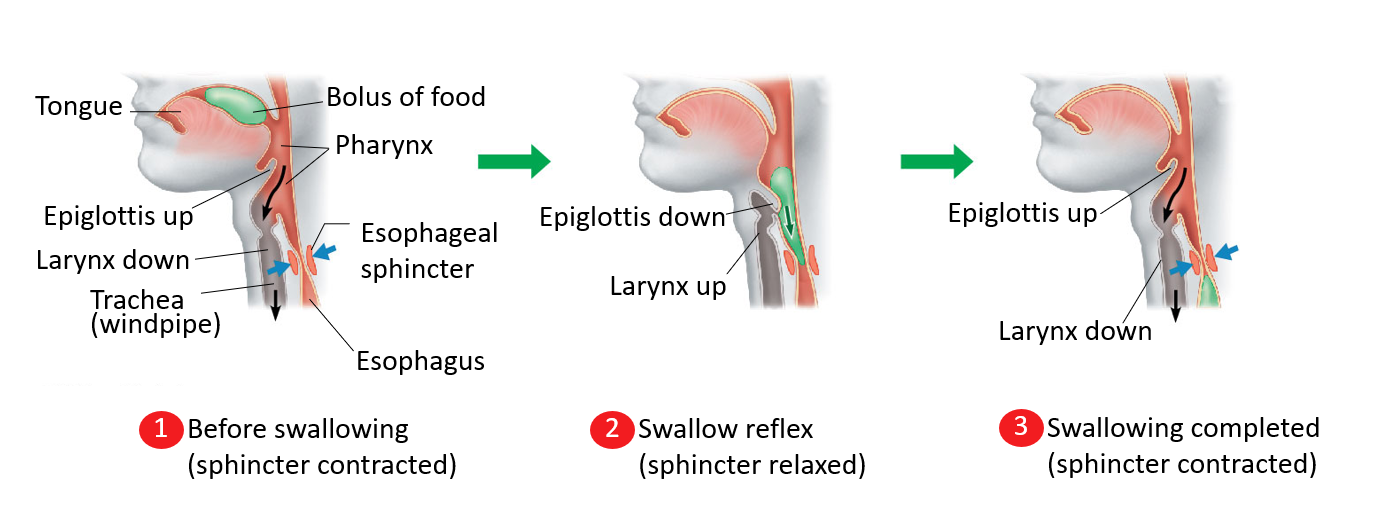
When we swallow what two things happen automatically?
the epiglottis goes down and the esophageal sphincter relaxes
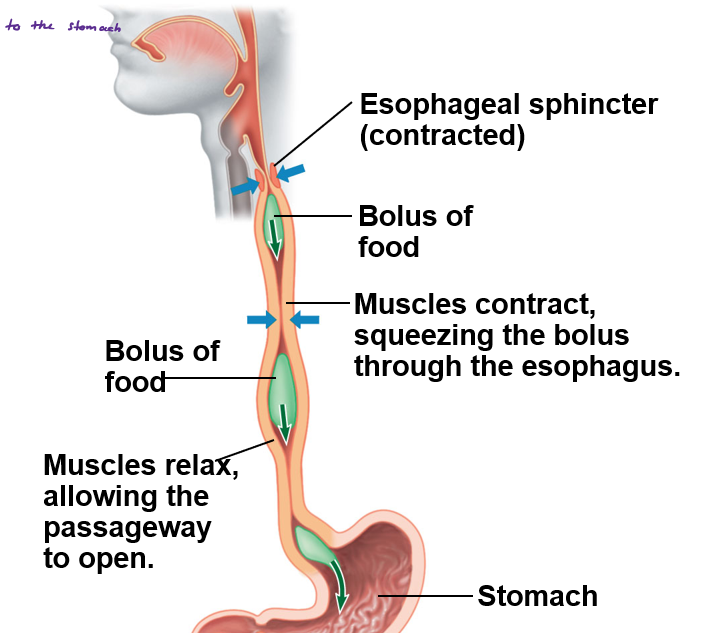
What is peristalsis?
moves food through the esophagus to the stomach, muscle contractions and gravity help push the bolus to the stomach, happens after swallowing
What is the function of the esophagus?
Transporting food and liquid, once you swallow, the esophagus takes over and uses rhythmic muscular waves called peristalsis to push food downward toward the stomach. This process is automatic and continues even if you’re upside down.
What are the functions of the stomach?
stores food and breaks it down with acid and enzymes, stores 2 L, mechanical and chemical digestion
What are the main parts of stomach?
the two sphincters (one at the opening and exit), the lumen of the stomach, gastric gland
What is gastric juice and where does it come from?
does chemical digestion, has a pH of about 2 and breaks apart cells and denatures proteins, comes from the gastric gland
Gastric glands are found where and what do they include?
Mucous cells, Chief cells, and Parietal cells, can be found in the pits of the stomach lining
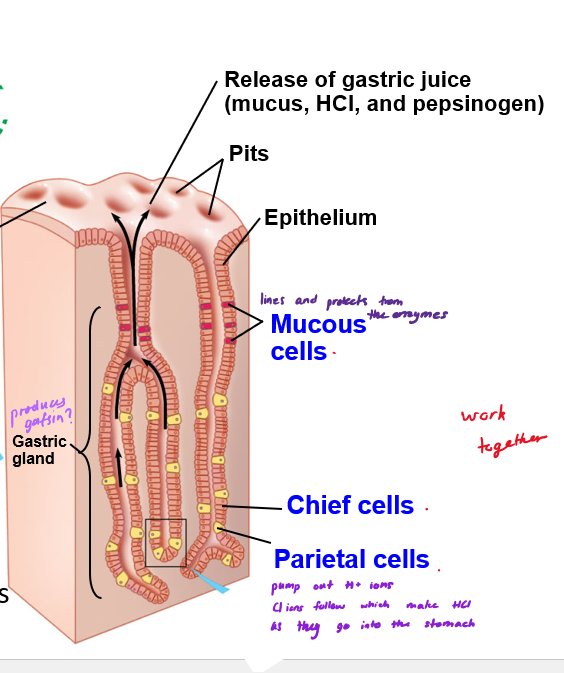
Function of Mucous cells
lines and protects the stomach from the digestive enzymes
Function of Chief cells
produces pepsinogen - deactivated pepsin (pepsin breaks peptide bonds in proteins)
Pepsinogen activates when …
its exposed to a very low pH, it is not active all the time because these enzymes would wear down the stomach lining very fast
The activation of pepsin is what kind of feedback?
Positive, as pepsin activates and moves around if it comes in contact with pepsinogen it will activate it, increasing the amount of digestive enzymes till the food has been broken down, so it drives the process forward until the food is taken care of
What signals chief cells to release pepsinogen?
the hormone gastrin, it regulates when pepsinogen is released from the chief cells, parietal cells for H+ and acid secretion
Function of the Parietal cells
pump out H+ ions which pull Cl- ions with them forming HCl in the stomach, creates the acidic environment
What is chyme?
the digested bolus, its blended with water, HCl, enzymes like pepsin and mucus, its a thick semi-fluid mixture, takes this state before entering the small intestine, its creamy acidic and designed to optimize the next stage of digestion
How does mechanical digestion work in the stomach?
smooth muscle of the stomach contracts, churning the bolus
Functions of the small intestine
major organ of of chemical digestion and nutrient absorption, includes the duodenum, and brings in things from the pancreas, liver, and gall-bladder
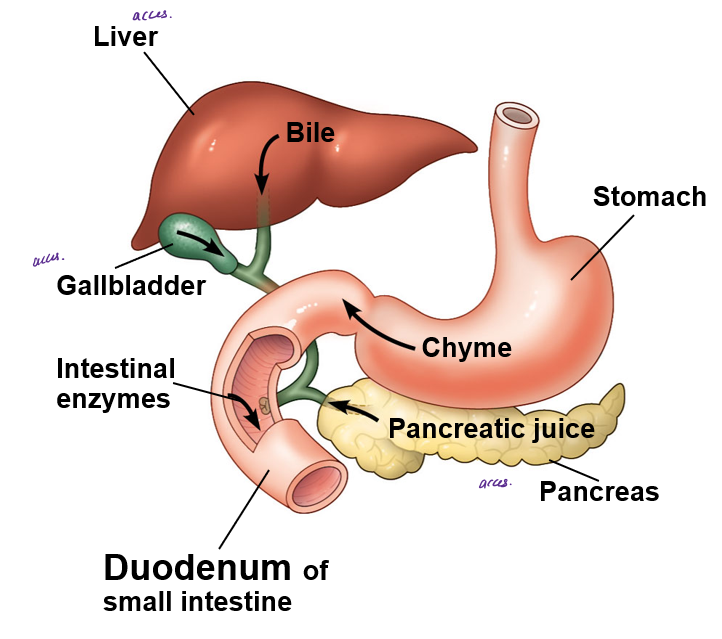
What is the duodenum?
the first 10 inches of the small intestine, mixes the chyme with digestive juices from the pancreas, liver, gall-bladder, and intestine
How does the duodenum regulate digestion?
regulates digestion by controlling what enters from the stomach, neutralizing acid, and coordinating pancreatic and biliary secretions through a tightly tuned mix of hormones and neural signals. It acts as the “traffic controller” of the entire digestive process
What is the role of the liver in digestion?
producing bile, processing and distributing absorbed nutrients, and detoxifying substances that arrive from the digestive tract
What is the role of the gall-bladder in digestion?
stores, concentrates, and releases bile into the duodenum
What is the role of the pancreas in digestion?
produces enzyme‑rich pancreatic juice that flows into the duodenum, where it completes the chemical breakdown of food pancreatic juice = bicarbonate and digestive enzymes like trypsin and chymotrypsin),
The gall-bladder and liver also recycle …
nonfunctioning red blood cells
What are all the digestive enzymes?
Pancreatic amylase, Trypsin and chymotrypsin, nucleases, and bile salts
What does pancreatic amylase do?
breaks down maltose into maltase, sucrase, lactase, etc. and other disaccharides (carbohydrates in general), comes from the pancreas and does its job in the duodenum
What does trypsin and chymotrypsin do?
breaks down smaller polypeptides into amino acids, comes from the pancreas and does its job in the duodenum
What do nucleases do?
break down RNA and DNA/ nucleotides into nitrogenous bases, sugars, and phosphates, comes from the pancreas and does its job in the duodenum
What do bile salts do?
break down fat globules/droplets into glycerol and fatty acids, comes from the liver/gallbladder, includes lipase
What is emulsification?
breaking big fat globules into droplets to increase surface area, so it is not breaking them down into fatty acids and glycerol yet
What structures in the small intestine increase surface area?
large circular folds and villi
Why does the small intestine have a large surface area?
to maximize nutrient absorption, the more contact points the more space/opportunity for absorption
What are the other two areas of the small intestine?
the jejunum and ileum, both are just for absorption
How long is the small intestine, what about its diameter?
about 20 ft long, it has a smaller diameter compared to the large intestine which is where it gets its name
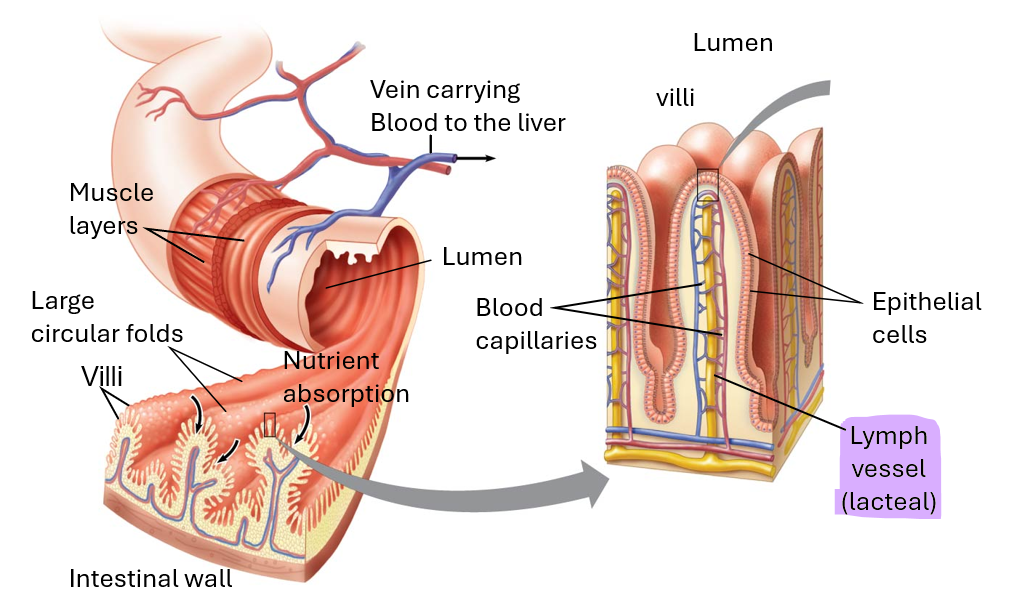
What is a villi?
a finger like projection that lines the inside of the small intestine, dramatically increases the surface area
What does a villi contain?
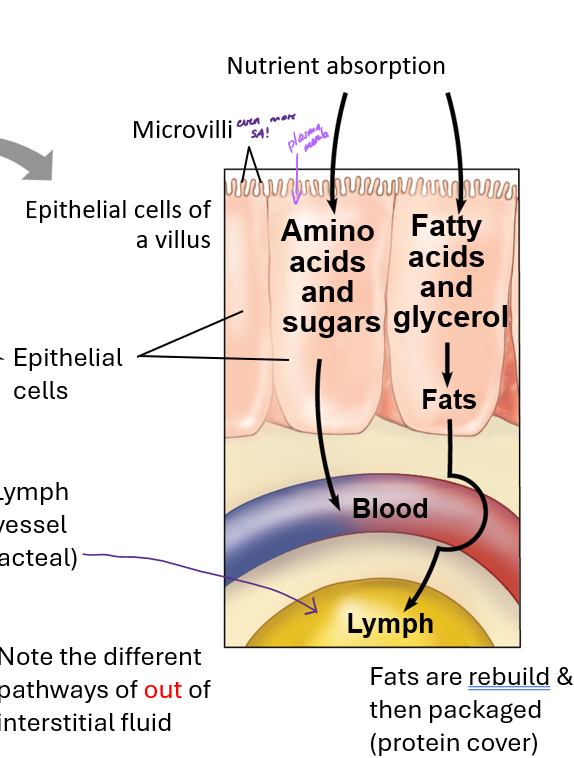
a single layer of epithelial cells, a capillary network, a lacteal, and connective tissue
What does the single layer of epithelial cells on villi do?
has microvilli that form the brush border of the intestine’s lining
What does the capillary network of villi do?
absorbs amino acids, sugars, and water-soluble nutrients
What does the lacteal of villi do?
a lymphatic vessel that absorbs fats and fat-soluble vitamins
What is the hepatic port vein?
the capillaries from the small intestine that lead to the liver instead of straight back to the heart,
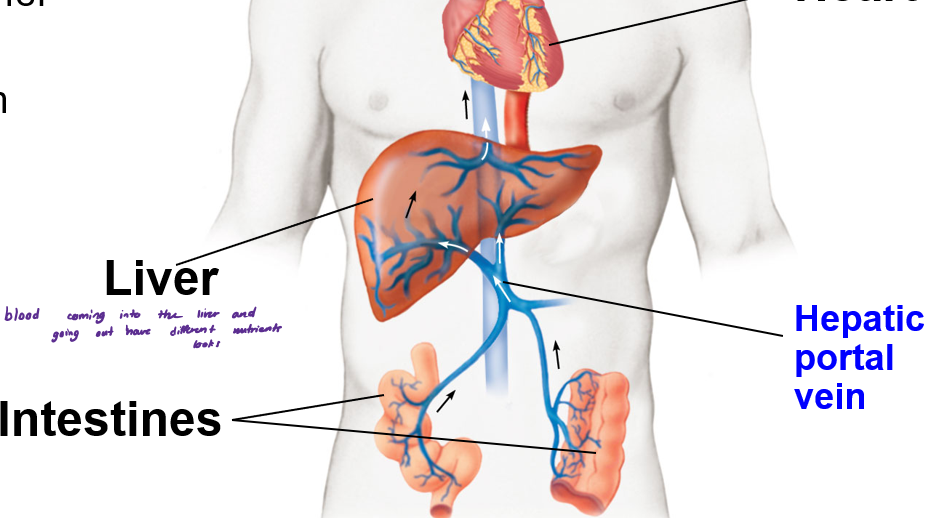
What does the liver do with blood from the intestines?
processes the nutrient laden blood from the intestines, detoxifies, converts many raw nutrient to other substances, glycogen, the blood that leaves the liver has nutrients that will look different then when it first came
Pancreatic hormones regulate blood glucose levels through …
antagonistic hormones = insulin and glucagon (antagonistic means these two hormones do the opposite of the other)
When the glucose level in blood rises, beta cells of the pancreas are …
stimulated and produce insulin which tell body cells to take up glucose to be used as energy or stored or it tells the liver and muscle to convert glucose into glycogen for later use
What are pancreatic islets?
clusters of endocrine cells inside the pancreas that produce insulin and glucagon, beta and alpha cells are found inside the islets
When the glucose level in blood drops, alpha cells of the pancreas are …
stimulated and produce glucagon, which signals to the liver to break down glycogen and release glucose, raising blood sugar levels
Where is glycogen found?
the liver
Functions of the large intestine?
reclaims some water and compacts the feces, little is absorbed here, the 10% of water that is not reabsorbed by the small intestine is absorbed by the large intestine
How long is the large intestine?
5 feet, this tells us that it does way less absorbing then the small intestine
What is at the end of the digestion system?
the rectum and anus
What is the cecum?
the receiving chamber of the small intestine, like the start of the large intestine, herbivores have a larger cecum for tough plant material

