1.3.2 Negative Externalities (in production + small subsection of consumption)
 Call Kai
 Learn
Learn Practice Test
 Spaced Repetition
 Match
Match Flashcards
 Knowt Play
1/29

Earn XP
Description and Tags
Consumption part not on spec but good to know
Name | Mastery | Learn | Test | Matching | Spaced | Call with Kai |
|---|
No analytics yet
Send a link to your students to track their progress
30 Terms
Define an externality
3rd part spill over affects arising from population/ consumption of a good for which no appropriate compensation is paid
List some external spill over costs form the production of burgers
weight gain (of customers)
health issues in customers
pressure on healthcare systems - NHS
List some external spill over costs from the consumption of burgers
litter that may need to be picked up by someone else
litter which isn’t disposed - impact on wildlife
pressure on healthcare if overconsumption of burgers leads to
What is a negative externality?
negative externalities occur when the producer or consumer of a good causes harmful effects to third parties, leading to market failure and inefficiencies
Give some examples of external costs in consumption
environmental costs
pressure on healthcare services
Give some examples of external costs in production
carbon generation
land erosion
soil damage
loss of biodiversity
noise pollution
eyesores
What is the formula for a negative externality
social cost > private cost
What are private costs?
costs to firms
What are external costs
costs to the public
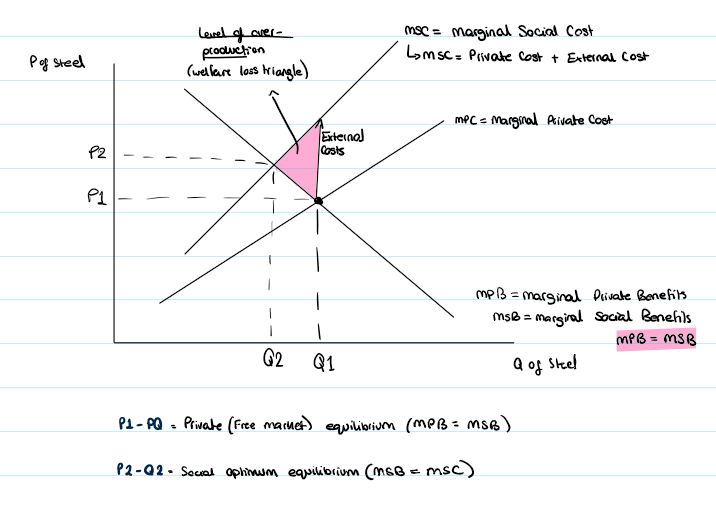
Using the example of a steel manufacturer draw a diagram and explain the private cost and external costs
Private costs to firm = the costs of production (i.e workers wages, capital equipment, factories etc) → these are the unavoidable costs
External costs to society = pollution (firm generates CO2) this has further health costs, damage to local environment)
P1 Q1 = Private (Free market) equilibrium (MPB=MSB)
P2 Q2 = Social optimum equilibrium (MSB=MSC)
Define Government intervention for negative externalities of production
Governments intervene to correct market failure to make markets work more efficiently. E.g through taxes, Subsidies, Permits, Property Right and Regulation
Taxes (environment taxes), What is the aim?
The government aims to internalise the externality.
the tax imposed on the polluting firm/ consumer in order to encourage them to stop polluting
Assess the cost of pollution, then imposes a tax equal to its value
What are the positives of taxation?
Fair: only the polluter pays → heaviest polluters pay more tax whilst those who pollute less pay less
Complement market forces, internalising costs whilst maintaining choice
Revenue can be used to clean up or compensate suffers
What are the negatives of taxation?
Difficult to measure pollution and place a money value on it
Leads to increased business costs and possible inflation → makes firms less competitive
Firms may relocate to countries where laws are more relaxed
Demand for product may be inelastic, so consumption reduction may be small
Give a real example of indirect taxation
In India, indirect tax on petrol includes a combination of excise duties and state level VAT, adding up to 55% of the market price of petrol.
Exercise duty on petrol: 19.90 pupees per litre
State-level VAT on petrol: VAT rate differ in between each state, ranging from 20% - 30% = higher rates of transportation/ car use, high VAT value.
55% of the market price being indirect tax is quite significant, as it is contributing to inflation as petrol is quite inelastic (producers push price onto consumers - cost-push inflation). This incentivises consumers to reduce the use of petrol (private cars), and instead find alternative transportation methods like public transport.
This way, the government can reduce the negative externalities that come with petrol such as pollution.
What are pollution permits?
Quota to limit the amount of pollution al
Firms can pollute up to the allowed amount.
Firms are able to buy and sell permits, or bank for future use → internalises the cost + encourages firms to turn to more sustainable methods
What are the positives of pollution permits?
pollution can be reduced overtime
government can charge firms for the right to pollute which internalises the externality
Funds generated can clean up damage
Firm generated can be used to clean up damages
What are the negatives of pollution permits?
increase the pollution costs for firms → internationally uncompetitive
only worth it if internationally enforced
less pressure on pollutants
Give a real world example of pollution permits
The EU carbon emissions trading scheme, called the ‘Cap-and-Trade’ scheme for carbon dioxide. It operates in 31 countries. It covers the 45% of the EU’s greenhouse gas emissions that come from energy intensive sectors.
The scheme sets a decreased cap (i.e maximum limit) for CO2 from energy intensive industries, and then allocates or auctions emission allowances (permits) which can be traded on the open market.
Businesses must buy enough emissions allowances to cover their CO2 emissions - the higher the price, the greater the incentive to cut pollution. Increasing the scarcity of carbon permits leads to an increase in price. This is one reason why the cap is reduced over time.
This makes it more expensive for firms to emit carbon which in turn increases the incentive to for investment in low carbon technology
What are property rights?
negative externalities exit because no one owns the resource
government allocates ownership of certain resources, e.g environmental agency responsible for protecting river/ issuing fines
compensation process may take years to resolve
What are the positives of property rights?
increased knowledge for organisation rights - pressure off gov
better likelihood that resources management carefully for future generation
property owners can change for pollution → money to clean up
What are the negatives of property rights?
difficult to extend property rights e.g phishing
difficult to trace source of damage
compensation process may take years to resolve
Give a real world example of property rights
Central Park in New York
Central park in NY is an example of a public garden. In cities these can be overused and damaged because they are open to everyone and the cost of this damage is shared by the public. Therefore there is a lack on incentive form the users to clear up because they will not profit form it (no profit motive).
The government intervened by issuing property rights to Central Park Conservancy. Because the Central Park Conservancy now owned it, they were now able to exclude harmful users, charge feed (for littering), and enforce rules. This creates incentives to maintain and protect Central park.
By giving property rights and management responsibilities to the Conservancy, overuse is reduced, the garden i swell-maintained, and the negative externalities are minimised, leading to a more socially efficient outcome.
What is regulation?
legal regulations can be imposed on producers/ consumers
measures include; complete ban on product
What are the positives on regluation
extent of activity can be more closely limited
may act an incentive to consumers/ producers to change habits
What are the negatives of regulation?
high cost of enforcement laws/ regulations (i.e inspectors may be needed)
difficult to determine what is the socially effective level of output
can be very costly to hire inspectors to ensure regulations are being followed
firms may move to other countries were there are more relaxed regulation
Give a real world example of regulation
In the UK the Environmental protection act was introduced in 1989 This set minimum environmental standards for emissions from over 3500 factories involved in chemical processes, waste incineration and oil refining.
These firms were monitored by government pollution inspectors who have the power to impose fines and close down factories
Give some negative external costs in consumption (not on the spec but good to know)
passive smoking
air travel
litter
road congestion
excessive drinking
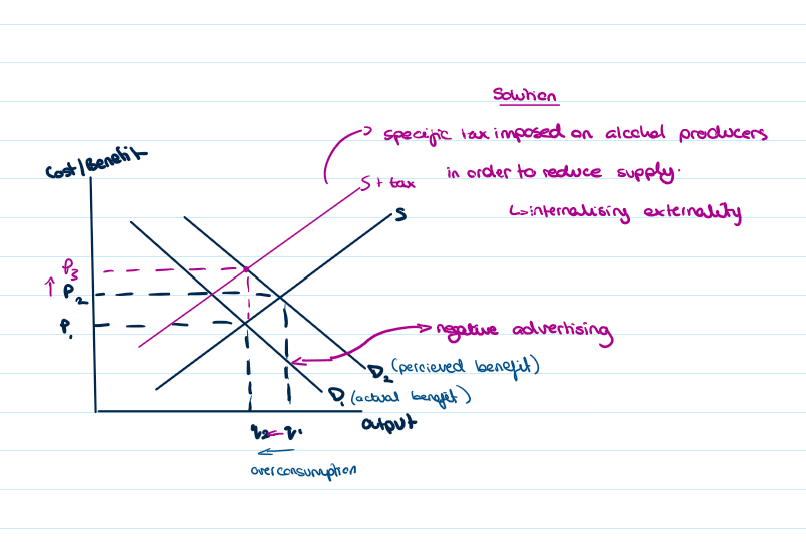
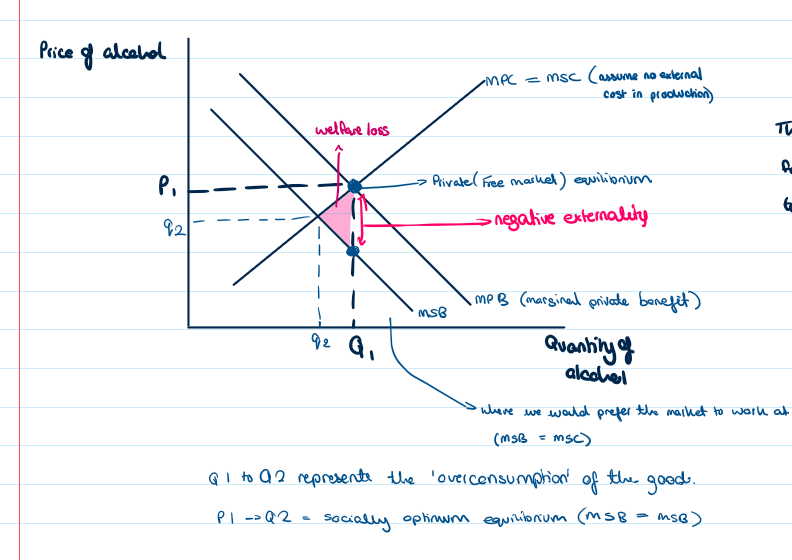
Draw out a diagram showing the negative externality of alcohol in consumption
The government intervened and imposed a specific tax on the production of alcohol. Draw this internalisation of the negative externality on a diagram