action potentials
 Studied by 0 people
 Call Kai
 Learn
Learn Practice Test
 Spaced Repetition
 Match
Match Flashcards
 Knowt Play
1/11

There's no tags or description
Looks like no tags are added yet.
Name | Mastery | Learn | Test | Matching | Spaced | Call with Kai |
|---|
No analytics yet
Send a link to your students to track their progress
12 Terms
what is an action potential?
rapid impulse that travels along a neurone, causing changes in membrane potential
what are the 3 main stages of generating an action potential?
depolarisation
repolarisation
hyperpolarisation
describe and explain how an action potential is generated:
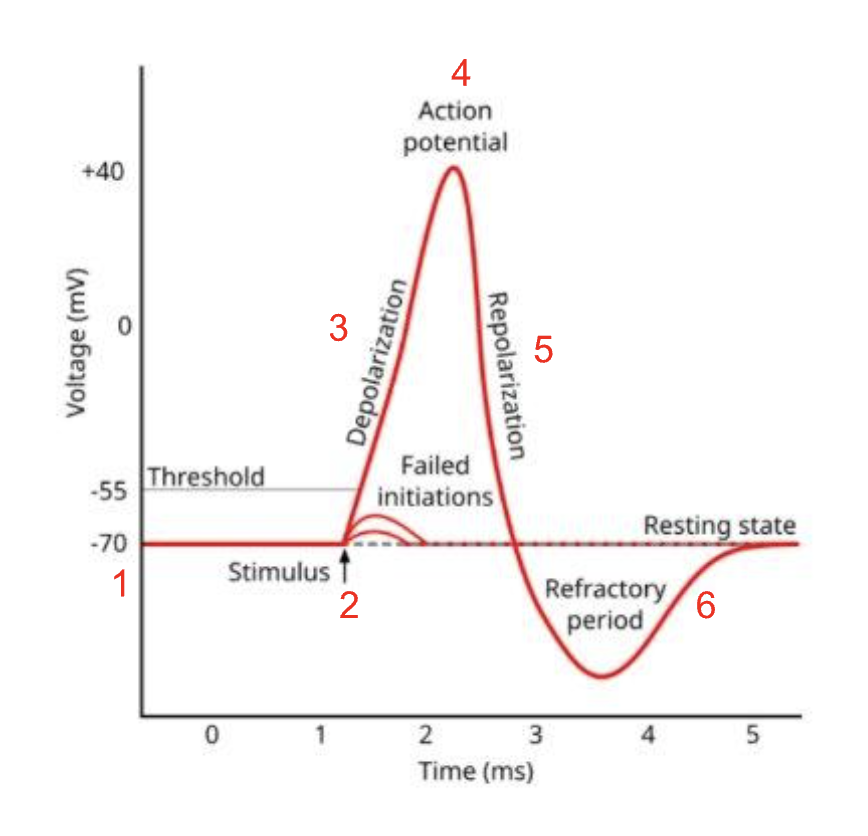
resting neurone at resting potential - some K+ voltage gated channels are open, all Na+ channels are closed
stimulus arrives at neurone, causing voltage-gated Na+ channels to open ∴ Na+ diffuses into the axons down an electrochemical gradient, making it less -ve
if the membrane potential reaches the threshold potential of -55 mV, more voltage-gated Na+ channels open - this influx of Na+ causes depolarisation
when enough Na+ enters the axon, membrane potential reaches +40 mV - this is action potential
when action potential has been reached, all voltage-gated Na+ channels close and voltage gated K+ channels open - this means that K+ start diffusion down the electrochemical gradient out of the axon
the diffusion of K+ out causes a temporary overshoot of the resting potential - this is hyperpolarisation - to restore resting potential, voltage-gated K+ channels close and Na-K pump actively transports 3Na+ out and 2K+ in
what is depolarisation?
a reversal in membrane potential
what voltage is action potential?
+40 mV
what voltage is the threshold potential?
-55 mV
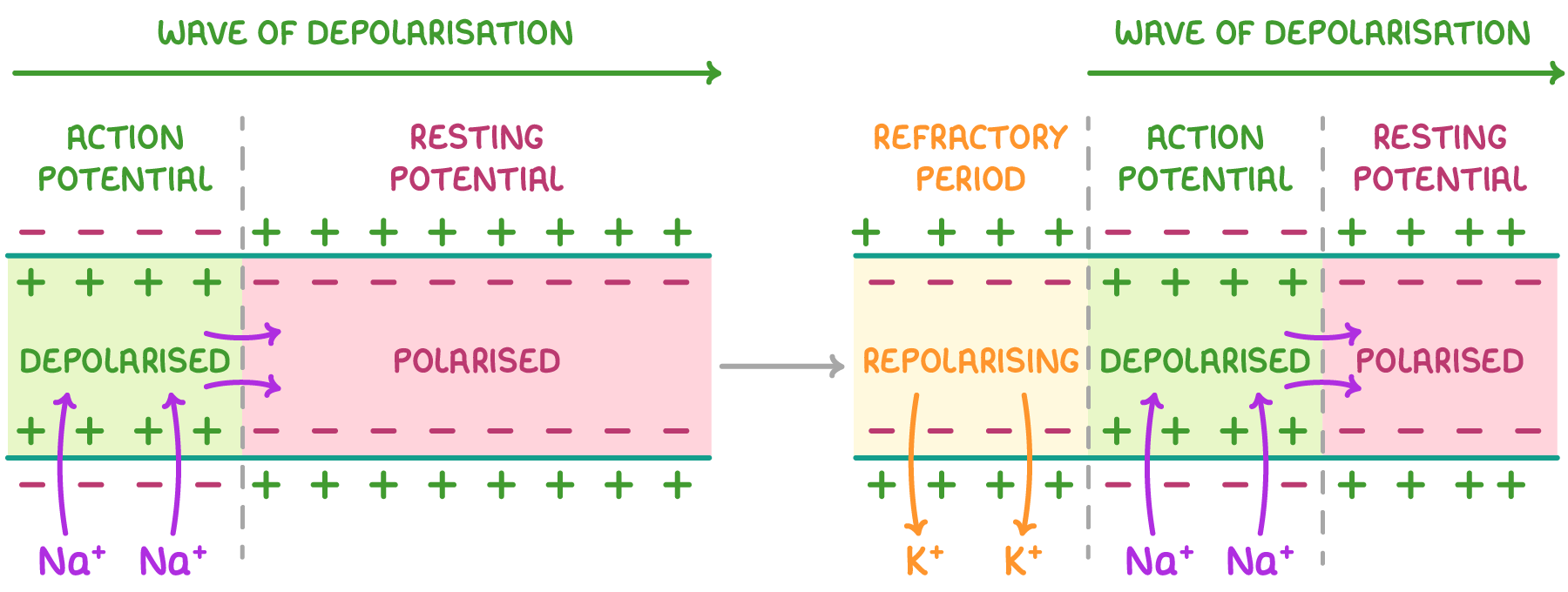
how does the action potential move along the neurone?
as a wave of depolarisation
how does the speed of action potential transmission change with axon diameter?
larger axon diameter means there is less resistance to ion flow
∴ wave of depolarisation travels faster
how does the speed of action potential change with temperature?
higher temp → faster diffusion of ions
∴ faster action potential transmissions
over 40oC - proteins denature → slower action potential transmission due to membrane damage
explain the importance of the refractory period:
ensures action potentials are discrete (i.e. don’t overlap)
limits the freq of impulses by setting a minimum time period between action potentials
ensures impulse travels in 1 direction
describe and explain the all-or-nothing principle:
once the threshold is reached, an action potential will always fire w/ the same change in voltage, no matter how big the stimulus is
if the threshold isn’t reached, an action potential won’t fire
a bigger stimulus won’t cause a bigger action potential, but it will cause them to fire more frequently
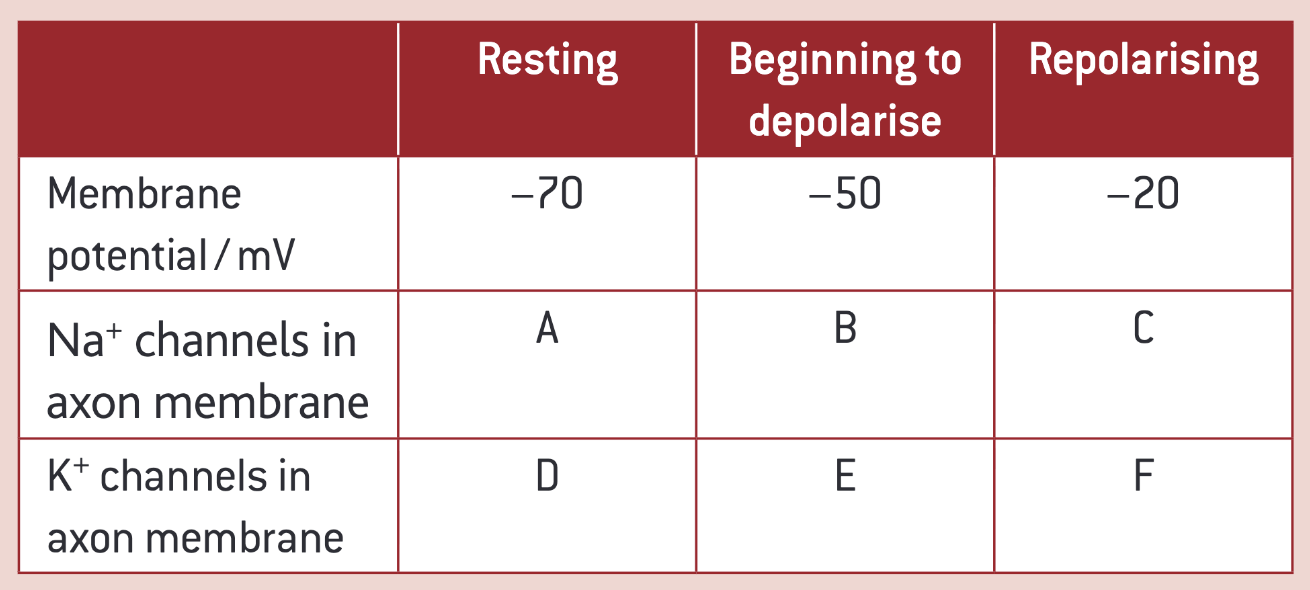
complete this table:
A = closed
B = open
C = open
D = closed (but leaky)
E = closed
F = open
 Note
Note  Flashcards (62)