A(6)- Maslow's Motives (Q2)
 Studied by 0 people
 Call with Kai
 Learn
Learn Practice Test
 Spaced Repetition
 Match
Match Flashcards
 Knowt Play
1/82

There's no tags or description
Looks like no tags are added yet.
Name | Mastery | Learn | Test | Matching | Spaced | Call with Kai |
|---|
No study sessions yet.
83 Terms
Psychology
The scientific study of behavior and mental processes.
Example: Dr. Freedia studying how stress impacts mice behavior.
Nature
The influence of heredity (genes and biological factors) on behavior and mental processes.
Example: Dr. Rojas examining the influence of genes on academic performance.
Example: Identical twins’ similarities in traits (genetically determined).
Evolutionary Perspective
A viewpoint that explains behavior as shaped by natural selection to increase survival and reproduction.
Example: Dr. Vaughn studying how traits pass to future generations for survival.
Natural Selection
The process by which traits that enhance survival and reproduction are passed on more frequently over generations.
Example: Advantageous behaviors or traits becoming more common in a population.
Behavior Genetics
The study of how genes and environment interact to influence behavior and mental processes.
Twin studies comparing identical vs. fraternal twins’ traits.
Mutations
Random changes in genes that can introduce new traits into a population.
Environment
All external influences on behavior, including family, culture, education, peers, and experiences.
Dr. Freedia’s cage changes for mice.
Heredity
The genetic transmission of traits from parents to offspring.
Example: Identical twins sharing 100% of their genes.
Example: Dr. Grant studying shared human genes.
Genes
Segments of DNA that carry instructions for inherited traits.
Example: Dr. Rojas examining how genes influence academic performance.
Genome
The complete set of genetic material (all genes) in an organism.
Example: Humans share most of their genome across all people (Dr. Grant).
Nurture
The influence of environmental factors and life experiences on behavior and development.
Example: Dr. Yondu providing a social skills intervention to see effects on emotional stability.
Example: Prenatal cocaine exposure in rats affecting hyperactivity.
Example: Frequent housing changes in mice increasing stress hormone levels in offspring.
Eugenics
A discredited movement that aimed to improve the human population by controlling reproduction.
Example: Misusing genetics to justify discrimination.
Identical (Monozygotic) Twins
Twins who develop from a single fertilized egg (zygote) and share 100% of their genes.
Example: Dr. Koulianos expecting identical twins raised together to be most alike in athletic ability.
Fraternal (Dizygotic) Twins
Twins who develop from two separate fertilized eggs (zygotes) and share about 50% of their genes.
Interaction
The idea that genes and environment work together to shape behavior and mental processes.
Example: Identical twins raised apart show differences due to environment.
Example: Prenatal cocaine exposure affects hyperactivity in rats.
Epigenetics
How environmental factors can turn genes on or off without changing DNA 🧬
- Example: Chronic stress can activate genes linked to anxiety 😟
motivation
A need or desire that energizes and directs behavior.
physiological need
A basic bodily requirement such as hunger or thirst.
Example: Karl’s hunger when he arrives home.
homeostasis is
the body’s tendency to maintain a balanced internal state.
incentives
External stimuli that motivate behavior.
Example: The freshly baked bread Karl smells.
drive- reduction theory
behavior is motivated by the desire to reduce drives (uncomfortable physiological need) and return the body to a state of balance (homeostasis). → drives: (e.g., hunger, thirst).
Example: Prunella drinks water to reduce thirst.
Example: Feeling hungry (need) + smelling bread (incentive) → Karl eats to reduce the drive.
arousal theory
People are motivated to maintain an optimal level of arousal.
optimal level of arousal
The level of alertness at which performance is maximized.
Yerkes-dodson law
Performance increases with arousal up to a point, then decreases.
Example: Students performed worse doing calculus in front of experts due to high arousal.
self-determination
humans thrive when three basic psychological needs are met
Autonomy – feeling in control of your choices
Competence – feeling capable
Relatedness – feeling connected to others
intrinsic motivation
A desire to perform a behavior for its own sake.
A student studies psychology because they genuinely love understanding human behavior.
extrinsic motivation
A desire to perform a behavior to receive external rewards or avoid punishment. • Example: Nolan studies because his teacher praises him.
insticnts
Innate, biologically rooted behaviors.
Example: A baby grasping a finger placed in their palm (grasp reflex).
instinct theory
A theory that suggests behaviors are driven by innate tendencies and instincts that are biologically programmed.
Lewins motivational conflicts theory
A theory that describes how individuals experience conflict when choosing between different goals or desires, categorized into approach-approach, avoidance-avoidance, and approach-avoidance conflicts.
approach-approach conflict
A conflict between two desirable options.
approach-avoidance conflict
A conflict involving one option with both positive and negative aspects.
avoidance-avoidance conflict
A conflict between two undesirable options.
sensation-seeking theory
Some individuals seek high levels of arousal and novel experiences.
hormones
Chemical messengers that travel through the bloodstream to regulate body processes 🩸
😴 Melatonin → sleep
😡 Adrenaline → stress response
Ghrelin
The “hunger hormone” that increases appetite 📈
Example:
⏰ Stomach releases ghrelin → you feel hungry
🥪 Signals brain it’s time to eat
Leptin
The “fullness hormone” that decreases appetite 📉
Example:
🍽 After eating → leptin released
🧠 Tells brain to stop eating
Glucose
Definition:
A type of sugar in the blood that provides energy ⚡
Example:
🍞 Eating carbs → glucose rises
🧠 Low glucose → hunger signal
Hypothalamus
Brain area that maintains homeostasis and links the nervous system to the endocrine system ⚖
Example:
🌡 Regulates body temperature
🍽 Controls hunger & thirst
🧪 Directs the pituitary gland
Pituitary Gland
The “master gland” that controls other endocrine glands 🧬
Example:
📏 Releases growth hormone
🧠 Takes orders from hypothalamus
Orexin
Brain chemical that stimulates hunger and arousal 🔥
Example:
🍔 High orexin → increased appetite
👀 Keeps you awake + motivated to eat
PYY (Peptide YY)
Hormone that reduces hunger after eating 🛑
Example:
🍕 Released by intestines after meals
🧠 Signals brain: “I’m full”
Set Point
Body’s preferred or stable weight, maintained by metabolism and hunger 🔄
Example:
📈 Weight drops → hunger increases
📉 Weight rises → appetite decreases
Basal Metabolic Rate (BMR)
Energy your body uses at rest to stay alive ⚡
Example:
🛌 Breathing, heartbeat, temperature control
📉 Eating less → BMR drops → weight loss slowsThe rate at which your body expends energy while at rest, necessary for basic physiological functions.
Metabolic Adaptation
Body’s ability to adjust metabolism in response to calorie intake ⚖
Example:
🍽 Eating less → body conserves energy
🐢 Slower metabolism over time
Research methods used to support the genetic influence on weight?
twin studies comparing identical and fraternal twins to study genetic influence 🧪
Similar weights in identical twins—even when raised apart—support a genetic influence on weight.
humanistic psychology
Focuses on human potential, growth, and self-fulfillment 🌟
Example:
Therapists encourage clients to explore feelings and personal goals
Emphasizes free will and conscious choices
unconditional positive regard
Accepting and valuing a person without conditions ❤
Example:
👂 Therapist listens without judgment
Parents loving a child no matter what
self-actualizing tendency
The natural drive to reach one’s full potential ✨
Example:
🧗 Person striving for personal growth and meaning
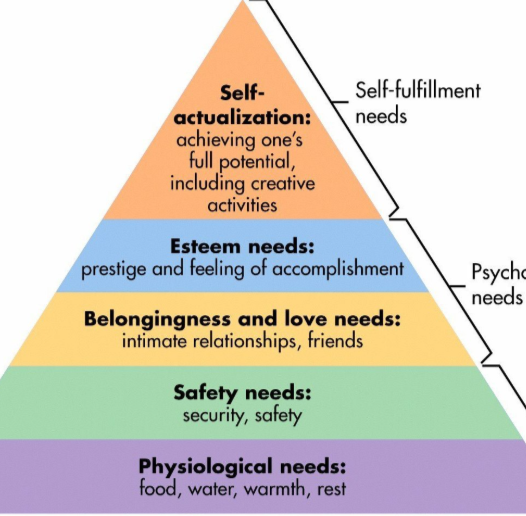
Maslow’s hierarchy of needs
Self-Actualization
Esteem Needs
Belongingness & Love Needs
Safety Needs
Physiological Needs
self concept
A person's perception of their own identity, beliefs, and abilities; how one views oneself in relation to the world.
ostracism
The experience of being ignored, excluded, or rejected by others.
Sandra feels shunned after being left out of a party — she is experiencing ostracism.
achievement motivation
The desire to master skills, meet standards, and achieve excellence.
The graph showing a positive correlation between achievement motivation and mental health reflects this concept.
intrinsic motivation
Motivation driven by internal satisfaction, curiosity, or enjoyment.
JaCorie works hard because he enjoys learning — intrinsic motivation predicts long‑term academic persistence.
extrinsic motivation
Motivation driven by external rewards such as money, grades, or praise
Josslyn works hard because her parents pay her for good grades — short term motivation.
Self-Determination Theory (SDT)
A theory stating that humans need autonomy, competence, and relatedness to thrive
Close relationships support the SDT need for relatedness, which is why they increase meaning in life.
Public Commitment (goal-setting principle)
Stating goals to others increases accountability and follow‑through.
Fergie telling friends and family about her goal improves her chances of earning a high exam score.
one-trial conditioning
Learning that occurs after a single, biologically meaningful event (such as illness, pain, or danger), because the association is strong enough to form immediately.
Example: Esther ate a hamburger once, got sick 🤢, and immediately avoided hamburgers afterward — a classic one‑trial learning effect.
biological preparedness
The evolutionary tendency to form certain associations more easily because they aid survival.
Example: Dr. Cao studies why organisms quickly learn to avoid foods that once made them sick 🧬, showing how survival‑related associations are learned faster.
habituation
A decrease in response to a repeated, harmless stimulus over time.
Example: If Ari eventually stopped jumping out, Yaya would get used to the grocery store wall and stop reacting 🔁 — but because the scares continued, she developed fear instead of habituation.
primary reinforcers
A reinforcer that is naturally rewarding because it satisfies a biological need.
Example: Giving a hungry child food 🍎 increases the behavior because food is inherently rewarding.
secondary reinforcers
A reinforcer that becomes rewarding through learning because it is associated with a primary reinforcer.
Example: Greg sells cards because they are linked to receiving praise or bonuses 💵
reinforcement discrimination
Learning to respond to a specific stimulus because only that stimulus is reinforced.
Example: A dog learns that sitting only earns a treat when the owner says “Sit!” in a firm tone 🎯, not in a playful voice.
reinforcement generalization
When a behavior reinforced in one situation spreads to similar situations.
Example: A student praised for raising her hand in math class starts raising her hand in other classes too 🙋♀.
shaping
Reinforcing successive steps toward a complex behavior that the learner cannot perform all at once.
Example: Training a dolphin by rewarding each small step toward jumping through a hoop 🐬.
instinctive drift
When an animal’s biological instincts gradually replace or interfere with learned behaviors.
Example: A raccoon trained to drop coins eventually starts rubbing and hoarding them 🦝 because instinct takes over.
interviewer illusion
the tendency for interviewers to overestimate their ability to accurately judge a candidate.
Example: An interviewer thinks a 10‑minute chat reveals someone’s true personality 😎
personnel psychology
The subfield that selects, hires, trains, and evaluates workers.
Example: A company uses assessments to choose the best job applicants 📝
human factors psychology
The subfield that designs tools, machines, and environments to fit human abilities.
Example: Engineers redesign a control panel so workers don’t press the wrong button 🔧
organizational psychology
The subfield that studies workplace motivation, leadership, teamwork, and satisfaction.
Example: A consultant helps improve communication between team members 👥
positive psychology
The subfield focused on human strengths, well‑being, and flourishing.
Example: A workplace program encourages gratitude and strengths‑based reflection 🌱
strengths-based hiring
A modern personnel psychology approach emphasizing candidates’ job‑relevant abilities over past experience.
Example: A company hires someone for their creativity rather than years in the field 💡
past job experience (deemphasized)
traditional hiring focus now less emphasized in favor of strengths and potential.
Example: A résumé with many past jobs matters less than demonstrated skill 🎯
McClelland’s Theory of Needs
A motivational framework proposing that achievement, affiliation, and power drive workplace behavior and performance.
achievement need
affiliation need
power need
high achievement motivation
high affiliation motivation
high power motivation
personal power
socialized power
achievement need
McClelland’s motivational need to excel, meet high standards, and accomplish challenging goals.
Example: Bovary practices trumpet daily to become first chair 🎺
affiliation need
The motivation to form close, meaningful social relationships.
Paola believes humans are “social animals,” which reflects a high affiliation need.
power need
The desire to influence, control, or direct others’ behavior.
Example: A student volunteers to lead the group presentation and assign roles 🗣
High achievement motivation
Preference for moderately challenging tasks, personal responsibility, and clear feedback.
Example: A worker picks a project that is difficult but doable so they can prove their skill 🎯
high affiliation motivation
Preference for cooperation, social harmony, and avoiding conflict.
Example: A team member smooths over disagreements to keep everyone feeling connected 😊
high power motivation
Preference for leadership roles, status, and opportunities to influence others.
Example: A student runs for club president to guide the group’s direction 👑
personal power
A form of power motivation focused on controlling others for personal gain.
Example: A manager insists on making every decision alone to feel important 💼
socialized power
A form of power motivation focused on helping groups or organizations succeed.
Example: A coach motivates the team to improve so everyone benefits 🏆
Type A vs Type B
A:
planned organizer, not procrastinator, rigid, mindful of risks
B
relaxed, spontaneous, more flexible in approach, enjoys leisure activities, less organized, more creative
 Note
Note  Flashcards (128)