ADs, WC Specs, Lines, Tubes, Other Equipment, and Diagnostic tests
 Call Kai
 Learn
Learn Practice Test
 Spaced Repetition
 Match
Match Flashcards
 Knowt Play
1/33

Earn XP
Description and Tags
From Equipment and Devices in CM
Name | Mastery | Learn | Test | Matching | Spaced | Call with Kai |
|---|
No analytics yet
Send a link to your students to track their progress
34 Terms
What are primary uses of an AD during ambulation?
Decreasing WB on the LEs
MM weakness of the trunk or LEs
Dec balance or impaired kinesthetic awareness
Pain
What AD is the most stable for beginning ambulation with a patient?
Parallel bars
What height is used for parallel bars, walkers, canes, and axillary crutches?
To allow for 20-25 dgs of elbow flexion when grasping 4-6 inches in front of the body (and to the ulnar styloid process when arms are at the side)
What gait pattern is a walker most suited for?
3-point
How much spaces should their be between the top of axillary crutches and a patient’s axilla (armpit)?
At least 3 finger widths away
What side should a cane be used on?
The non-affected side (strong side)
How do you measure for a WCs seat height/leg length?
Measure from the user’s heel to the popliteal fold and then add 2 in. (avg is 19.5-20.5 in.)
How do you measure for a WCs seat depth?
Measure from the user’s posterior glute, along the lateral thigh, to the popliteal fold and then subtract 2 in. (avg is 16 in.)
How do you measure for WC seat width?
Measure from the widest aspect of the users glutes, hips, or thighs and add 2 in. (avg is 18 in.)
How do you measure for WC back height?
Measure from the seat of the chair to the floor of the axillar with the user’s shoulder flexed to 90 dgs, then subtract 4 in. (avg is 16-16.5 in.)
How do you measure for WC armrest height?
Measure from the seat of the chair to the olecranon process with the user’s elbow flexed to 90 dgs and then add 1 in. (avg is 9 inches above the chair seat)
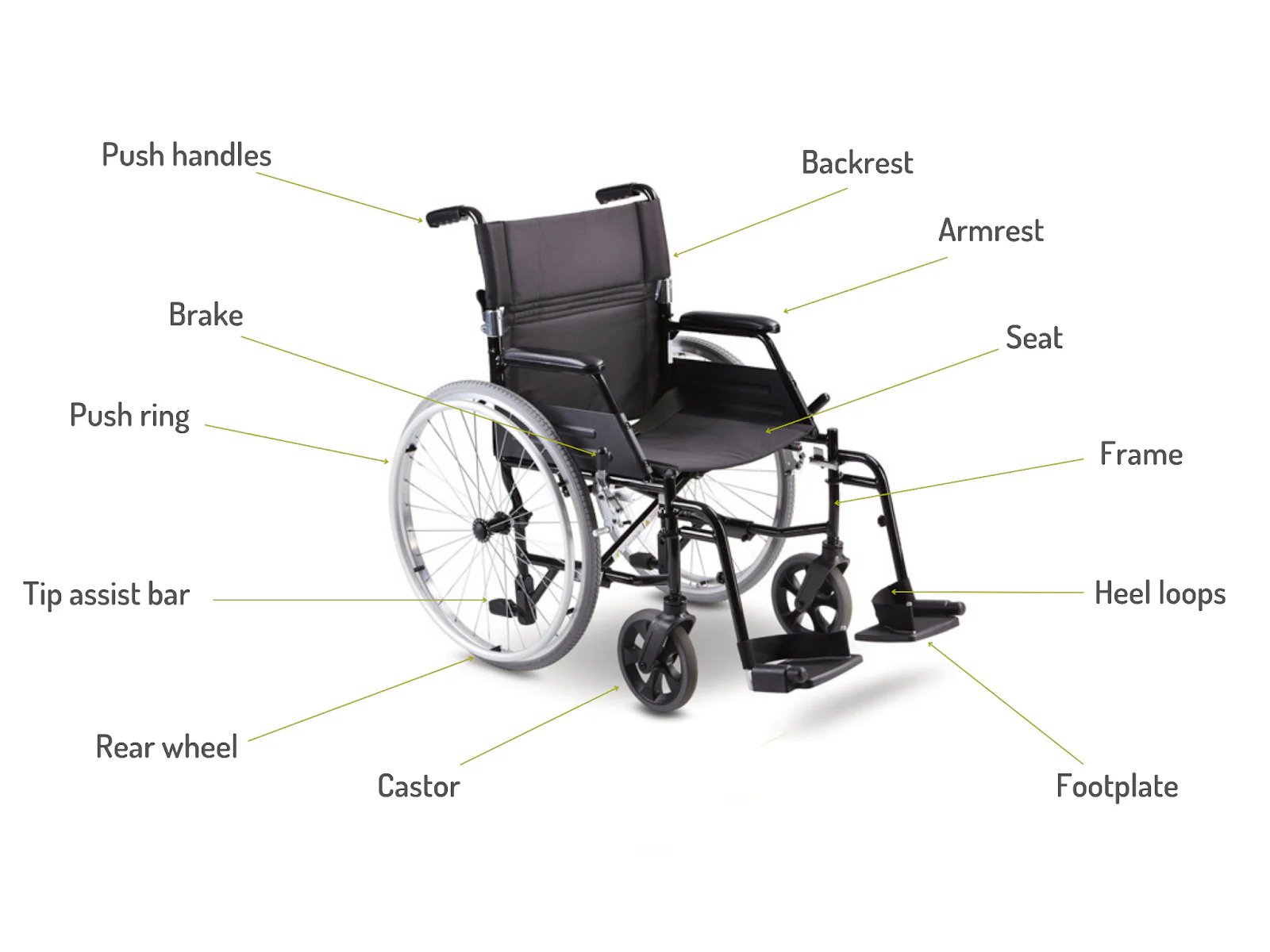
Wheelchair parts
Nasogastric (NG) tube
A plastic tube inserted through the nostril that extends to the stomach
Used for short-term feeding, administering meds, or to remove gas from the stomach
Gastrostomy (G) tube
A tube is inserted through a small incision in the abdomen into the stomach
Used for long-term feeding when swallowing is difficult due to anatomic or neuro disorders or to avoid aspiration
Jejunostomy (J) tube
A tube inserted through endoscopy into the jejunum via the abdominal wall
Used for long-term feeding for patients who cannot receive food by mouth
Intravenous system (IV)
A sterile fluid source, a pump, a clamp, and a catheter to insert into a vein
Used to infuse fluids, electrolytes, nutrients, and meds when the intestinal tract is not able to digest and absord food
Most commonly inserted into the basilic, cephalic, or antecubital
Arterial line
A thin catheter that is inserted into an artery and attached to an electronic monitoring system (EM)
Used to measure arterial blood pressure, obtain blood samples, or administer meds
*If displaced, the therapist should apply pressure to limit blood loss and call for assistance
Central venous pressure catheter
Used for measuring pressures in the R atrium or the sup vena cava through an indwelling venous catheter and pressure manometer
Also used to evaluate R ventricular function, R atrial venous pressure, and circulating blood volume
Indwelling right atrial catheter (Hickman)
Runs through the cephalic or internal jugular vein and is threaded into the sup vena cava or R atrium
Used for long term admin of substances into the venous system such as chemo agents, parenteral nutrition, and antibiotics
Intracranial pressure (IP) monitor
Measure the pressure exerted against the skull or pressure within the brain
Pulmonary artey catheter (Swanz-Ganz catheter)
A flexible catheter that is inserted through a vein into the pulmonary artery
Used to provide continuous monitoring of pulmonary artery pressure
Nasal cannula
Tubing extending approx. 1 cm into each nostril of a patient
Used to deliver up to 6 liters of O2 per minute
Oronasal mask
A facepiece designed to cover the nose and mouth with small vent holes to expel exhaled air along with a breathing tube and connector
Used most often for O2 therapy, but can also be used to give meds, mucolytic detergents, or humidity by the use of an accessory nebulizer
Tent
A canopy placed over the head and shoulders or the entire body for the purpose of deliver O2 at a higher lvl than normal
Tracheostomy mask
A mask placed over a stoma or tracheostomy for the purpose of giving supplemental O2
Balanced suspension traction
Surgically inserted pins, screws, and wires that apply traction force
Commonly used for comminuted femur fractures and requires prolonged immobilization (and therefore risks skin breakdown)
External fixation
A surgical procedure were holes are drilled into uninjured areas of bone surrounding a fracture to insert wires, pins, bolts, and screws so that the bone fragments can be aligned
Allows for earlier mobility for complex fractures
Internal fixation
A surgical procedure that uses metal plates, rods, wires, etc., and attempts to promote the healing process of bone without any external applications being applied to the skin
Commonly used for comminuted or displaced fractures
Urinary catheter types
External - applied over the shaft of the male genital
Foley - indwelling that has a balloon attachment at the end
Suprapubic - surgically inserted into the bladder
Chest tube
A flexible plastic tube that is inserted through an incision into the side of the chest so suction can be used to remove air, fluid, or pus from the intrathoracic space
Mechanical ventilator
Produces a controlled flow of gas into a patient’s airways that causes positive pressure the the inflation of the lungs for those that cannot breathe on their own
Volume cycled = delivers a predetermined amount of gas based on the patients need during the inspiratory phase
Pressure cycled = delivers a predetermined max pressure of gas during respiration
Ostomy device
A method for collection of waste from a surgically produced opening in the abdomen
Removal occurs through a stoma extending into the SI
Arteriography
An invasive procedure that uses X-ray and injects contrast dye to visualize blood vessels and identify arteriosclerosis, aneurysms, vascular malformations, tumors, and blockages
Pros: Useful for dx of vascular abnormalities
Cons: Invasive, potential allergy to contrast dye
Athrography
UNFINISHED - START BACK UP HERE IN DIAGNOSTIC TESTS

