Characteristics of phobias (and depression + OCD)
 Call Kai
 Learn
Learn Practice Test
 Spaced Repetition
 Match
Match Flashcards
 Knowt Play
1/50

There's no tags or description
Looks like no tags are added yet.
Name | Mastery | Learn | Test | Matching | Spaced | Call with Kai |
|---|
No analytics yet
Send a link to your students to track their progress
51 Terms
Phobia
A phobia is an excessive, irrational and persistent fear of a specific object, situation or activity that leads to avoidance and significant anxiety.
What does the DSM say about phobias?
It lists the following categories of phobia and related anxiety disorder:
specific phobia
social anxiety
agoraphobia
Specific phobia
A phobia of a particular object or situation, such as animals, heights or blood.
Example of a specific phobia
Arachnophobia, which is an intense fear of spiders.
Apiphobia - fear of bees
Satanophobia - fear of satan
Social phobia (social anxiety disorder)
A phobia involving an intense fear of social situations where the individual may be judged, criticised or embarrassed by others.
Example of a social phobia
Fear of public speaking (glossophobia) due to anxiety about being negatively evaluated.
Fear of public toilets
Agoraphobia
fear of public spaces
Example of agoraphobia
Avoiding public transport or busy shopping centres due to fear of having a panic attack.
fear of outside
Behavioural characteristics of phobias
Panic responses - such as crying, screaming or freezing,
Avoidance of the feared stimulus,
Endurance where the individual remains in the presence of the stimulus with high anxiety.
Emotional characteristics of phobias
Intense and persistent fear and anxiety triggered by a specific object or situation, which is disproportionate to the actual threat.
Cognitive characteristics of phobias
Irrational beliefs about the feared stimulus,
Selective attention towards the phobia,
Cognitive distortion - thinking about danger (perceptions often inaccurate/ unrealistic
How does the behavioural approach explain phobias?
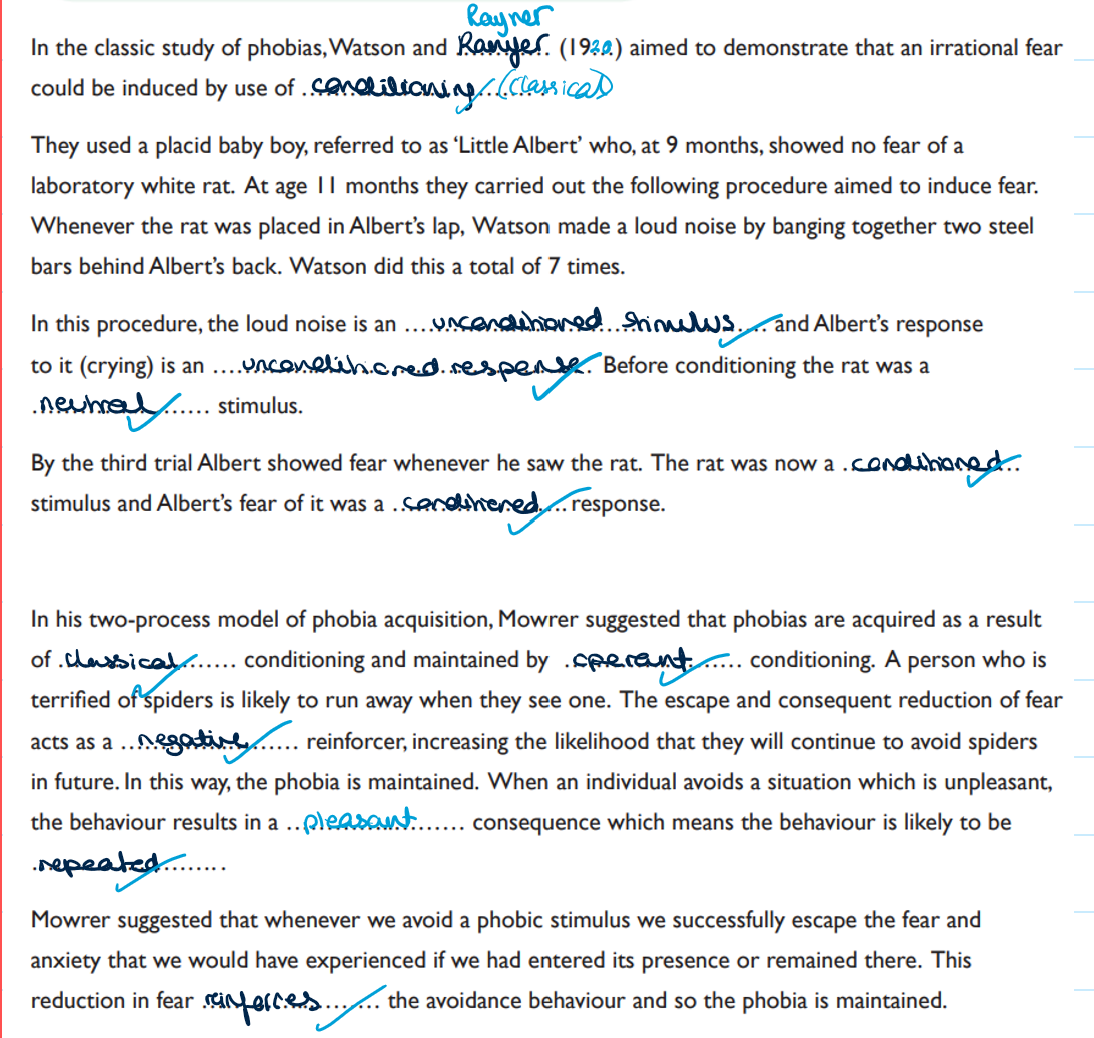
Through the two way process
What is the two way process?
The two way process states that phobias are learned first by classical conditioning and then continue to operant conditioning.
It consists of classical and operant conditioning
What was Watson & Rayner (1920)’s Little Albert study?
Neutral stimulus — a furry animal (monkey, white rat or dog) → no response
Uncontained stimulus — loud noise →unconditioned response → fear
Neutral stimulus — furry animals + Unconditioned stimulus — loud noise → unconditioned response — fear
Conditioned stimulus — furry animals → conditioned response — fear
Explain the two way process
The two way approach states that phobias are learned first by classical conditioning and then continue due to operant conditioning.
One of the behavioural characteristics of phobias is avoidance - by avoiding a situation which the individual feels unpleasant, the avoidance behaviour is negatively reinforced as it results in a desirable response (individual escapes the fear/ anxiety form the situation).
The reduction in fear/ anxiety reinforces the avoidance behaviour to maintain the phobia.
Behavioural approach in treating phobias
Systematic desensitisation, including relaxation and use of hierarchy and flooding
What is systematic desensitisation?
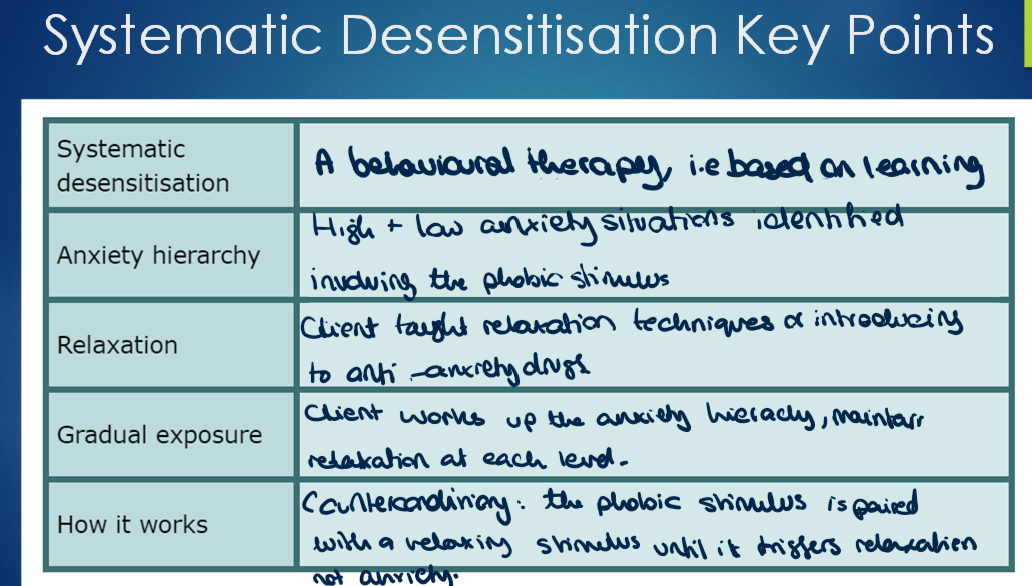
A behavioural therapy designed to gradually reduce phobic anxiety by teaching a person to relax whilst exposing them to phobic situations so that the phobic stimulus is paired with relaxation rather than anxiety. This learning of a different response is called counterconditioning
What is the process of systematic desensitisation?
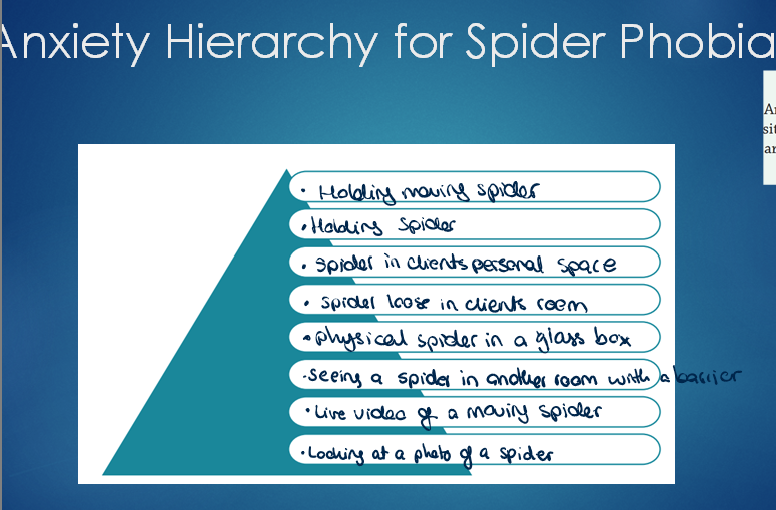
Anxiety hierarchy
Relaxation
Exposure
What is an anxiety hierarchy?
The client creates a list of situations related to the phobic stimulus from least to most frequent with the therapist
What is relaxation?
Client learns to relax as deeply as possible through breathing exercises, meditation, mental imagery techniques or through the use of drugs (e.g valium). It is not possible to afraid and relaxed at the same time so relaxation prevents fear through reciprocal inhibition. Examples: Box breathing, counting down from 39 in threes, naming 5 things you can see, hear, smell, feel
What is exposure
Whilst in a relaxed state the client is exposed to phobic stimulus across several sessions, stating at the lowest levels of phobic stimulus and moving up the hierarchy when the client can stay relaxed. Once client can stay relaxed in the highest anxiety hierarchy then treatment is thought to be successful.
Make an anxiety hierarchy
Give a supporting peel for systematic desensitisation (more effective than drugs)
P: Systematic desensitisation is more effective compared to drugs
E: Klosko et al (1990) suggested that systematic desensitisation was as good as or better in treating phobias than most popular drugs. On completion of treatment, 87% of patients from the systematic de- sensitisation treatment group were free of fear/ anxiety compared to 50% of the drug treatment group.
E: This evidence suggests that systematic desensitisation is 37% more effective than drug treatment, therefore strengthening the treatment and due to the higher success rate the validity of the method of treating phobias is increased
L:
Give a limitation peel for systematic de sensitisation (cost)
P: Systematic desensitisation can be quite expensive
E: This is because it may require many sessions which may go over years and each session which have a cost.
E: As a result of this, systematic desensitisation can be inaccessible to certain populations
L: This is a disadvantage of this methods because it is not accessible to all who need it.
Give a limitation peel for systematic desensitisation (practicality for some phobias)
P: Systematic desensitisation may not be realistic for all types of phobias
E: This is because for phobias such as flights it may be hard to organise the desensitisation process. This may be because it is difficult to
What is a key thing to take into account about systematic desensitation?
must be completely relaxed at a staged to move on to the next stage
Summarise systematic desensitisation
What is flooding?
It is a behavioural therapy
A fast process: small number of long sessions, sometimes just one session of three hours
preparing the client: flooding is a traumatic experience so the client needs to be well prepared for the exposure
How does flooding work?
through extinction
The theory is that the clients cannot make their usual avoidance responses and anxiety peaks at such high levels it cannot be maintained and eventually decreases
As the response is decreasing the patient is learning that the phobic stimulus is harmless. In classical conditioning terms this is called extinction
The learned response is extinguished when the conditioned stimulus (e.g a dog) is encountered without the unconditioned stimulus (e.g being bitten). The result is the conditioned stimulus no longer produces the conditioned response (fear).
DEPRESSION
Behavioural characteristics of depression
Reduced activity levels, withdrawal from social interaction, disrupted sleep and eating patterns, and possible self-harm.
Emotional characteristics of depression
Persistent low mood, feelings of sadness, worthlessness or guilt, and a reduced experience of pleasure.
Cognitive characteristics of depression
Negative thinking patterns such as negative self-concept, pessimistic view of the world and future, and poor concentration.
OBSESSIVE-COMPULSIVE DISORDER (OCD)
Behavioural characteristics of OCD
Compulsive behaviours such as repetitive cleaning, checking or counting, which are performed to reduce anxiety.
Emotional characteristics of OCD
Intense anxiety and distress when obsessions occur, and temporary relief following compulsive behaviour.
Cognitive characteristics of OCD
Obsessive thoughts that are intrusive and persistent, catastrophic thinking, and awareness that thoughts are irrational but difficult to control.
Arachnophobia
Fear of spiders.
Claustrophobia
Fear of enclosed or confined spaces.
Acrophobia
Fear of heights.
Agoraphobia
Fear of situations where escape may be difficult or help unavailable, often involving open or crowded spaces.
Social phobia
Fear of social situations where the individual may be judged or negatively evaluated.
Ophidiophobia
Fear of snakes.
Aerophobia
Fear of flying.
Trypanophobia
Fear of needles or injections.
Cynophobia
Fear of dogs.
Thanatophobia
Fear of death or dying.

