Routes of Administration
 Studied by 3 people
 Call Kai
 Learn
Learn Practice Test
 Spaced Repetition
 Match
Match Flashcards
 Knowt Play
1/94

Earn XP
Description and Tags
Name | Mastery | Learn | Test | Matching | Spaced | Call with Kai |
|---|
No analytics yet
Send a link to your students to track their progress
95 Terms
Intravascular administration
[ROUTES OF ADMINISTRATION]
Places a drug directly into the bloodstream, resulting in immediate effect and 100% bioavailability.
Intravascular administration
[ROUTES OF ADMINISTRATION]
This route does not undergo absorption; the drug is directly distributed.
Dissolution
Rate-limiting step prior to absorption
Bioavailability
How much of the drug reaches the systemic circulation.
Extravascular administration
[ROUTES OF ADMINISTRATION]
Involves the drug being delivered to a site outside the bloodstream, requiring an absorption process that leads to delayed and potentially incomplete bioavailability.
Intravascular
[ROUTES OF ADMINISTRATION]
Intravascular vs. Extravascular route
Direct to bloodstream; 100% bioavailability
Extravascular
[ROUTES OF ADMINISTRATION]
Intravascular vs. Extravascular route
Requires absorption
potentially incomplete bioavailability
Intravenous (IV)
Intra-arterial
Intracardiac
Example of Intravascular route [3]
Parenteral (Extravascular)
Oral
Subcutaneous
Intramuscular
Intranasal
Intradermal
Intrathecal
Sublingual
Rectal
Ocular
Urethral
Vaginal
Transdermal
Example of Extravascular route [13]
Intravenous (IV)
[ROUTES OF ADMINISTRATION]
Immediate onset of action
100% bioavailability
Precise dose control
Intravenous (IV)
[ROUTES OF ADMINISTRATION]
Risks: Toxicity, infection, embolism
Cannot be recalled once given
Intravenous (IV)
[ROUTES OF ADMINISTRATION]
Best for: Emergencies
Embolism
Can dislodge a blood clot, causing it to travel through the bloodstream
Pulmonary embolism
[Types of Venous thromboembolism]
Clot travels to lungs
Deep vein thrombosis
[Types of Venous thromboembolism]
Clot forms in deep veins, usually legs
Intra-Arterial (IA)
[ROUTES OF ADMINISTRATION]
Delivers drug directly to target organ
Intra-Arterial (IA)
[ROUTES OF ADMINISTRATION]
Used in chemotherapy and imaging
Intra-Arterial (IA)
[ROUTES OF ADMINISTRATION]
High risk of tissue necrosis – maximum concentration in the organ
Rarely used routinely
Example: Regional cancer chemotherapy
Tissue necrosis
The tissue/organ dies
Intracardiac (IC)
[ROUTES OF ADMINISTRATION]
Emergency-only route
Direct injection into the heart
Intracardiac (IC)
[ROUTES OF ADMINISTRATION]
Very high risk
Largely replaced by IV route
Intracardiac (IC)
[ROUTES OF ADMINISTRATION]
Example: Cardiac resuscitation (historical use)
Enteral Route
Extravascular Route is also known as ____ ?
Oral (PO)
[ROUTES OF ADMINISTRATION]
Most common and convenient route
Oral (PO)
[ROUTES OF ADMINISTRATION]
Subject to First-pass effect metabolism (in the liver)
Onset
Refers to “How long before the drug takes effect”
Oral (PO)
[ROUTES OF ADMINISTRATION]
Variable absorption (affected by food, pH, motility)
Slower onset compared to parenteral routes
Oral (PO)
[ROUTES OF ADMINISTRATION]
Not suitable for patients who are vomiting, unconscious, or NPO (Nothing By Mouth)
Avoid for: Acid-labile drugs, emergencies
Oral (PO)
[ROUTES OF ADMINISTRATION]
Examples: Paracetamol, Amoxicillin
Sublingual (SL)
[ROUTES OF ADMINISTRATION]
under the tongue; directly connected to superior vena cava
Sublingual (SL)
[ROUTES OF ADMINISTRATION]
Absorbed directly via the oral mucosa
Bypasses first-pass metabolism
Sublingual (SL)
[ROUTES OF ADMINISTRATION]
Rapid onset – but may also be excreted quickly
Sublingual (SL)
[ROUTES OF ADMINISTRATION]
Drug must be lipophilic and potent
Sublingual (SL)
[ROUTES OF ADMINISTRATION]
Patient must not swallow the drug
Example: Nitroglycerin (NTG)
Sublingual (SL): 2–3 kg hardness
Buccal: 8–10 kg hardness → HARDER
Between sublingual (SL) and buccal, which tablet is harder?
Buccal
[ROUTES OF ADMINISTRATION]
Slower onset than sublingual
More sustained absorption
Buccal
[ROUTES OF ADMINISTRATION]
Bypasses first-pass metabolism
Less irritation than sublingual route
Buccal
[ROUTES OF ADMINISTRATION]
Examples: Buccal testosterone, Fentanyl
Fentanyl
______-
300x more potent than morphine
Opioid analgesic
Side Effect (SE): Respiratory depression
Rectal
[ROUTES OF ADMINISTRATION]
Useful if oral route is not possible
Partially bypasses first-pass metabolism
1/3 (upper part) → Hepatic Portal Vein → Subject to First-Pass (FP) metabolism
2/3 (middle and lower part) → Iliac vein→ No First-Pass (FP) metabolism
Rectal
[ROUTES OF ADMINISTRATION]
Absorption can be erratic
Useful in pediatrics and geriatrics
Rectal
[ROUTES OF ADMINISTRATION]
Example: Diazepam suppository (for Seizure)
seizure
Diazepam suppository is for ____ ?
Rectal suppository
[Type of Suppository Bases]
Made of Theobroma cacao (cocoa butter)
Vaginal suppository
[Type of Suppository Bases]
Made of Polyethylene Glycol (PEG)
Subcutaneous (SC)
[ROUTES OF ADMINISTRATION]
Slower absorption than IM
Limited volume (≤ 1–2 mL)
Subcutaneous (SC)
[ROUTES OF ADMINISTRATION]
Absorption affected by blood flow
Suitable for self-administration
Subcutaneous (SC)
[ROUTES OF ADMINISTRATION]
Examples: Insulin, Heparin
Avoid: Irritant drugs
Subcutaneous (SC)
[ROUTES OF ADMINISTRATION]
Injection sites should be rotated to prevent tissue damage.
Lipodystrophy
An alteration in fat cells due to repeated injections at the same site (common with insulin).
True
[True or False]
Blood flow affects the rate of absorption.
90° angle
[ROUTES OF ADMINISTRATION]
Intramuscular (IM) is conducted in _____ angle
Intramuscular (IM)
[ROUTES OF ADMINISTRATION]
Faster absorption than subcutaneous (SC)
Intramuscular (IM)
[ROUTES OF ADMINISTRATION]
Larger volume allowed (2–5 mL)
Can use depot preparations
Intramuscular (IM)
[ROUTES OF ADMINISTRATION]
Risk of pain and nerve injury
Examples: Vaccines, Benzathine penicillin
Depot preparation
A preparation in which the drug is stored and released slowly over time
Sciatic nerve
If the ____ nerve is hit during intramuscular injection, can lead to paralysis.
Intradermal (ID)
[ROUTES OF ADMINISTRATION]
Very small volume (≤ 0.1 mL)
Slow absorption
Intradermal (ID)
[ROUTES OF ADMINISTRATION]
Mainly for diagnostic purposes
Intradermal (ID)
[ROUTES OF ADMINISTRATION]
Examples:
Tuberculin skin test
Allergy testing
Tuberculin skin test
Used for diagnosing tuberculosis (TB).
Intrathecal (IT)
[ROUTES OF ADMINISTRATION]
Injected directly into cerebrospinal fluid (CSF)
Intrathecal (IT)
[ROUTES OF ADMINISTRATION]
Bypasses blood–brain barrier
Intrathecal (IT)
[ROUTES OF ADMINISTRATION]
Requires strict aseptic technique
Intrathecal (IT)
[ROUTES OF ADMINISTRATION]
High risk of neurotoxicity
Intrathecal (IT)
[ROUTES OF ADMINISTRATION]
Examples:
Methotrexate
Spinal anesthesia
Inhalational
[ROUTES OF ADMINISTRATION]
Rapid absorption due to large surface area of the lungs
Avoids first-pass metabolism
Inhalational
[ROUTES OF ADMINISTRATION]
Useful for local and systemic effects
Inhalational
[ROUTES OF ADMINISTRATION]
Technique-dependent (patient must use correctly)
Inhalational
[ROUTES OF ADMINISTRATION]
Examples:
Salbutamol
Anesthetic gases
Salbutamol (also known as Albuterol)
_______-
It is used for acute asthma.
It is a β₂ agonist (bronchodilator).
Inranasal
[ROUTES OF ADMINISTRATION]
Rapid onset
Bypasses first-pass metabolism
Inranasal
[ROUTES OF ADMINISTRATION]
Limited dose volume
Possible nasal irritation
Inranasal
[ROUTES OF ADMINISTRATION]
Examples:
Desmopressin (analogue of vasopressin)
Naloxone (for opioid poisoning)
Naloxone
Analogue of vasopressin
Naloxone
Used for opoid poisoning
Ocular (Ophthalmic)
[ROUTES OF ADMINISTRATION]
Mainly local effect
Minimal systemic absorption
Ocular (Ophthalmic)
[ROUTES OF ADMINISTRATION]
Requires sterility
Frequent dosing needed
Ocular (Ophthalmic)
[ROUTES OF ADMINISTRATION]
Examples:
Timolol
Aantibiotics (Tobramycin)
Tobradex
Used for sore eyes (eye infections/inflammation).
Contains:
Tobramycin (antibiotic)
Dexamethasone (corticosteroid)
Vaginal
[ROUTES OF ADMINISTRATION]
Local or systemic effect
Bypasses first-pass metabolism
Variable absorption
Vaginal
[ROUTES OF ADMINISTRATION]
Useful for hormonal therapy
Vaginal
[ROUTES OF ADMINISTRATION]
Examples:
Clotrimazole
Estrogen creams
fungal infection
Clotrimazole is for _____infection.
Urethral
[ROUTES OF ADMINISTRATION]
Local action
Rarely used
Urethral
[ROUTES OF ADMINISTRATION]
Limited patient acceptability
Urethral
[ROUTES OF ADMINISTRATION]
Example: Alprostadil (for erectile dysfunction)
Alprostadil
A very small tablet for erectile dysfunction
Transdermal
[ROUTES OF ADMINISTRATION]
Use for both local and systemic
Transdermal
[ROUTES OF ADMINISTRATION]
Sustained drug release
Bypasses first-pass metabolism
Transdermal
[ROUTES OF ADMINISTRATION]
Requires potent, lipophilic drugs
Transdermal
[ROUTES OF ADMINISTRATION]
Skin irritation possible
Transdermal
[ROUTES OF ADMINISTRATION]
Fentanyl
Nicotine
NTG patch
Scopolamine patch
Angina pectoris
NTG (Nitroglycerin) patch is used for _____ ?
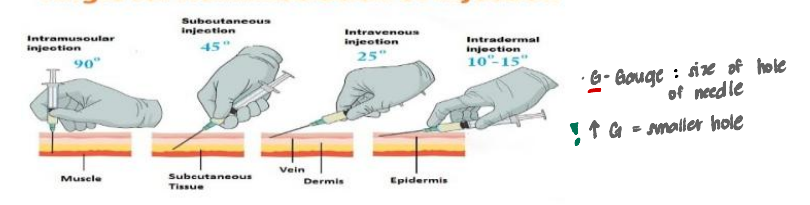
Angle for Administration of Injection
 Note
Note  Flashcards (52)