Biology AOS 2 Ch3
 Call Kai
 Learn
Learn Practice Test
 Spaced Repetition
 Match
Match Flashcards
 Knowt Play
1/33

There's no tags or description
Looks like no tags are added yet.
Name | Mastery | Learn | Test | Matching | Spaced | Call with Kai |
|---|
No analytics yet
Send a link to your students to track their progress
34 Terms
an enzyme is
an organic molecule that acts as a catalyst
Key features of an enzyme
Most are proteins
Active site that is complementary to a substrate
Explain the difference between the ‘Lock and Key’ vs ‘Induced Fit’ model
Lock and key indicates a perfect fit of a substrate to an enzyme
Whereas, induced fit indicates that enzymes change/adjust shape slightly to better accommodate the substrate
How are substrates held together
hydrogen bonds
Hydrophobic interactions
What is activation energy and what is it needed for?
it is the minimum amount of energy required for a substrate to form into a product, and is needed for starting chemical reactions
When an enzyme is present … is needed for the chemical reaction
less/low activation energy
Without an enzyme… for a chemical reaction
-more activation energy is required
What are the 2 main types of reactions
Catabolic (energy releasing)
Anabolic (energy requiring)
In a catabolic reaction with an enzyme…by…to form products
low activation energy is needed in order to make products from reactants
releasing energy
In an anabolic reaction with an enzyme…therefore…to form reactants (as products)
Low activation energy is needed
Acquiring more energy
The biochemical pathway uses the product of one reaction…
as the substrate for the next
What are 4 main factors that affect enzymes
temperature
Ph levels
Substrate concentration
Enzyme concentration
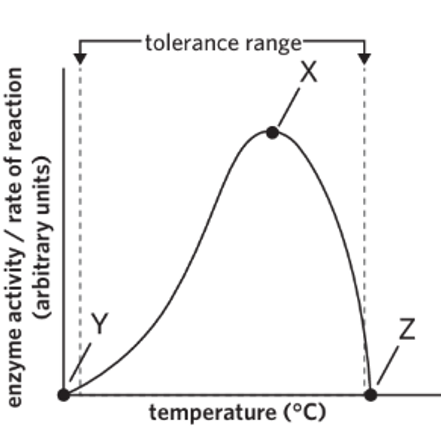
What occurs at Y
temperature is below optimal level (too cold) therefore:
slows molecular motion
Less collisions
But can regain activity when reheated
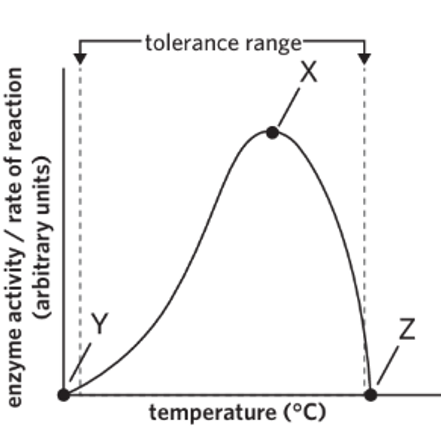
What occurs at Z
Temperature is above optimal level (too hot) therefore:
reaches irreversible denaturation
active sites undergo conformational change
Permanent loss of function
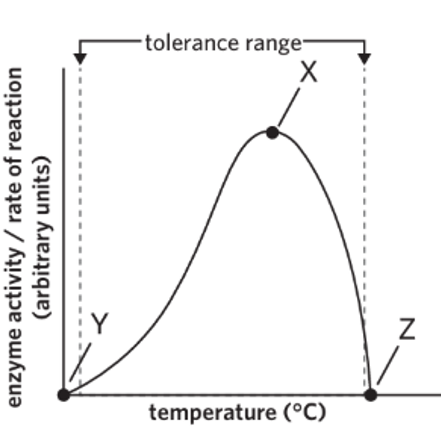
What does X indicate
Optimal temperature resulting in enzymes are most functional state
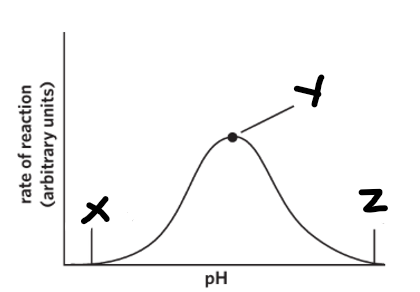
PH: Each enzyme has…
its own optimal pH
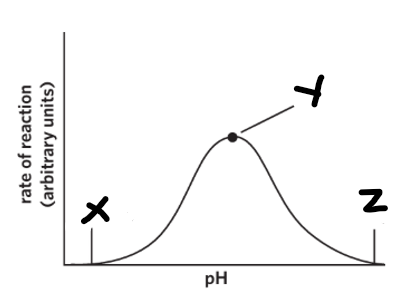
At X and Z the enzyme is…
fully denatured at basic (X) and acidic (Z) conditions
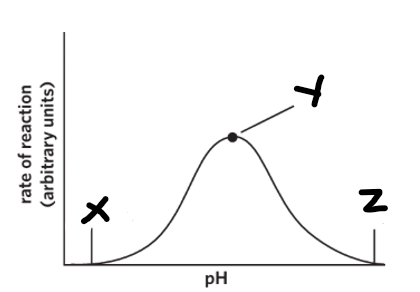
At Y it is at…
optimal levels
High Enzyme concentration results in…
Faster reaction rates as more active sites are present to accommodate for substrate processing
Low Enzyme concentration results in…
Slower reaction rates
What happens when Enzyme concentration reaches saturation point (plateau)
it won’t continue substrate processing due to all active sites being occupied
high Substrate concentration results in…whereas low substrate concentration
Faster reaction rate
Slower reaction rate
When substrates reach saturation point
reactions stop as all active sites are occupied, unless enzyme concentration is increased in order for substrates to continue being processed
Competitive inhibition is when…because…
Inhibitor molecules compete for an active site
molecules are similar/complementary to substrate

