WEEK 16 -> Why are some people happier than others? Contextual factors & individual differences.
 Call Kai
 Learn
Learn Practice Test
 Spaced Repetition
 Match
Match Flashcards
 Knowt Play
1/46

Earn XP
Description and Tags
need to include the readings!
Name | Mastery | Learn | Test | Matching | Spaced | Call with Kai |
|---|
No analytics yet
Send a link to your students to track their progress
47 Terms
Positive psychology has 3 main concerns; subjective, induvdial level and group level
today we focus on individual level and group level
Character Strengths (Peterson & Seligman, 2004)
the VIA Classification is a classification of positive traits in people.
• 24 positive traits are proposed to reflect 6 core virtues
• Peterson & Seligman (2004) propose that these virtues are universal
• Suggest they developed through an evolutionary process that selected for these character strengths as means of solving the important tasks necessary for survival of the species.
Character Strengths (Peterson & Seligman, 2004) —> how did these positive traits/ virtues develop
through an evolutionary process that selected for these character strengths as means of solving the important tasks necessary for survival of the species.
Character Strengths (Peterson & Seligman, 2004) —> the virtues;
wisdom and knowledge
courage
Humanity
Justice
Temperance
Transcendence
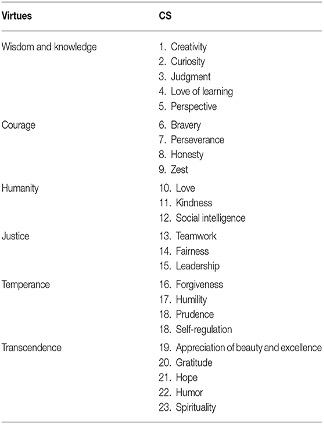
Character Strengths (Peterson & Seligman, 2004) —> the relation of the 24 VIA-strengths to 6 ubiquitous virtues.- method
- 70 experts (from psychology, philosophy, theology, etc.) and 41 laypersons rated how prototypical the strengths are for each of the six virtues.
- Used 5 sources of knowledge (strength’s name including synonyms, short definitions, brief descriptions, longer theoretical elaborations, and item content) for each strength for the ratings
Character Strengths (Peterson & Seligman, 2004) —> the relation of the 24 VIA-strengths to 6 ubiquitous virtues.- Results.
- Found that 19 were rated as good to very good markers of their virtues, 4 were acceptable, and 1 (humour) failed to reach the cut-off score
- Considerable overlap was also found among the classification of certain character strengths
Individual differences, including personality traits may impact happiness levels, for better or worse… example — > traits linked to higher well-being
Trait gratitude
Self-compassion
ndividual differences, including personality traits may impact happiness levels, for better or worse… example — > traits linked to lower well-being
• Dark triad
• Perfectionism
personality definition
is all of the psychologically relevant attributes, qualities, and characteristics that distinguish the behaviour, thoughts, and feelings of individuals as well as the psychological impacts individuals have on others (including the evaluations they tend to elicit). (Saucier, 2009).
personality __. refers to stable individual differences…..
differences believed to be present early in life and that are (relatively) consistent across time and place.
Personality shows myriad individual differences in:
Emotions
Behaviours
Cognition
Motivations
Social tendencies
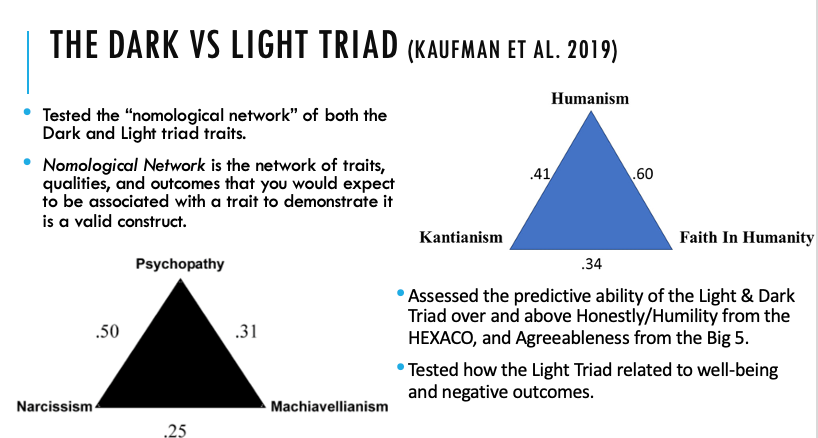
The dark vs the light triad — The Dark triad —> PAULHUS & WILLIAMS. 2002.
Qualities that embody a socially malevolent character with behaviour tendencies toward self-promotion, emotional coldness, duplicity, and aggressiveness.
The dark vs the light triad — The Dark triad —> PAULHUS & WILLIAMS. 2002.—→ what does it consist of….
Machiavellianism: manipulation and exploitation of others, an absence of morality, unemotional callousness, and a higher level of self interest
Narcissism: grandiosity, pride, egotism, and a lack of empathy.
Psychopathy: continuous antisocial behaviour, impulsivity, selfishness, callous and unemotional traits and remorselessness
When combined with other factors (intelligence, physical attractiveness), dark triad traits often help an individual acquire….
positions of leadership.
\
The light Triad; - Kaufman et al., 2019
Qualities that embody a loving and beneficent orientation toward others (“everyday saints”)
The light Triad; - Kaufman et al., 2019 —> comprised of 3 facets
Kantianism: treating people as ends unto themselves
Humanism: valuing the dignity and worth of each individual
Faith in Humanity: believing in the fundamental goodness of humans.
The light Triad; - Kaufman et al., 2019 —> created a scale guided by this question…..
What would an everyday loving and beneficent orientation toward others look like that is in direct contrast to the everyday antagonistic orientation of those scoring high on dark traits?
The dark vs the light triad - image
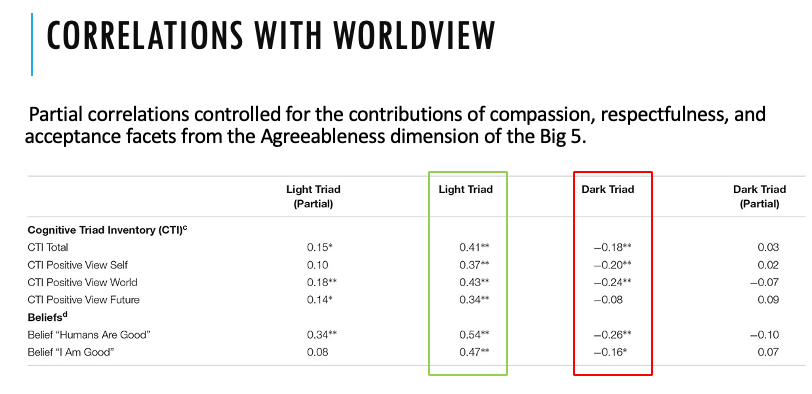
The dark triad vs light triad —> correlations with worldview
partial correlations controlled for the contributions of compassion, respectfulness, and acceptance facets from agreeableness dimension of the Big 5.
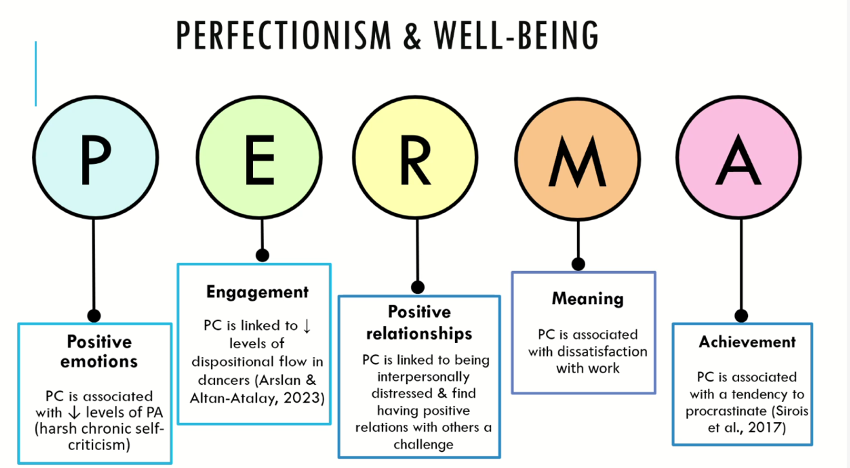
Perfectionism & Well-being
• Understanding individual differences in happiness and flourishing requires explaining why some individuals may NOT be happy.
• Doing so can provide insights into where additional resources may be needed to bolster well-being
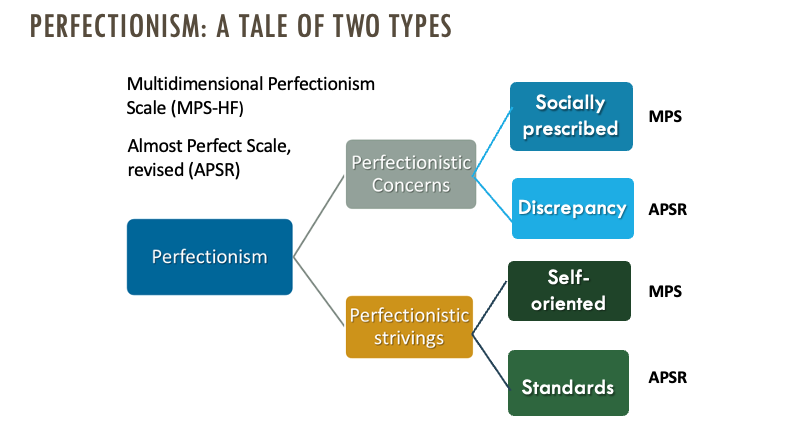
Perfectionistcm —> 2 types —> perfectionist concerns + Perfectionist strivings —→ 1. Perfectionitic Concerns
extraordinarily critical appraisal of one’s own behaviour, chronic harsh self-scruitiny, excessive preoccupations with other’s evaluations, an inability to gain satisfaction even when one is successful in an endeavour
Perfectionistcm —> 2 types —> perfectionist concerns + Perfectionist strivings —→ 1. Perfectionitic Strivings
the propensity to set excessively high standards that are often unrealistic and demand nothing less than perfection from the self.
Some researchers have advocated for two higher-order forms of perfectionism:
a form that taps into adaptive aspects of perfectionism and a form that captures the maladaptive aspects of perfectionism.
PERMA AND PERFECTIONISM - LOOK AT IMAGE
How to measure types of perfectionism
2 ways kindness can be expressed
self compassion
Gratitude (to and from others)
Expressing kindness to others and ourselves can….
can create conduits to enhance well-being.
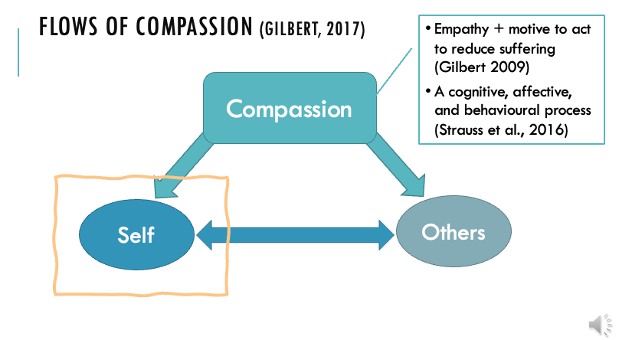
Flows of compassion (Gilbert, 2017)
compassion = empathy + motive to act to reduce suffering
a cognitive affective and behavioural process.
Self-compassion - Neff, 2003 - def
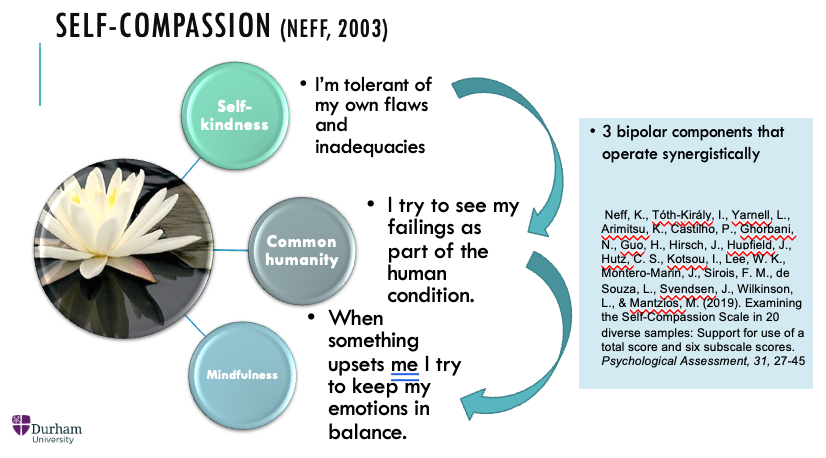
Taking a kind and understanding stance toward oneself in instances of pain or failure rather than being harshly self-critical.
Self-compassion - Neff, 2003 - 3 components
being kind rather than critical to oneselfI (self kindness)
Recognising that suffering and failure is part of the human condition (common humanity)
approaching emotions in a balanced manner (mindfulness)
Self-compassion & Well-being: The relationship between self-compassion and Well-being: a meta-analysis (Zessin, 2015).
Meta-analysis of how self-compassion is associated with well-being.
• Conceptualised well-being as cognitive well-being, positive affective well-being, negative affective well-being, and psychological well-being + overall well-being
• Analysed 79 samples (N =16,416)/ Found a moderate sized positive association r = .47
• Association was stronger for cognitive and psychological well-being compared to affective well-being.
Fear of Happiness: Fear of happiness (FOH) – Cherophobia
An aversion to experiences of joy, often driven by the belief that happiness leads to inevitable negative consequences, misfortune, or tragedy. Aka “aversion to happiness” in scientific terms.
eople afraid of happiness tend to …..
be more averse to prolonged and extreme forms of happiness, as opposed to milder forms.
fear of happiness has weak links to
weak links to Big 5 personality factors.
BUT FOH has strong links to high self-critical perfectionism, and low self-esteem.
fear of happiness →. Unlike Western attitudes towards happiness (asian cultures)
Asian cultures tend to hold aversive views about it, such as that pursuing extreme happiness can lead to unhappiness or an unfavourable personality change like egoism (Joshanloo et al., 2015).
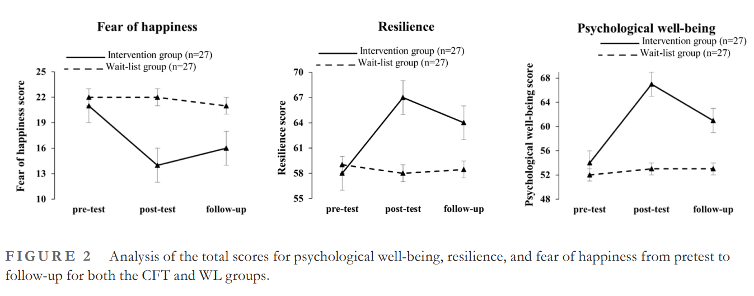
Fear of happiness and self-compassion: Can cultivating compassion reduce fear of happiness? — Gilbert — Compassion focused therapy (CFT) —> METHOD
Randomised controlled pilot study with Iranian medical students (N = 54)
Group 1 (WL): No treatment
Group 2 (CFT): 8 X 90-minute weekly sessions online
2 month follow u
Participants were provided with psychoeducation, group discussions, experiential exercises, and at-home exercises (e.g., meditation and relaxation) during each session
Fear of happiness and self-compassion: Can cultivating compassion reduce fear of happiness? — Gilbert — Compassion focused therapy (CFT) —> Results
Findings: CFT was effective for reducing fear of happiness, & increasing resilience and PWB
gratitude as a trait
Gratitude can be conceptualized as having a life orientation towards noticing and appreciating the positive in life.
gratitude as a trait —> grateful people are more appreciative…..
• (a) frequently
• (b) intensely
• (c) through a wide range of situations
The world as seen by the grateful individual: Wood et al., 2008.
More costly to the giver
- Valuable to the receiver
- Given altruistically
Cultivating gratitude: Gratitude can be increased with simple interventions
Gratitude diaries: keeping a journal
Gratitude lists: Writing about 3 things you are grateful for before going to bed at night.
Can reduce negative thoughts, depression, and body dissatisfaction.
Research has demonstrated that the effects of gratitude lists can persist for up to 6 months.
Using gratitude lists helps you develop a habit of noticing and appreciating the positive in life.
Contextual factors that may impact individual happiness
• Where you live
• What is happening in the world
• Where you are in your life
• How much money you make
• What is happening in your life
World Happiness report 2025: Reviews the state of happiness in the world today and shows how the science of happiness explains personal and national variations in happiness.
3 main indicators for rankings:
1. Life evaluation question (Cantril ladder)
2. Positive affect (positive emotions: laughter, enjoyment, and interest) Y/N ratings
3. Negative affect (worry, sadness, and anger).
2025 report WHR: focus on the impact of caring and sharing on people’s happiness.
Sharing meals with others: how sharing meals supports happiness and social connections.
Living with others: how household size and family bonds relate to happiness.
Connecting with others: how social connections improve the happiness of young adults.
Supporting others: how prosocial behaviour reduces deaths of despair.
Giving to others: how to convert your money into greater happiness for others
Does money make you happy: Kahenman & Deaton (2010)
Avg. proportion of the population reporting positive affect (happiness) vs avg. not reporting negative affect (unhappiness).
• sample of 1,000 US residents.
• daily survey of retrospective happiness from previous day.
• note that threshold of $75K is a midpoint between 60 to 90K.
Does money make you happy? Killingsworth et al. (2021)
• Sample of 33,391 employed US adults
• Reported their happiness 3 times a day for several weeks.
• Used a continuous scale ranging from very bad to very good.
• Found increases in happiness well beyond $200,000 USD.
Does money make you happy → what can we conclude from the 2 evidence bases
- The relationship between money and happiness is not linear.
- In the low range of income, unhappy people gain more from increased income than happier people do
- In the high range of income very happy people gain more from increased income than unhappy people do
- In the midrange of happiness there is a linear relationship with income.
Explore top notes

Explore top flashcards
