Plants part 1
 Call Kai
 Learn
Learn Practice Test
 Spaced Repetition
 Match
Match Flashcards
 Knowt Play
1/76

There's no tags or description
Looks like no tags are added yet.
Name | Mastery | Learn | Test | Matching | Spaced | Call with Kai |
|---|
No analytics yet
Send a link to your students to track their progress
77 Terms
Protists
Very diverse multi/unicellular eukaryotes that are present in all 4 supergroups (SAR, unikonta, archaeplastida, excavata.
Most are unicellular, but some live in groups (colonies) and multicellular organisms
SAR clade
Stramenopiles, alveolates, rhizarians
massively diverse all protist clade defined by DNA similarities
Diatoms
Stramenopile
Cell wall is made up of silicon dioxide (glass)
Microscopic and unicellular, major component of phytoplankton
Fossilized cell walls compose much of the sediments known as diatomaceous earth (sand)
Golden algae
Stramenopile
Yellow/brown carotenoids. Small groups of unicellular organisms (colonies)
Contain plastids (area for photosynthesis)
Flagella present
Brown algae
Stramenopile
Larger and more complex multicellular structures than golden algae
ex: kelp, giant seaweed
Holdfast: Anchors plant to solid substrate (root)
Stipe: support leaf like blades (stem)
Blades: leaf like structures that reach for sunlight (leaves
Leaves (blades), stem (stipe), root (holdfast) are all analogous structures between brown algae and land plants. CONVERGENT EVOLUTION
Life cycle of Brown alga Laminaria
Alternation of multicellular haploid and diploid forms.
Sporophyte: A plant/algae that makes spores. Spores come from outer edge of the blades, house in the sporangia. DIPLOID
Spores are produced and settle to germinate into gametophytes (sperm/egg) by undergoing meiosis. HAPLOID
Fertilization: Gametes fuse to form a zygote. DIPLOID
Zygote develops into a sporophyte. DIPLOID
Gametophytes are heteromorphic, as they are microscopic and the main life stage (sporophytes) are macroscopic
Heteromorphic
Generations are structurally different
Isomorphic
Generations are structurally similar
Heterogamy
Gametes have a distinct sex (female/male)
Isogamy
Gametes have no distinct sex but are considered (+/-)
Dinoflagellates
Alveolates
Body is made up of cellulose. Generally phytoplankton that live in shallow water and are microscopic, spherical and have flagella.
Blooms (explosive growth) results in giant red tides. Occur in warm, shallow, and nutrient rich waters
Toxins produced from blooms result in massive deaths of invertebrates and fish in that habitat
Archaeplastida
Red+ green algae
Unicellular: Chlamydomonas
Generally grouped together: Volvox
Multicellular: Ulva, Caelerpa
Closest relatives to land plants (land plants are within this clade)
Red algae
Archaeplastida
Red due to pigment called phycoerythrin
Commonly multicellular, no flagellate structures
ex: nori in sushi (seaweed)
Green algae
Archaeplastida
Cell wall: cellulose and some carbohydrates. Rigid when mature, permeable to water, gases, and minerals
Vacuole: regulate water content of cell. Water moving exerts outward pressure (turgor pressure) that keeps the plant upright. The vacuole swells up and pushes against the cell wall. Lack of turgor pressure results in wilting
Pyrenoids (only in algae, no in higher plants): Within chloroplasts, site of starch synthesis
Life cycle of unicellular Chlamydomonas
Model system (we know a lot about it, often a reference for studies)
Uses isogamy
Prefers to reproduce asexually, but can reproduce sexually in unfavorable environments
Mature cell haploid cell uses mitosis to create gametes that are ± that come together to fertilize
Diploid zygote is produced that uses meiosis to create 4 daughter cells that become mature cells
Either new gametes are produced (sexual reproduction) or the cell creates zoospores and reproduces asexually.
Mature cells develop into gametes due to environmental stresses. Zygote is the only diploid state in the life cycle, everything else is haploid.
No alternation of generations, not multicellular, main form is haploid
Haplontic life cycle
Lichens
Made up of a symbiotic relationship between a photosynthetic microorganism (algae/cyanobacteria) and a nutrient providing organism (fungus, sometimes yeast).
Algae: glucose, food via photosynthesis
Fungus: mines nutrients from nutrient poor environments, ascomycete (spore shooters) are the main visible fungal component of lichens
Algae or cyanobacteria occupy an inner layer below the lichen surface. Lichens typically reproduce asexually via soredia (spore like structures that eventually disperse
Millions of photosynthetic cells are held in a mass of fungal hyphaeOne of the oldest symbiotic relationships in nature
Lichens are the first inhabitants on new rock/soil surfaces, first stage in succession process after mass destructions (ex: fires)
Lichens may have helped the introduction and evolution land plants around 550-600 million years ago.
Bryophytes
Come from aquatic algae
Non-vascular plants, meaning they have no xylem/phloem (no real stem). This makes them smaller and occupy forest floors (mosses). No secondary growth (wood parts, seed plants, that allow plants to grow very tall)
Consists of liverworts, mosses, and hornworts.
Not a monophyletic group
Mosses
Bryophyte
Inhabits areas of high moisture, hostile environments (nutrient poor areas).
Take in nutrients from soil, but they quickly die and release nutrients back to forest floor (nutrient cycling). Peat moss (Sphagnum) is dead/dying moss that later turns into coal.
Sphagnum also acidifies the soil and is an important organic carbon reservoir
Peatland covers 3% of earth’s surface, holds 30% of world’s soil carbon and helps stabilize carbon dioxide levels. Canada is the world’s largest producer of horticultural peat (17% of Manitoba is covered in peat).uyh7
Bryophyte 5 structures
Sporophyte: multicellular diploid form of the plant body
Gametophyte: structure that produces haploid gametes in plants
Sporangium: structure where meiosis occurs and haploid spores develop
Antheridia: structure where gametes develop in male structures of plants
Archegonia: structure where gametes develop in female structures of plants
Bryophyte 6 main traits
Dominant gametophytic phase (1n)
No xylem or phloem (non-vascular)
No roots
No leaves
No cuticle (waxy surface on leaves/overall plant that protects plant from excess sunlight. Lack of this is why mosses can survive in light poor environments and have maximum absorption of nutrients, water, and sunlight)
Sporophyte dependent on female gametophyte for nutrition as the stalk portion of the plant in the sporophyte, and the main “bush” portion of the plant is the gametophyte. Most of the moss one sees is mainly the gametophyte
Moss life cycle
Alternating life cycle (distinct haploid/diploid stages in multicellular organism)
Diploid sporophyte produces sporangium (site of meiosis) that is a capsule that houses spores and is dispersed usually via wind
Sporangium (many morphological variations depending on environment) opens up due to water pressure and apoptosis of sporangium cells and releases spores. Spores either develop into female/male gametes
Female gametes grow into female haploid gametophytes (bush like structure) and have structures for sperm deposition (archegonia). Male gametes grow into male gametophytes and release sperm from the antheridia. Sperm swims into archegonia via water droplets and fertilization occurs
Diploid zygote develops into embryo and later into a sporophyte on top of the previously existing female gametophyte.
Sporophyte composition
Foot: receives nutrients from female gametophyte
Seta: elongated stalk (not true stem as there is no xylem or phloem). Also used for dispersal of sporangium so it must be tall to access the wind.
Sporangium: site of meiosis. Sporocyte (2N)→ spores (1N)
Hornworts and moss sporophytes have stomata for gas exchange, LIVER WORTS DO NOT HAVE STOMATA
Liverworts (Hepatophyta)
Bryophytes
Liver shaped leafy gametophytes.
Has smallest sporophytes out of all the bryophytes
Male and female gametangia on seperate plants.
Archegonia (female) and antheridia (male) are developed on gametangia elevated on gemetophores/stalks
Miniature sporophytes can be seen on the undersurface of female gametangia (like little palm trees, and the spores are the “coconuts" under the sporophyte leaves)
NO STOMATA (gas exchange)
Hornworts (Anthocerophyta)
Bryophytes
Horizontal gametophytes
Long tapered sporophytes
No seta, only sporangium
Relatively unexplored group due to lack of research interest
Vascular plant advantage/overview
Allowed for plants to grow taller and transport things (nutrients, water) over long distances
Seedless vascular plants have flagellated sperm. Plants are typically found in moist areas.
Seedless vascular plants: lycophytes and monilophytes
Seed producing vascular plants: angiosperms and gymnosperms
Monilophyta
Ferns, horsetails (very old species, found in river beds typically), and whisk ferns
Most diverse seedless vascular plants (over 12,000 species)
Lycophyta
NOT MOSSES, as lycophyta have vascular tissues: club mosses, spike mosses, and quillworts
Giant lycophyte trees (lepidodendron) thrived for millions of years in moist swamps, survivors are small herbaceous plants
Golden fern anatomy
Golden fern sporophyte and tiny, separate and independent gametophyte
Sporophyte:
Rhizome: underground stem. Produced by the shoot apical meristem, SAM (cluster of stem cells that results in all above ground plant structures)
Leaves: Produced by the SAM, compound leaf, leaflets.
Roots: Produced by root apical meristem (RAM). Each root has a RAM (cluster of stem cells that produce all the below ground plant structures)
Sporophyte is the typical fern plant structure, gametophyte is a more rarely seen almost sponge/moss like structure composed of both antheridium and archegonium.
Fern Life Cycle
Mature sporophyte (2N) has sori on the underside of each leaf. A Sorus (plural: sori) is a cluster of sporangia.
Sporangium undergoes meiosis and produces haploid spores. When the plant is ready, the sporangia curl back and catapult the spores into a new environment. Annulus helps disperse spores.
Spores germinate into a gametophyte, which forms a small moss/sponge like green structure. It is monoecious, meaning the gametophyte holds both female and male counter parts at the same time (“bisexual”). Antheridium releases sperm and the sperm enter the archegonium to fertilize the egg.
Diploid zygote is produced and forms a new sporophyte out of the gametophyte
Thallus: the green tiny sponge/moss structure that houses the archegonium and antheridium. It is poorly adapted to life on land.
Photosynthetic, adsorbs water/minerals.
Rhizoid cells for anchorage
Archegonia and antheridia on the same gametophyte
Self fertilization is rare
LACKS: leaves, cuticle, complex tissue system, roots, stems
Sporophylls and Spore variation
Sporophylls: modified leaves with sporangia
Strobili: cone-like structures formed from groups of sporophylls (lycophytes) Production of spores.
Sori: clusters of sporangia on the undersides of the sporophylls (ferns). Curl back and catapult spores into environment
Evolution of three tissue system
Vascular tissue: Most inner part.
Xylem: transport of water and minerals (usually up the plant from the roots)
Phloem: transport of photosynthetically produced nutrients (usually down the plant from the leaves)
Ground tissue: middle part
Parenchyma
Collenchyma
Sclerenchyma
Dermal tissue: most outer part
Periderm
Cork
Epidermis
Above ground structures are covered in a cuticle
Below ground structures have no cuticle (helps with maximum water/mineral absorbtion)
Transport in xylem/phloem
Xylem: conducts most of the water and minerals and includes dead tube-shaped cells called tracheids. Cells have no nucleus, cytoplasm, etc. to remove friction in movement of bulk transport.
Water conduction cells strengthen by lignin and provide structural suppourt.
Phloem: consists of living cells that are arranged into tubes and distributes sugars, amino acids, and other organic products. Cells are typically alive as transportation involves active transport and cell signaling.
Plants move things up ←> down and left ←> right, so tubes in xylem/phloem have little pits (channel openings) that allow to switch flow directions.
Vascular plants allowed for increased height, which provided an evolutionary advantage (more sunlight absorption = larger success rate)
Evolution of roots
Roots are organs that anchor vascular plants
They enable vascular plants to absorb water and nutrients from the soil
Types of roots:Primary root: originates in embryo
Lateral root: secondary root, branches off another. Horizontal root growth, helps with stabilizing plant and accessing higher nutrient rich soil areas.
Adventitious root: comes from stem tissue an from rhizomes, not ground. Help prop plant. Common in corn/orchids/monstera, visible roots come off of stem to stabilize plant
Evolution of leaves
Leaves are organs that increase surface area of vascular plants, thereby capturing more solar energy that is used for photosynthesis
Two leaf types:
Microphylls: leaves with a single vein (lycophyta)
Megaphylls: leaves with a highly branched vascular system (many veins), seen in: monilophyta, gymnosperms, and angiosperms
Seed producing plants
Originated over 300 million years ago
Seeds and pollen are key adaptations for life on land. (Disperse over long distances by wind/animal feces)
Reproductive adaptations include fruits and flowers
Reduced gametophytes (microscopic, found deep within the maternal plant, develop on very different parts of the plant)
Heterospory: ovules, pollen grains. Different gametophytes are developed on very different parts of the plant, production of two distinct spores.
Who are the seed plants
Gymnosperms:(naked seed) pine, spruce, fir. No development of fruit
Angiosperms: (enclosed seed) canola, rose, corn, wheat. Development of fruit (carpel which houses the ovary (ovule → egg → development of embryo → seeds in the fruit)
Common traits of seed plants
Reduced gametophytes: Gametophytes of seed plants develop within walls of spores that are retained in the parent plant
Seed plants are heterosporous (develop two sex gametophytes in very different portions of the plant, while seedless plants are homosporous meaning they produce their spores together despite sex): Megasporangia produce megaspores that give rise to the female gametophytes. Microsporangia produce microspores that give rise to male gametophytes
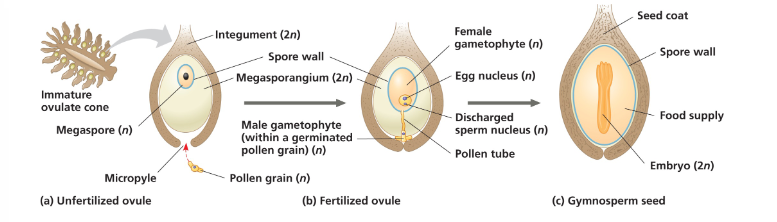
An ovule consists of a megasporangium, megaspore, and one or more protective integuments. Gymnosperm megaspore have one integument. Angiosperm megaspores usually have two integuments
Gametophyte-Sporophyte relationships in different plant groups
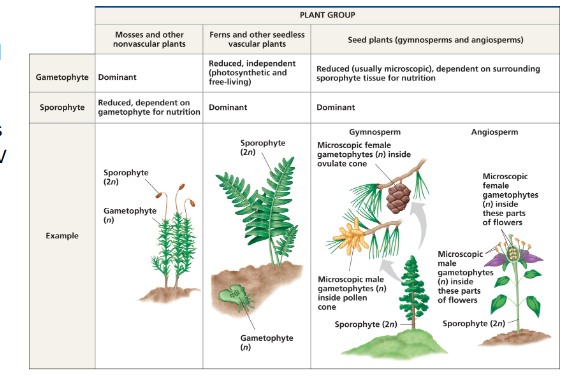
Pollen and sperm production in seed plants
Microspores (haploid) develop into pollen grains, which contain male gametophytes.
Pollination is the transfer of pollen to part of a seed plant containing ovules (pollen nuclei entering the egg cell within the ovule/female gametophyte). Water is no longer essential for fertilization in seed plants
If a pollen grain germinates, it gives rise to a pollen tube that discharges sperm into female gametophyte within ovule
Pollen grain has a very tough outer covering that protects it
Pollen development: pollen, commonly found in spring on the lower branches of gymnosperms. Uses wind to let spores pollinate trees nearby (hence lower branches). Spores captured by ovulate cones,
Major model plant
Arabidopsis
Gymnosperms seeds
Seeds are exposed on sporophylls that form cones, where we see ovules that contain egg cells (surfaces of scales, not incased in an ovary). Cone bearing plants (pine cones)
No fruit/flowers
Has one single integument (hard outer seed covering)
A seed develops from the whole ovule. A seed is a sporophyte embryo, along with its food supply, packaged in a protective coat
Spore will enter the microphyte (opening in female gametophyte) and wait there for when the egg develops. Once it developed, the spore releases sperm and an embryo develops
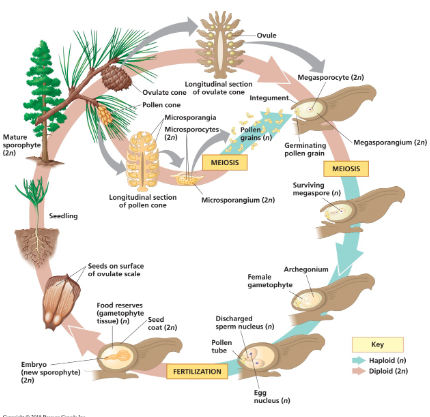
Life cycle of pine
Dominance of the sporophyte (diploid) generation
Development of seed from fertilized ovules
Transfer of sperm to ovules by pollen
Alternation of generations (distinct haploid/diploid phase)
Ovulate cone: cone that has ovules/eggs
Pollen cone: develops all the spores that release sperm
Sporophyte (2N) is the pine trees, and produces sporangia in male and female cones
Small cones produce microspores called pollen grains, each one contains a male gametophyte (spores that house sperm)
The larger cones contain ovules, which produce megaspores (under go meiosis to produce eggs, female gametophytes)
Spore will enter the tube and stay there until the egg cell is developed and fertilized. Embryo is produced and new diploid is grown
Takes 3 years for cone production to mature seed
Microspore: pollen (sperm)
Megaspore: ovule (egg)
Gymnosperm diversity
Cycadophyta:
Thrived during mesozoic era, but relatively few exist today. Unlike most seed plants (have flagellated sperm). Individuals have large cones and palm like leaves
Ginkgophyta:Living fossil, consist of a single living species (Ginkgo biloba). Like cycads has flagellated sperm. Has a high tolerance to air pollution and is a popular ornamental tree
Gnetophyta (typically have a thick cuticle):Gnetum, Ephedra, Welwitschia. Not a lot of diversity, species vary in appearance and some are tropical/desert inhabitants
Coniferophyta:Largest gymnosperm phyla. Emerged in the Jurassic period. Most conifers are evergreens (not all)
Angiosperms overview
Flowers and fruits (seed plants, not naked as they are protected by a fruit/flower)
The most widespread and diverse of all plants. Divided into monocots (one cotyledon, single embryonic leaf) and eudicots (two cotyledons, two embryonic leaves).
Monocots: 50,000 species (lilies, orchids, grasses)
Dicots/Eudicots: 200,000+ species (elms, willows, roses, peas, canola)
Flowers
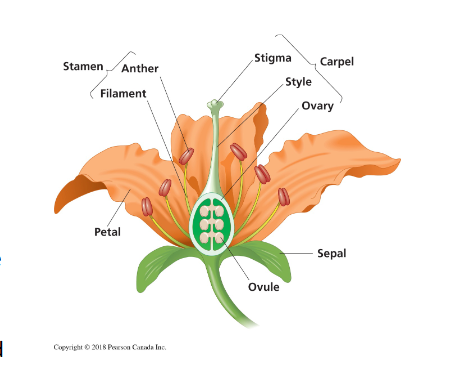
Key reproductive adaptation of angiosperms. A flower is a specialized shoot with modified leaves.
Sepal: enclose the flower. Green/leaf-like. Encloses other flower parts, ex: broccoli (part eaten is thousands of flower buds covered by green sepals)
Petals: are brightly coloured and attract pollinators
Stamens: produce pollen. Consist of a stalk (filament) with an anther where pollen is produced.
Carpels: produce ovules:
Ovaries (fertilization occurs here, protects ovule).
Style (elevates stigma to make accessible to pollinators).
Stigma (where pollen is received, lots of sugary/sticky substances at the tip)
If a flower is complete, it means that it has all four flower organs. However, not all flowers are complete. Can have radial or bilateral symmetry
ex: Holy has nonfunctional stamen and other variety has no stamens. This causes the plants to need to cross pollinate between the two variety of plants.
Fruit
Reduced dependent gametophytes help with innovation of seed plants outcompeting ferns and other seedless plants
A fruit is formed when the ovary wall thickens and matures (can be fleshy or dry, ex: seeds in tomato, nectarine pit, hazelnuts)
Fruits protect seeds (and embryo) and aid in dispersal
Fruits develop from a flower’s fertilized ovary and contain seeds, while vegetables are any other edible part of the plant, like a root, stem or leaf
Seed dispersal in fruits: seeds can be carried by wind, water, or animals. May need physical roughing up before germination. New sporophytes are moved at a distance from the parent plant.
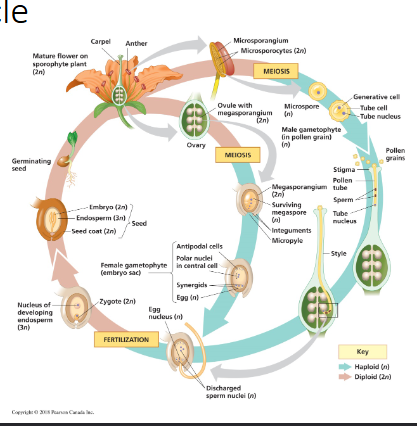
Angiosperm life cycle (lily)
Sporophyte flowers are composed of both male/female structures
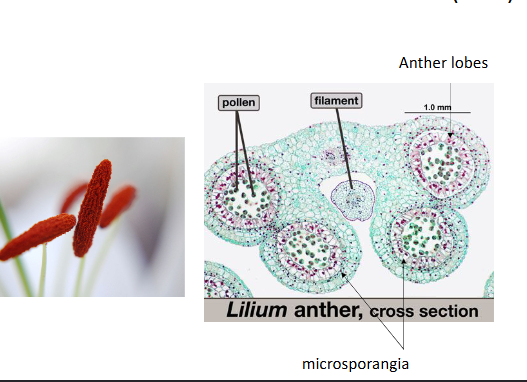
Male gametophytes: contained within pollen grains produced by microsporangia of anthers
Female gametophyte/embryo sac: develops within an ovule contained within an ovary at the base of a stigma
Some plants self fertilize while others cross-pollinate. (genetic and biochemical factors determine whether a plant can self or cross fertilize)
After meiosis, each microsporangium contains spore tetrads. Each spore produces pollen grains containing the male gametophyte.
A pollen grain that lands on a stigma (sticky surface), germinates, and the pollen tube of the male gametophyte goes down to the ovary (pollen grain contains two haploid sperm nuclei: tube nucleus and generative cell).
The ovule is accessible because small pores in the integuments called micropyle.
Double fertilization occurs when pollen tube discharges two sperm (two nuclei) into the female gametophyte within an ovule
One sperm fertilizes the egg and gives rise to the embryo, while the other combines with two nuclei in the central cell of the female gametophyte cell of the female gametophyte and initiates development of food storing.
The triploid endosperm nourishes and supports the developing embryo
Within a seed, the embryo consists of a root and two seed leaves called cotyledons.
Cross section of anther
As anther dries down, apoptosis is present in the anther, and the pollen is released.
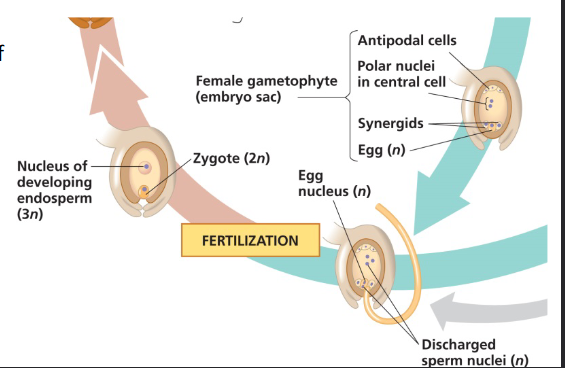
Female gametophyte of a typical angiosperm
Female gametophyte of a typical angiosperm contains 7 cells:
3 antipodal cells
1 central cells
2 synegrid cells
1 egg cell
Every cell is haploid expect for the central cells. Central cell is however going to be pollinated and develops into a triploid endosperm (3N)
Products from seed plants
Most food and materials (wood, medicines) come from angiosperms
Six crops (wheat, rice, maize, potatoes, cassava, and sweet potatoes) yield 80% of the calories consumed by humans
Modern technologies developed from genetic engineering and breeding efforts
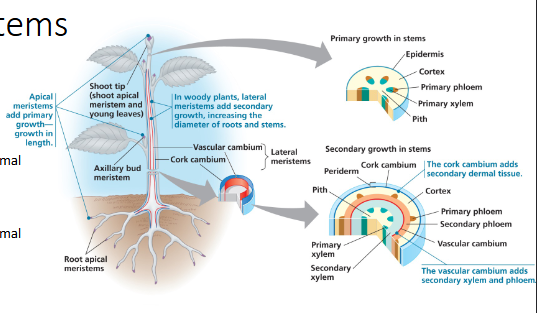
Plant primary growth
Shoot apical meristem (SAM). Primary growth in the axial direction. All plant parts above ground come from this.
Root apical meristem (RAM). Cells are protected by the root capule. All below ground structures come from this part.
Localized regions of cell growth
Cell divisions produce new tissues
Populations of pluripotent stem cells
Primary growth
Plants sustain growth in apical meristems. Meristems make the plant!
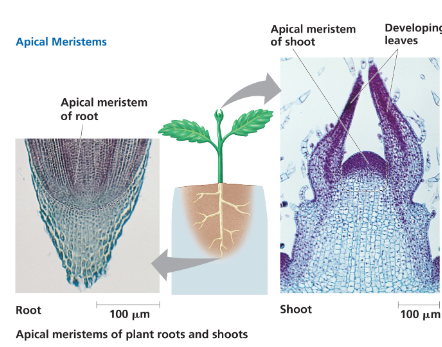
Meristems
Densely cytoplasmic (very metabolically active and dividing a lot)
Lateral meristems add thickness to woody plants, a process called secondary growth.
There are two lateral meristems:Vascular cambium: adds layers of vascular tissue (secondary xylem, aka wood, and secondary phloem (inner back))
Cork cambium: replaces the epidermis with periderm. Thicker and tougher.
Shoot apical meristem (SAM):
Primary growth
Axial growth
Primary tissues: ground, vascular, dermal
Root apical meristem (RAM):
Primary growth
Axial growth
Primary tissues: vascular, ground, dermal
3 plant tissues
Each plant organ has dermal, vascular, and ground tissues. Each category forms a tissue system: ground, vascular, and dermal. All tissue systems are continuous throughout the plant but organization may change.
Dermal tissue system
In non-woody plants, the dermal tissue system consists of the epidermis
A waxy coating called the cuticle helps prevent water loss from the epidermis
In woody plants, protective tissues called periderm replace the epidermis in older regions of stems and roots
Trichomes (hair like) are outgrowths of shoot epidermis that help reduce water loss and with insect defense. Glandular trichomes accumulate specialized metabolites for plant defense. Trichomes are living cells with a nucleus. Other trichomes help to prevent the plant from drying out and can increase the relative humidity closer to the leaf or stem surface
Above ground plant structures: secrete substances that form wax that then forms a cuticle to protect from sunlight and help with water absorption
Roots do not have a cuticle: they need to absorb as much as possible.
Vascular tissue system
Facilitates long-distance transport of materials between roots and shoots and provides mechanical support.
Xylem: conducts water and dissolved minerals upward from roots into shoots
Phloem: transports organic nutrients from where they are made to where they are needed
The vascular tissue of a stem/root is collectively called the stele
In angiosperms, the stele of the root is a solid central vascular cylinder
The stele of stems and leaves is divided into vascular bundles, strands of xylem and phloem
Ground tissue system
Tissues that are neither dermal nor vascular are the ground tissue system
Ground tissue internal to the vascular system: pith
Ground tissue external to the vascular system: cortex
Ground tissue includes specialized cells used for:Storage
Photosynthesis
Support
Transportation
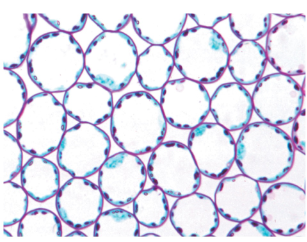
Parenchyma cells
Mature parenchyma cells: have thin and flexible primary walls. Cellulose, other sugars, and proteins
Lack secondary walls (primary walls + lignin)
Are the least specialized. Performs metabolic functions. Retains the ability to divide and differentiate
Little dots within cells are chloroplasts
Alive
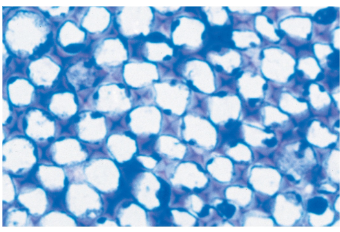
Collenchyma cells
Have thicker and uneven cell walls
Provide flexible support without restraining growth
Are grouped in strands and help support young parts of the plant shoot (plant can grow a bit taller)
Alive
Ex: celery: mainly made of collenchyma cells to help with growth/support. Found in strands/bundles. What makes celery crunchy
Sclerenchyma
Thick secondary walls strengthened with lignin.
Dead at maturity (thick cell wall does not allow for movement/transport across the membrane of the cell)
Two types:Sclereids: short and irregular in shape with thick lignified secondary walls. ex: grainy texture in pears
Fibers: long and slender and arranged in threads
Angiosperm seed
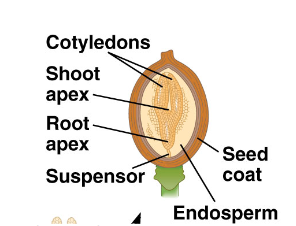
Embryo (2N): primary dermal, ground vascular tissue. SAM, RAM, established in the embryo. Cotyledons (dictates eudicot vs. monocot)
Endosperm (3N): stores starch, proteins and lipids. Supports embryo in organogenesis. Forms from the double fertilization, as the pollen has two nuclei, one becomes the embryo, the other becomes the endosperm.
Seed coat (Parent 2N tissues): thickened cell walls of seed coat help to protect the seed, especially during periods of dormancy.
The two cells that are fertilized in a typical angiosperm are: central cell (endosperm) and egg cell (embryo)
Embryo is much more reduced in monocot seeds and a single cotyledon. They have protective sheaths called coleoptile that helps protects the young shoot.
Endosperm is greatly reduced in eudicots.
Gymnosperm seeds are not held in an ovary, while angiosperm seeds are.
Seed dormancy
Seed dormancy increases the chances that germination will occur at a time and place most advantageous to the seedling.
The breaking of seed dormancy often requires environmental cues, such as moisture, temperature, or lighting changes. Environmental cues set off biochemical and genetic cascades that promote seed germination.
Most seeds remain viable after a year or two of dormancy, but some last only days, and others can remain viable for centuries
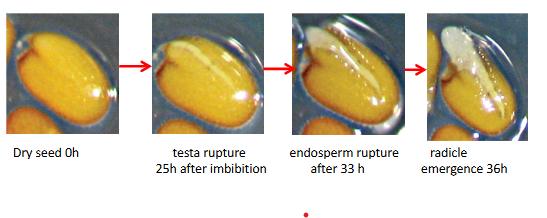
Germination depends on imbibition: the uptake of water due to low water potential of a dry seed. As seed expands, cell walls begin to rupture.
The radicle (embryonic root) emerges first. The developing root system anchors the plant. Next, shoot tip breaks through soil surface.
Roots
Functions:
Anchoring plant
Absorbing minerals and water
Storing carbohydrates
Primary roots emerge first. Lateral roots/hairs branch from primary root. Increase in surface area of roots increases the uptake of nutrients and water. Mycorrhizas (soil fungus), forms a mutualistic association.
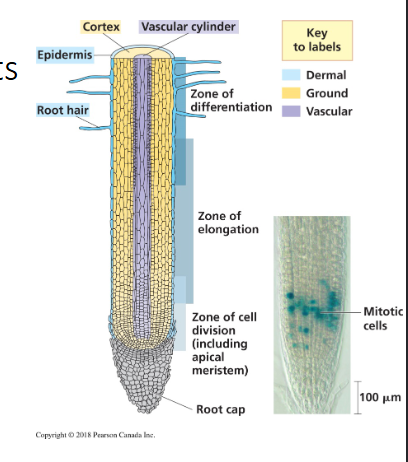
Root apical meristem (RAM)
Primary root growth occurs at the RAM. The RAM produces cells in two directions: RAM produces a cap tissues called the root cap and it covers the distal tip of the root. This protects the root tip as it grows through the soil. Cells are sloughed off during this process
RAM produces cells proximally that contribute to the root proper. Produce no lateral appendages (root hairs)
Growth occurs just behind the root tip in three zones of the cells: Zone of cell division, zone of elongation, zone of differentiation/maturation (root hairs are developed from this zone, ideal for nutrient/water uptake).
Root cap
The root tip is covered by a root cap, which protects the apical meristem as the root pushes through soil. It secretes polysaccharide slime, continually sloughs off and regrows, produces signals to attract beneficial microbes, and senses gravity to grow down into the soil.
Protect the essential cells of the RAM.
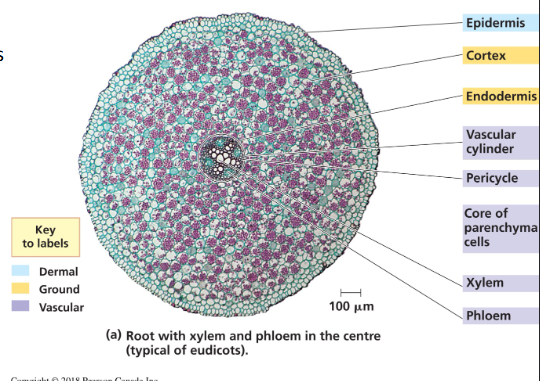
Typical dicot root cross section
In most eudicots, the xylem is starlike in appearance with phloem between the “arms”
The ground tissue, mostly parenchyma cells, fills the cortex (massive), the region between the vascular cylinder and epidermis.
The innermost layer of the cortex is called the endodermis
The endodermis regulates passage of substances from soil into the vascular cylinder
(Pink granules are stained starches in image)
Distinct cross shape with xylem and phloem
Typical monocot root cross section
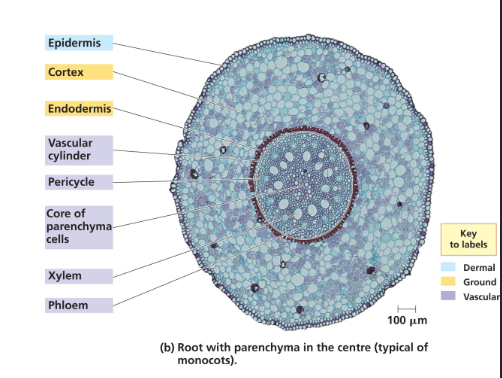
In many monocots, the core parenchyma cells are surrounded by rings of xylem, then phloem. Endodermis is more waxy to create a physical barrier to prevent pathogenic microbes and soil particles from entering the central vascular stele.
Distinct circle shape with xylem and phloem
Primary growth of roots
Lateral roots arise from within the pericycle, the outermost cell layer in the vascular cylinder. They are in line with xylem to facilitate transport.
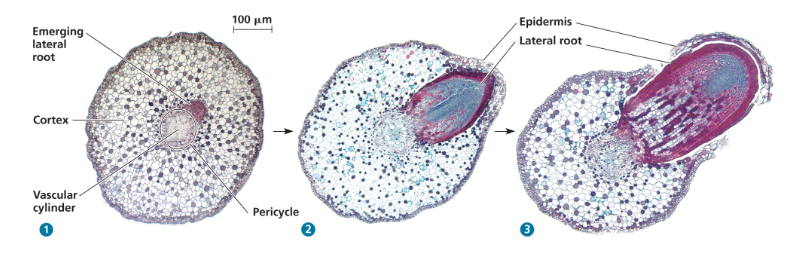
Root systems
Tap root system: Tall plants, result in large shoot masses (eudicots, gymnosperms
Fibrous root system: Adventitious roots that come from the stem. Results in lots of lateral roots (monocots, aka grasses)
Stem terminology
Nodes: where leaves attach
Internodes: between leaves
Axillary buds: potential to form a lateral shoot/branch (dormant meristems, that when activated, forms a new branch)
Apical bud: Elongation of young shoot. Apical dominance helps to maintain dormancy in most axillary buds
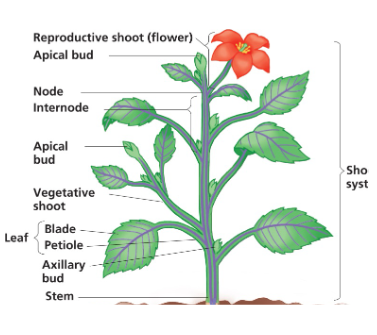
Stem adaptations
Rhizomes: a horizontal shoot that grows just below the surface (Irises)
Stolon: horizontal shoots that grow along the surface. These “runners” enable a plant to reproduce asexually, as plantlets form at nodes along each runner (strawberries)
Tubers: (potatoes). Enlarged ends of rhizomes or stolons specialized for storing food. The “eyes” of a potato are clusters of axillary buds that mark the node.
Dicot vs Monocot stem
Eudicots: the vascular tissue consists of vascular bundles arranged in a ring
Monocot: the vascular bundles are scattered throughout the ground tissue, rather than forming a ring. Monocot bundles are surrounded by a sheath.
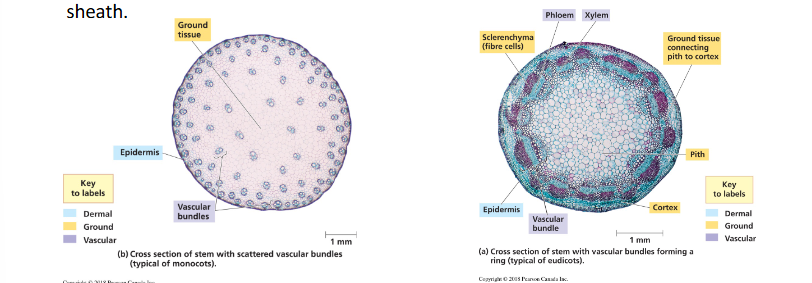
Water conducting cells in xylem
Tracheids: are found in the xylem of all vascular plants. Very slender, contain pits. (smallest opening in xylem)
Vessel elements: common to most angiosperms and a few gymnosperms. Vessel elements align end to end to form long micropipes called vessels. Have more girth to them. Have perforation plates and pits. (Biggest opening is xylem)
Both cells are water conducting and dead at maturity. They are very closely packed and this allows for capillary action to take place
Sugar conducting cells in the phloem
Sieve-tube elements: are alive at functional maturity, though they lack organelles. Sieve plates are the porous end walls that allow fluid to flow between cells along the sieve tube. Also prevents the movement of microbes into the phloem (fungi, other pathogens)
Each sieve-tube element has a companion cell whose nucleus and ribosomes serve both cells.
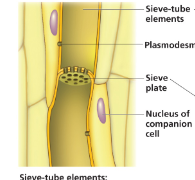
Primary growth of the shoot
SAM initiates new stem tissues and new leaves. Primary growth is concentrated at the shoot tip
Primary growth is continuous and increases stem length (internode elongation, stimulated by auxin and gibberellic acid, aka plant hormones).
Leaf development is mostly determinant
Cells of the SAM are undifferentiated
Leaves
Initiated by the activity of the SAM
Main photosynthetic structures of the plant
Leaves intercept light, exchange gases, dissipate heat, defend the plant from herbivores and pathogens
Generally consist of a flattened blade and a stalk called the petiole, which joins the leaf to a node of the stem
Holes in leaves (stomata) allow for gas exchange
Leaves can reflect more light (sunscreen) by secreting waxy chemicals that form a cuticle
Leaf types:
Simple leaf: blade not divided into leaflets (oak, maple)
Compound leaf: blade is divided into leaflets. Pinnate leaf is the leaflets attached along the petiole (fern) . Palmate leaf is all the leaflets that connect to a central location (Cannabis).
Needles/spines (cactus)
Storage leaves (onion)
Tendrils (peas, beans, that help the plant to climb things)
Reproductive leaves (succulents)
Tissue organization of leaves
Epidermis: interrupted by stomata, pores that allow carbon dioxide and oxygen exchange between the air and the photosynthetic cells in a leaf. Stomata are also major avenues for evaporative water loss
Each stomatal pore is flanked by two guard cells, which regulate opening and closing
Vast majority of stomata are found on the underside of the leaf
Mesophyll: ground tissue in leaf, sandwiched between the upper and lower epidermis.
Eudicots: have two layers of mesophyll: palisade mesophyll in the upper part of the leaf. Spongy mesophyll in the lower part of the leaf.
Loose arrangement with ample air spaces around cells allows for gas exchange. Vast majority of photosynthesis takes place in the mesophyll
Vascular tissues: continuous in each leaf. Veins are the leaf’s vascular bundles and function as the leaf’s skeleton. Each vein in a leaf is enclosed by a protective bundle sheath. Xylem is found in the bottom of the bundle, and the phloem is found in the upper part of the bundle.
Most monocots have parallel veins
Most eudicots have branching veins
Stomata
Occur in pairs in the epidermis of the leaf stem. Guard cells and stomata.
Function: gas exchange. Changes in potassium ions and plant hormones like cytokinin and abscisic acid open/close the stomata. Open during the day and closed at night.

